By Wallace Nutting
Located in Soquel, CA
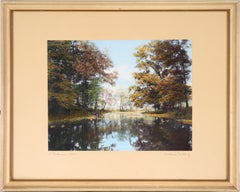
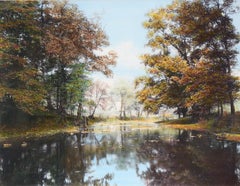
"A Perkiomen October" Hand-Colored Photograph
Brightly oil paints colored black and white photograph of a pond by Wallace Nutting (American, 1861 - 1941). The viewer looks out across a glass pond, reflecting the scenery above. The pond is surrounded by trees that have been tinted in various shades of yellow, red, and green. Beyond the trees, puffy white clouds hang in a soft blue sky.
Signed in the lower right, below the photograph, on the backing mat: Wallace Nutting
Titled in the lower left, below the photograph, on the backing mat: A Perkiomen October
Tag on verso from the artist.
Presented in a wood frame with a tan backing mat.
Frame size: 18.5"H x 22.5"W
Image size: 10.5"H x 13"W
Wallace Nutting (American, 1861-1941) was an American minister, photographer, artist, and antiquarian, who is most famous for his landscape photos of New England. He also was an accomplished author, lecturer, furniture maker, antiques expert and collector. His atmospheric photographs helped spur the Colonial Revival style.
Nutting graduated from high school in Augusta, Maine. He studied at Phillips Exeter Academy, Harvard University, Hartford Theological Seminary and Union Theological Seminary. He graduated from Harvard with the class of 1887. Nutting earned a Doctor of Divinity degree from Whitman College in 1893. He received an honorary doctor of Humanities from Washington & Jefferson College in 1938.
Nutting began his career as a Congregational minister in several towns including Minneapolis, Seattle, and Providence and Fryeburg, Maine, but he was forced to retire at age 43 because of poor health. He suffered from neurasthenia, and turned to bicycling as a means of relaxation and improving his health. It was on these bicycle rides in the countryside that Nutting started taking photographs. In 1904 he opened the Wallace Nutting Art Prints Studio on East 23rd Street in New York. After a year he moved his business to a farm in Southbury, Connecticut. He called this place "Nuttinghame". In 1912 he moved the photography studio to Framingham, Massachusetts, in a home he called "Nuttingholme". That year he published a catalog of prints that was 97 pages and included about 900 images. By 1915, Nutting claimed to be earning $1,000 per day.
Nutting's photographs ranged in subject and price to suit a variety of tastes. His catalog included pastoral scenes such as views of abbeys, cathedrals, bridges, mountains, flowers, and winding roads. One of his most common themes was "Colonials", which were photos of women...
Category
Early 20th Century Photorealist Silver Gelatin Paintings
MaterialsOil, Photographic Paper, Silver Gelatin