1930s Paintings

to
299
378
381
474
285
161
Overall Width
to
Overall Height
to
2,089
6,420
43,423
116,654
756
726
1,324
1,680
1,673
2,345
3,130
3,588
3,346
3,386
1,022
388
297
134
100
42
41
18
5
4
2
2
852
787
36
923
503
364
280
179
140
138
126
121
83
76
73
63
62
56
55
50
49
43
40
1,571
1,339
686
668
247
61
20
19
19
18
1,157
127
1,104
564
Period: 1930s
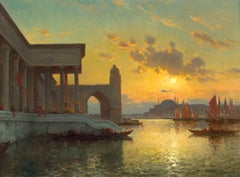
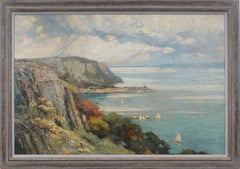
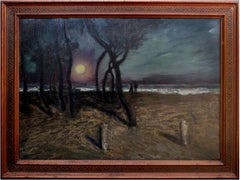
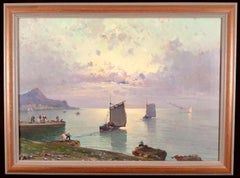
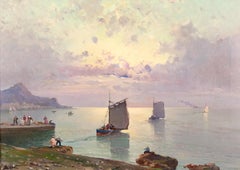
Andre MORISSET Seaside at Sunset, oil on canvas, 1931

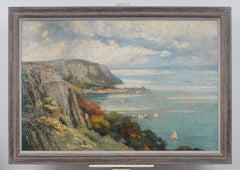
Andre MORISSET Seaside at Sunset, oil on canvas, 1931

Located in Saint Amans des cots, FR

Large Oil on Canvas by André Morisset (1876–1954), France, 1931 Title: Seaside at Sunset With frame: 91 x 120 cm – 35.8 x 47.2 inches Without frame: 75 x 103 cm – 29.5 x 40.6 inches...

Category

Symbolist 1930s Paintings

Materials

Canvas, Oil

1930's Modernist Oil Painting Paris Rooftops Hazel Guggenheim Mckinley Fauvist

1930's Modernist Oil Painting Paris Rooftops Hazel Guggenheim Mckinley Fauvist

By Hazel Guggenheim McKinley

Located in Surfside, FL

Hazel Guggenheim King-Farlow McKinley (American, London, New Orleans, 1903-1995), "Paris Rooftops" c. 1930 Oil paint on wood panel Attributed, dated and titled verso (I am not sure in whose hand not signed by the artist herself). Dimensions H.- 18 in., W.- 15 in., Framed- H.- 26 1/2 in., W.- 23 in. Provenance: From an estate New Orleans, Louisiana. Hazel Guggenheim King-Farlow McKinley (born Barbara Hazel Guggenheim; April 30, 1903 – June 10, 1995) was an American painter, art collector, and art benefactor. Hazel Guggenheim was born in New York City to Benjamin Guggenheim and Fleurette (Seligman) Guggenheim. The marriage united two wealthy German-Jewish families. Born into the well-known Guggenheim family, a niece of Solomon Guggenheim who founded the Guggenheim Museum, she grew up in New York, alongside her sisters Benita Guggenheim and Marguerite Peggy Guggenheim who would become the influential gallery proprietor, art collector, museum founder, and midwife to the Abstract Expressionism art movement. Her father Benjamin gave up much of his financial interest in the family's mining business to start his own business in Paris. With his business failing, in 1912 he set out to return to the United States in time for McKinley's ninth birthday on the Titanic. Following the shipwreck, he drowned aged 46; his body was not recovered. McKinley inherited $450,000. She later inherited money on the deaths of her mother, and of her older sister, Benita, who died in childbirth. The loss of her father haunted McKinley for the rest of her life, and in 1969 she recorded "In Memoriam, Titanic Lifeboat Blues." McKinley began painting as a teenager and was a prolific artist throughout her life. When she fled New York for Paris at age 19 she studied at the Sorbonne and became part of 1920's bohemian Paris, France, where she was taught by key modernism artists of the time. Her primary mediums were ink, water color, tempera, and crayon. Some of her work is hand signed and some is not. In 1928 her sister Peggy moved to London and mar­ried the British writer John Holmes. In 1931, McKinley married the Englishman Denys King-Farlow. They settled in Sussex, UK, and had two children, John King-Farlow, who became a philosopher and poet, and Barbara Benita King-Farlow, who became an artist in her own right. In 1938 Peggy opened Guggenheim Jeune, a London gallery of mod­ern art, starring Wassily Kandinsky, Henry Moore, Salvador dali, Constantin Brancusi, Max Ernst, Pablo Pic­asso and Jean Miro with whom they socialized. Whilst living in the south of England with Denys King-Farlow in the 1930s, McKinley was influenced by a group of avant-garde artists, and had her first solo exhibition in London in April 1937 at the Coolings Gallery. She received instruction from British artists Rowland Suddaby, Raymond Coxon, and Edna Ginesi, becoming associated with the London Group and the Euston Road School. She painted primarily in watercolor. Her work included still-life, portraits, townscapes and landscapes. Although her first work was done in a "slightly plain palette," her later work in the 1930s brightened, sometimes falling within the realm of fauvism. "Under the influence of the Surrealist artists, Hazel's paintings after the 1930's became freer, though her work was far more whimsical and humorous than many artists more closely associated with the surrealism movement." In 1939 McKinley fled Europe due to the impending war and returned to the US, living mostly in California. She took brief art lessons from her sister Peggy's one-time husband Max Ernst and much later attended several summer schools taught by muralist and renowned teacher Xavier Gonzalez. In her life in the United States and abroad, McKinley met many prominent artists of the Paris, London, and New York art scenes including Jackson Pollock. McKinley continued to paint, and ran a small gallery of her own in the late 1950s and early 1960s in West Cornwall, Connecticut. One show at her gallery featured the works of British and Irish painters including Rowland Suddaby, Frank Beteson, Tom Nisbett, and Patrick Swift. McKinley showed two of her own works in the same exhibit, a watercolor painted at Positano, Italy and one painted at the Tuileries, Paris. Another featured work was a surrealistic water color portrait of McKinley by London artist Mervyn Peake. McKinley exhibited her work both in Europe and the United States throughout her long career, mostly at smaller venues. An incomplete listing of her exhibits and museum acquisitions of her work include: Berkshire Museum, the Galerie Raymond Duncan in Paris, Stendahl Galleries, the Jake Zeitlin Gallery, the Montgomery Museum of Fine Art, the Artists' Own Gallery in London, the Manchester City Art Gallery, and Santa Fe Art Museum. McKinley's work was only once included in a show by her sister Peggy. In 1943 McKinley was selected to exhibit a painting in Peggy's infamous show Exhibition by 31 Women in her New York gallery Art of This Century. The exhibition was radical at the time for being one of the first all-woman exhibitions, as well as showing only abstract or Surrealist works. The Exhibition by 31 Women was conceived by Peggy Guggenheim in collaboration with Marcel Duchamp, who is usually credited with suggesting the idea. The participating artists were selected by a jury that included André Breton, Max Ernst Duchamp, and Guggenheim. Advice was sought from Alfred H. Barr Jr., first director of the Museum of Modern Art in New York, who provided Guggenheim with five names, of which three were included in the exhibition, Suzy Frelinghuysen, Irene Rice Pereira, and Esphyr Slobodkina. Those already known to Guggenheim through their partners included Xenia Cage, wife of the composer John Cage, Frida Kahlo, wife of Diego Rivera, who was noted for his frescoes, Sophie Taeuber-Arp, wife of the sculptor, Hans Jean Arp, and Jacqueline Lamba, ex-wife of the surrealist André Breton. Guggenheim’s sister, Hazel Guggenheim McKinley and her daughter, Pegeen Vail Guggenheim exhibited. Also in the exhibition was the burlesque dancer, Gypsy Rose Lee, another friend of Guggenheim, who was possibly included more to help publicise the event than for her artistic skills. Other artists were friends of Guggenheim or of Max Ernst. One, Dorothea Tanning, was Ernst's lover, leading Guggenheim to say: "I realized that I should have only had thirty women in the show". Only one artist is known to have refused the invitation to submit works, Georgia O'Keeffe, who reportedly responded that she wished to be identified as a painter, and not singled out because of her gender. In the late 1950s, McKinley moved back to Europe for a while, before returning to the United States in 1969. She lived in New Orleans until her death in 1995. On her death, her only living son, John King-Farlow, wrote a poem in his mother's honor, entitled "Eulogy For My Mother (Hazel Guggenheim McKinley, Artist)." A short obituary distributed by the Associated Press noted she was a member of the illustrious New York Guggenheim family, that she was determined to make a name for herself as an artist, that her art works were shown in museums in the United States and Europe, and were in the collections of such celebrities as Greer Garson, Benny Goodman, and Jason Robards. In 1998 after her death, one of her paintings was exhibited in Peggy Guggenheim's Venice home museum the Palazzo Venier dei Leoni. Guggenheim’s work in various media and her connections to influential artists and collectors provide glimpses into the complex tapestry of the art world in the first half of the 20th century. In her later life she settled in New Orleans, where she continued painting, exhibiting, and studying art into her eighties at Newcomb College, New Orleans. She was part of a regional art scene that included Ida Kohlmeyer, George Rodrigue, Noel Rockmore and Hunt Slonem. Towards the end of her life while confined to bed, her last works were colored pen drawings and sketches. McKinley collected major contemporary artworks and she donated many of these works to public institutions. She donated over 15 works to Wakefield Art Gallery, UK, in the 1930s, and in 1938 presented the painting Cossacks...

Category

Modern 1930s Paintings

Materials

Oil, Panel

Moonlit Coastal Landscape, 1936

Moonlit Coastal Landscape, 1936

Located in Stockholm, SE

This striking coastal landscape by Bertel Bertel-Nordström captures the solemn beauty of a moonlit night along the Nordic shoreline. The composition is dominated by a dramatic interp...

Category

Romantic 1930s Paintings

Materials

Canvas, Oil

Autumn Morning Spain oil on canvas painting mediterranean landscape

Autumn Morning Spain oil on canvas painting mediterranean landscape

Located in Sitges, Barcelona

Author: Joan Gil i Gil (Barcelona, 1900 – 1984) Title: Autumn Morning Date: 1934 Technique: Oil on canvas Dimensions: 81 × 100 cm (31.9 × 39.4 in) Signature: Signed lower left: Joan ...

Category

Impressionist 1930s Paintings

Materials

Canvas, Oil

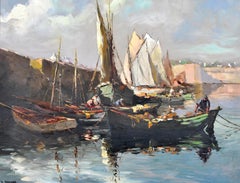
Antique Glouster Harbor New England Fishing Boat Seascape Oil Painting

Antique Glouster Harbor New England Fishing Boat Seascape Oil Painting

Located in Douglas Manor, NY

5169 Antique American Large Impressionist seascape oil painting .Oil on canvas circa 1930 Framed Image size 15.5x19.5"

Category

1930s Paintings

Materials

Oil

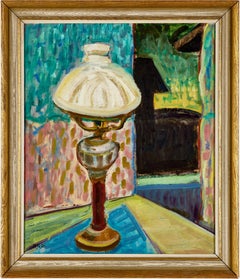
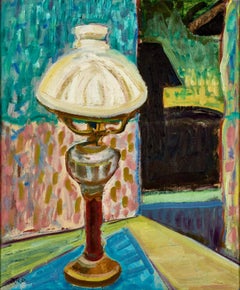
1930's English Impressionist Signed Oil Painting Still Life Thick Impasto Paint

1930's English Impressionist Signed Oil Painting Still Life Thick Impasto Paint

Located in Cirencester, Gloucestershire

Interior Still Life by Harry Bloomfield (British, 1883-1940) *see notes below signed verso oil on canvas, framed framed: 28 x 24 inches canvas: 22 x 18 inches Provenance: private co...

Category

Post-Impressionist 1930s Paintings

Materials

Oil, Canvas

Antique American Impressionist Signed Fall Forest Interior Framed Oil Painting

Antique American Impressionist Signed Fall Forest Interior Framed Oil Painting

Located in Buffalo, NY

Antique American impressionist fall landscape oil painting. Oil on canvas. Signed faintly. Framed. Provenance from a Sag Harbor, NY collection. Measuring: 20 by 22 inches overall. H...

Category

Impressionist 1930s Paintings

Materials

Oil, Canvas

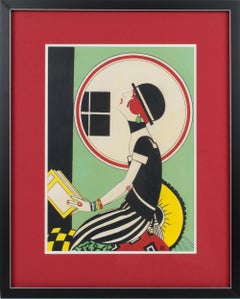
The Cabaret Dancer
The Cabaret Dancer

The Cabaret Dancer

Located in London, GB

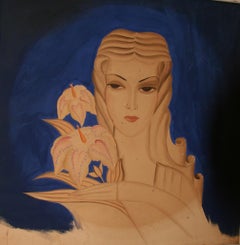
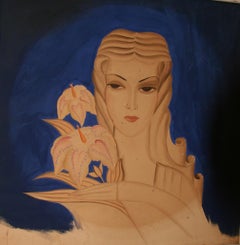
'The Cabaret Dancer', crayon on art paper, by Kolomon Moore (circa 1930s). The Crazy Years (les Années Folles) of Paris in the 1920s hit an abrupt end in...

Category

1930s Paintings
Materials

Paper, Crayon

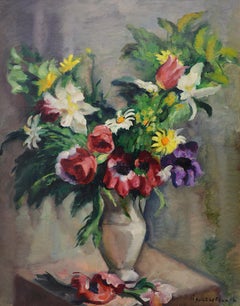
Potted Flowers
Potted Flowers

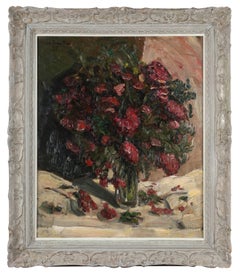
Charles KvapilPotted Flowers, 1933

$3,713Sale Price|40% Off

Potted Flowers

By Charles Kvapil

Located in London, GB

'Potted Flowers', oil on canvas, by Charles Kvapil (1933). Potted red geraniums symbolise happiness, good health, good wishes, and friendship. They are ...

Category

Expressionist 1930s Paintings

Materials

Canvas, Oil

Pêcheurs Sur Les Rochers 1930s Framed Provencal Côte d'Azur Oil Painting

Pêcheurs Sur Les Rochers 1930s Framed Provencal Côte d'Azur Oil Painting

Located in Sutton Poyntz, Dorset

Gustave Vidal. French ( b.1895 - d.1966 ). Pêcheurs Sur Les Rochers. Bord De Mer En Côte d'Azur. Oil On Panel. Signed Lower Right. Image size 12.4 inches x 15.6 inches ( 31.5cm x 39.5cm ). Frame size 22.2 inches x 26 inches ( 56.5cm x 66cm ). Available for sale, this original oil painting is by the French artist Gustave Vidal and dates from around 1935. The painting is presented and supplied in its original frame. The original cotton slip has been replaced with a sympathetic contemporary slip that is in keeping with the fresh coastal aesthetic of the painting (which is shown in these photographs). This antique painting is in a good condition. It wants for nothing and is supplied ready to hang and display. The painting is signed lower right. Gustave Vidal was a 20th century French artist, and one of the best Provencal landscapers of his generation. He worked in the Provencal and Basque regions as well as Corsica and the centre of France. He was born in Avignon in 1895, in the Provence region of France, and died in the same town in 1966. Vidal trained at the École des Beaux-Arts in Avignon. It is often reported that he studied under Pierre Grivolas, (1823-1906) who was a prominent teacher there who had encouraged plein air painting to capture light and colour directly from nature. However, Grivolas died when Vidal was only 9 or 10, so it is very unlikely that there was a direct teacher/student relationship between them in a formal apprenticeship or atelier setting. Pierre Grivolas had been a director of the École des Beaux-Arts in Avignon until his death in 1906, and found what became known as the Nouvelle école d’Avignon, promoting outdoor practice and modern landscape painting. Grivolas influenced a generation of Provençal painters directly, and his teachings persisted after his death. Vidal therefore studied in the establishment that continued his ethos and would have been influenced by Grivolas’ directorship. Vidal won numerous awards at the Beaux-Arts in Avignon and became a sociétaire (member) of the Salon des Artistes Français in Paris, an important exhibition venue for French artists of the period. He actually wrote the articles of association for this establishment. As well as exhibiting in Avignon and Paris Vidal also exhibited in Berlin and Brussels. Vidal was primarily a landscape and marine painter. His work is associated with Provencal scenes — including rural landscapes, village streets, harbours, seascapes, and views of the French Riviera and interior France. His technique combined impasto application with both palette knife and brush, reflecting influences from Impressionism and post-Impressionist colourism encountered during his career, especially in Paris. This gives his canvases a textured, lively surface and strong sense of light and atmosphere. His works typically show rich colour and balanced composition, with evocative French light. Nowadays Vidal’s paintings appear regularly in antique galleries, auctions, and online sales in Europe and beyond, though he’s not commonly featured in major public museums or standard art history encyclopaedias. Auction results indicate steady interest among collectors of regional French painting, with prices varying according to size and subject. Although not among the most famous French painters of his generation, Gustave Vidal holds a solid place within early-to-mid-20th-century Provence painting, continuing the regional tradition of light, colour, and landscape that followed Impressionism, and appealing to contemporary collectors of Provençal and southern French art...

Category

Post-Impressionist 1930s Paintings

Materials

Oil, Wood Panel

Rockport Landscape
Rockport Landscape

Rockport Landscape

By Giovanni Martino

Located in Wilton Manors, FL

Beautiful 1931 painting by American artist, Giovanni Martino (1908-1997). Oil on canvas measures 25 x 30 inches. Measures 35 x 39 inches framed. The scene depicts what is definitively the Rockport, Mass. fishing pier. Excellent condition with a few very minor areas of paint flaking. The darker areas in the sky is a result of unpainted areas. The canvas is sized with glue but not primed white: observable areas of natural linen color results. Signed wet into wet and dated lower left. No restoration or overpaint. Giovanni Martino, National Academy of Design* member, was born on May 1, 1908 in Philadelphia PA where all seven brothers and one sister, Filomina, Frank, Antonio, Albert, Ernest, Giovanni, Edmond, and William became painters. They were under the tutelage of their eldest brother, Frank, who in the late 1920s, founded the first commercial art* studio, Martino Studios, at 27 South 18th Street. Besides studying with his two eldest brothers, Giovanni also studied with Albert Jean Adolph at La France Institute, The Pennsylvania Academy of the Fine Arts*, The Graphic Sketch Club, and Spring Garden Institute in Philadelphia. In his mid teens he accompanied his two eldest brothers to New Hope searching for subjects to paint. In the 1930s, he also started to paint in Manayunk, a hilly mill town along the Schuylkill River...

Category

American Impressionist 1930s Paintings

Materials

Oil

"BLUE HEAVEN" BLUEBONNET 1930s NEWCOMB MACKLIN FRAME 38 x 46 Framed Robert Wood

"BLUE HEAVEN" BLUEBONNET 1930s NEWCOMB MACKLIN FRAME 38 x 46 Framed Robert Wood

Located in San Antonio, TX

Robert Wood (G. Day) (1889 -1979) San Antonio Artist Image Size: 28 x 36 Frame Size: 38 x 46 Medium: Oil on Canvas Signed Front & Signed & Titled on Verso Newcomb Macklin Frame Circa Late 1930s "Blue Heaven" Bluebonnets Biography Robert Wood (G. Day) (1889 -1979) A painter of realistic landscapes reflecting a vanishing wilderness in America, Robert Wood (not to be confused with Robert E. Wood) is reportedly one of the most mass-produced artists in the United States. His painting became so popular he was unable to meet all of the demands, and many of his works were reproduced in lithographs and mass distributed as prints, place mats, and wall murals by companies including Sears, Roebuck. He was born in Sandgate, Kent on the south coast of England near Dover, the son of W.L. Wood, a famous home and church painter who recognized and supported his son's talent. In fact, he forced his son to paint by keeping him inside to paint rather than playing with his friends. At age 12, Wood entered the South Kensington School of Art. As a youth, he came to the United States in 1910, having served in the Royal Army, and he never returned to England. He traveled extensively all over the United States, especially in the West, often in freight cars, and also painted in Mexico and Canada. His itinerant existence took him to Illinois where he worked as a farmhand, to Pensacola, Florida where he married, briefly in Ohio, Seattle, Washington, and Portland, Oregon. In 1912, he was in Los Angeles, and in the late 1920s and early 1930s, in San Antonio, Texas, where he lived and in 1928 exhibited in the "Texas Wildflower Competition." From San Antonio, he gained a national reputation for his strong colored, dramatic paintings. Some of that prestige has been credited to his association with Jose Arpa, prominent Texas artist. Wood also gave art lessons, and one of his students was Porfirio Salinas. During this period, Wood sometimes signed his paintings G. Day or Trebor, which is Robert spelled backwards. In 1941 he went to California and painted numerous desert and mountain landscapes and coastal scenes. He lived in Carmel for seven years, and then moved to Woodstock, New York, but he soon returned to California, settling first in Laguna Beach, then San Diego, and finally in the High Sierras, where he and his wife built a home and studio near Bishop and lived until his death in 1979. Robert Wood was born March 4, 1889, in Sandgate, England, a small town on the Kentish coast not far from the white cliffs of Dover. His father, W. J. Wood, was a successful painter who recognized Robert's unusual talent. At the age of twelve, his father enrolled Wood in art school in the small town of Folkstone. He then attended the South Kensington School of Art. While attending art school, Wood won four first awards and three second awards, one each year, a record. In 1910 after service in the Royal Army, nineteen-year-old Wood and his friend, Claude Waters, immigrated to America. Initially, he settled in Illinois and worked as a hired hand on a farm belonging to Water's uncle. He would then strike out on his own, living the life of an itinerant painter. Wood traveled as a hobo, hopping freight trains and selling or bartering small paintings to support him along the way. When times were hard, he worked at whatever job was available. In this manner, he saw most of the United States and fell in love with rural America. By 1912, Wood visited Los Angeles for the first time, arriving on the day of the Titanic tragedy. Later that year, he had met, courted and married young Eyssel Del Wagoner in Florida. The couple moved to Ohio where a daughter, Florence, was born. During World War I, the family moved to Seattle where a son, John Robert Wood, was born in 1919. In the early 1920's, the young Wood family was almost constantly on the move. They stayed for short periods in Kansas, Missouri, California and for a longer time in Portland, Oregon, where Wood's friend Claude Waters had settled. Wood's seemingly endless wanderings disrupted his family life and delayed his development as a painter. However, through his travels he developed an appreciation for the American landscape that would inspire him for the rest of his career. Although aware of the current movement away from traditional realism in American art, he elected to travel that solitary path and remain true to his own vision of American’s grandeur and beauty poetically translated through his landscape and seascape paintings. In 1923, the Wood family discovered the beautiful city of San Antonio, Texas and it was there that he and his family would finally settle. He studied briefly at the San Antonio Art School with Spanish colorist Jose Arpa y Perea (1860-1952), who had arrived in San Antonio that same year. In the latter part of the 1920’s, Jose Arpa’s influence quickly became evident. Wood after several years of experimentation was becoming fine easel painter, capable of great subtlety with a new mature original style. Like Texas painters Robert Onderdonk (1853-1917) and his son Julian Onderdonk (1882-1922), Robert Wood concentrated on the distinctive Texas landscape with its Red Oak trees and wildflowers that covered the hill country landscape. He developed a reputation for his scenes of Blue Bluebonnets, the state flower. In the spring, the Texas prairie is covered with wildflowers, especially in the hill country surrounding San Antonio and Austin. Wood incorporated native stone barns and rough wood farmhouses that added authenticity and romance to his compositions. In 1925, Wood was divorced from his wife. In 1932, he moved to the famous scenic loop on San Antonio's outskirts. While still living in Texas, he took extensive western sketching trips that brought him to California. It is evident that his 1930’s California...

Category

Impressionist 1930s Paintings

Materials

Oil

Parc des Buttes-Chaumont, Paris

Parc des Buttes-Chaumont, Paris

By Lucien Génin

Located in London, GB

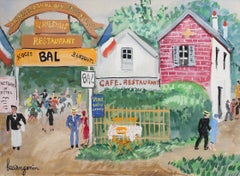
'Parc des Buttes-Chaumont' in Paris, gouache on art paper, by Lucien Génin (circa 1930s). A charming depiction of well turned out Parisians enjoying a day at the park. Boaters, strollers and swans all co-mingle around the peaceful lake. The reflection of the rocky bluff in the water is superbly treated by Génin. It's a cheerful and uplifting image of days-gone-by in 1930s Paris. The park takes its name from the 'bare hill' (chauve-mont) that once occupied the site. It became a place where gypsum was mined, and where the limestone was quarried to be used in buildings in Paris and the United States. Worse, though, it was a site that also became a dumping ground. Luckily, during the 19th-century renovation of Paris under Napoleon III, chauve-mont was chosen as a place for a large park, as part of the emperor's fascination with endowing Paris with green spaces. The artificial lake created at that time wraps around a hilly central island. The lake attracts waterfowl and other birds and is stocked with fish. The 19th-century planners cleaned up the site and added tons of soil to fill the pits left by a limestone mining operation. Then dynamite was used to "sculpt" the site into the craggy shapes seen today, including the 50-metre-high central hill with cliffs, an interior grotto, pinnacles, and arches. Up on top, overlooking the rest of the park - and depicted in this artwork - is a small, round belvedere, based on the Roman Temple of Vesta in Italy. From that spot you can see a lovely view of Montmartre and the white cupolas of the Sacre-Coeur. The painting is in very good condition. It has been newly framed and glazed with museum-quality glass (anti-reflective and UV protection) to preserve this significant artwork for decades to come. Dimensions with frame: H 62 cm / 24.4" W 76 cm / 29.9" Dimensions without frame: H 48.5 cm / 19.1" W 63 cm / 24.8" About the Artist: After the devastation of the First World War, Lucien Génin (1894 - 1953) left his provincial home in the autumn of 1919 to find his fortune among the lively Parisians in the heart of Montmartre. Génin befriended the painters Frank Will, Gen Paul, Émile Boyer, Marcel Leprin...

Category

Post-Impressionist 1930s Paintings

Materials

Paper, Gouache

Le Cafe Briard - Paris - Impressionist Figures in Landscape Oil - Edouard Cortes

Le Cafe Briard - Paris - Impressionist Figures in Landscape Oil - Edouard Cortes

By Édouard Leon Cortès

Located in Marlow, Buckinghamshire

Signed impressionist oil on canvas figures in cityscape circa 1930 by sought after French painter Edouard Cortes. The work depicts a bustling evening street scene outside the Cafe Br...

Category

Impressionist 1930s Paintings

Materials

Canvas, Oil

New Hampshire Hills, Landscape Painting

New Hampshire Hills, Landscape Painting

By Maxfield Parrish

Located in Fort Washington, PA

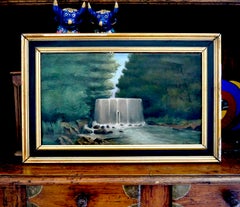
Date: 1932 Medium: Oil on Board Dimensions: 23.00" x 18.63" Framed Dimensions: 33.00" x 28.63" Signature: inscribed MP Jr. No. 76. / Painted by Maxfield Parrish / Maxfield Parrish I...

Category

1930s Paintings
Materials

Oil, Board

Authentic Woodblock print Set of 6 from 東海道五十三次大津 The 53 Stations of the Tōkaidō

Authentic Woodblock print Set of 6 from 東海道五十三次大津 The 53 Stations of the Tōkaidō

By Utagawa Hiroshige

Located in London, GB

GSY Gallery has curated a set of 6 from the series The Fifty-Three Stations of the Tōkaidō Road ( 東海道五十三次大津Tōkaidō gojūsan tsugi, Ōtsu) , this set is from the series of 55 prints by ...

Category

Edo 1930s Paintings

Materials

Ink, Washi Paper

Selfportrait
Selfportrait

Selfportrait

Located in Paris, FR

Odette DUMARET (Bois le Roi 1895 - 1950) Self-portrait, circa 1935 Oil on canvas Signed top right Work: 55 x 46 cm Frame: 62 x 53 cm Very good condition "To Odette Dumaret; To p...

Category

Fauvist 1930s Paintings

Materials

Canvas, Oil

Fall in the Mountain Valley

Fall in the Mountain Valley

Located in North Clarendon, VT

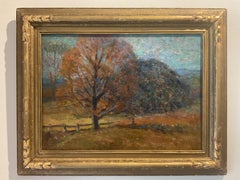
Beautiful American School impressionist piece, unsigned, oil on board. Likely 1920-1940. Painted by a talented artist with wonderful composition and brushwork. 10" x 14" sight, 16.2...

Category

American Impressionist 1930s Paintings

Materials

Oil

Signed Antique American Impressionist Framed Landscape Oil Painting

Signed Antique American Impressionist Framed Landscape Oil Painting

Located in Buffalo, NY

Charles Sutton, “April Afternoon,” Oil on Board, Framed Landscape Painting Warmly toned impressionist oil painting by Charles Sutton, titled April Afternoon. The work captures a tra...

Category

Impressionist 1930s Paintings

Materials

Canvas, Oil

'Early Morning River Landscape, ' by Harry L. Hoffman, Oil on Canvas Painting

'Early Morning River Landscape, ' by Harry L. Hoffman, Oil on Canvas Painting

By Harry L. Hoffman

Located in Oklahoma City, OK

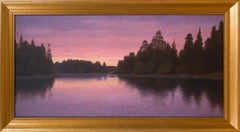
In this gilt wood framed oil on canvas waterscape, American Impressionist artist Harry Hoffman depicts the last moments of a morning sunrise over a river in predominant hues of lavender, purple, pink and blue. The sky is reflected in the water below with a sandy brown beach and large green tree in the foreground. Harry Leslie Hoffman was born in Cressona, a small community in Pennsylvania’s Schuylkill Valley. His mother was an amateur artist who encouraged her son to pursue a career in the arts. In 1893, Hoffman entered the School of Art at Yale University and studied with John Ferguson Weir, the son of Robert Walter Weir. After graduation in 1897, Hoffman moved to New York to continue his studies at the Art Students League. He also traveled to Paris and took classes at the Académie Julien. In the summer of 1902, Hoffman attended the Lyme Summer School of Art, in the town of Old Lyme on the Connecticut coast. The school was headed by Frank Vincent Dumond and was located in a boarding house owned by Florence Griswold. The school eventually grew into an artists’ colony and a center for American Impressionism. When Hoffman first arrived as a student, he was not permitted to stay in the house which was designated for the professional artists only. However, his outgoing personality soon won him many friends at the colony. In 1905, Hoffman settled in Old Lyme and worked as a full member of the artist colony. He was particularly influenced by Willard Leroy Metcalf, an Impressionist also working in Old Lyme. Fellow artists later fondly recalled Hoffman’s antics at the Griswold house, which included playing the flute and banjo, tap-dancing, singing humorous songs, and performing magic tricks. In 1910, Hoffman married another Old Lyme artist named Beatrice Pope, and the couple had one child in 1921. Hoffman and his wife often escaped New England during the harsh winter months. In the winters of 1914 and 1915 he traveled to Savannah, Georgia with fellow Old Lyme artist William Chadwick...

Category

American Impressionist 1930s Paintings

Materials

Canvas, Oil

Dunes on California Coast, c 1930s

Dunes on California Coast, c 1930s

By Carl Sammons

Located in Pasadena, CA

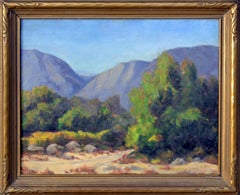
Consigned to the gallery, Pasadena, California; By descent to a private collector, Encino, California; Acquired in 1998 by a private collector, San Carlos, Palo Alto, and Oceanside, California; From the Santa Barbara Historical Society Signed "Carl Sammons" on lower right Description This luminous coastal landscape by Carl Sammons is a striking example of the artist’s signature plein air style, depicting the rolling coastal dunes and lush vegetation of California’s shoreline. Best known for his depictions of Carmel and Monterey, the composition and palette of this work suggest inspiration from the Monterey Peninsula dunes. Sammons’ ability to merge vibrant, clean color with a sense of atmospheric perspective is evident here in the interplay of bright, sunlit sands and the rich greens of windswept foliage. His vibrant yet naturalistic color harmonies, crisp edges, and keen sensitivity to light bring the fleeting beauty of the coastal environment to life. The hazy eucalyptus grove in the background adds a distinctive regional touch, situating the composition firmly within California’s coastal identity. Sammons’ paintings of California’s unique landscapes played a significant role in documenting the natural beauty of the state during the early 20th century. Connection to the Monterey Art Colony By the 1920s and 1930s, Sammons became closely associated with the Monterey art colony, an influential hub for plein air painters such as Armin Hansen (1886–1957), William Ritschel (1864–1949), and Percy Gray...

Category

Impressionist 1930s Paintings

Materials

Oil, Board, ABS

Landscape - Oil Painting by Armando Cermignani - 1930

Landscape - Oil Painting by Armando Cermignani - 1930

Located in Roma, IT

Oil on plywood realized by Armando Cermignani (1888-1957) in 1930s. Hand signed and dated. Excellent condition. Armando Cermignani was an Italian painter, engraver, ceramist and p...

Category

Modern 1930s Paintings

Materials

Oil

Vintage post-impressionist landscape oil painting of a French port

Vintage post-impressionist landscape oil painting of a French port

Located in AIGNAN, FR

Large post impressionist landscape oil painting by French artist Lucienne Capdevielle (1885-1961) entitled, 'Le Petit Port'. This substancial, unusual and captivating landscape oil painting on canvas is quite eye catching. The colourful town houses painted in pastel hues shine jewel like over a busy port on a large canvas that is textured to the touch. MORE ABOUT THIS PAINTING: Medium: Oil on stretched canvas Overall size: 26ins x 30ins or 66cms x 76cms (approx) Date: 1930's Condition: The painting is in overall good condition, note that at some time it would have been pinned at the corners and still carries the scars. The frame is the original and has imperfections throughout including flaking paint and indentations. Signed: Lucienne Capdevielle (1885-1961) Lucienne was born in Algiers in 1885, she died in a Parisien hospital in 1961, she was a French painter and pastelist. She was a student of Georges-Antoine Rochegrosse, Jean-Paul Laurens, Paul Albert Laurens and Léon Cauvy...

Category

Post-Impressionist 1930s Paintings

Materials

Oil

Industry and Commerce

Industry and Commerce

Located in Los Angeles, CA

This mural study is part of our exhibition America Coast to Coast: Artists of the 1930s Industry and Commerce, 1936, tempera on panel, 16 ½ x 39 ½ inches, signed verso “John Ballator, Portland Ore.” provenance includes: J.C. Penney Company, represented by Russell Tether Fine Arts Assoc.; presented in a newer wood frame About the Painting Industry and Commerce is a prime example of WPA Era muralism. Like a Mediaeval alter, this mural study is filled with icons, but the images of saints and martyrs are replaced with symbols of America's gospel of prosperity through capitalism. Industry and Commerce has a strong narrative quality with vignettes filling the entire surface. Extraction, logistics, design, power generation, and manufacturing for printing, chemicals, automobiles and metal products are all represented. To eliminate any doubt about the mural's themes, Ballator letters a description into the bottom of the study. Ballator also presents an idealized version of industrial cooperation, as his workers, lab-coated technicians and tie-wearing managers work harmoniously toward a common goal in the tidy and neatly designed environments. Although far from the reality of most industrial spaces, Ballator's study reflects the idealized and morale boosting tone that many mural projects adopted during the Great Depression. About the Artist John R Ballator achieved success as a muralist, lithographer, and teacher during the Great Depression. Born in Oregon, he studied at the Portland Museum Art School, the University of Oregon and at Yale University where he received a Bachelor of Fine Art. In 1936, Ballator was commissioned to paint a mural panel for the new Department of Justice Building in Washington DC, an important project that spanned five years with several dozen artists contributing a total of sixty-eight designs. Ballator completed murals for the St. Johns Post Office and Franklin High School, both in Portland, Oregon. He also contributed to the 1938 murals at Nathan Hale School in New Haven, Connecticut. During the late 1930s, Ballator taught art for several years at Washburn College in Topeka, Kanas, where he completed a mural for the Menninger Arts & Craft Shop before accepting a professorship at Hollins College...

Category

American Realist 1930s Paintings

Materials

Tempera

Yuletide Spirit
Yuletide Spirit

Yuletide Spirit

Located in North Clarendon, VT

Whimsical Kate A. Williams arts and crafts impressionist painting circa 1930. Perfect for the holiday season. 20"x 16" oil on board, signed lower left. Frame is about 25x21. Painter...

Category

American Impressionist 1930s Paintings

Materials

Oil

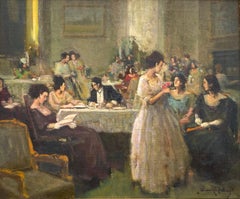
Cocktail party

Cocktail party

By Arpad Bardocz

Located in Los Angeles, CA

Monumental Art Deco oil painting on canvas by renown Hungarian artist Arpad Bardocz. In good condition. Signed and dated. We can arrange shipping worldwide. We was born in Budape...

Category

Art Deco 1930s Paintings

Materials

Canvas, Oil

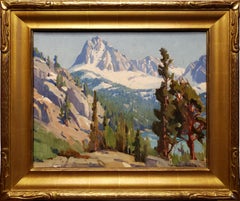
Landscape
Landscape

Landscape

Located in Genève, GE

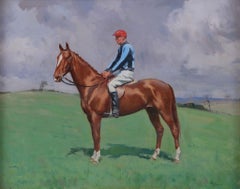
Work on canvas Illegible signature

Category

1930s Paintings
Materials

Oil

Neighbors

Neighbors

By Norman Barr

Located in Los Angeles, CA

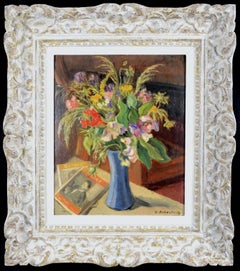
Neighbors, 1939, oil on canvas, signed and dated lower right, 22 x 26 inches Norman Barr was an American Scene painter and muralist known for his poignant depictions of working-clas...

Category

American Modern 1930s Paintings
Materials

Canvas, Oil

Read More