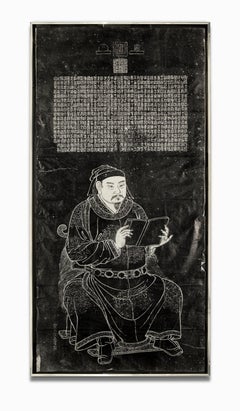
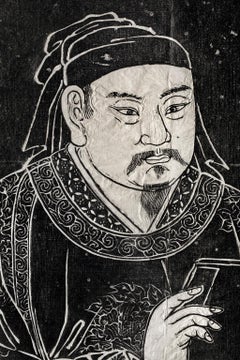
This exquisite work is a late Qing Dynasty stone rubbing of historical Chinese folk hero Yue Fei. Yue Fei is no stranger to any student of Chinese history. A military general, calligrapher, and poet, he lived during the 12th century Southern Song dynasty in what is now Henan, China. Yue Fei has become synonymous with unyielding patriotic loyalty in China, one of the most well-known stories about him involved his challenge to charges of treason by ripping off his jacket to reveal four tattoos on his back that read "serve the country with the utmost loyalty" on his back. His status of folk hero in China derived from his military career fighting the Jurchen-led Jin Dynasty as a military commander which led to his execution on false charges when he patriotically followed the emperor's orders to return to the capital in order to prevent internal strife within the dynasty. Since then he has been a national hero in the pantheon of Chinese figures.
Above the stele text is a seal that honors Yue Fei:
武勝定國軍節
度使開府儀同
三司湖北京西
路宣撫使兼營
田大使岳飛印
Translated it means "Seal of Yue Fei, the Military Commissioner of Wusheng Province, Commander Unequaled in Honor, Governor of Hubei, Jingxi-lu and Yingtan Provinces"
Stone rubbings hold a long-held role in Chinese art and culture. These stone rubbings were produced when rice paper was placed upon an engraved stone or stele's surface and brushed with a liquid containing orchid juice. The paper was pressed into the engravings of the written characters and design with a brush. The inking method of this production caused the characters and images to stand out as white while the rest of the paper became black, giving it a distinct photo negative effect.
During the Qing Dynasty, which existed from 1644 to 1912, antiquarian studies were a major tenet of the Chinese scholastic tradition, resulting in the widespread production and collection of rubbings. During the 19th century Qing Dynasty of China, stele rubbings that connected with Chinese antiquity became highly sought after. These rubbings were highly valued as faithful reproductions of ancient engravings of characters, images, and decorative motifs that carried important historical and art-historical information. The Chinese script is written in seal script, an older form of Chinese writing that developed out of its oldest form of writing, Oracle Bone...
Category
Late 19th Century Rice Paper Portrait Paintings