Tea Still-life Paintings

to
1
Overall Width
to
Overall Height
to
1
1
1
1
1
1
1
1
1
2
1
Medium: Tea
Artist: Ruby Silvious
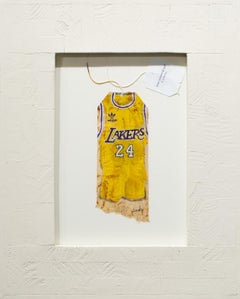
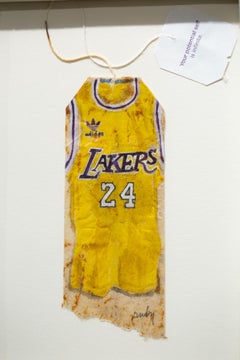
R.I.P. Kobe, Painting on Tea Bag, Tribute to Kobe Bryant

R.I.P. Kobe, Painting on Tea Bag, Tribute to Kobe Bryant

By Ruby Silvious

Located in Philadelphia, PA

This purple, white, beige and orange painting titled "R.I.P. Kobe" is an original artwork by Ruby Silvious made of watercolor and gouache on used tea bag. This...

Category

21st Century and Contemporary Contemporary Tea Still-life Paintings

Materials

Found Objects, Watercolor, Gouache, Tea

Related Items
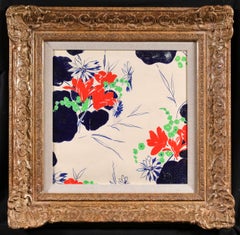
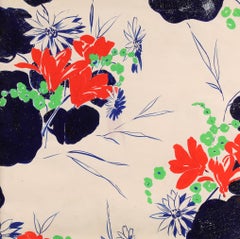
Projet de Tissus - Fauvist Flowers Watercolor & Gouache by Raoul Dufy

Projet de Tissus - Fauvist Flowers Watercolor & Gouache by Raoul Dufy

By Raoul Dufy

Located in Marlow, Buckinghamshire

Botanical watercolour and gouache on paper circa 1920 by French fauvist painter Raoul Dufy. The work depicts flowers in red, blue and green. This work was executed by Dufy as a fabric design. Dimensions: Framed: 19.5"x19.5" Unframed: 12"x12" Provenance: Private collection of works by Raoul Dufy for Bianchini Ferier Bianchini Ferrier Collection - Christie's London - July 2001 SF Fall Show Raoul Dufy was one of a family of nine children, including five sisters and a younger brother, Jean Dufy, also destined to become a painter. Their father was an accountant in the employ of a major company in Le Havre. The Dufy family was musically gifted: his father was an organist, as was his brother Léon, and his youngest brother Gaston was an accomplished flautist who later worked as a music critic in Paris. Raoul Dufy's studies were interrupted at the age of 14, when he had to contribute to the family income. He took a job with an importer of Brazilian coffee, but still found time from 1892 to attend evening courses in drawing and composition at the local college of fine arts under Charles Marie Lhullier, former teacher of Othon Friesz and Georges Braque. He spent his free time in museums, admiring the paintings of Eugène Boudin in Le Havre and The Justice of Trajan in Rouen. A municipal scholarship enabled him to leave for Paris in 1900, where he lodged initially with Othon Friesz. He was accepted by the École des Beaux-Arts, where he studied under Léon Bonnat, whose innate conservatism prompted Dufy to remark later that it was 'good to be at the Beaux-Arts providing one knew one could leave'. And leave he did, four years later, embarking with friends and fellow students on the rounds of the major Paris galleries - Ambroise Vollard, Durand-Ruel, Eugène Blot and Berheim-Jeune. For Dufy and his contemporaries, Impressionism represented a rejection of sterile academism in favour of the open-air canvases of Manet, the light and bright colours of the Impressionists, and, beyond them, the daringly innovative work of Gauguin and Van Gogh, Seurat, Cézanne, Toulouse-Lautrec and others. Dufy was an out-and-out individualist, however, and was not tempted to imitate any of these artists. He produced, between 1935 and 1937, Fée Electricité (Spirit of Electricity), the emblem for the French utilities company Electricité de France (EDF). Dufy visited the USA for the first time in 1937, as a member of the Carnegie Prize jury. In 1940, the outbreak of war (and his increasingly rheumatic condition) persuaded him to settle in Nice. When he eventually returned to Paris 10 years later, his rheumatism had become so debilitating that he immediately left for Boston to follow a course of pioneering anti-cortisone treatment. He continued working, however, spending time first in Harvard and then in New York City before moving to the drier climate of Tucson, Arizona. The cortisone treatment was by and large unsuccessful, although he did recover the use of his fingers. He returned to Paris in 1951 and decided to settle in Forcalquier, where the climate was more clement. Within a short time, however, he was wheelchair-bound. He died in Forcalquier in March 1953 and was buried in Cimiez. Between 1895 and 1898, Raoul Dufy painted watercolours of landscapes near his native Le Havre and around Honfleur and Falaise. By the turn of the century, however, he was already painting certain subjects that were to become hallmarks of his work - flag-decked Parisian cityscapes, Normandy beaches teeming with visitors, regattas and the like, including one of his better-known early works, Landing Stage at Ste-Adresse. By 1905-1906 Friesz, Braque, Matisse, Derain, Vlaminck, Van Dongen and Rouault were described collectively as Fauves (the wild beasts). What they had in common was a desire to innovate, but they felt constrained nonetheless to meet formally to set out the guiding principles of what promised to be a new 'movement'. Dufy quickly established that those principles were acceptable; moreover, he was most impressed by one particular painting by Henri Matisse ( Luxury, Calm and Voluptuousness) which, to Dufy, embodied both novelty and a sense of artistic freedom. Dufy promptly aligned himself with the Fauves. Together with Albert Marquet in particular, he spent his time travelling the Normandy coast and painting views similar...

Category

1920s Fauvist Tea Still-life Paintings

Materials

Paper, Watercolor, Gouache
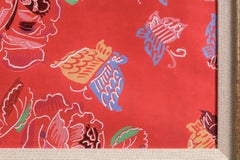
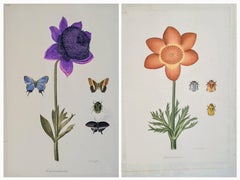
Botanical Studies, Pair of Watercolours on Silk on Handmade Paper, Anemones

Botanical Studies, Pair of Watercolours on Silk on Handmade Paper, Anemones

Located in Cotignac, FR

A pair of fine hand painted botanical watercolour studies on silk of anemones by La Roche Laffitte. The works are signed bottom right. Both are titled. The silk has been mounted on h...

Category

Late 20th Century Tea Still-life Paintings

Materials

Silk, Watercolor, Handmade Paper, Gouache

Projet de Tissus - Fauvist Still Life Study Gouache by Raoul Dufy

Projet de Tissus - Fauvist Still Life Study Gouache by Raoul Dufy

By Raoul Dufy

Located in Marlow, Buckinghamshire

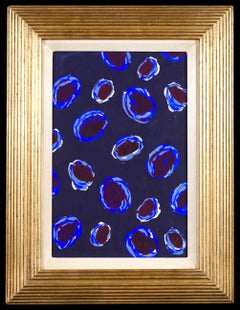
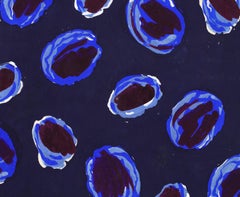
Gouache on paper fabric design circa 1920 by French fauvist painter Raoul Dufy executed in dark blues and a deep red. Dimensions: Framed: 16"x12.5" Unframed: 11"x7.5" Provenance: P...

Category

1920s Fauvist Tea Still-life Paintings

Materials

Paper, Gouache

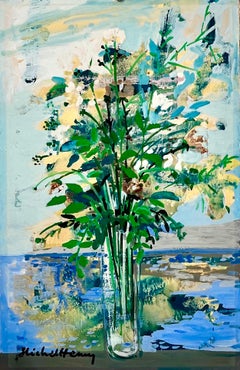
Small, Charming, Fauvist Painting Michel Henry French Modernist School of Paris

Small, Charming, Fauvist Painting Michel Henry French Modernist School of Paris

By Michel Henry

Located in Surfside, FL

Michel-Henry was born in Langres in 1928 and has shown strong passion for drawing since his childhood. Michel-Henry is acknowledged as an important painter in French contemporary a...

Category

1960s Modern Tea Still-life Paintings

Materials

Paper, Gouache

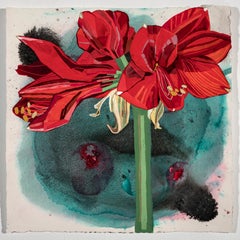
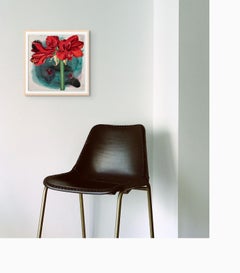
Amaryllis, Flower Painting, Bold Red Botanical Artwork, 16 x 16 Inches, Framed

Amaryllis, Flower Painting, Bold Red Botanical Artwork, 16 x 16 Inches, Framed

By Elisabeth Condon

Located in New York, NY

Elisabeth Condon’s Memorial Flowers series reimagines the still life as a meditation on memory, impermanence, and renewal. Using gouache and ink, she stages vibrant floral arrangemen...

Category

2010s Contemporary Tea Still-life Paintings

Materials

Ink, Gouache, Handmade Paper

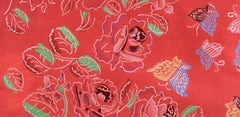
Fleurs et Papillons - Fauvist Flowers Watercolor & Gouache by Raoul Dufy

Fleurs et Papillons - Fauvist Flowers Watercolor & Gouache by Raoul Dufy

By Raoul Dufy

Located in Marlow, Buckinghamshire

Botanical watercolour and gouache on paper circa 1920 by French fauvist painter Raoul Dufy. The work depicts flowers in red and butterflies in blues, yellows, black and white. This work was executed by Dufy as a fabric design. Dimensions: Framed: 17"x27" Unframed: 10"x20" Provenance: Private collection of works by Raoul Dufy for Bianchini Ferier Bianchini Ferrier Collection - Christie's London - July 2001 SF Fall Show Raoul Dufy was one of a family of nine children, including five sisters and a younger brother, Jean Dufy, also destined to become a painter. Their father was an accountant in the employ of a major company in Le Havre. The Dufy family was musically gifted: his father was an organist, as was his brother Léon, and his youngest brother Gaston was an accomplished flautist who later worked as a music critic in Paris. Raoul Dufy's studies were interrupted at the age of 14, when he had to contribute to the family income. He took a job with an importer of Brazilian coffee, but still found time from 1892 to attend evening courses in drawing and composition at the local college of fine arts under Charles Marie Lhullier, former teacher of Othon Friesz and Georges Braque. He spent his free time in museums, admiring the paintings of Eugène Boudin in Le Havre and The Justice of Trajan in Rouen. A municipal scholarship enabled him to leave for Paris in 1900, where he lodged initially with Othon Friesz. He was accepted by the École des Beaux-Arts, where he studied under Léon Bonnat, whose innate conservatism prompted Dufy to remark later that it was 'good to be at the Beaux-Arts providing one knew one could leave'. And leave he did, four years later, embarking with friends and fellow students on the rounds of the major Paris galleries - Ambroise Vollard, Durand-Ruel, Eugène Blot and Berheim-Jeune. For Dufy and his contemporaries, Impressionism represented a rejection of sterile academism in favour of the open-air canvases of Manet, the light and bright colours of the Impressionists, and, beyond them, the daringly innovative work of Gauguin and Van Gogh, Seurat, Cézanne, Toulouse-Lautrec and others. Dufy was an out-and-out individualist, however, and was not tempted to imitate any of these artists. He produced, between 1935 and 1937, Fée Electricité (Spirit of Electricity), the emblem for the French utilities company Electricité de France (EDF). Dufy visited the USA for the first time in 1937, as a member of the Carnegie Prize jury. In 1940, the outbreak of war (and his increasingly rheumatic condition) persuaded him to settle in Nice. When he eventually returned to Paris 10 years later, his rheumatism had become so debilitating that he immediately left for Boston to follow a course of pioneering anti-cortisone treatment. He continued working, however, spending time first in Harvard and then in New York City before moving to the drier climate of Tucson, Arizona. The cortisone treatment was by and large unsuccessful, although he did recover the use of his fingers. He returned to Paris in 1951 and decided to settle in Forcalquier, where the climate was more clement. Within a short time, however, he was wheelchair-bound. He died in Forcalquier in March 1953 and was buried in Cimiez. Between 1895 and 1898, Raoul Dufy painted watercolours of landscapes near his native Le Havre and around Honfleur and Falaise. By the turn of the century, however, he was already painting certain subjects that were to become hallmarks of his work - flag-decked Parisian cityscapes, Normandy beaches teeming with visitors, regattas and the like, including one of his better-known early works, Landing Stage at Ste-Adresse. By 1905-1906 Friesz, Braque, Matisse, Derain, Vlaminck, Van Dongen and Rouault were described collectively as Fauves (the wild beasts). What they had in common was a desire to innovate, but they felt constrained nonetheless to meet formally to set out the guiding principles of what promised to be a new 'movement'. Dufy quickly established that those principles were acceptable; moreover, he was most impressed by one particular painting by Henri Matisse ( Luxury, Calm and Voluptuousness) which, to Dufy, embodied both novelty and a sense of artistic freedom. Dufy promptly aligned himself with the Fauves. Together with Albert Marquet in particular, he spent his time travelling the Normandy coast and painting views similar...

Category

1920s Fauvist Tea Still-life Paintings

Materials

Paper, Watercolor, Gouache
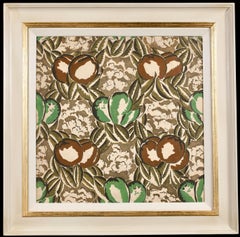
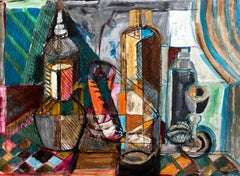
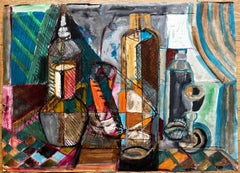
Mid Century French Cubist Still Life Bottles Glass Curtain Interior

Mid Century French Cubist Still Life Bottles Glass Curtain Interior

Located in Cirencester, Gloucestershire

Title: Mid Century French Cubist Still Life Bottles Glass Curtain Interior Medium: Gouache and mixed media on artists paper unframed Size: 20 x 27.5 inches (height x width) Provenan...

Category

20th Century French School Tea Still-life Paintings

Materials

Acrylic, Gouache, Mixed Media

Lilacs and Peonies Still-Life Gouache, Signed, Mid Century, 1969

Lilacs and Peonies Still-Life Gouache, Signed, Mid Century, 1969

By Carolyn Tyson

Located in Soquel, CA

Lilacs and Peonies, Mid Century Floral Still-Life with Pink & Purple Vibrant mid century floral still-life featuring lilacs and peonies by Carolyn Tyson (American, b-1941). This...

Category

1960s Abstract Impressionist Tea Still-life Paintings

Materials

Gouache, Paper

Projet de Tissus - Fauvist Still Life Study Gouache by Raoul Dufy

Projet de Tissus - Fauvist Still Life Study Gouache by Raoul Dufy

By Raoul Dufy

Located in Marlow, Buckinghamshire

Botanical gouache on paper circa 1920 by French fauvist painter Raoul Dufy. The work depicts a study of apples and pears. This work was executed by Dufy as a fabric design. Dimensio...

Category

1920s Fauvist Tea Still-life Paintings

Materials

Paper, Gouache

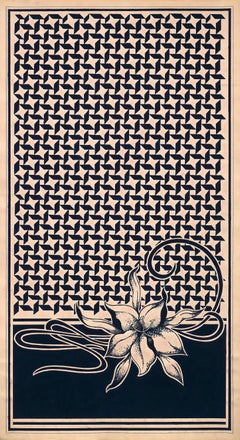
Original 70's Hand Painted Textile Design Gouache Navy Blue Color on White Paper

Original 70's Hand Painted Textile Design Gouache Navy Blue Color on White Paper

Located in ALCOY/ALCOI, ES

Compass Rose and Flower design. Sealed on the back with the design studio name and number 397 We offer a small number of these original illustration designs by this design studio ba...

Category

1970s Modern Tea Still-life Paintings

Materials

Paper, Gouache

Delicacy, Jo Haran, Original Painting, Affordable Art, Floral Artwork

Delicacy, Jo Haran, Original Painting, Affordable Art, Floral Artwork

By Jo Haran

Located in Deddington, GB

Delicacy by Jo Haran [2020] original Watercolour, gouache and gesso Image size: H:36.5 cm x W:49 cm Complete Size of Unframed Work: H:38 cm x W:50.7 cm x D:0...

Category

21st Century and Contemporary Naturalistic Tea Still-life Paintings

Materials

Gesso, Paper, Watercolor, Gouache
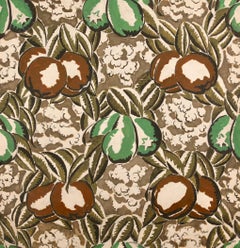
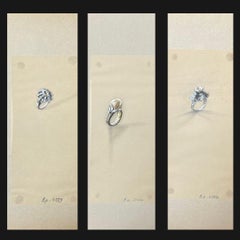
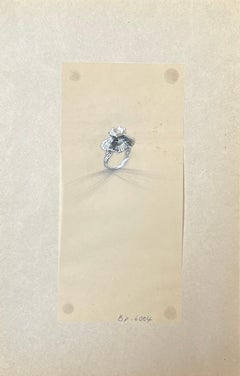
Original Parisian Vintage Jewelry Design Art by Van Cleef & Boucheron Designer

Original Parisian Vintage Jewelry Design Art by Van Cleef & Boucheron Designer

Located in Cirencester, Gloucestershire

Set of Two Silver Rings Jewelry Design circa mid 20th century by Paul Touzet (French b. 1917) original gouache painting, with pencil on tracing paper stuck on thick paper, unframed measurements: 10 x 6.5 inches condition: the overall condition is very good, minor creasing to the corners/ edges, very minor staining. provenance: private collection, France We are honored to introduce to you an incredible and unique collection of original jewelry design artwork. We have over 100 similar original works - some offered as pairs, some individually. For the collector of jewelry they offer the ultimate accessory for their home. Equally, these would look stunning framed together in a jewelry or fashion store or even a vintage bistro or hotel! Discover the timeless elegance of original French vintage jewelry design artwork by the illustrious Paul Touzet, a master jeweler whose craftsmanship has left an indelible mark on the world of haute joaillerie. Born on January 12, 1917, Touzet's journey into the art of jewelry began at the tender age of 13, training under the prestigious Mauboussin in Paris. His talent and dedication quickly set him apart, and by November 17, 1944, he had officially registered his business, soon after obtaining his hallmark—a distinctive "P.A.T. / a bicycle wheel butterfly"—on December 7, 1944. Paul Touzet's artistry is celebrated for its collaborations with iconic houses such as Van Cleef & Arpels, Boucheron, and Sterlé, reflecting the highest standards of French luxury. His exclusive designs have graced the likes of legendary figures, including the beloved singer Charles Aznavour, for whom he crafted exquisite pieces. Touzet's craftsmanship even reached royal circles, with bespoke tuxedo buttons personally delivered to Prince Rainier of Monaco and stunning jewelry designed for his wife, Princess Grace of Monaco (Grace Kelly). Each piece of Touzet's original design artwork...

Category

Mid-20th Century French School Tea Still-life Paintings

Materials

Watercolor, Gouache, Pencil

Tea still-life paintings for sale on 1stDibs.

Find a wide variety of authentic Tea still-life paintings available on 1stDibs. While artists have worked in this medium across a range of time periods, art made with this material during the 21st Century is especially popular. There are many well-known artists whose body of work includes ceramic sculptures. Popular artists on 1stDibs associated with pieces like this include and Ruby Silvious. Frequently made by artists working in the Contemporary, all of these pieces for sale are unique and many will draw the attention of guests in your home. Not every interior allows for large Tea still-life paintings, so small editions measuring 0.1 inches across are also available Prices for still-life paintings made by famous or emerging artists can differ depending on medium, time period and other attributes. On 1stDibs, the price for these items starts at $1 and tops out at $1,985,000, while the average work can sell for $2,192.