1990s Art

to
2,135
4,368
3,084
2,809
1,769
2,021
Overall Width
to
Overall Height
to
7,719
21,701
164,126
227,411
2,021
2,305
4,954
6,558
5,844
15,101
20,639
25,847
18,717
14,141
5,511
4,802
1,892
1,810
1,155
491
303
181
148
92
73
70
21
15
5
7,315
5,196
945
5,010
2,567
1,720
1,624
1,276
1,199
945
872
709
708
681
632
598
567
349
332
314
313
294
286
4,469
3,637
2,001
1,636
1,513
490
185
176
146
125
2,559
3,718
9,544
4,207
Period: 1990s
Disney: Donald Duck (custom framed hand signed serigraph)

Disney: Donald Duck (custom framed hand signed serigraph)

By Peter Max

Located in Aventura, FL

Serigraph in colors on paper. Hand signed lower right by Peter Max. Hand numbered AP 35/75 lower left (slightly faded; see pic). Sheet size: 16 x 14 inches. Custom framed as pict...

Category

Pop Art 1990s Art

Materials

Paper, Screen

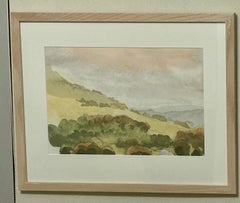
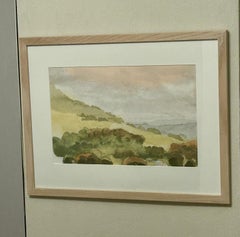
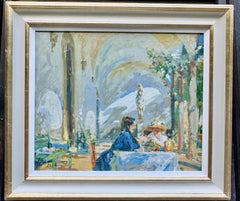
"Veduta Verso Sera" - Textured Post-Impressionist Landscape - Green Hillside

"Veduta Verso Sera" - Textured Post-Impressionist Landscape - Green Hillside

By Masri Hayssam

Located in Carmel, CA

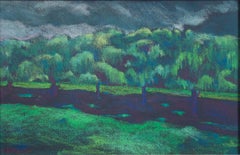
Masri Hayssam (Lebanese, Italian, born 1965) "Veduta Verso Sera" 1998 Oil paint on wood panel Signed by the artist on the bottom left corner and on the back of the painting. “Veduta Verso Sera” is a richly textured landscape, completed in 1998 during a period when the artist was deeply invested in translating lived experience into painterly structure. The title, which evokes an evening view, aligns with the work’s tonal depth and shifting sense of light rather than a fixed geographic location. The composition unfolds through vigorous, layered brushwork, with sweeping passages of green and deep blue suggesting rolling terrain as daylight recedes. Masri’s palette is punctuated by sharp accents of yellow and red, which animate the surface and introduce moments of tension within the otherwise expansive landscape. These gestures pull the viewer forward, creating a sense of movement and immediacy, as though the scene is still unfolding. About the Artist: Masri is a passionate Italian, US-based artist whose work has been exhibited in the USA, the UK, Germany, Lebanon, Italy, and Norway. His work is varied and known especially in Europe and in Major collections - Ellen DeGeneres, Ringo Starr, Al Gore, and many more. Harnessing an insatiable desire for artistic discovery, innovation, and perfection, he dives into experimentation with openness and enthusiasm. As a result, his works are bright, expansive, and bold. Masri has developed a style that captures the Middle Eastern mood with a Lucien Freud...

Category

Post-Impressionist 1990s Art

Materials

Wood Panel, Oil

"Requiem/Let Them Be, " Etching and Aquatint signed by Joan Snyder

"Requiem/Let Them Be, " Etching and Aquatint signed by Joan Snyder

By Joan Snyder

Located in Milwaukee, WI

"Requiem" is an original etching and aquatint by Joan Snyder. The artist signed the piece, and the edition is of 120. This piece features abstract, expressionist text and an striking portrait of a woman with red lipstick on a pink background. 25 5/8" x 20" art 32" x 26" frame Joan Snyder was born on April 16, 1940, in Highland Park, New Jersey. She received her AB from Douglass College in New Brunswick, New Jersey (1962), and an MFA from Rutgers University in New Brunswick, New Jersey (1966). She was the recipient of a National Endowment for the Arts Fellowship (1974) and a John Simon Guggenheim Memorial Fellowship (1983). Snyder lives in Brooklyn and Woodstock, New York. Although Snyder’s paintings are often placed under various art-movement umbrellas—Abstract...

Category

Contemporary 1990s Art

Materials

Etching, Aquatint

Woman - Original Drawing in Watercolor and China Ink - 1996

Woman - Original Drawing in Watercolor and China Ink - 1996

Located in Roma, IT

Woman is an original drawing in watercolor and China ink, realized in 1996 by an Anonymous artist of the XX century, Hand-signed and dated on the lower right, the firm is not readabl...

Category

Modern 1990s Art

Materials

Watercolor

Les Quais - Paris, France

Les Quais - Paris, France

Located in New York, NY

The work is available as Silver gelatin print, by the artist, made in the darkroom, from the original 35 mm black and white negative and in a total edition of 25. Available in 4 siz...

Category

Contemporary 1990s Art

Materials

Photographic Paper, Black and White, Silver Gelatin

Sottovuoto (Vacuum-Packed) - b/w Photograph by Plinio Martelli - 1990s

Sottovuoto (Vacuum-Packed) - b/w Photograph by Plinio Martelli - 1990s

Located in Roma, IT

Sottovuoto is a b/w photographic print realized by Plinio Martelli in the 1990s. Very good conditions. Hand signed and titled by the artist on the back of the photograph. Plinio Martelli (1945-2016) After scientific studies he graduated from the Albertina Academy of Fine Arts in Turin with masters such as Enrico Paolucci and Mario Calandri...

Category

Modern 1990s Art

Materials

Photographic Paper

Boy on Bike, Salvador, Brazil, 1998

Boy on Bike, Salvador, Brazil, 1998

By Robin Rice

Located in Hudson, NY

This listing is for the unframed photograph. The Robin Rice Gallery proudly announces SUMMERTIME Salon 2019, an annual photography exhibit featuring gallery artists as well as a fe...

Category

Contemporary 1990s Art

Materials

Digital Pigment

Jupiter

Marlene SiffJupiter, 1991

$19,800Sale Price|20% Off

Jupiter

Located in New York, NY

The wall sculpture Jupiter came about from the Vogue Magazine Virgo horoscope in September 1991, my birthday month. It stated that Jupiter was in my sign and all my wishes would come...

Category

Abstract Geometric 1990s Art

Materials

Acrylic

Méchant Méchant
Méchant Méchant

Méchant Méchant

By Niki de Saint Phalle

Located in Paris, FR

Lithograph, 1995 Edition : 173/250 Publisher : La Différence (Paris) 65.00 cm. x 105.00 cm. 25.59 in. x 41.34 in. (paper) Handsigned by the artist in pencil Certificate of authentic...

Category

Abstract 1990s Art

Materials

Lithograph

Leaving school
Leaving school

Leaving school

By Niki de Saint Phalle

Located in Paris, FR

Lithograph, 1995 Edition : 197/250 Publisher : Editions de la Différence Printer : Arti Grafiche Motta, Arese 76.00 cm. x 56.00 cm. 29.92 in. x 22.05 in. (paper) 76.00 cm. x 56.00 c...

Category

Abstract 1990s Art

Materials

Lithograph

Theimer - Galerie Di Meo - Vintage Poster 1992

Theimer - Galerie Di Meo - Vintage Poster 1992

By Ivan Theimer

Located in Roma, IT

Theimer - Galerie Di Meo is a vintage poster. This artwork was realized in occasion of the exhibition by Ivan Theimer held at Galerie Di Meo in Paris in 1992. Ivan Theimer (Olomou...

Category

1990s Art

Materials

Offset

Arembepe Palms #2, Bahia, Salvador, Brazil, 1998

Arembepe Palms #2, Bahia, Salvador, Brazil, 1998

By Robin Rice

Located in Hudson, NY

Listing is for UNFRAMED print. Inquire within for framing. Edition 1 of 25 After 30 years on West 11th Street, The Robin Rice Gallery celebrates its first ever exhibition for Robin...

Category

Contemporary 1990s Art

Materials

Archival Pigment

Spring

Spring

By Todd Burris

Located in Hudson, NY

Listing is for UNFRAMED print. Inquire within for framing. Edition of 1 of 25 Any framed photographs purchased during the show will be available after May 8th. If the exhibitio...

Category

Contemporary 1990s Art

Materials

Archival Ink, Archival Paper

PONT NEUF LE SOIR Signed Lithograph Paris Night Scene Historic Bridge, Moon Boat

PONT NEUF LE SOIR Signed Lithograph Paris Night Scene Historic Bridge, Moon Boat

By Michel Delacroix

Located in Union City, NJ

Pont Neuf Le Soir is a hand drawn, limited edition lithograph(not a photo reproduction or digital print) printed using hand lithography techniques on archival Arches paper by the popular French artist Michel Delacroix, well known for his naif style paintings of a city he calls "the Paris of then". Pont Neuf Le Soir is a dramatic Paris night scene depicted with a deep gray blue moonlit evening sky as a backdrop for the oldest historic Paris bridge crossing the River Seine - the Pont Neuf. In the foreground, a nostalgic street scene of people in Victorian dress strolling beneath the glowing lampposts; women with a baby carriage, flowers, children, small dog, and a black tugboat billowing smoke heading up river toward a rosy...

Category

Contemporary 1990s Art

Materials

Lithograph

La Petite Femme Chere - Signed Silkscreen Print - Blue Dog

La Petite Femme Chere - Signed Silkscreen Print - Blue Dog

By George Rodrigue

Located in Mount Laurel, NJ

This Blue Dog work consists of a single dog sitting in the middle of a pure white background. The dog has soulful yellow eyes. This pop art animal original silkscreen print on paper is hand signed by the artist. Artist: George Rodrigue Title: Blue Dog “La Petite Femme...

Category

Pop Art 1990s Art

Materials

Screen

Primitive American Landscape Oil Painting: The Four Seasons, 1990s

Primitive American Landscape Oil Painting: The Four Seasons, 1990s

Located in Douglas Manor, NY

5006 Primative American landscape oil on canvas of the four seasons Framed signed Al Ledesky on verso

Category

1990s Art

Materials

Oil

Foot Musik

Foot Musik

By Roberto Matta

Located in Östermalm, Stockholms län

Artwork size: 56 x 58 cm. Frame size: 76 x 78 cm. Free shipment worldwide. Archive number (P90/36) Acquired directly from the artist. “The heart is an eye,” writes Nobel laureate Octavio Paz in an essay on Matta’s paintings. Matta creates a world coloured both by a sunny faith in the future and by visions of impending doom. Roberto Sebastian Echaurren Antonio Matta, who died aged 91 on 23 November 2002, was born in Santiago, Chile, on 11 November 1911 into a family with Spanish, French and Basque roots, and raised in an atmosphere of religiosity. By the age of 21 he had graduated and begun work as an architect, but his leisure time he devoted to sketching and painting. In 1933 he travelled to Europe for the first time, visiting Greece, Yugoslavia, Italy and other countries, and subsequently taking the initiative to collaborate with the architect, Le Corbusier. As time passed, however, Matta’s enthusiasm for a career in architecture waned, and he began to devote himself full-time to art, making early acquaintances with surrealists such as Max Ernst, Salvador Dalí, André Breton and others. Between 1939 and 1948 Matta, like many of his artistic contemporaries, lived in self-imposed exile in the USA, but, after almost 10 years’ absence from Europe, he returned to make first Rome and then, a few years later, Paris his home. Throughout most of the rest of his life Matta commuted between his studio in Paris and his creative refuge in the monastery outside Rome. And it is here, in Italy, that he produced his greatest paintings. Matta’s first retrospective in Sweden was organised in 1956 when his works were exhibited in what was then Galerie Colibri – run by, among others, the artist C O Hultén at number 36 Södra Förstadsgatan in Malmö, Sweden. This was also the time when Matta began to collaborate with poets and other artists in Sweden. He produced the illustrations for Lasse Söderberg’s first anthology of poems, Akrobaterna (“The Acrobats”), published in 1955, and was also responsible for the cover of the Swedish art and literary magazine Salamander. In 1959 the first museum exhibition of Matta’s work in Europe was arranged at the Museum of Modern Art (Moderna Museet) in Stockholm. Held under the aegis of Pontus Hultén, it was entitled “Fifteen Forms of Doubt” and included 15 or so gigantic paintings...

Category

Surrealist 1990s Art
Materials

Mixed Media

Park XVI (Berlin artist, Postwar, Contemporary, Abstract vs Figurative)

Park XVI (Berlin artist, Postwar, Contemporary, Abstract vs Figurative)

Located in Kansas City, MO

Barbara Keidel Park XVI Mixed media, pastel on handmade, toned laid paper 1997 Size: 29.5 × 21.25 inches (75 × 54 cm) Signed and dated in pencil Additionally hand-signed, dated, tit...

Category

Contemporary 1990s Art

Materials

Pastel, Mixed Media, Laid Paper

Untitled, two prints (Schellmann 267-269)

Untitled, two prints (Schellmann 267-269)

By Donald Judd

Located in Miami, FL

Donald Judd (June 3, 1928 – February 12, 1994, American) Untitled, two prints (Schellmann 267-269) 1992-93 Two woodcuts in orange and purple on Echizen kozo paper 23 x 31 in. each Ed...

Category

Minimalist 1990s Art

Materials

Woodcut

Ross Bleckner, Dome (Grey)

Ross Bleckner, Dome (Grey)

By Ross Bleckner

Located in New York, NY

Dome, Blue, 2017 Archival pigment inks on Crane Museo Max 365 gsm fine art paper 37 x 34 inches (94 x 86 cm) Edition of 40 Suite of 3 also available for $7500 Ross Bleckner is an i...

Category

Contemporary 1990s Art

Materials

Archival Ink

"The Magnificent Seven" Aaron Bohrod, Pun Humor, Magic Realism, Numbers, Text

"The Magnificent Seven" Aaron Bohrod, Pun Humor, Magic Realism, Numbers, Text

By Aaron Bohrod

Located in New York, NY

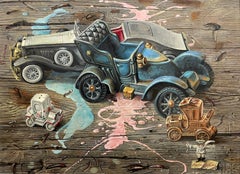
Aaron Bohrod The Magnificent Seven, 1990 Signed lower right Oil on gesso panel 11 x 14 inches Aaron Bohrod's work has not been limited to one style or medium. Initially recognized as a regionalist painter of American scenes, particularly of his native Chicago, Bohrod later devoted himself to detailed still-life paintings rendered in the trompe l'oeil style. He also worked for several years in ceramics and wrote a book on pottery. Born in 1907, Bohrod began his studies at Chicago's Crane Junior College in 1925, and two years later enrolled in the Art Institute of Chicago. But it was at the Art Students League in New York City, from 1930 to 1932, that he studied under the man believed to be his most significant early influence, John Sloan. Sloan's romantic realism is reflected in the many depictions of Chicago life...

Category

Realist 1990s Art
Materials

Oil, Board

Think Different Poster Apple Computer Original 1998 - Martha Graham

Think Different Poster Apple Computer Original 1998 - Martha Graham

Located in Boca Raton, FL

Steve Jobs had just returned to the struggling company, Apple Computer in 1997. Jobs and Lee Clow had collaborated back in 1984 to launch the MacIntosh. Now was the time to recover t...

Category

1990s Art

Materials

Lithograph

Gordon and Duke

Gordon and Duke

By Theodore Waddell

Located in Bozeman, MT

Waddell's paintings are a combination of rough marks, thick paint, transparent elegant strokes, and, on a few occasions a slow, hard line scratched into the canvas. You can feel the ...

Category

Contemporary 1990s Art

Materials

Canvas, Encaustic, Oil

Untitled
Untitled

Untitled

By Geoff Rees

Located in Vancouver, CA

Geoff Rees (1930–2018) A Modernist Voice of the West Coast Geoff Rees was a defining figure in Western Canadian abstraction, known for paintings that balance radiant colour, medita...

Category

Abstract 1990s Art

Materials

Canvas, Acrylic

Untitled (Abstraction)

Untitled (Abstraction)

By Jack Roth

Located in Astoria, NY

Jack Roth (American, 1927-2004), Untitled, Acrylic on Canvas, 1994, signed and dated "Roth 94" lower right, estate stamp and marked "JR-4288" verso, unframed. 36" H x 36.25" W x 1" ...

Category

Abstract 1990s Art

Materials

Canvas, Acrylic

Metamorphosis, Figurative Abstraction, Modernist Abstract, 1995

Metamorphosis, Figurative Abstraction, Modernist Abstract, 1995

By Ray Leight

Located in Doylestown, PA

"Metamorphosis" is a 40" x 26" acrylic on paper abstract painting by American painter Ray Leight. The painting is in original condition, from the estate of the artist, and it is sign...

Category

Abstract 1990s Art

Materials

Paper, Acrylic

Untitled

Untitled

By Andrew Spence

Located in New York, NY

Untitled 1999 Signed, dated, and numbered in pencil, recto Iris print (Edition of 100) 22 x 30 inches (55.9 x 76.2 cm), sheet 18 x 19.75 inches (45.7 x 50.2 cm), image This work ...

Category

Contemporary 1990s Art

Materials

Digital

Christo - The Wrapped Reichstag at Night, offset lithograph poster, plate signed

Christo - The Wrapped Reichstag at Night, offset lithograph poster, plate signed

By Christo and Jeanne-Claude

Located in New York, NY

Christo The Wrapped Reichstag at Night, 1993 Offset Lithograph Plate signed (printed signature) by Christo on lower right front 40 × 25 1/2 inches Unframed and affixed to matting (a...

Category

Pop Art 1990s Art

Materials

Lithograph, Offset

Untitled 111
Untitled 111

Untitled 111

By Richard Caldicott

Located in London, GB

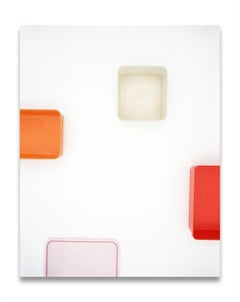
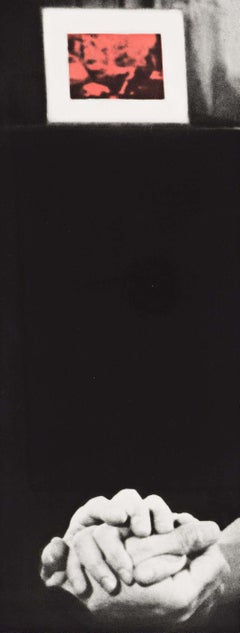
C Print. Unframed. Richard Caldicott is most well known for this earlier work series which used Tupperware containers as the subject for his photographs. As he describes: "Tupperwa...

Category

Minimalist 1990s Art
Materials

C Print

"India, " Abstract Woodcut and Monotype signed by Carol Summers

"India, " Abstract Woodcut and Monotype signed by Carol Summers

By Carol Summers

Located in Milwaukee, WI

"India" is a woodcut and monotype signed by Carol Summers. Here, Summer's abstract language for landscape imagery is taken to its most extreme: The image offers a view of a highly stylized waterfall, with red water falling down behind green foliage below. A hint of light blue at the lower left suggests a continuation of the water's flow. Above, purples and yellows mist upward from the power of the water. The playfulness of the image is enhanced by Summers' signature printmaking technique, which allows the ink from the woodblock to seep through the paper, blurring the edges of each form. Summers' signature can be found in pencil at the bottom of the rightmost blue form, with the title and edition at the bottom of the leftmost blue form. A copy of this print can be found in the collection of the Fine Arts Museums of San Francisco. 37.25 x 24.88 inches, artwork 48.5 x 35.5 inches, frame Numbered 44 from the edition of 75 Carol Summers (1925-2016) has worked as an artist throughout the second half of the 20th century and into the first years of the next, outliving most of his mid-century modernist peers. Initially trained as a painter, Summers was drawn to color woodcuts around 1950 and it became his specialty thereafter. Over the years he has developed a process and style that is both innovative and readily recognizable. His art is known for it’s large scale, saturated fields of bold color, semi-abstract treatment of landscapes from around the world and a luminescent quality achieved through a printmaking process he invented. In a career that has extended over half a century, Summers has hand-pulled approximately 245 woodcuts in editions that have typically run from 25 to 100 in number. His talent was both inherited and learned. Born in 1925 in Kingston, a small town in upstate New York, Summers was raised in nearby Woodstock with his older sister, Mary. His parents were both artists who had met in art school in St. Louis. During the Great Depression, when Carol was growing up, his father supported the family as a medical illustrator until he could return to painting. His mother was a watercolorist and also quite knowledgeable about the different kinds of papers used for various kinds of painting. Many years later, Summers would paint or print on thinly textured paper originally collected by his mother. From 1948 to 1951, Carol Summers trained in the classical fine and studio arts at Bard College and at the Art Students League of New York. He studied painting with Steven Hirsh and printmaking with Louis Schanker. He admired the shapes and colors favored by early modernists Paul Klee (Sw: 1879-1940) and Matt Phillips (Am: b.1927- ). After graduating, Summers quit working as a part-time carpenter and cabinetmaker (which had supported his schooling and living expenses) to focus fulltime on art. That same year, an early abstract, Bridge No. 1 was selected for a Purchase Prize in a competition sponsored by the Brooklyn Museum. In 1952, his work (Cathedral, Construction and Icarus) was shown the first time at the Museum of Modern Art in New York City in an exhibition of American woodcuts. In 1954, Summers received a grant from the Italian government to study for a year in Italy. Woodcuts completed soon after his arrival there were almost all editions of only 8 to 25 prints, small in size, architectural in content and black and white in color. The most well-known are Siennese Landscape and Little Landscape, which depicted the area near where he resided. Summers extended this trip three more years, a decision which would have significant impact on choices of subject matter and color in the coming decade. After returning from Europe, Summers’ images continued to feature historical landmarks and events from Italy as well as from France, Spain and Greece. However, as evidenced in Aetna’s Dream, Worldwind and Arch of Triumph, a new look prevailed. These woodcuts were larger in size and in color. Some incorporated metal leaf in the creation of a collage and Summers even experimented with silkscreening. Editions were now between 20 and 50 prints in number. Most importantly, Summers employed his rubbing technique for the first time in the creation of Fantastic Garden in late 1957. Dark Vision of Xerxes, a benchmark for Summers, was the first woodcut where Summers experimented using mineral spirits as part of his printmaking process. A Fulbright Grant as well as Fellowships from the Louis Comfort Tiffany Foundation and the Guggenheim Foundation followed soon thereafter, as did faculty positions at colleges and universities primarily in New York and Pennsylvania. During this period he married a dancer named Elaine Smithers with whom he had one son, Kyle. Around this same time, along with fellow artist Leonard Baskin, Summers pioneered what is now referred to as the “monumental” woodcut. This term was coined in the early 1960s to denote woodcuts that were dramatically bigger than those previously created in earlier years, ones that were limited in size mostly by the size of small hand-presses. While Baskin chose figurative subject matter, serious in nature and rendered with thick, striated lines, Summers rendered much less somber images preferring to emphasize shape and color; his subject matter approached abstraction but was always firmly rooted in the landscape. In addition to working in this new, larger scale, Summers simultaneously refined a printmaking process which would eventually be called the “Carol Summers Method” or the “ Carol Summers Technique”. Summers produces his woodcuts by hand, usually from one or more blocks of quarter-inch pine, using oil-based printing inks and porous mulberry papers. His woodcuts reveal a sensitivity to wood especially its absorptive qualities and the subtleties of the grain. In several of his woodcuts throughout his career he has used the undulating, grainy patterns of a large wood plank to portray a flowing river or tumbling waterfall. The best examples of this are Dream, done in 1965 and the later Flash Flood Escalante, in 2003. In the majority of his woodcuts, Summers makes the blocks slightly larger than the paper so the image and color will bleed off the edge. Before printing, he centers a dry sheet of paper over the top of the cut wood block or blocks, securing it with giant clips. Then he rolls the ink directly on the front of the sheet of paper and pressing down onto the dry wood block or reassembled group of blocks. Summers is technically very proficient; the inks are thoroughly saturated onto the surface of the paper but they do not run into each other. The precision of the color inking in Constantine’s Dream in 1969 and Rainbow Glacier in 1970 has been referred to in various studio handbooks. Summers refers to his own printing technique as “rubbing”. In traditional woodcut printing, including the Japanese method, the ink is applied directly onto the block. However, by following his own method, Summers has avoided the mirror-reversed image of a conventional print and it has given him the control over the precise amount of ink that he wants on the paper. After the ink is applied to the front of the paper, Summers sprays it with mineral spirits, which act as a thinning agent. The absorptive fibers of the paper draw the thinned ink away from the surface softening the shapes and diffusing and muting the colors. This produces a unique glow that is a hallmark of the Summers printmaking technique. Unlike the works of other color field artists or modernists of the time, this new technique made Summers’ extreme simplification and flat color areas anything but hard-edged or coldly impersonal. By the 1960s, Summers had developed a personal way of coloring and printing and was not afraid of hard work, doing the cutting, inking and pulling himself. In 1964, at the age of 38, Summers’ work was exhibited for a second time at the Museum of Modern Art. This time his work was featured in a one-man show and then as one of MoMA’s two-year traveling exhibitions which toured throughout the United States. In subsequent years, Summers’ works would be exhibited and acquired for the permanent collections of multiple museums throughout the United States, Europe and Asia. Summers’ familiarity with landscapes throughout the world is firsthand. As a navigator-bombardier in the Marines in World War II, he toured the South Pacific and Asia. Following college, travel in Europe and subsequent teaching positions, in 1972, after 47 years on the East Coast, Carol Summers moved permanently to Bonny Doon in the Santa Cruz Mountains in Northern California. There met his second wife, Joan Ward Toth, a textile artist who died in 1998; and it was here his second son, Ethan was born. During the years that followed this relocation, Summers’ choice of subject matter became more diverse although it retained the positive, mostly life-affirming quality that had existed from the beginning. Images now included moons, comets, both sunny and starry skies, hearts and flowers, all of which, in one way or another, remained tied to the landscape. In the 1980s, from his home and studio in the Santa Cruz mountains, Summers continued to work as an artist supplementing his income by conducting classes and workshops at universities in California and Oregon as well as throughout the Mid and Southwest. He also traveled extensively during this period hiking and camping, often for weeks at a time, throughout the western United States and Canada. Throughout the decade it was not unusual for Summers to backpack alone or with a fellow artist into mountains or back country for six weeks or more at a time. Not surprisingly, the artwork created during this period rarely departed from images of the land, sea and sky. Summers rendered these landscapes in a more representational style than before, however he always kept them somewhat abstract by mixing geometric shapes with organic shapes, irregular in outline. Some of his most critically acknowledged work was created during this period including First Rain, 1985 and The Rolling Sea, 1989. Summers received an honorary doctorate from his alma mater, Bard College in 1979 and was selected by the United States Information Agency to spend a year conducting painting and printmaking workshops at universities throughout India. Since that original sabbatical, he has returned every year, spending four to eight weeks traveling throughout that country. In the 1990s, interspersed with these journeys to India have been additional treks to the back roads and high country areas of Mexico, Central America, Nepal, China and Japan. Travel to these exotic and faraway places had a profound influence on Summers’ art. Subject matter became more worldly and nonwestern as with From Humla to Dolpo, 1991 or A Former Life of Budha, 1996, for example. Architectural images, such as The Pillars of Hercules, 1990 or The Raja’s Aviary, 1992 became more common. Still life images made a reappearance with Jungle Bouquet in 1997. This was also a period when Summers began using odd-sized paper to further the impact of an image. The 1996 Night, a view of the earth and horizon as it might be seen by an astronaut, is over six feet long and only slightly more than a foot-and-a-half high. From 1999, Revuelta A Vida (Spanish for “Return to Life”) is pie-shaped and covers nearly 18 cubic feet. It was also at this juncture that Summers began to experiment with a somewhat different palette although he retained his love of saturated colors. The 2003 Far Side of Time is a superb example of the new direction taken by this colorist. At the turn of the millennium in 1999, “Carol Summers Woodcuts...

Category

Contemporary 1990s Art
Materials

Monotype, Woodcut