Want more images or videos?
Request additional images or videos from the seller
1 of 6
Malvina HoffmanMongolian Dancer bronze sculpture by Malvina Hoffman1932
1932
Price:$15,209.83
$21,000List Price
About the Item
- Creator:Malvina Hoffman (1887 - 1966, American)
- Creation Year:1932
- Dimensions:Height: 20.25 in (51.44 cm)Width: 15 in (38.1 cm)Depth: 6 in (15.24 cm)
- Medium:
- Movement & Style:
- Period:
- Condition:This piece is in very good condition, retaining its original untouched patina.
- Gallery Location:Hudson, NY
- Reference Number:1stDibs: LU2465212130012
About the Seller
5.0
Vetted Professional Seller
Every seller passes strict standards for authenticity and reliability
Established in 1973
1stDibs seller since 2023
14 sales on 1stDibs
Authenticity Guarantee
In the unlikely event there’s an issue with an item’s authenticity, contact us within 1 year for a full refund. DetailsMoney-Back Guarantee
If your item is not as described, is damaged in transit, or does not arrive, contact us within 7 days for a full refund. Details24-Hour Cancellation
You have a 24-hour grace period in which to reconsider your purchase, with no questions asked.Vetted Professional Sellers
Our world-class sellers must adhere to strict standards for service and quality, maintaining the integrity of our listings.Price-Match Guarantee
If you find that a seller listed the same item for a lower price elsewhere, we’ll match it.Trusted Global Delivery
Our best-in-class carrier network provides specialized shipping options worldwide, including custom delivery.You May Also Like
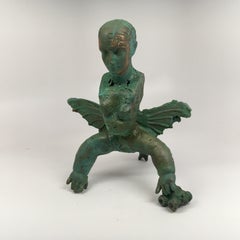
Modern Bronze Relic Sculpture of figure with 3 legs: 'Rhoman Fertility Goddess'
By Joshua Goode
Located in New York, NY
Inspired by amateur archaeologists such as Heinrich Schliemann who discovered Troy and by past elaborate hoaxes like that of the Piltdown Man, Joshua travels the world performing sta...
Category
2010s American Modern Figurative Sculptures
Materials
Bronze
$2,250
H 10 in W 9 in D 7 in
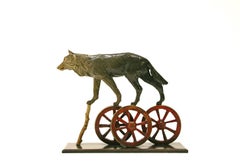
Renegade
By Brad Rude
Located in Bozeman, MT
Ed. 3/6
Artist Brad Rude was born in Montana and has lived in Walla Walla, Washington most of his life. His journeys through his grandfather's folk art st...
Category
2010s American Modern Figurative Sculptures
Materials
Bronze, Enamel
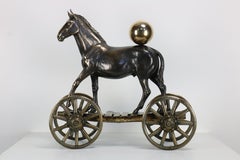
Show of Interest
By Brad Rude
Located in Bozeman, MT
Artist Brad Rude was born in Montana and has lived in Walla Walla, Washington most of his life. His journeys through his grandfather's folk art studio left...
Category
2010s American Modern Figurative Sculptures
Materials
Bronze, Enamel
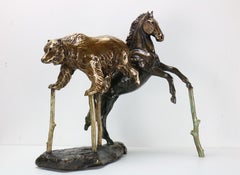
Combined Effort
By Brad Rude
Located in Bozeman, MT
Artist Brad Rude was born in Montana and has lived in Walla Walla, Washington most of his life. His journeys through his grandfather's folk art studio left...
Category
2010s American Modern Figurative Sculptures
Materials
Bronze, Enamel
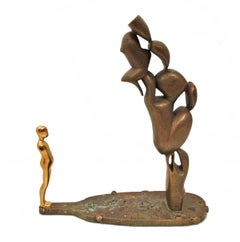
Falling Man and Form
By Ernest Tino Trova
Located in Missouri, MO
Ernest Tino Trova
"Falling Man and Form" 1996
Brass and Bronze
14 x 4.5 x 4.5 inches
Signed and Numbered 1/1 (Unique)
Known for his Falling Man series in...
Category
1990s American Modern Figurative Sculptures
Materials
Brass, Bronze
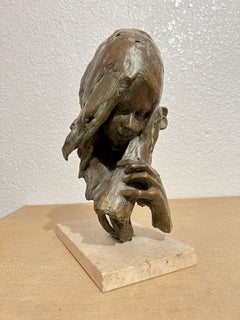
Bronze Sculpture American Modernist Art Stanley Bleifeld Girl with Bass or Cello
By Stanley Bleifeld
Located in Surfside, FL
Retaining a fine patina and in overall good condition.
Signed with initials SB.
I believe the edition size was 7 But I cannot find a mark.
Stanley Bleifeld (1924 – 2011) was an American sculptor.
Stanley Bleifeld was born and raised in Brooklyn, New York, Bleifeld earned bachelor of fine arts, bachelor of science in education and in 1949 a master of fine arts degree in painting at Tyler School of Art of Temple University. After a trip to Rome in 1959 or 1960 he gave up painting for sculpture. He began his fine-art career as a painter. However, a visit to Italy and exposure to the bronzes of Donatello, Michelangelo, and Ghiberti changed his direction He worked with the Art Foundry of Massimo del Chiaro and alongside artists such as Lucchesi, Harry Marinsky, Fernando Botero, Igor Mitoraj and Ivan Theimer. Many of his early pieces were religious subjects, and reflected both painting and sculptural techniques in bas reliefs* that had "liquid landscapes in undulating reliefs and free-flowing portraits reminiscent of classical fragments" (166-167). He later turned from these abstract pieces to more realistic figures in bronze.
Bleifeld was a National Academician in Sculpture, and a member of the National Academy of Design, and helped set policy for that organization. He was also President of the National Sculpture Society. Past presidents of the society have included John Quincy Adams Ward, James Earle Fraser, Chester Beach, Wheeler Williams, Leo Friedlander, Neil Estern, and Cecil de Blaquiere Howard. The first woman to gain admission into the NSS was Theo Alice Ruggles Kitson, in 1893. She was followed a few years later by Enid Yandell and Bessie Potter Vonnoh in 1898; Janet Scudder in 1904; Anna Hyatt Huntington in 1905 and Evelyn Longman and Abastenia St. Leger Eberle in 1906. In 1946, Richmond Barthé was likely the first African-American to be admitted.
In 1994, the NSS held their first exhibition outside the United States at the Palazzo Mediceo Di Seravezza in Italy. Titled “100 Years of the National Sculpture Society of the United States of America in Italy” it ran from the 16th of July through the 4th of September and was curated by Nicky and Stanley Bleifeld along with Costantino Paolicchi, Lodovico Gierut and Paolo Giorgi. Among the 60 notable American sculptors whose work was selected for the exhibition were Stanley Bleifeld, Andrew DeVries, Neil Estern, Leonda Finke...
Category
1970s American Modern Figurative Sculptures
Materials
Bronze
$5,500
H 12 in W 7 in D 6 in
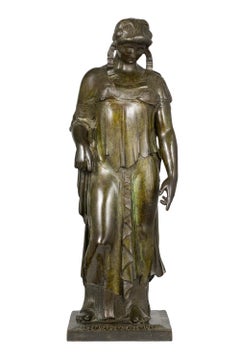
Female Warrior
Located in New York, NY
A very unique bronze that touches upon the classic, female strength in form and the details beaux arts style in America. A work that really is for a collector and to be put in a spo...
Category
1910s American Modern Figurative Sculptures
Materials
Bronze
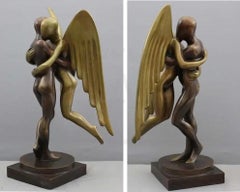
Mark Kostabi - Divine Embrace - Bronze Sculpture
By Mark Kostabi
Located in Winterswijk, NL
Mark Kostabi - Divine Embrace - Bronze sculpture
Divine Embrace is a unique bronze sculpture by renowned artist Mark Kostabi, featuring two faceless figures in an intimate embrace...
Category
21st Century and Contemporary American Modern Figurative Sculptures
Materials
Bronze
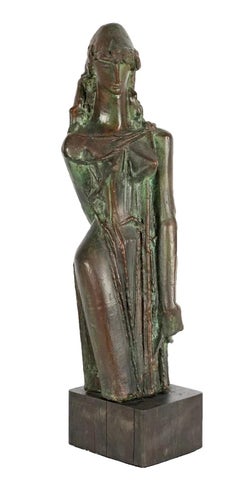
"Naomi" Mid 20th Century American Bronze Sculpture Female Portrait Figurative
Located in New York, NY
"Naomi" Mid 20th Century American Bronze Sculpture Female Portrait Figurative
Albert W. Wein (1915-1991)
"Naomi"
Bronze, c. 1960s
Signed
Figure: 19 1/2 x 5 1/2 x 5 inches
Overall he...
Category
1960s American Modern Figurative Sculptures
Materials
Bronze
$15,000
H 23 in W 5 in D 5 in
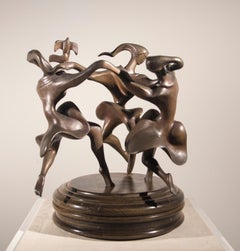
Joie De Vivre, bronze figurative dance sculpture
Located in New York, NY
This joyous in the round bronze can turn on its base, making for dramatic presentation and enjoyment that is interactive. It is based on the idea of the Three Graces which is often an allegorical subject in sculpture. Wein has done a contemporary feeling interpretation of this classic theme. Piece itself measure 12 1/2 inches and sits on a 3 1/4 inch base and is attached to its base at two points and it is a revolving or rather turning base. The two points on which the toes touch and are secured are striking for how little of the bronze touches the base. It is Fourth in an edition of 13. Albert Wein...
Category
Mid-20th Century American Modern Figurative Sculptures
Materials
Bronze
More From This Seller
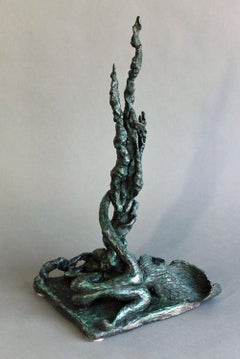
View AllWoman Lying Down & Growing with Tree bronze sculpture by Yulla Lipchitz
Located in Hudson, NY
Organic, abstract bronze sculpture by Yulla Lipchitz of a woman lying down with a tree.
About this artist: Yulla Lipchitz, née Halberstadt, was born on April 21, 1911 in Berlin, Ge...
Category
1970s Modern Figurative Sculptures
Materials
Bronze
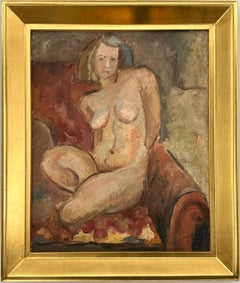
The Artist's Wife oil painting by Hans Burkhardt
By Hans Burkhardt
Located in Hudson, NY
Hans Burkhardt
The Artist's Wife (1930)
Oil on canvas, 20" x 16"
24" x 20 ½" x 1 ½" framed
Dated 1930 lower right recto. Annotated "To Elsa HB Louise Burkhardt 1930. HB" verso.
...
Category
1930s American Modern Nude Paintings
Materials
Canvas, Oil
Untitled-055 Pastel Figure by Hans Burkhardt
By Hans Burkhardt
Located in Hudson, NY
Hans Burkhardt frequently used live models for his figural pastels, which he maintained an interest in throughout his long career.
Untitled (1972)
Pastel on paper
25" x 20"
Signed a...
Category
1670s American Modern Figurative Drawings and Watercolors
Materials
Paper, Pastel
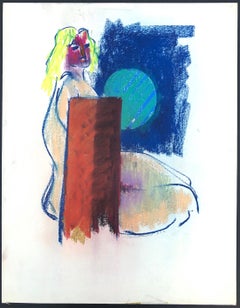
Inevitable Day – Birth of the Atom oil and tempera painting by Julio De Diego
By Julio de Diego
Located in Hudson, NY
Julio De Diego’s Atomic Series paintings made an extraordinary statement regarding the shock and fear that accompanied the dawn of the nuclear age. In the artist’s own words, “Scientists were working secretly to develop formidable powers taken from the mysterious depths of the earth - with the power to make the earth useless! Then, the EXPLOSION! . . . we entered the Atomic Age, and from there the neo-Atomic war begins. Explosions fell everywhere and man kept on fighting, discovering he could fight without flesh.”
To execute these works, De Diego developed a technique of using tempera underpainting before applying layer upon layer of pigmented oil glazes. The result is paintings with surfaces which were described as “bonelike” in quality. The forms seem to float freely, creating a three-dimensional visual effect. In the 1954 book The Modern Renaissance in American Art, author Ralph Pearson summarizes the series as “a fantastic interpretation of a weighty theme. Perhaps it is well to let fantasy and irony appear to lighten the devastating impact. By inverse action, they may in fact increase its weight.”
Bibliography
Art in America, April 1951, p.78
About this artists: Julio De Diego crafted a formidable persona within the artistic developments and political struggles of his time. The artist characterized his own work as “lyrical,” explaining, “through the years, the surrealists, the social-conscious painters and the others tried to adopt me, but I went my own way, good, bad or indifferent.” [1] His independence manifested early in life when de Diego left his parent’s home in Madrid, Spain, in adolescence following his father’s attempts to curtail his artistic aspirations. At the age of fifteen he held his first exhibition, set up within a gambling casino. He managed to acquire an apprenticeship in a studio producing scenery for Madrid’s operas, but moved from behind the curtains to the stage, trying his hand at acting and performing as an extra in the Ballet Russes’ Petrouchka with Nijinsky. He spent several years in the Spanish army, including a six-month stretch in the Rif War of 1920 in Northern Africa. His artistic career pushed ahead as he set off for Paris and became familiar with modernism’s forays into abstraction, surrealism, and cubism.
The artist arrived in the U.S. in 1924 and settled in Chicago two years later. He established himself with a commission for the decoration of two chapels in St. Gregory’s Church. He also worked in fashion illustration, designed magazine covers and developed a popular laundry bag for the Hotel Sherman. De Diego began exhibiting through the Art Institute of Chicago in 1929, and participated in the annual Chicago Artists Exhibitions, Annual American Exhibitions, and International Water Color Exhibitions. He held a solo exhibition at the Art Institute of Chicago in the summer of 1935. Though the artist’s career was advancing, his family life had deteriorated. In 1932 his first marriage dissolved, and the couple’s young daughter Kiriki was sent to live with friend Paul Hoffman.
De Diego continued to develop his artistic vocabulary with a growing interest in Mexican art. He traveled throughout the country acquainting himself with the works of muralists such as Carlos Merida, and also began a collection of small native artifacts...
Category
1940s American Modern Abstract Paintings
Materials
Masonite, Oil, Tempera
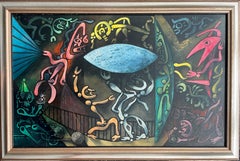
The Magician oil and tempera painting by Julio de Diego
By Julio de Diego
Located in Hudson, NY
Julio De Diego’s Atomic Series paintings made an extraordinary statement regarding the shock and fear that accompanied the dawn of the nuclear age. In the artist’s own words, “Scientists were working secretly to develop formidable powers taken from the mysterious depths of the earth - with the power to make the earth useless! Then, the EXPLOSION! . . . we entered the Atomic Age, and from there the neo-Atomic war begins. Explosions fell everywhere and man kept on fighting, discovering he could fight without flesh.”
To execute these works, De Diego developed a technique of using tempera underpainting before applying layer upon layer of pigmented oil glazes. The result is paintings with surfaces which were described as “bonelike” in quality. The forms seem to float freely, creating a three-dimensional visual effect. In the 1954 book The Modern Renaissance in American Art, author Ralph Pearson summarizes the series as “a fantastic interpretation of a weighty theme. Perhaps it is well to let fantasy and irony appear to lighten the devastating impact. By inverse action, they may in fact increase its weight.”
Exhibited
1964 Marion Koogler McNay Art Institute, San Antonio, Texas
This work retains its original frame which measures 54" x 42" x 2"
About this artist: Julio De Diego crafted a formidable persona within the artistic developments and political struggles of his time. The artist characterized his own work as “lyrical,” explaining, “through the years, the surrealists, the social-conscious painters and the others tried to adopt me, but I went my own way, good, bad or indifferent.” [1] His independence manifested early in life when de Diego left his parent’s home in Madrid, Spain, in adolescence following his father’s attempts to curtail his artistic aspirations. At the age of fifteen he held his first exhibition, set up within a gambling casino. He managed to acquire an apprenticeship in a studio producing scenery for Madrid’s operas, but moved from behind the curtains to the stage, trying his hand at acting and performing as an extra in the Ballet Russes’ Petrouchka with Nijinsky. He spent several years in the Spanish army, including a six-month stretch in the Rif War of 1920 in Northern Africa. His artistic career pushed ahead as he set off for Paris and became familiar with modernism’s forays into abstraction, surrealism, and cubism.
The artist arrived in the U.S. in 1924 and settled in Chicago two years later. He established himself with a commission for the decoration of two chapels in St. Gregory’s Church. He also worked in fashion illustration, designed magazine covers and developed a popular laundry bag for the Hotel Sherman. De Diego began exhibiting through the Art Institute of Chicago in 1929, and participated in the annual Chicago Artists Exhibitions, Annual American Exhibitions, and International Water Color Exhibitions. He held a solo exhibition at the Art Institute of Chicago in the summer of 1935. Though the artist’s career was advancing, his family life had deteriorated. In 1932 his first marriage dissolved, and the couple’s young daughter Kiriki was sent to live with friend Paul Hoffman.
De Diego continued to develop his artistic vocabulary with a growing interest in Mexican art. He traveled throughout the country acquainting himself with the works of muralists such as Carlos Merida, and also began a collection of small native artifacts...
Category
1940s American Modern Abstract Paintings
Materials
Masonite, Oil, Tempera
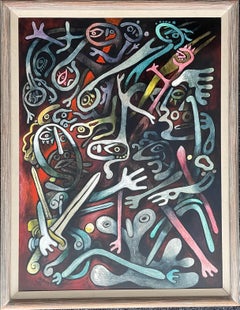
The Artist's Studio oil painting by Jacob El Hanani
By Jacob El Hanani
Located in Hudson, NY
This 1983 El Hanani oil painting comes from the estate of Anita Rosen. The overall artwork size is 15" x 15" with the central image area measures 9" x 9".
Category
1980s American Modern Interior Paintings
Materials
Canvas, Oil
Still Thinking About These?
All Recently ViewedMore Ways To Browse
Cellini Bronze
Guitarist Sculpture
Harden Sculpture
Herbert Haseltine
Howling Wolf
Indiana Hope Sculpture
Indoor Tree Sculpture
Jacqueline Picasso Ceramic
Jiang Tie Feng Sculpture
Jimmie Martin
Joseph Ndandarika
Julie Jaler
Kaws Resting
Klein Blue Sculpture
Kurt Weiser
Leonard Baskin Bronze Sculpture
Leonard Baskin Bronze
Lolly Pop