Jugendstil Figurative Sculptures

to
2
5
8
6
1
Overall Width
to
Overall Height
to
9
11
1
1
5,147
858
580
290
189
90
89
74
41
19
15
8
5
3
19
19
18
14
12
10
4
1
1
1
1
19
19
2
1
1
1
1
20
Style: Jugendstil
Seifert, Victor Heinrich. 1870 Wien - 1953 Berlin “Young athlete with slingshot”

Seifert, Victor Heinrich. 1870 Wien - 1953 Berlin “Young athlete with slingshot”

Located in Berlin, DE

Seifert, Victor Heinrich. 1870 Vienna - 1953 Berlin "Young Athlete with Slingshot" "David" Large bronze, dark patinated, signed: Prof. V.H. Seifert Height: 71.5 cm, approx. 85 cm h...

Category

Early 20th Century Jugendstil Figurative Sculptures

Materials

Bronze

Bronze Fairy with Butterfly Sculpture, French Art Nouveau, 1893

Bronze Fairy with Butterfly Sculpture, French Art Nouveau, 1893

Located in Berlin, DE

A late 19th-century French bronze sculpture titled "Fairy with Butterfly" by Franz Rosse (1858-1900), signed and dated "Frosse 93" on the base, depicting a semi-dressed woman floatin...

Category

1890s Jugendstil Figurative Sculptures

Materials

Bronze

Idyll Bronze Sculpture of Man with Flute and Goat, Art Nouveau

Idyll Bronze Sculpture of Man with Flute and Goat, Art Nouveau

Located in Berlin, DE

JOAQUÍN ANGLÉS CAÑÉ (Tortosa, 1859 - Paris, 1911). Joaquin Anglès Cañé (born 1859 Tortosa - c. 1925) Idyll. Original title: Bronze, dark brown patinated. Sign. 'Idyll', a bronze sta...

Category

20th Century Jugendstil Figurative Sculptures

Materials

Bronze

Eugene Laurent (French, 1832-1898) Diana the Huntress

Eugene Laurent (French, 1832-1898) Diana the Huntress

Located in Berlin, DE

LAURENT, Eugene, (French, 1832-1898): Diana the Huntress, bronze, 64 cm high, signed, resting on a black marble base, in an antique dress with her hunting dog. Patinated bronze....

Category

Late 19th Century Jugendstil Figurative Sculptures

Materials

Bronze

Beachcomber Bronze Sculpture, Jugendstil, Early 19th Century, Signed

Beachcomber Bronze Sculpture, Jugendstil, Early 19th Century, Signed

Located in Berlin, DE

Eugène Laurent (1832-1898), The Beachcomber Inscribed "E. Laurent" on the base plate in the cast. H 63 cm Eugène Laurent studied at the École des Beaux-Arts in Paris and was awa...

Category

Early 19th Century Jugendstil Figurative Sculptures

Materials

Bronze

Forest idyll / - Soulmate -

Forest idyll / - Soulmate -

By Rudolf Kaesbach

Located in Berlin, DE

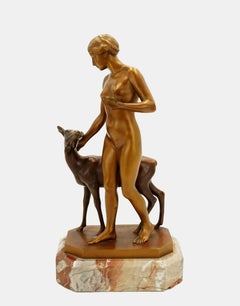
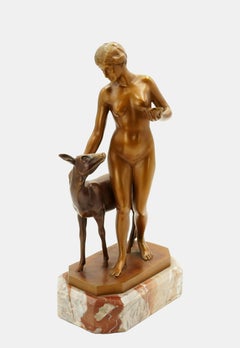
Rudolf Kaesbach (1873 Gladbach - 1955 Berlin), Forest idyll, around 1915. Bronze, gold and golden brown patina, with cast plinth, mounted on a marble base (5 cm high), total height 36 cm, dimensions of the bronze: 31 cm (height) x 17 cm (length) x 12 cm (width). Weight 4,6 kg, signed on the plinth "R.[udolf] KAESBACH". - a few rubbed areas, overall in excellent condition for its age - Soulmate - The bronze sculpture depicts a young woman in an intimate exchange with a deer that accompanies her. The animal pauses to turn toward her, while the nude beauty slows her pace to look into the deer's eyes and tenderly caress it with her hand. The woman and the deer are in inner harmony. Even though her lips remain motionless, she speaks the language of the animal with which she is deeply connected. The golden patina, which contrasts with the more naturalistic coloring of the deer, gives the young woman the appearance of a saint, even if she cannot be identified as such. At the same time, she evokes memories of Diana, the goddess of the hunt, or a nymph. But she lacks the ferocity. In her innocent naivety, she is more like a vestal virgin, who is not at home in the solitude of the forest. And yet, the young beauty, moving unclothed in the heart of nature, looks like a priestess with her hair tied up and a carefully carried bowl on her way to a sacred grove. In order to open up the above-mentioned associations, Kaesbach deliberately designed the female figure in such a way that she cannot be identified as a specific person. He has created an allegory of natural femininity, characteristic of Art Nouveau, in which the deer is far more than a companion animal. It displays the same gracefulness as the young woman, and the inner resemblance between the two makes the deer appear as her other self. In animal terms, it embodies her inner being, which also gives the deer an allegorical character. About the artist Rudolf Kaesbach studied sculpture at the Hanau Academy and worked in a bronze foundry in Paris in 1900. In order to work as an independent artist, he opened a workshop in Düsseldorf, where he cast bronzes from models he designed. In 1902 he made his debut at the German National Art Exhibition in Düsseldorf. The following year Kaesbach went to the academy in Brussels. There he was inspired by contemporary Belgian sculpture, especially the work of Constantin Meunier. He moved to Berlin, where he opened a studio in the villa district of Grunewald and devoted himself to life-size marble sculptures and the design of bronzes. From 1911, he regularly presented his works at the major art exhibitions in Berlin, as well as in Düsseldorf and Malmö. Between 1936 and 1939, he also created models for the Rosenthal porcelain factory. From 1939 to 1944, Kaesbach was represented at the major German art exhibitions in Munich. GERMAN VERSION Rudolf Kaesbach (1873 Gladbach - 1955 Berlin), Waldidyll, um 1915. Gold und goldbraun patinierte Bronze mit gegossener Plinthe, auf einem Marmorsockel montiert (5 cm Höhe), Gesamthöhe 36 cm, Maße der Bronze: 31 cm (Höhe) x 17 cm (Länge) x 12 cm (Breite). Gewicht 4,6 kg, auf der Plinthe mit „R.[udolf] KAESBACH“ signiert. - vereinzele beriebene Stellen, insgesamt in einem altersgemäß ausgezeichneten Zustand - Seelenverwandtschaft - Die Bronzeplastik veranschaulicht eine junge Frau im innigen Austausch mit einem sie begleitenden Reh. Das Tier hält inne, um sich zu ihr hochzuwenden, während die nackte Schönheit ihren Schritt verlangsamt, um dem Reh ebenfalls in die Augen zu schauen und es zärtlich mit der Hand zu liebkosen. Die Frau und das Reh sind in einem inneren Gleichklang. Auch wenn ihre Lippen unbewegt bleiben, spricht sie die Sprache des Tieres, mit dem sie auf eine tief empfundene Weise verbunden ist. Die im Kontrast zur naturalistischeren Einfärbung des Rehs aufstrahlende goldfarbene Patina lässt die junge Frau wie eine Heilige erscheinen, auch wenn sich nicht als Heilige identifizierbar ist. Zugleich ruft sie Erinnerungen an die Jagdgöttin Diana oder eine Nymphe hervor. Dafür fehlt ihr allerdings die Wildheit. In ihrer unschuldigen Naivität gemahnt sie vielmehr an eine Vestalin, die freilich nicht in der Waldeinsamkeit zu Hause ist. Und doch wirkt die sich unbekleidet im Herzen der Natur bewegende junge Schönheit wie eine Priesterin, die sich mit hochgebundenem Haar und der vorsichtig getragenen Schale und dem Wege zu einem Heiligen Hain befindet. Um die gennannten Assoziationen zu eröffnen, hat Kaesbach die Frauenfigur bewusst so gestaltet, dass sie nicht als konkrete Person identifizierbar ist. Damit hat er eine für den Jugendstil charakteristische Allegorie natürlicher Weiblichkeit geschaffen, bei der das Reh weit mehr als ein Begleittier ist. Es weist dieselbe grazile Anmut wie die junge Frau auf und der innere Gleichklag der beiden lässt das Reh als ihr anderen Ich erscheinen. Es verkörpert – ins Animalische übertragen - ihr inneres Wesen, wodurch auch dem Reh ein allegorischer Charakter zukommt. zum Künstler Rudolf Kaesbach studierte an der Akademie Hanau Bildhauerei und war im Jahr 1900 in einer Pariser Bronzegießerei tätig. Um sich als eigenständiger Künstler betätigen zu können, eröffnete er in Düsseldorf eine Werkstatt, in der er Bronzen nach selbstentworfenen Modellen goss. 1902 debütierte er auf der Deutschen Nationalen Kunstaustellung in Düsseldorf. Im Folgejahr ging Kaesbach an die Akademie nach Brüssel. Dort wurde er von der zeitgenössischen belgischen Bildhauerei, insbesondere vom Werk Constantin Meuniers, inspiriert. Zurückgekehrt zog er nach Berlin, wo er im Villenviertel Grunewald ein Atelier eröffnete und sich neben dem Entwurf für Bronzen der lebensgroßen Marmorbildhauerei widmete. Ab 1911 präsentierte er seine Werke regelmäßig auf den Großen Berliner Kunstausstellungen, aber auch in Düsseldorf und Malmö. Zwischen 1936 und 1939 fertigte er zudem Modelle für die Porzellan-Manufaktur Rosenthal an. Von 1939 bis 1944 war...

Category

1910s Jugendstil Figurative Sculptures
Materials

Bronze

Raoul Fançois Larche Patinated bronze figure of a woman

Raoul Fançois Larche Patinated bronze figure of a woman

Located in Berlin, DE

FRANCOIS-RAOUL LARCHE 1860 SAINT-ANDRÉ-DE-CUBZAC - 1912 PARIS Signed on the base with "RAOUL LARCHE," foundry mark "SIOT DECAUVILLE PARIS FONDEUR," and number "R 276." Total height...

Category

Early 1900s Jugendstil Figurative Sculptures

Materials

Bronze

Hebe Par Drouot Edouard Drouot  (French, 1859-1945)

Hebe Par Drouot Edouard Drouot (French, 1859-1945)

Located in Berlin, DE

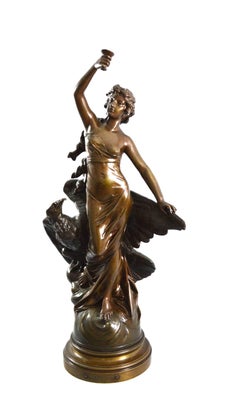
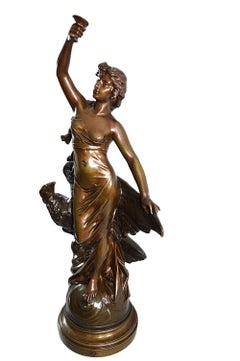
Bronze, beautifully cast, patinated. Above a fluted round base, the figure of the Greek goddess of youth. Hébé is depicted here rising in a tight-fitting robe before an eagle, the sy...

Category

Early 20th Century Jugendstil Figurative Sculptures

Materials

Bronze

L'Abondance Art Nouveau Sculpture, Regule, Signed, Early 20th Century

L'Abondance Art Nouveau Sculpture, Regule, Signed, Early 20th Century

By Vincent Desire Faure de Brousse 1

Located in Berlin, DE

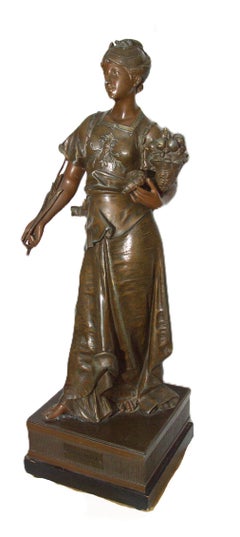
Regule / a metal casting alloy 73 cm signed Vincent Désiré Faure de Broussé, "L'Abondance", large Art Nouveau sculpture, reguleVincent Désiré Faure de Broussé, 1834 - Paris - 19...

Category

Early 20th Century Jugendstil Figurative Sculptures

Materials

Other Medium

Related Items
Art Nouveau Italian Signed Dated and Inscribed Original Bronze

Art Nouveau Italian Signed Dated and Inscribed Original Bronze

By Constantino Barbella

Located in Roma, IT

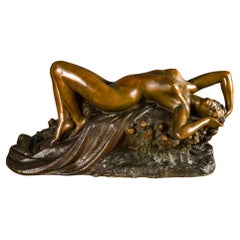
Wonderful Art Nouveau "Ebrezza" bronze sculpture of a woman lying on a bed of roses. It bears at the base the signature Barbella and the wording “Rome Palm Sunday 31 III 1912” Brand...

Category

Early 20th Century Jugendstil Figurative Sculptures

Materials

Bronze

Agathon Leonard Silvered Bronze Of Marguerite

Agathon Leonard Silvered Bronze Of Marguerite

By Agathon Léonard

Located in Dallas, TX

Agathon Leonard (French, 1841 - 1923) Art Nouveau Silvered Bronze A French Art Nouveau gilt bronze sculpture, "Marguerite", by Agathon Léonard of Margeruite, placing a flower in her...

Category

1890s Jugendstil Figurative Sculptures

Materials

Bronze

Bust of a young woman / - The Opulence of Beauty -

Bust of a young woman / - The Opulence of Beauty -

Located in Berlin, DE

Anton Nelson (i.e. Antoine Joseph van den Kerckhoven) (1849 Brussels - after 1910 ibid.), Bust of a young woman, c. 1890. Patinated bronze on cast base, 30 cm (total height) x 20 cm ...

Category

1890s Jugendstil Figurative Sculptures

Materials

Bronze

Seated Mercury Life-Size Bronze Sculpture, Italian, Late 19th Century

Seated Mercury Life-Size Bronze Sculpture, Italian, Late 19th Century

Located in Palm Beach, FL

Seated Mercury (Hermes) — Grand Tour Life-Size Bronze Italian School (possibly Naples) Italy, Late 19th–Early 20th Century This commanding life-size Grand Tour bronze depicts Mercury (Hermes) seated in quiet repose upon a rock, rendered with classical authority and exceptional refinement. The youthful god’s finely modeled anatomy, serene, introspective expression, and distinctive winged sandals draw directly from the celebrated ancient prototype, creating a sculpture of enduring presence and balance. Fully restored and ready to place, the bronze presents beautifully for interior display or garden installation, where its patinated surface responds richly to natural light. The composition derives from the renowned Seated Mercury discovered on August 3, 1758, in the peristyle garden of the Villa dei Papiri at Herculaneum. The ancient original—now housed in the Museo Archeologico Nazionale di Napoli—became a touchstone of classical taste and a must-see for Grand Tour travelers of the 18th and 19th centuries, admired for its harmony, restraint, and technical mastery. Cast in richly toned bronze and finished with a nuanced patina, this example exemplifies the Neapolitan tradition of Grand Tour bronzes, prized for archaeological fidelity and sculptural finesse. Its impressive scale and poised silhouette make it a significant focal point in both modern and classical settings—an object that bridges antiquity and the cultivated collecting culture of the Grand Tour. Notable Related Examples: Getty Villa · Kunsthistorisches Museum · Villa San Michele...

Category

Late 19th Century Jugendstil Figurative Sculptures

Materials

Bronze

Demian Undressing
Demian Undressing

Ian Rank-BroadleyDemian Undressing, 2023

$19,910

H 25.99 in W 10.24 in D 14.18 in

Demian Undressing

Located in London, GB

Bronze Numbered 1/10 66cm × 26cm × 36cm (incl. base) Ian Rank-Broadley is one of the foremost sculptors working today. His effigy of the late Queen Elizabeth II appears on all UK an...

Category

2010s Jugendstil Figurative Sculptures
Materials

Bronze

Nature unveiling in front of Science

Nature unveiling in front of Science

By Louis Ernest Barrias

Located in PARIS, FR

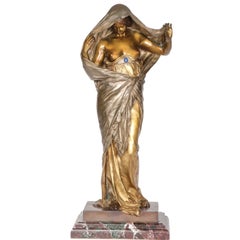
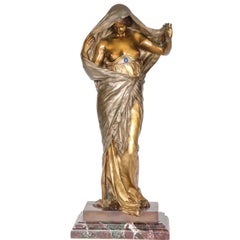
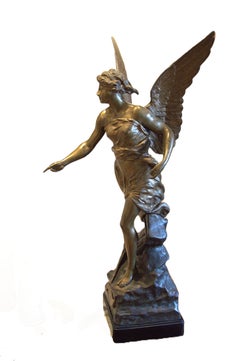
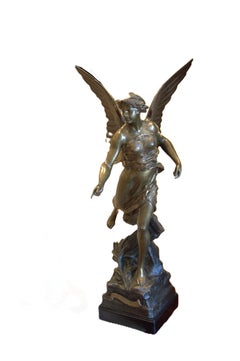
Nature unveiling in front of Science by Louis-Ernest BARRIAS (1841-1905) Bronze sculpture with triple patina, old-gilt, light brown and dark brown patina. Signed on the side of the...

Category

Early 1900s Jugendstil Figurative Sculptures
Materials

Bronze

Female torso
Female torso

Gunnar NilssonFemale torso, 1960

$2,278

H 18.51 in W 5.12 in D 5.91 in

Female torso

Located in Täby, SE

This female torso represents the young woman's strength and vulnerability. It´s was conceived in the 70ths and is signed with the artists initials on a thumbprint. Gunnar Knut Nilsson, born 1904 in Karlskrona, died 1995 in Versailles in France, was a Swedish sculptor. Gunnar Nilsson studied watercolor painting and modeling at the Technical Vocational School in Karlskrona in 1918-19 and on his own in addition to working as a clerk at Finspångs Metallwerk. His debut exhibition was in Finspång in 1927. With the help of a local fundraiser, and after the encouragement of Carl Eldh, he traveled to Paris in 1928 to study sculpture for, among others, Charles Despiau and Paul Niclausse. In Paris he socialized with Bror Hjorth, whose former studio he also rented, Carl Frisendahl and Alberto Giacometti. He came to belong to "Le groupe des Neuf'' with Paul Cornet...

Category

1950s Jugendstil Figurative Sculptures
Materials

Bronze

The Return of the Prodigal Son

Constantin Meunier The Return of the Prodigal Son, 1895

$49,079

H 17.52 in W 16.93 in D 7.88 in

The Return of the Prodigal Son

Located in PARIS, FR

The Return of the Prodigal Son or The Reconciliation by Constantin MEUNIER (1831-1905) A rare bronze group with a nuanced dark brown patina signed on the back "C. Meunier" cast by "...

Category

Early 1900s Jugendstil Figurative Sculptures
Materials

Bronze

Grand Tour sculpture “Archer”, Otto Lessing, gilt bronze and onyx, Germany

Grand Tour sculpture “Archer”, Otto Lessing, gilt bronze and onyx, Germany

Located in Valladolid, ES

One of a kind and masterpiece sculpture “Archer” (“Bogenschütze,” original German title) in gilt bronze, a work by Otto Lessing, based on an original design from 1908. Many small-sc...

Category

1920s Jugendstil Figurative Sculptures
Materials

Marble, Bronze

"A Girl Sitting on a Stool Tying Her Shoe", 20th Century Bronze by Juan Clará

"A Girl Sitting on a Stool Tying Her Shoe", 20th Century Bronze by Juan Clará

By Juan Clará Ayats

Located in Madrid, ES

JUAN CLARÁ AYATS Spanish, 1878 - 1958 A GIRL SEATED ON A STOOL TYING HER SHOE signed "Juan Clara" and stamped A.G. Paris (on the stool ) bronze figure 6-3/8 x 3 x 4 inches (16 X 7.5 X 10 cm.) PROVENANCE Private Collector, France Gilded bronze sculpture of Art Nouveau style, depicting a little girl sitting on a sidewalk tying her shoe. The plasticity that Juan Clará achieves with the bronze when shaping this beautiful little sculpture is wonderful. We notice the effort that the little girl is making to put on her shoe, her gestures and attitudes which moves us and attracts us towards her. Juan Clará Ayats. Olot (Gerona), 6.XII.1875 - Paris (France), II.1958. Sculptor Student of José Berga at the Olot School of Fine Arts, developed his training in France, first at the School of Fine Arts in Toulouse, in 1896, and from 1901 in Paris. At this stage he lived with his younger brother, José Clará...

Category

1920s Jugendstil Figurative Sculptures
Materials

Bronze

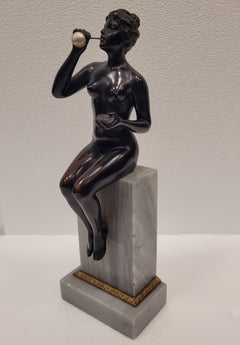
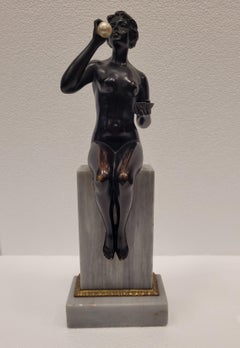
Art Nouveau sculpture “Woman blowing bubbles”, Bronze and marble, Germany

Art Nouveau sculpture “Woman blowing bubbles”, Bronze and marble, Germany

Located in Valladolid, ES

Gorgeous Sculpture “Woman blowing bubbles”, Bronze and marble, Art Nouveau, 1920 – Germany Refined antique solid bronze sculpture depicting a woman blowing bubbles. This piece is of...

Category

1920s Jugendstil Figurative Sculptures
Materials

Marble, Bronze

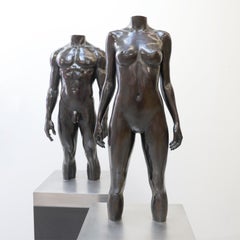
Jugendstil figurative sculptures for sale on 1stDibs.
Find a wide variety of authentic Jugendstil figurative sculptures available for sale on 1stDibs. Works in this style were very popular during the 20th Century, but contemporary artists have continued to produce works inspired by this movement. Frequently made by artists working with Bronze, and Metal and other materials, all of these pieces for sale are unique and have attracted attention over the years. Not every interior allows for large Jugendstil figurative sculptures, so small editions measuring 3.5 inches across are also available. Prices for figurative sculptures made by famous or emerging artists can differ depending on medium, time period and other attributes. On 1stDibs, the price for these items starts at $880 and tops out at $149,500, while the average work sells for $75,190.