By Ray Johnson
Located in Miami, FL
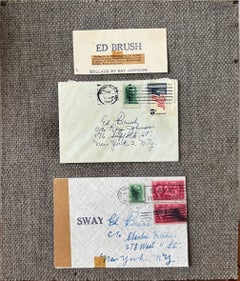
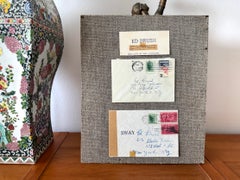
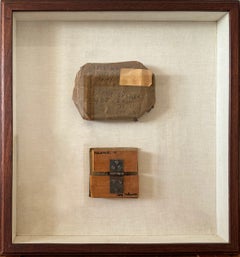
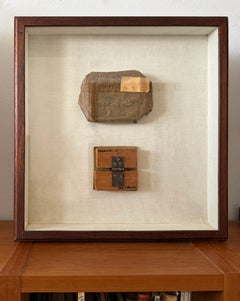
Ray Johnson, 1964. Mail art assemblage collage titled "Ed Brush," composed of cut paper stamped " Ed Brush Collage by Ray Johnson " with a paper cutout, and two mailed covers addressed by Johnson to Ed Brush- one c/o Ray Johnson and one c/o Stanton Kreider- postmarked October 20, 1964, and November 19, 1964, respectively. Mounted on board covered with fabric, board measures 13 x 11 in. Not framed. Signed on Envelopes, Stamped Collage by Ray Johnson
Bio from Wikipedia:
Raymond Edward "Ray" Johnson (October 16, 1927 – January 13, 1995) was an American artist. Known primarily as a collagist and correspondence artist, he was a seminal figure in the history of Neo-Dada and early Pop art and was described as "New York's most famous unknown artist".[1][3] Johnson also staged and participated in early performance art events as the founder of a far-ranging mail art network – the New York Correspondence School –which picked up momentum in the 1960s and is still active today. He is occasionally associated with members of the Fluxus movement but was never a member. He lived in New York City from 1949 to 1968, when he moved to a small town in Long Island and remained there until his suicide.
Early years and education
Born in Detroit, Michigan, on October 16, 1927,Ray Johnson grew up in a working-class neighborhood and attended Cass Technical High School where he was enrolled in the advertising art program. He took weekly classes at the Detroit Art Institute and spent a summer drawing at Ox-Bow School in Saugatuck, Michigan, affiliated with the Art Institute of Chicago.
Johnson left Detroit after high school in the summer of 1945 to attend the progressive Black Mountain College (BMC) in North Carolina,[4][6] where he stayed for the next three years (spending the spring 1946 semester at the Art Students League in New York but returning the following summer). Josef Albers, before and after his notable sabbatical in Mexico, was in residence at Black Mountain College for six of the ten semesters that Johnson studied there. Anni Albers, Walter Gropius, Lyonel Feininger, Robert Motherwell, Ossip Zadkine, Paul Rand, Alvin Lustig, Ilya Bolotowsky, Jacob Lawrence, Beaumont Newhall, M. C. Richards, and Jean Varda also taught at BMC during Johnson's time there. Johnson decided on Albers' advice to stay at BMC for a final term in summer 1948, when the visiting faculty included John Cage, Merce Cunningham, Willem de Kooning, Buckminster Fuller, and Richard Lippold.[1] Johnson took part in "The Ruse of Medusa" – the culmination of Cunningham's Satie Festival - with Cage, Cunningham, Fuller, Willem and Elaine de Kooning, Lippold, Ruth Asawa, Arthur Penn, and others among the cast and crew. "Because of those who participated, the event has taken on the reputation of a watershed event in 'mixed media'" wrote Martin Duberman in his history of BMC.
In the documentary How to Draw a Bunny, Richard Lippold confessed to carrying on a love affair with Johnson for several years.
I risk to say, [that at Black Mountain College] 'anything went'—between the students and the faculty ... he would arrive every morning with a little bouquet of wild flowers, and singing. Eventually our relationship became very intimate, so I brought him back to New York ... and obviously, we didn't live together, steadily, because I had my family. We were quite close together until 1974, so that's a long period of time. From '48 to '74, twenty some years. Because it was a very intimate relationship, a loving relationship.[8]
New York years
Johnson moved with Richard Lippold to New York City by early 1949, rejoining Cage and Cunningham and befriending, within the next couple of years, Robert Rauschenberg, Jasper Johns, Cy Twombly, Ad Reinhardt, Stan Vanderbeek, Norman Solomon, Lucy Lippard, Sonia Sekula, Carolyn Brown and Earle Brown, Judith Malina, Diane di Prima, Julian Beck...
Category
1960s Conceptual Ink Still-life Sculptures
MaterialsFabric, Paper, Ink, Masonite