Old Masters Art

OLD MASTERS

Encompassing centuries of change in Europe between 1300 and 1800, from booms of prosperity to bloody revolutions, Old Masters describes a wide range of artists. The informal term was derived from the title of an artist who trained in a guild long enough to become a master, such as Leonardo da Vinci, who studied in a Florence painters’ guild. However, Old Masters paintings, prints and other art is now used to refer to work made by any artist with a high level of skill in painting, drawing, sculpture or printmaking who worked during this era.

The 15th century’s expansive trade and commerce spread culture across borders. A vibrant period of art emerged, bolstered by studies of anatomy and nature that influenced a new visual realism. From Raphael and Michelangelo in the Renaissance to Rembrandt van Rijn and Johannes Vermeer in the Dutch Golden Age, artists expressed emotion, naturalism, color and light in new ways. El Greco and Paolo Veronese were leaders in the dramatic style of Mannerism, while Caravaggio and Peter Paul Rubens demonstrated the movement and meticulous detail of Baroque art.

Historically, most attention was concentrated on male artists, but recent research and exhibitions have elevated the impactful work of women such as Rachel Ruysch and Artemisia Gentileschi. In late-18th-century France, female artists like Adélaïde Labille-Guiard and Élisabeth Vigée Le Brun were prominent names. Nevertheless, access to the academies and guilds was highly restricted for women, and even those able to establish practices were expected to adhere to portraits and still lifes rather than the grand history paintings being created by men.

Find a collection of Old Masters prints, paintings, drawings and watercolors and other art on 1stDibs.

to
787
2,431
736
322
334
372
Overall Width
to
Overall Height
to
3,158
816
98
136
9
5
7
2
2
6
3
13
1
4
2,274
119,217
64,202
54,941
28,522
14,469
9,043
6,178
5,490
3,140
2,526
2,287
2,119
569
2,045
1,728
386
2,869
1,508
976
945
918
547
460
319
286
269
210
201
189
165
111
105
101
91
88
84
2,300
1,314
1,162
424
418
94
93
86
83
61
1,211
2,179
3,404
781
Style: Old Masters
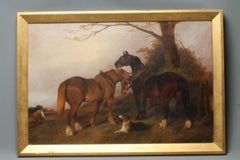
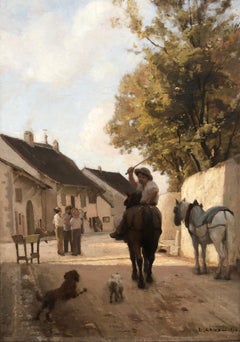
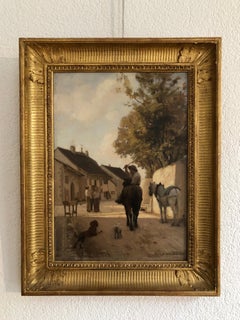
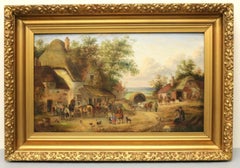
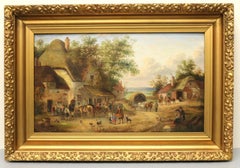
19th century landscape  village scene horses, animals  inn  by georgina lara

19th century landscape village scene horses, animals inn by georgina lara

By Georgina Lara

Located in York, GB

A very fine village scene depicting An English Village with figures, animals, horses, and cart by an Inn, oil on canvas, indistinctly signed,G Lara , lower left The size being 51cm x 31cm whilst overall being 66 cm x 47cm in excellent ready to hang condition Georgina Lara was also known as Edwina Lara ,she was a London painter of rustic farmyard and village scenes. Her work is extremely similar to Edward Masters who also went by the name of William Masters...

Category

19th Century Old Masters Art

Materials

Oil

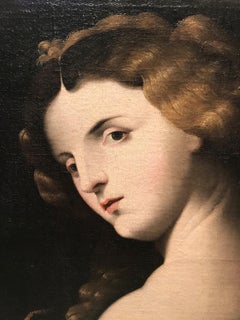
17th Century by Il Padovanino Mary Magdalene or Young Woman Oil on Canvas

17th Century by Il Padovanino Mary Magdalene or Young Woman Oil on Canvas

Located in Milano, Lombardia

Alessandro Leone Varotari, known as Il Padovanino (Padua, Italy, 1588 – Venice, Italy, 1649) Title: Mary Magdalene or Young Woman Medium: Oil on canvas Dimensions: Without frame 50.5...

Category

17th Century Old Masters Art

Materials

Canvas, Oil

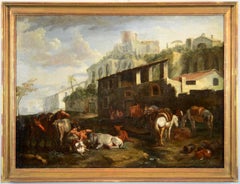
Van Bloemen Landscape Rome Paint 17/18th Century Oil on canvas Old master Italy

Van Bloemen Landscape Rome Paint 17/18th Century Oil on canvas Old master Italy

Located in Riva del Garda, IT

Antichità Castelbarco SRLS is proud to present: Painting depicting "View of Rome with countryside scene with ancient ruins, with the Palatine from via dei Cerchi", work of high qual...

Category

17th Century Old Masters Art

Materials

Oil

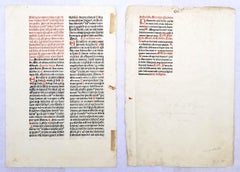
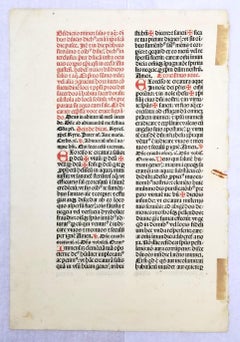
Set of Two Leaves from "Missale Frisingense" /// German Catholic Incunabula 15th

Set of Two Leaves from "Missale Frisingense" /// German Catholic Incunabula 15th

Located in Saint Augustine, FL

Artist: Erhard Ratdolt (German, 1442-1528) Title: "Preface Page" and "Page CVI - 106" Portfolio: Missale Frisingense Year: 1492 (First edition) Medium: Set of Two Original Incunabula Leaves on watermarked laid paper Limited edition: Unknown Printer: Erhard Ratdolt, Ausburg, Germany Publisher: Sixtus of Tannberg, Freising, Germany Sheet size (each): approx. 11.94" x 8.13" Reference: Hain No. 11303; Weale/Bohatta No. 396; Schreiber No. 4699; Pell No. 7944 Condition: "Preface Page" has the occasional wormhole. Remnants of tape, a tape and a paper clip stain along its edge. Minor foxing and soiling mainly in margins. "Page CVI - 106" has remnants of tape and a small stain along its left edge. Light foxing and soiling about its sheet with some general edge wear. Have been professionally stored away for decades. They are both otherwise strong impressions in good condition with strong colors Very rare Notes: Comes from Ratdolt's one volume "Missale Frisingense", (1492) (First edition), which consists of 576 pages of Gothic texts in Latin with red rubricated initials, music, and woodcut illustrations. Printed in Augsburg by Erhard Ratdolt on March 17, 1492. "Preface Page" has a bull's head and cross watermark in the upper center of its sheet. Some information and old prices inscribed in pencil to their sheets. A missal is a book that contains the prayers, chants, biblical readings, and rubrics for celebrating Mass. The first missals were found in monasteries in the 12th and 13th centuries. The term missale is Latin for "Mass book". Biography: Erhard Ratdolt (1442–1528) was an early German printer from Augsburg. He was active as a printer in Venice from 1476 to 1486, and afterwards in Augsburg. From 1475 to 1478 he was in partnership with two other German printers. The first book the partnership produced was the Calendarium (1476), written and previously published by Regiomontanus, which offered one of the earliest examples of a modern title page. Other noteworthy publications are the "Historia Romana of Appianus" (1477), and the first edition of "Euclid's Elements" (1482), where he solved the problem of printing geometric diagrams, the "Poeticon astronomicon", also from 1482, "Haly Abenragel" (1485), and "Alchabitius" (1503). Ratdolt is also famous for having produced the first known printer's type specimen...

Category

15th Century and Earlier Old Masters Art

Materials

Laid Paper, Woodcut

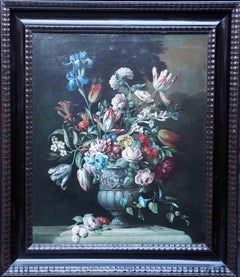
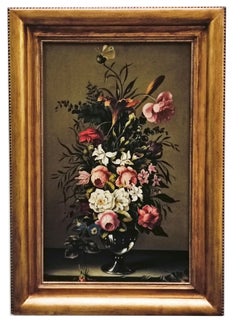
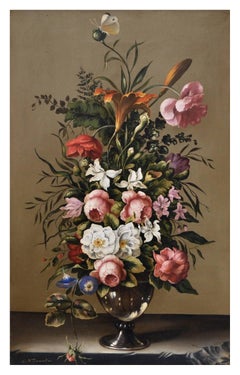
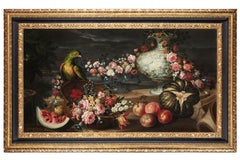
Still Life of Flowers in Ornamental Urn on Ledge - Dutch Old Master oil painting

Still Life of Flowers in Ornamental Urn on Ledge - Dutch Old Master oil painting

By Gerard van Spaendonck

Located in Hagley, England

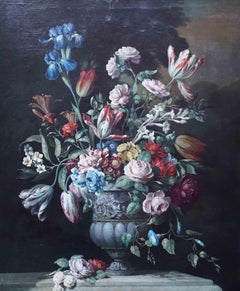
This superb vibrant Dutch 18th century Old Master floral oil painting is attributed to circle of Gerard Van Spaendonck. Painted circa 1790, it is a beautiful mixed floral still life flower arrangement in an ornate urn on a marble ledge against a landscape. The flowers include roses, tulips, blue iris and trailing blue morning glory. The carved ornate grey/blue urn on the cream marble ledge create a strong textural contrast with the soft petals and leaves. This is a wonderful example of Dutch 18th century floral oil paintings with fine detail and brushwork. Provenance. Private Collection, UK (by descent). Condition. Oil on canvas, 30 inches by 25 inches unframed and in good condition. Frame. Housed in an ebonised frame, 39 by 34 inches framed and in good condition. Gerard van Spaendonck (1746-1822) was a Dutch painter. Gerard was born in Tilburg, an older brother of Cornelis van Spaendonck...

Category

1790s Old Masters Art

Materials

Oil

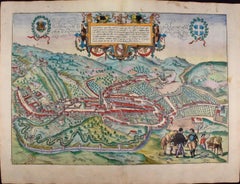
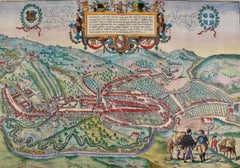
View of Seravalle, Italy: A 16th Century Hand-colored Map by Braun & Hogenberg

View of Seravalle, Italy: A 16th Century Hand-colored Map by Braun & Hogenberg

By Franz Hogenberg

Located in Alamo, CA

This is an original 16th century copperplate originally hand-colored engraved map of View of Seravalle, Italy entitled "Seravallum Celeberrimum Marchiae Tarvisiniae in Agro Foro Juliensi Opp. - Seravalli, quam vides, Spectator, iconem, operi huic nostro suis sumptib. . . ." by Georg Braun & Franz Hogenberg, from their famous city atlas "Civitates Orbis Terrarum", published in Augsberg, Germany in 1575. The map depicts a view of Seravalle, now Vittorio Veneto, in San Marino, Italy, north of Venice, in a topographically accurate bird's-eye view from the south. A water-filled moat is seen to the south of the city walls and farmland to the east. Two men are depicted standing on a hill in the lower right in conversation next to grain sacks and a grazing horse, while a younger man behind them to the right herds a mule carrying presumably pigs. A very colorful and ornate title cartouche is in the upper center and coat-of-arms are in the right and left upper corners. Serravalle lies in an idyllic setting in the foothills and surrounded by orchards. St Mary's Cathedral with its tall bell tower is prominent in the center of the town. The marketplace and town hall with a bell tower in the square are depicted. Houses and shops are around the main square. Serravalle's importance as an agricultural centre is emphasized by the figures in the foreground. In 1337 Serravalle was conquered by the Republic of Venice. In 1866 the town was united with neighbouring Ceneda to form the town of Vittorio Veneto. The following is an English translation of an excerpt from the French description of the city on the back of the map: "Serravalle, a market town renowned for cloth, wine and grain, is in such a beautiful situation that the number of its inhabitants, attracted by the loveliness of the place, has grown so much at times that the wall encircling it has had to be enlarged for the third time. The city with the surrounding town once belonged to the Church in Ceneda as an imperial fief. It subsequently became the seat of the Da Camino family (a princely house that at that time was one of the five most noble in all Italy). Now the city is under the sway of the Venetians but is prudently governed by them. For they send only one city councillor with instructions to ensure that justice prevails and to collect duties. In all else, power lies in the hands of the noble families." This is a translation of the Latin in the title cartouche on the front: "The picture of the town of Serravalle, which you see, viewer, has been contributed to our work entirely at his own expense by Minutius, son of Hieronymus Minutius, a noble gentleman and one renowned for the far-reaching competence of his jurisdiction. We saw him sojourning in Cologne, where he was on business for Gregory XIII; while our good wishes accompany him, we should also like to accompany him on his way with this remembrance, even though it might be against his will, so that even those who have not seen him may learn of his excellence. However, those who do not yet know him will also see his excellence if God the Almighthy does not summon erring souls too soon back to the eternal seat of the Blessed." References: Van der Krogt 4, 4728, State 1; Taschen, Braun and Hogenberg, p.331; Fauser, #14960 This striking hand-colored city view is printed on laid, chain-linked paper with wide margins. The sheet measures 16" high by 21" wide. There is a central vertical fold as issued and French text on the verso, with Latin on the front. There is some discoloration in the upper and right margins which may represent some watercolor paint from the time of the original hand-coloring of the map. There is a small hole to the right of the upper portion of the vertical fold, which is only visible when held up to light and an area of reinforcement on the verso of the lower vertical fold. The map is otherwise in very good to excellent condition. Braun and Hogenberg's 'The Civitates Orbis Terrarum' was the second atlas of maps ever published and the first atlas of cities and towns of the world. It is one of the most important books published in the 16th century. Most of the maps in the atlas were engraved by Franz Hogenberg and the text, with its descriptions of the history and additional factual information of the cities, was written by a team of writers and edited by Georg Braun. The work contained 546 bird-eye views and map views of cities and towns from all over the world. It gave graphic representation of the main features of the illustrated cities and towns, including the buildings and streets. Although the ordinary buildings are stylized, the principal buildings are reproduced from actual drawings created on location. The principal landmarks and streets can still be recognized today. In addition, the maps often include the heraldic arms of the city, the nature of the surrounding countryside, the important rivers, streams and harbors, even depicting stone bridges, wooden pontoons, flat-bottomed ferries, ships and working boats, wharves and jetties, as well as land-based activities, including horsemen, pedestrians, wagons, coaches, and palanquins. Small vignettes are often included which illustrate the trade, occupations and habits of the local inhabitants, such as agriculture, paper-making and textiles, as well as local forms of punishment, such as gibbets, wheels, floggings etc. Large figures dressed in their local costume are often presented out of proportion in the foreground. The aim of the authors was to give as much information as possible in a pleasing visual form. They succeeded in creating maps that were both informative and decorative works of art. The atlas is a wonderful glimpse of life in medieval Europe. Georg Braun (1541-1622) was German Catholic...

Category

16th Century Old Masters Art

Materials

Engraving

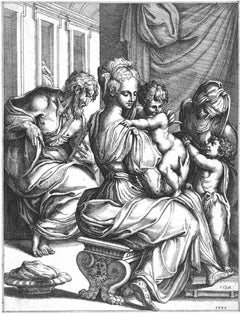
The Holy Family

The Holy Family

By Fra Bonaventura Bisi

Located in Chicago, IL

The Holy Family, 1634 Etching after Parmigianino (Parma 1503 - 1540 Casal Maggiore) 305 x 230 mm.; 12 x 9 inches References: Nagler Monogrammisten II...

Category

17th Century Old Masters Art

Materials

Etching

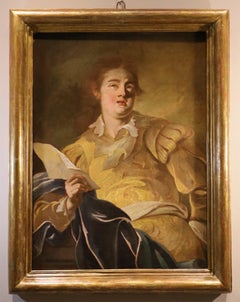
Portrait Singer Vignon Paint 17th Century Oil on canvas Old master French school

Portrait Singer Vignon Paint 17th Century Oil on canvas Old master French school

Located in Riva del Garda, IT

Claude Vignon (Tours, 1593 – Paris, 1670) Portrait of a singer in a doublet Circa 1625 Oil on canvas (105 x 79 cm. - In frame 120 x 94 cm.) The work has been the subject o...

Category

17th Century Old Masters Art

Materials

Oil

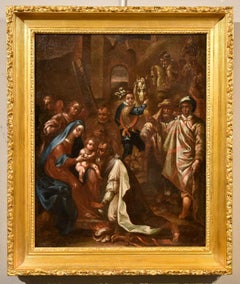
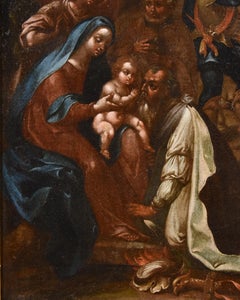
Adoration Magi Jan Van Der Straet Paint Oil on canvas Old master 16th Century

Adoration Magi Jan Van Der Straet Paint Oil on canvas Old master 16th Century

Located in Riva del Garda, IT

Jan Van der Straet, known as Giovanni Stradano (Bruges 1523 - Florence 1605), Workshop of The Adoration of the Magi late 16th century - early 17th century oil painting on canvas Mea...

Category

16th Century Old Masters Art

Materials

Oil

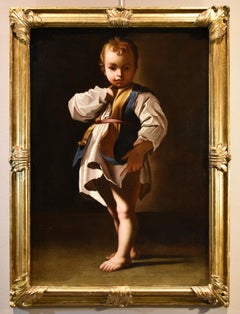
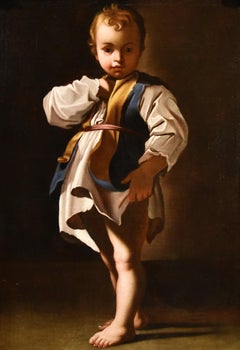
Portrait Child Schedoni 17th Century Paint Oil on canvas Old master

Portrait Child Schedoni 17th Century Paint Oil on canvas Old master

Located in Riva del Garda, IT

Bartolomeo Schedoni (Modena 1578 - Parma 1615) workshop of Portrait of a child (Alessandro Farnese?) First half 17th century Oil on canvas (95 x 66 cm. - In frame 109 x 80) This i...

Category

17th Century Old Masters Art

Materials

Oil

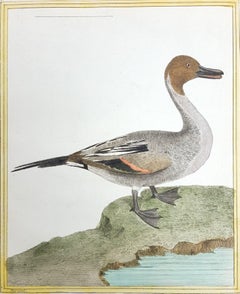
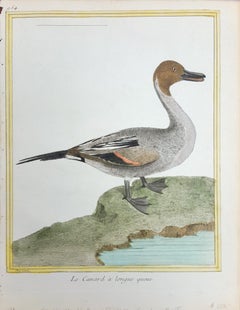
Le Canard a Longue Queue (The Long Tailed Duck) /// Ornithology Martinet Bird

Le Canard a Longue Queue (The Long Tailed Duck) /// Ornithology Martinet Bird

By François Nicolas Martinet

Located in Saint Augustine, FL

Artist: François-Nicolas Martinet (French, 1731-1800) Title: "Le Canard a Longue Queue (The Long Tailed Duck)" (Plate 954) Portfolio: Histoire Naturelle Des Oiseaux *Signed by Martin...

Category

1770s Old Masters Art

Materials

Watercolor, Laid Paper, Engraving, Intaglio

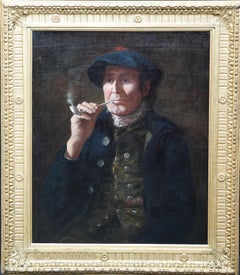
Portrait of Scottish Gentleman with Clay Pipe - 18th century art oil painting

Portrait of Scottish Gentleman with Clay Pipe - 18th century art oil painting

Located in Hagley, England

This atmospheric 18th century portrait oil painting is attributed to a Scottish artist. Painted circa 1790, The painting is a half length portrait of a seated gentleman. He is wearing a blue bonnet, the badge of a Scottish country gentleman and smoking a clay pipe. The way the light catches his hand and face and gleams on his buttons is lovely. The frame is super in that it echoes the button on his jacket. This is an excellent example of an 18th century Scottish portrait...

Category

17th Century Old Masters Art

Materials

Oil

Jean-Henri Cless (1774-1812) Portrait of a young woman, signed drawing

Jean-Henri Cless (1774-1812) Portrait of a young woman, signed drawing

Located in Paris, FR

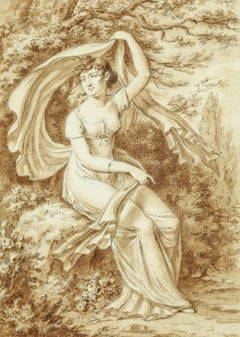
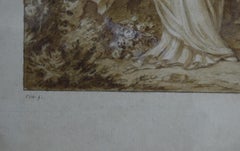
Jean-Henri Cless (1774-1812) Portrait of a young woman in a landscape signed "Cless fec" for fecit on the lower left Brown ink and brown ink wash on paper Size of the sheet : 31.5 x 22 cm Size of the motive : 24.5 x 17 cm very simply framed under glass without actual frame 32 x 22.5 cm This pre...

Category

Early 1800s Old Masters Art

Materials

Pencil, Ink

Travellers and Dogs in Landscape, Ruins on Right - Dutch Old Master oil painting

Travellers and Dogs in Landscape, Ruins on Right - Dutch Old Master oil painting

By Pieter Wouwerman

Located in Hagley, England

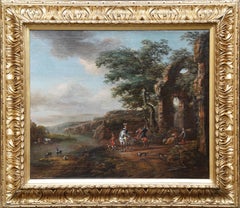
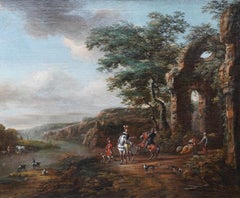
This lovely Dutch Old Master oil painting is attributed to artist Pieter Wouwerman. Painted circa 1660 it is figurative landscape with horseback travellers and their dogs in the foreground with ruins on their right. Beyond is a river and hilly landscape, all in the fading light of approaching dusk. There are some superb details making this an excellent Dutch Golden Age oil painting. Provenance: Devonshire estate. Condition. Oil on canvas, 24 inches by 20 inches and in good condition. Frame. Housed in a complementary gilt frame, 31 inches by 27 inches and in good condition. Pieter Wouwerman (1623-1682) was a Dutch Golden Age landscape painter. He was born in Haarlem. According to Arnold Houbraken, a biographer of artists from the Dutch Golden Age, Pieter Wouwerman was the brother of the landscape painters Jan and Philips Wouwerman, who, like his more famous brother, made a living selling Italianate landscapes in the manner of Pieter van Laer...

Category

Mid-17th Century Old Masters Art

Materials

Oil

Rare Jacobean Portrait on Panel Lady Elizabeth Wheeler née Cole 1623 Historical

Rare Jacobean Portrait on Panel Lady Elizabeth Wheeler née Cole 1623 Historical

By Cornelius Johnson

Located in London, GB

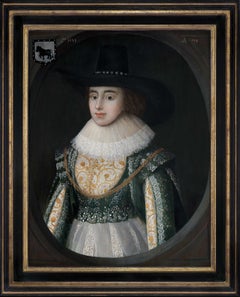
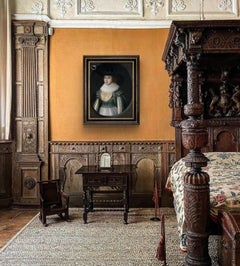
A Rare Jacobean Portrait of Lady Elizabeth Wheeler (née Cole), 1623 Attributed to Cornelius Johnson (1593–1661) This remarkably rare early oil on panel, presented by Titan Fine Art, has emerged as far more than an anonymous “Portrait of a Lady.” Preserved in outstanding condition—its surface retaining exceptional clarity in the lace and textiles—it has only recently been reunited with the identity of its sitter: Elizabeth Cole (1607–1670), later Lady Elizabeth Wheeler, a Westminster gentlewoman whose later life brought her into intimate royal service as laundress for His Majesty’s person. That combination—high quality, uncommon survival, a newly identified sitter, and a life that intersects directly with the last acts of Charles I—places this portrait in a category of genuine rarity. It is not simply a beautiful Jacobean likeness; it is a rediscovered historical document - legible and compelling. The sitter is presented half-length against a dark ground, enclosed within a painted sculpted oval surround that functions like an architectural frame. This device, fashionable in the 1620s, concentrates the viewer’s attention and heightens the sense of social presentation: the sitter appears both physically and symbolically “set apart,” as if viewed through a refined aperture. The portrait’s immediate power, however, lies in the costume—an ensemble of striking modernity for c. 1623 and rendered with a precision that survives with remarkable crispness. She wears a deep green gown—a fitted overgown with open sleeves—over a finely embroidered linen jacket (a stiffened bodice/waistcoat garment). The sleeves form pronounced “wings” at the shoulder, a structurally assertive fashion detail of the early 1620s that enlarges the silhouette and signals sophistication. Beneath the green overlayer, the white linen jacket is richly ornamented in gilt embroidery. The goldwork is arranged as scrolling foliate forms—looping, curling tendrils punctuated by seed-like stippling—organised into balanced compartments across the bodice and sleeves. The motifs read as stylised botanical forms with rounded fruit-like terminals and leaf elements: not literal naturalism, but controlled abundance. The technique is described with extraordinary intelligence, mimicking couched metallic thread through patterned, “stitched” marks, while tiny dots and short dashes create a lively tactile shimmer. This embroidered jacket sits above a newly fashionable high-waisted, sheer apron or overskirt. The translucent fabric falls in soft vertical folds and is articulated with narrow lace-edged bands, giving the skirt a crisp rhythm of alternating sheer and patterned strips. At the neck, a fine ruff frames the face: a disciplined structure of pleated linen finished with delicate lace. Draped diagonally across the torso are long gold chains, painted to suggest weight and metallic gleam; they function both as ornament and as a further signifier of status. The cumulative effect is controlled luxury: she is not overloaded with jewels, but clothed in textiles whose cost and craftsmanship speak unmistakably. The recent sitter’s identification rests on heraldic and genealogical analysis: the arms shown on the painting correspond to those recorded for several families in armorial sources, but when the lines of descent are tested against survival and chronology, the viable bearer by 1623 resolves to Cole, and—crucially—to the London branch. That resolution matters because it anchors the portrait to a very specific social world: London/Westminster civic gentry and Crown administration, the milieu in which portraiture served as both self-fashioning and social instrument. The recent identification of the sitter (the London Cole branch of the family) is not merely genealogical; it has direct implications for authorship. A London-based mercantile or civic-gentry family would have ready access to leading immigrant artists, familiarity with heraldic display conventions, and the means to commission oil on panel, still standard among Netherlandish-trained painters. In that context, the portrait’s age inscription and date become especially revealing. The painting states the sitter to be nineteen years of age. Yet Elizabeth Cole’s birth in 1607 suggests she would be younger if the portrait is dated as early as 1623. The key insight is that the “incorrect” age is best understood not as a mistake but as a deliberate social adjustment, a performative statement rather than a documentary one. The most persuasive explanation is strategic. Portraits of high-status unmarried women were frequently made in connection with marriage negotiations. In the early 1620s, Elizabeth’s future husband, William Wheeler, was resident abroad at Middelburg in Zeeland in the Dutch Republic. If a portrait was intended to support or facilitate a match with an educated, ambitious man—“a man of learning and letters,” —then presenting a seventeen-year-old as nineteen would subtly reposition her as more mature and more nearly a peer in age, Wheeler being around twenty-two. The portrait thus becomes an instrument of alliance, not merely a likeness: an image designed to persuade, reassure, and elevate. This reading aligns perfectly with the period’s wider conditions. The early 1620s in England were charged with anxiety and expectation: James I’s later reign was marked by court faction, diplomatic tension, and the pressures of European conflict. The so-called “art market” was inseparable from these dynamics. Portraiture flourished because it served multiple functions: it fixed lineage, advertised alliance, signalled readiness for marriage, and projected the stability of elite households in an uncertain world. For Westminster families whose power came through office, portraiture was also a declaration of belonging—proof that administrative elites possessed the cultural polish traditionally associated with older aristocratic rank. Elizabeth’s later life vindicates the portrait’s impression of steadiness. Although no record survives of her marriage ceremony to William Wheeler, wills suggest she had married him by the mid-1630s, and there are strong grounds—consistent with the portrait’s implications—for a union already in place by the early 1630s, possibly earlier. Wheeler himself rose rapidly. By 1639 he held a manor at Westbury Leigh in Wiltshire and sought letters of denization due to overseas birth, enabling him to stand as Member of Parliament for Westbury. He leased the principal manor of Westbury the following year, coinciding with his election. In government service he became Remembrancer of the Exchequer and held office across regime change, a testament to administrative skill and political pragmatism. It is Elizabeth, however, who makes this portrait exceptional. She became laundress for His Majesty’s person, responsible for the washing and oversight of the King’s personal linen—an office that, despite its domestic description, required unusual trust, discretion, and access. Her role becomes visible in 1643 when she was granted a warrant signed by the Speaker of the House of Commons to follow the King to Oxford with her servant after the outbreak of the Civil War. She continued to serve during the King’s captivity after 1646, and at Carisbrooke Castle in 1647 she and her maid were implicated in smuggling secret correspondence to and from Charles I, in service of escape plans. After the King’s failed attempt to escape in March 1648, she was removed—yet the King’s trust persisted: he was permitted to send her remaining jewels in an ivory casket...

Category

17th Century Old Masters Art
Materials

Oil, Panel

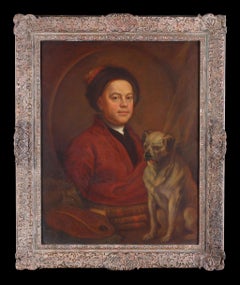
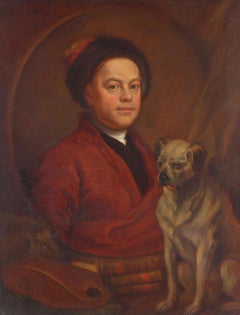
The Line of Beauty and Grace, Oil on Canvas, Framed, WH 1745

The Line of Beauty and Grace, Oil on Canvas, Framed, WH 1745

By William Hogarth

Located in St. Albans, GB

A copy of the self portrait of William Hogarth with his dog, called Trump. A fantastic quality image possibly from Hogarth's original school of art. This piece is titled, dated and monogrammed. It is in an antique, period Louis XIV style frame. The painting measures 36 x 28" (92 x 72cm) Outside Frame Size: 45 x 37" (104 x 94cm) Hogarth began this self-portrait in the mid-1730s. Initially Hogarth painted himself wearing a formal coat...

Category

19th Century Old Masters Art

Materials

Oil

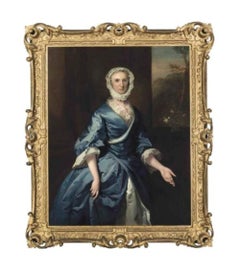
Joseph Highmore Portrait of a lady, 18th century

Joseph Highmore Portrait of a lady, 18th century

By Joseph Highmore

Located in York, GB

Portrait of a lady, traditionally identified as Grace Loftus,of Beverley hall yorkshire.Three-quarter-length, before a window. Dressed in blue and wearing a white bonnet. The paintin...

Category

1740s Old Masters Art

Materials

Oil

Wooden Landscape with Shepherds, Fountain and Flock - by Jan Frans van Bloemen

Wooden Landscape with Shepherds, Fountain and Flock - by Jan Frans van Bloemen

By Jan Frans van Bloemen (Orizzonte)

Located in Roma, IT

Bibliography: A.Busiri Vici, Jan Frans Van Bloemen Orizzonte e l’origine del paesaggio romano settecentesco, Ugo Bozzi Editore, Roma 1974, n.41 This artwork is shipped from Italy. U...

Category

18th Century Old Masters Art

Materials

Canvas, Oil

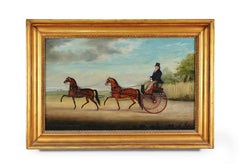
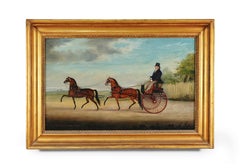
horse & carriage/gig , country scene, antique oil, by John Vine of Colchester

horse & carriage/gig , country scene, antique oil, by John Vine of Colchester

Located in York, GB

A fine antique oil painting, on canvas, of horses pulling a tandem at speed. signed and titled lower left, Vine Colchester 1834 This fine painting shows two horses pulling an open carriage /gig with gentleman in extensive landscape/park The size of the painting is approx 50 x 80 cms, whilst overall the size framed is 100cm x 71 cm This is a fine painting in very good condition housed in a gilt frame ready to hang Provenance: The E. W. Towler Collection, formerly of Glympton Park, Woodstock, Oxfordshire see details below The artist John Vine was born with a disability that did not appear to interfere with his ability to draw and paint, largely self-taught as an animal painter, as his reputation grew he exhibited at the Society of British Artists in Grosvenor Square. Based at Colchester he painted many different subjects including farms, houses, children and animals. Eric W. Towler was a remarkable man. He was born in 1900 and left school at the age of 12 to work in a Yorkshire pit and through a lifetime of hard work, self-improvement, luck and a refusal to limit his horizons achieved many of his aspirations. As a Yorkshireman through and through, he believed in ‘spending the brass in his pocket’ and over time he was successful enough to acquire enough ‘brass’ to enable his purchase of Glympton Park and furnish it as a traditional country house with all the trappings – in his case collections of...

Category

Mid-19th Century Old Masters Art

Materials

Oil

Wooded Figurative River Landscape - Dutch 17thC Golden Age art oil painting

Wooded Figurative River Landscape - Dutch 17thC Golden Age art oil painting

Located in Hagley, England

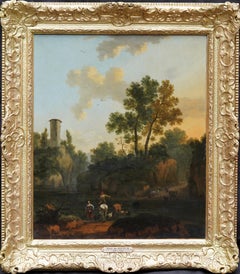
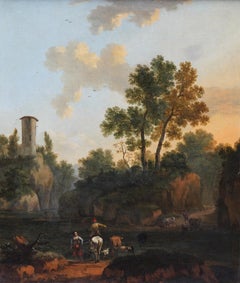
This superb 17th century Dutch Golden Age oil painting has been more recently reattributed to Abraham Begeyn by Dr Marijke C. de Kinkelder formerly of the RKD - Netherlands Institute for Art History. Painted circa 1640 it is an Italianate wooded river landscape with drovers and their herd crossing a river with a watchtower beyond. Begeyn was one of the many 17th-century Dutch and Flemish painters to embrace the Italianate style, populating their decidedly non-Dutch, mountainous landscapes with rustic travellers and picturesque ruins bathed in warm, Mediterranean light. It has Begeyn's characteristic brightly lit cattle and grouping of figures, similar to a comparable painting in the Lichtenstein Princely Collections. The brushwork and details are superb. One can see the influence of his teacher Nicholaes Berchem (1620-1683) and the typical golden glow of the Golden Age painters. This is a stunning 17th century Golden Age oil painting and an excellent example of Begeyn's work. Provenance: With Koetser Gallery, Zurich. Private Collection (Rhine region). Anon. sale, Dorotheum, Vienna, 22 June 2010, lot 357, as by Jacob de Heusch (€18,600). Anon. sale, Christie's South Kensington,18 November 2015, lot 432, as 'Follower of Nicolaes Berchem'; where purchased by the present owner. Note: Begeyn was one of the many 17th-century Dutch and Flemish painters to embrace the Italianate style, populating their decidedly non-Dutch, mountainous landscapes with rustic travellers and picturesque ruins bathed in warm, Mediterranean light. He is thought to have studied under Nicolaes Berchem (1620-1683), a pioneer of this genre of landscape painting, and travelled extensively to Italy, London and later to Germany in 1688, where he lived out his days as court painter to Frederick III, Elector of Brandenburg (later Frederick I, King of Prussia). The present work was previously thought to be the work of Jacob de Heusch (1656-1701), but has been more recently reattributed to Abraham Begeyn by Dr Marijke C. de Kinkelder formerly of the RKD - Netherlands Institute for Art History. A comparable scene, which also includes Begeyn's characteristic brightly lit cattle and a similar figure group, was sold at Christie's Amsterdam, 18 November 2015, lot 110. Another can be found in the Liechtenstein Princely Collections (no.GE 290). Condition. Oil on canvas, image size 21 inches by 18 inches and in good condition. Frame. Housed in a beautiful gilt frame, 28 inches by 25 inches and in good condition. Abraham Begeyn (c. 1637 Leiden - 11 June 1697 Berlin), was a Dutch Golden Age painter. Begeyn was born in Leiden. Though perhaps known mostly for his Italianate landscapes and cattle in the manner of Nicolaes Pietersz Berchem, Begyn was a highly skilled painter active in many genres, who travelled widely. According to the RKD, Begeyn's earliest known work is from 1653, though he was first accepted into the Guild of St. Luke in Leiden in 1655. He stopped paying dues in 1667, because he set off for a trip to Italy. He is registered in Rome and Naples from 1659–1660. In the rampjaar or disaster year, of 1672, he is registered in Amsterdam, and after that he lived in London, where he painted at Ham House, Surrey, together with Willem van de Velde the Younger (1633–1707) and Dirck van Bergen...

Category

1640s Old Masters Art

Materials

Oil

Portrait Mignard Paint Oil on canvsa Old master 17th Century French Lady Woman

Portrait Mignard Paint Oil on canvsa Old master 17th Century French Lady Woman

Located in Riva del Garda, IT

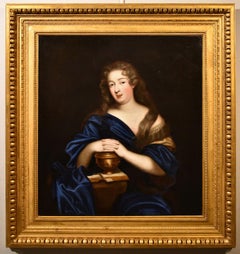
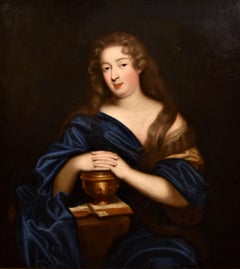
Pierre Mignard, known as Le Romain (Troyes 1612 - Paris 1695), attributed Portrait of 'Louise Renée de Penancoët de Keroualle, Duchess of Portsmouth and Aubigny (Brest 1649 - Paris 1734) as MADDALENA Oil on canvas 97 x 88 cm In an important gilded frame 132 x 122 cm. Provenance: Private collection, Naples The young and attractive noblewoman portrayed in this painting is Louis Renée de Penancoet de Keroualle, Duchess of Portsmouth and Aubigny (Brest 1649 - Paris 1734), known to have been King Charles II's favourite mistress for over fifteen years, from whose relationship Charles Lennox, 1st Duke of Richmond, was born, but above all to have gone down in history as one of Louis XIV's French informants at the English court. The duchess was a very influential figure at court, promoting French interests and often acting as an intermediary between the king, his ministers and French ambassadors. After the death of Charles II this influence quickly came to an end, forcing her to hastily leave London and renounce all her possessions to return to her homeland, between Aubigny-sur-Nère and Paris, where she died in 1734, always remaining in the sovereign's good graces. The peculiarity of the portrait, probably executed after her return to her homeland, is that the noblewoman takes the form of a charming Mary Magdalene, depicted here following her renunciation of earthly possessions, her rich robes and jewellery, in order to aspire to heavenly riches; We see her immortalised with her long hair loose on one breast, her intriguing but serene gaze directed at the observer, as she rests her crossed hands, as if in prayer, on the ampulla of perfumed ointments and the open book, both iconographic symbols. The custom of being portrayed in the guise of Magdalene was in vogue for powerful women of the great European courts as early as the 16th century, as it represented the most appropriate image to justify the union of female power and virtue. It must be said that court culture exalted only the positive characteristics of her personality, glossing over or downplaying all references to her sinful past and dissolute life. The work, whose style fits perfectly into 17th century French portraiture, suggests the pertinent attribution to the Baroque painter Pierre Mignard (Troyes, 1612 - Paris, 1695), whose works were highly praised and earned him a great reputation as a portrait painter for the demanding Parisian aristocracy at the time of Louis XIV, and who portrayed the Duchess de Kérouaille on numerous occasions. His first important artistic training took place in Simon Vouet's studio, and he then moved to Italy for over twenty years before returning to Paris, blending his own with the influence of Roman classicism. The elegant looseness of touch and sensual refinement typical of Mignard, combined with a very accurate chiaroscuro rendering, inherited from his artistic training in Rome (which he looked up to the examples of Ferdinad Voet), and the exceptional sweetness of the drawing, the floridity of the complexion and the almost enamelled surfaces, and finally, the peculiar pose of the figure portrayed (the beauty of the two intertwined hands...

Category

17th Century Old Masters Art
Materials

Oil

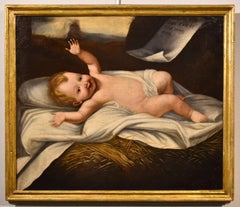
Child Jesus Paint Oil on canvas Old master 17th Century Baby Italian Religious

Child Jesus Paint Oil on canvas Old master 17th Century Baby Italian Religious

Located in Riva del Garda, IT

Lombard painter active in the 17th century Infant Jesus Oil painting on canvas 70 x 82 cm. - In antique frame 78 x 91 cm. This painting depicts an unusual and pleasant iconographic...

Category

17th Century Old Masters Art
Materials

Oil

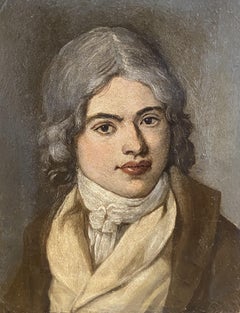
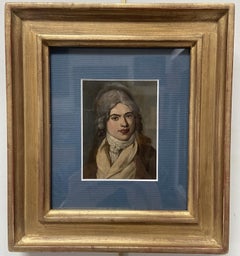
French school late 18th Century, Portrait of a young man, oil on metal

French school late 18th Century, Portrait of a young man, oil on metal

Located in Paris, FR

French school late 18th Century Portrait of a young man oil on metal 10.2 x 7.7 cm Framed under glass : 24.4 x 21.8 cm This small portrait painting, quite original in its technique...

Category

Late 18th Century Old Masters Art
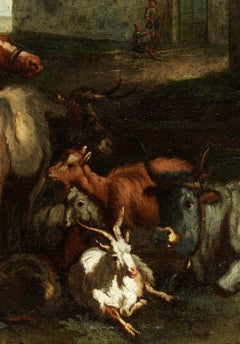
Materials

Oil

Old Masters art for sale on 1stDibs.
Find a wide variety of authentic Old Masters art available for sale on 1stDibs. Works in this style were very popular during the 21st Century and Contemporary, but contemporary artists have continued to produce works inspired by this movement. If you’re looking to add art created in this style to introduce contrast in an otherwise neutral space in your home, the works available on 1stDibs include elements of orange, yellow, blue and other colors. Many Pop art paintings were created by popular artists on 1stDibs, including Charles Amand Durand, Giuseppe Vasi, Thomas Holloway, and Vincenzo Campana. Frequently made by artists working with Etching, and Paint and other materials, all of these pieces for sale are unique and have attracted attention over the years. Not every interior allows for large Old Masters art, so small editions measuring 0.4 inches across are also available. Prices for art made by famous or emerging artists can differ depending on medium, time period and other attributes. On 1stDibs, the price for these items starts at $11 and tops out at $1,495,000, while the average work sells for $546.