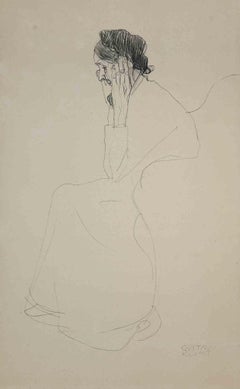
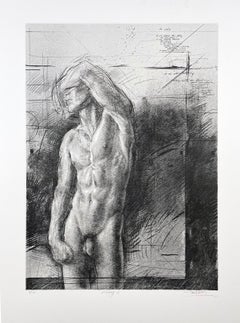
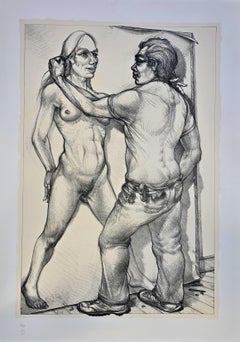
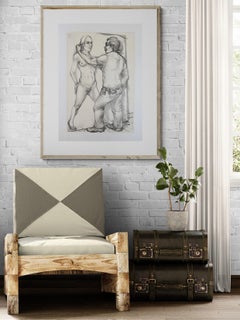
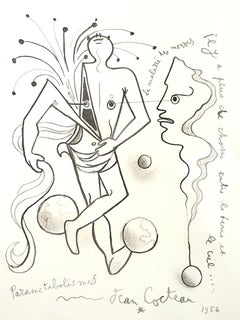
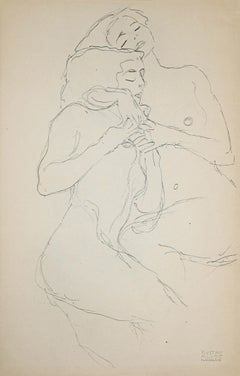
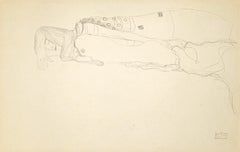
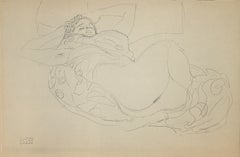
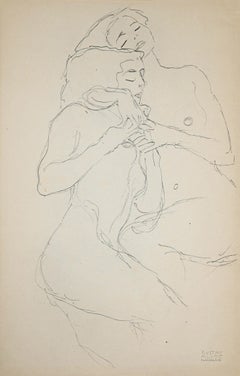
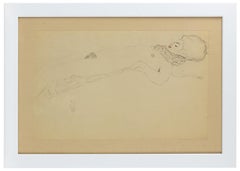
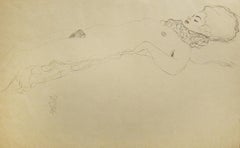
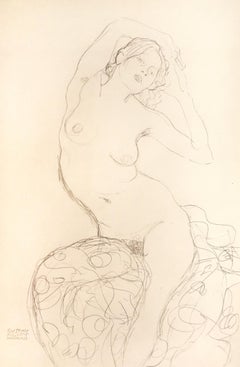
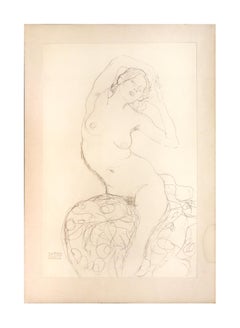
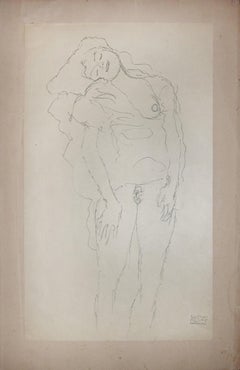
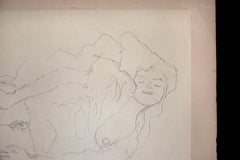
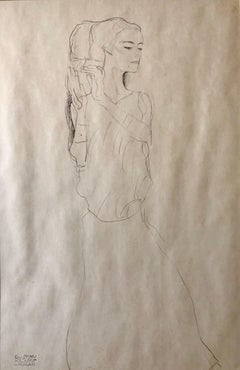
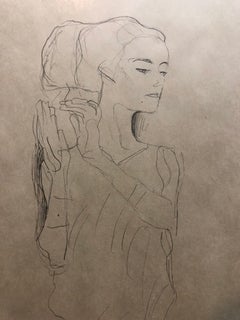
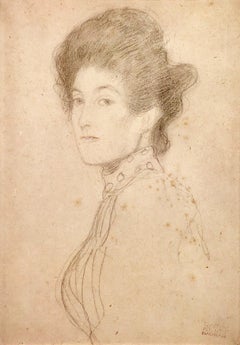
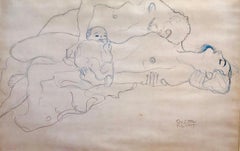
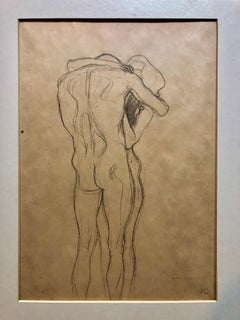
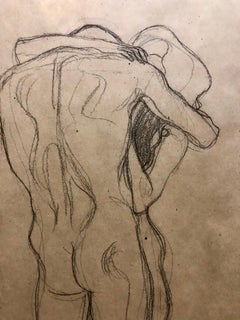
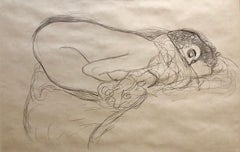
By (after) Gustav Klimt
Located in Surfside, FL
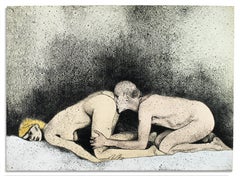
Signed in plate (or stamped with nachlass stamp), also with blind stamp from publisher; from limited edition of 1000 hand numbered; Published in Graz Austria in 1985. The justification sheet is not included.
Gustav Klimt (July 14, 1862 – February 6, 1918) was an Austrian symbolist painter and one of the most prominent members of the Vienna Secession movement. Klimt is noted for his paintings, murals, sketches, and other objets d'art. Klimt's primary subject was the female body, and his works are marked by a frank eroticism. In addition to his figurative works, which include allegories and portraits, he painted landscapes. Among the artists of the Vienna Secession, Klimt was the most influenced by Japanese art and its methods.
Early in his artistic career, he was a successful painter of architectural decorations in a conventional manner. As he developed a more personal style, his work was the subject of controversy that culminated when the paintings he completed around 1900 for the ceiling of the Great Hall of the University of Vienna were criticized as pornographic. He subsequently accepted no more public commissions, but achieved a new success with the paintings of his "golden phase", many of which include gold leaf. Klimt's work was an important influence on his younger contemporary Egon Schiele.
Klimt lived in poverty while attending the Vienna Kunstgewerbeschule, a school of applied arts and crafts, now the University of Applied Arts Vienna, where he studied architectural painting from 1876 until 1883. He revered Vienna's foremost history painter of the time, Hans Makart. Klimt readily accepted the principles of a conservative training; his early work may be classified as academic. In 1877 his brother, Ernst, who, like his father, would become an engraver, also enrolled in the school. The two brothers and their friend, Franz Matsch, began working together and by 1880 they had received numerous commissions as a team that they called the "Company of Artists". They also helped their teacher in painting murals in the Kunsthistorisches Museum in Vienna. Klimt began his professional career painting interior murals and ceilings in large public buildings on the Ringstraße, including a successful series of "Allegories and Emblems".
In 1888 Klimt received the Golden Order of Merit from Emperor Franz Josef I of Austria for his contributions to murals painted in the Burgtheater in Vienna. He also became an honorary member of the University of Munich and the University of Vienna. Characteristic of his style at the end of the 19th century is the inclusion of Nuda Veritas (naked truth) as a symbolic figure in some of his works, including Ancient Greece and Egypt (1891), Pallas Athene (1898) and Nuda Veritas (1899). Historians believe that Klimt with the nuda veritas denounced both the policy of the Habsburgs and the Austrian society, which ignored all political and social problems of that time. In the early 1890s Klimt met Austrian fashion designer Emilie Louise Flöge (a sibling of his sister-in-law) who was to be his companion until the end of his life. His painting, The Kiss (1907–08), is thought to be an image of them as lovers. He designed many costumes that she produced and modeled in his works.
Klimt became one of the founding members and president of the Wiener Sezession (Vienna Secession) in 1897 and of the group's periodical, Ver Sacrum ("Sacred Spring"). He remained with the Secession until 1908. The goals of the group were to provide exhibitions for unconventional young artists, to bring the works of the best foreign artists to Vienna, and to publish its own magazine to showcase the work of members. The group declared no manifesto and did not set out to encourage any particular style—Naturalist, Realist, and Symbolist all coexisted. The government supported their efforts and gave them a lease on public land to erect an exhibition hall. The group's symbol was Pallas Athena, the Greek goddess of just causes, wisdom, and the arts—of whom Klimt painted his radical version in 1898.
Klimt's 'Golden Phase' was marked by positive critical reaction and financial success. Many of his paintings from this period included gold leaf. Klimt had previously used gold in his Pallas Athene (1898) and Judith I (1901), although the works most popularly associated with this period are the Portrait of Adele Bloch-Bauer I (1907) and The Kiss (1907–08).
Klimt travelled little, but trips to Venice and Ravenna, both famous for their beautiful mosaics, most likely inspired his gold technique and his Byzantine imagery. In 1904, he collaborated with other artists on the lavish Palais Stoclet, the home of a wealthy Belgian industrialist that was one of the grandest monuments of the Art Nouveau age. Klimt's contributions to the dining room, including both Fulfillment and Expectation, were some of his finest decorative works, and as he publicly stated, "probably the ultimate stage of my development of ornament."
Klimt's paintings have brought some of the highest prices recorded for individual works of art. In November 2003, Klimt's Landhaus am Attersee sold for $29,128,000, but that sale was soon eclipsed by prices paid for Willem de Kooning's Woman III and later Klimt's own Adele Bloch-Bauer II, the latter of which sold for $150 million in 2016.
In 2006, the 1907 portrait, Adele Bloch-Bauer I, was purchased for the Neue Galerie New York by Ronald Lauder...
Category
20th Century Vienna Secession (after) Gustav Klimt Nude Prints