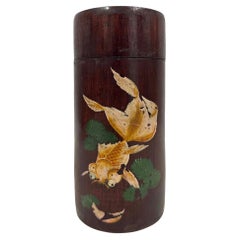
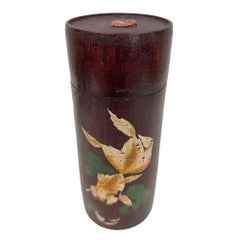
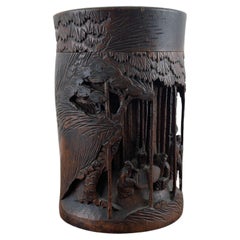
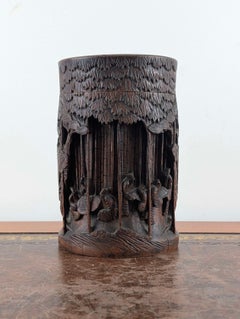
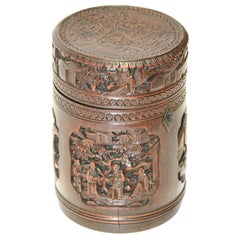
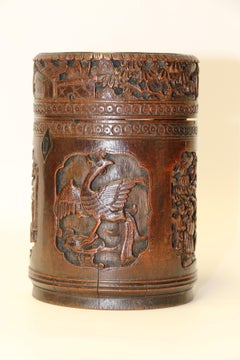
Expanded trade between Europe and East Asia, starting in the 16th century, led to a booming market for exported goods, particularly furniture. This was bolstered by the establishment of the Dutch and English East India Companies at the beginning of the 17th century. From folding screens and chairs to lacquer tables and silver, Chinese Export furniture was in demand and regularly copied and imitated, leading to styles like chinoiserie and Chinese Chippendale.
The expansion of exporting that had strengthened the arts during the Ming dynasty continued into the Qing dynasty era — Chinese designers made many furniture pieces specifically for export, resulting in distinctive designs that mixed traditional techniques with forms appealing to foreign buyers. For instance, cabinetmakers in Canton (modern-day Guangzhou) were prolific in crafting hardwood furniture for export in European styles that involved the expert joinery techniques of Chinese furniture. Designs for Chinese Export porcelain, cabinets, decorative objects and other furniture were often more ornately adorned than they would be for a local audience, such as with mother-of-pearl overlays or surfaces featuring lavish pictorial scenes or gold on black motifs. Some were even commissioned by wealthy European families to be adorned with their coat of arms.
Because lacquer furniture was especially prized, and the resin used to create it was difficult to import as it would harden during the long voyage, artisans in China and Japan exported numerous lacquer pieces. Long before lacquer made its way to Japan, the Chinese treated the material differently. They used it to create smooth, glossy surfaces, but also for carving, an art that began in the 12th century and is exclusively Chinese. These pieces are called cinnabar lacquer after the powdered mercury sulfide (cinnabar) employed to produce their characteristic red hue. A popular form for export was a compact cabinet with drawers, usually displayed on a small table. Undecorated furniture built in Europe was also shipped to China to be lacquered. The international exchange of design would influence furniture into the 19th century and later, informing styles such as Art Deco and Art Nouveau.
Find a collection of antique Chinese Export tables, beds, cupboards, table lamps and more furniture on 1stDibs.
Bamboo — the reed-like, woody grass revered the world over for its attractiveness, durability and unbeatable versatility — has a purity and elegance that Ming Dynasty dignitaries, European royals and workaday folks alike have appreciated for centuries. Antique and vintage bamboo furniture can help introduce an air of relaxation in any space, and pairs well with chinoiserie decor and a range of porcelain decorative objects.
So why is bamboo — in its many forms — so enduringly popular? The grass itself is classic-looking and pleasingly geometric, and it evokes a subtle exoticism that’s both glamorous and (due in large part to its sustainability) highly attainable.
Bamboo is harder than mahogany. It’s a rigid and hollow reed, and as such it is not rattan, which is dense, steamable and bendable, and has become its own ultimate decorative-arts chameleon over the years. But like rattan, bamboo is an organic material that provides a link to nature, helping us to bring a bit of the outside in, in an elegant yet no-frills way that seems comforting and familiar. Plus, bamboo’s lightness and slight irregularities make it the perfect counterpoint to heavy-feeling interiors.
For organic modern interiors — or any space that would benefit from a dose of the natural world — a variety of vintage bamboo outdoor furniture, side tables, dining chairs and more can be found on 1stDibs.