By Sir William Rothenstein
Located in Soquel, CA
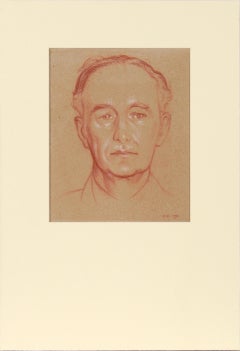
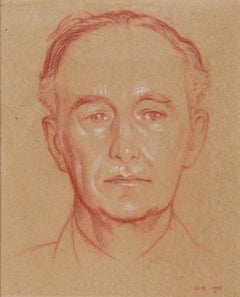
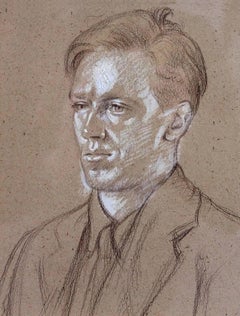
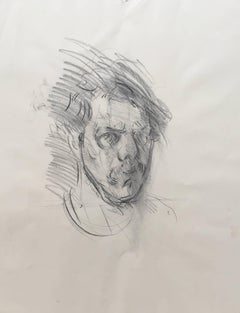
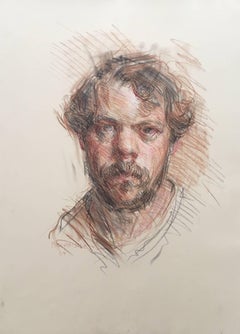
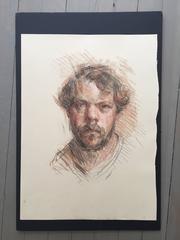
Stately sanguine portrait of Leopold Hamilton Myers (Novelist) by Sir William Rothenstein (English, 1872-1945). Captured in Rothenstein's characteristic style, Myers looks directly at the viewer with a neutral expression. Although this portrait uses only two colors and minimal shading, the likeness of Myers is incredibly well captured. Leo (Leopold) Hamilton Myers (1881 – 1944) was a British novelist. Numerous examples like this one of the writer are in the Tate Museum.
Initialed and dated in the lower right corner ("W.R. 1936")
Inscription on verso indicating materials, subject, and artist.
Presented in a new cream colored mat with foamcore backing.
Mat size: 18"H x 12"W
Paper size: 15.25"H x 10.75"W
William Rothenstein (English, 1872-1945) was born into a German-Jewish family in Bradford, West Yorkshire. His father, Moritz, emigrated from Germany in 1859 to work in Bradford's burgeoning textile industry. Soon afterwards he married Bertha Dux, and they had six children, of which William was the fifth. Rothenstein was knighted in 1931.
Rothenstein left Bradford Grammar School at the age of sixteen to study at the Slade School of Art*, London (1888-1893), where he was taught by Alphonse Legros, and the Académie Julian* in Paris (1889-1893), where he met and was encouraged by James McNeill Whistler, Edgar Degas and Henri Toulouse-Lautrec. Whilst in Paris he also befriended the Anglo-Australian artist Charles Conder, with whom he shared a studio in Montmartre. In 1893 he returned to England to work on "Oxford Characters" a series of lithographic* portraits.
In Oxford he met and became a close friend of the caricaturist* and parodist Max Beerbohm, who later immortalised him in the short story Enoch Soames (1919). During the 1890s Rothenstein exhibited with the New English Art Club* and, in 1900, won a silver medal for his painting The Doll's House at the Exposition Universelle. In 1898 he co-founded the Carfax Gallery in St. James' Piccadilly with John Fothergill. During its early years the gallery was closely associated with such artists as Charles Conder, Philip Wilson Steer, Charles Ricketts and Augustus John. It also exhibited the work of Auguste Rodin, whose growing reputation in England owed much to Rothenstein's friendship and missionary zeal. The gallery was later the home for all three exhibitions of The Camden Town Group*, led by Rothenstein's friend and close contemporary Walter Sickert.
Rothenstein is best known for his portrait drawings of famous individuals and for being an official war artist in both World War I and World War II. He was also a member of the International Society of Sculptors, Painters & Gravers. The style and subject of his paintings varies, though certain themes reappear, in particular an interest in 'weighty' or 'essential' subjects tackled in a restrained manner. Good examples include Parting at Morning (1891), Mother and Child (1903) and Jews Mourning at a Synagogue (1907) - all of which are owned by the Tate Gallery. The National Portrait Gallery owns over two hundred of his portraits. In 2011 the BBC and the Public Catalogue Foundation began cataloguing all of his paintings in public ownership online.
Between 1902 and 1912 Rothenstein lived in Hampstead, London, where his social circle included such names as H.G.Wells, Joseph Conrad and the artist Augustus John. Amongst the young artists to visit Rothenstein in Hampstead were Mark Gertler...
Category
1930s Realist Sir William Rothenstein Art
MaterialsConté, Handmade Paper