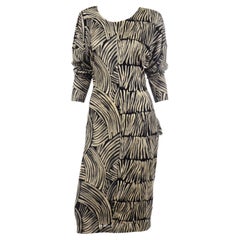
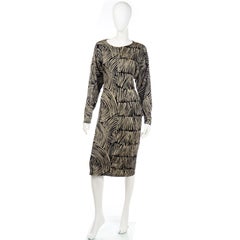
In 1953, Ottavio “Tai” Missoni (1921–2013) and Rosita Missoni (b. 1931) opened a small knitwear shop in Gallarate, Italy, paving the way for what would become an iconic style of colorful chevron knit.
Missoni began with a tracksuit, which featured zippers down the legs because, as Rosita recalls it, “Tai was too lazy to take off his shoes when putting them on.” The couple’s fashion really took off, though, once they discovered the Raschel knitting machine on a trip to a shawl factory. The machine enabled the Missonis to knit multiple colors in a zigzag pattern, a motif that would go on to become synonymous with the Missoni brand across everything from its alluring vintage day dresses and sweaters to its purses, seating and rugs.
Missoni held its first fashion show in Florence in 1967 and caused a bit of a sensation when the models’ Lurex dresses proved translucent under the lights at the Pitti Palace. Scandal aside, the show went down in history as a hit, and the Missonis soon made their debut in the United States with the help of legendary fashion editor Diana Vreeland, who gave the variegated Missoni stripe the Vogue seal of approval, saying, “Who says a rainbow has seven colors? It has many shades.” (It was also Vreeland who reportedly introduced the Missonis to Neiman Marcus president Stanley Marcus, effectively shepherding the brand to the American market.)
Missoni’s many-shaded rainbow would soon become an emblem of the 1970s fashion scene, earning the brand a permanent place in the fashion canon. In 1973, the New York Times proclaimed: “Missoni’s weaved garments have ended up universal materialistic trifles, as Vuitton sacks and Gucci shoes.”
The brand branched into the home market in 1983, with Rosita overseeing this new venture, Missoni Home, which included furniture, textiles and accessories. Daughter Angela succeeded her mother at the helm of the brand, where she served as creative director until 2021 and is currently president; her brother Luca is CEO, while her daughter Margherita was creative director of M Missoni, a modestly priced offshoot that was discontinued in 2021.
Find vintage Missoni clothing and accessories today on 1stDibs.
Luxurious and versatile, designer day dresses are as well suited to tea at an upscale hotel as they are to your next garden or rooftop party.
Today’s featherlight unisex day dresses — as well as the vibrant vintage day dresses of the 1950s and ’60s — look quite different from the heavy, fabric-rich de rigueur garments of the Victorian era. In the late 19th century, a woman of a certain standing might have multiple dresses to wear throughout the day: specifically, one or two for the daytime and one for the evening. For example, a long-sleeve silk dress with a prominently flared back and a round collar of gold beaded lace that hugs the neck would be suitable for stepping out during the day, while a velvet gown trimmed in silk embroidery but overall comparatively informal in appearance would be worn for afternoon tea at home. At night, a silk velvet evening dress could feature natural world motifs such as butterflies (a characteristic of Art Nouveau design) and have short sleeves adorned with lace and ruffles and a scooped neckline — the perfect attire for the theater.
During the 1920s, after all the chores were done, a woman would change from her housework clothing into a more fashionable day dress to run her errands or socialize. Some 1920s day dresses were brightly colored and featured bold patterns — a cotton dress with a dazzling floral print, perhaps, or, in the case of the more venturesome Art Deco apparel sold in high-end couture fashion boutiques of the era, semi-sheer silk garments embellished with three-dimensional beadwork or rich metallic gold lamé.
Today, a closet full of casual vintage day dresses is a must-have. Whether you opt for black, crimson or beige, day dresses bring an element of glamour to your next appointment, and in the summer, who doesn’t love a wonderfully simple, lightweight day dress cut in cotton and linen?
Because different fashion designers of every decade have offered their own take on the widely loved day dress, you’ll be able to find a variety of vintage and designer day dresses on 1stDibs. Search by creator to find enduring designs by the likes of Emilio Pucci, Pierre Cardin, Yves Saint Laurent and Christian Dior, or browse by period to uncover a scintillating collection of cotton and satin patterned dresses of the 1950s and ’60s.