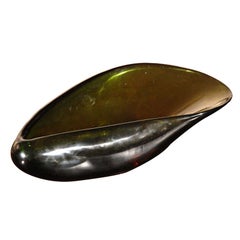
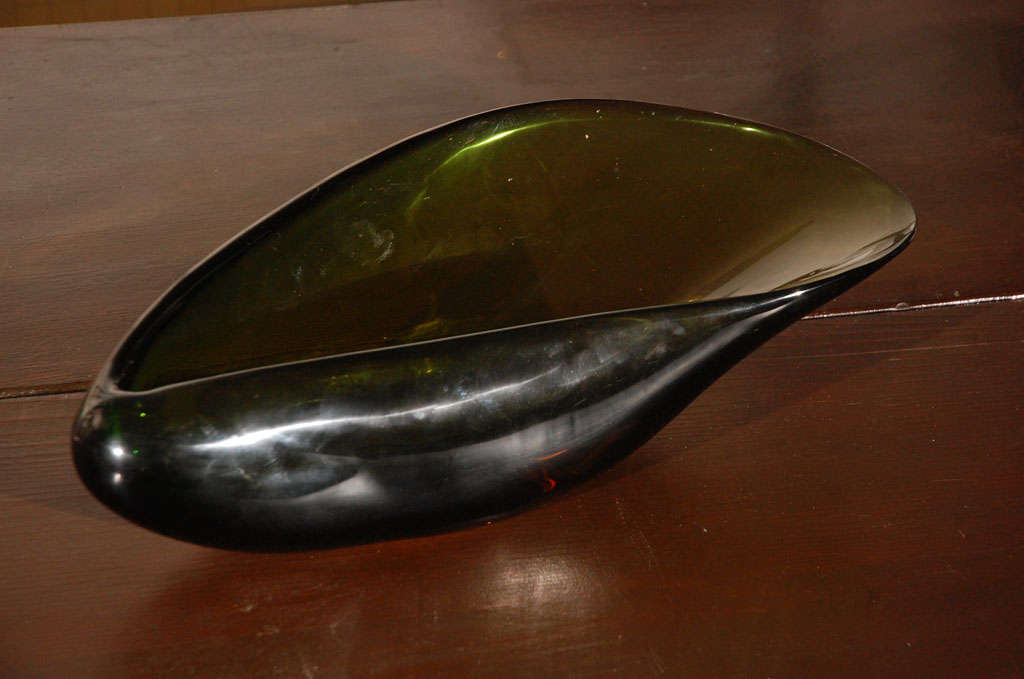
Rare Archimede Seguso \"Valva\" murano glass bowl
By Seguso Vetri d'Arte
Located in Los Angeles, CA
This is a rare Valva line in a thick glass green, brown, yellow colors.
Category
Vintage 1950s Italian Modern Decorative Bowls
Materials
Glass
Rare Archimede Seguso \"Valva\" murano glass bowl
By Seguso Vetri d'Arte
Located in Los Angeles, CA
This is a rare Valva line in a thick glass green, brown, yellow colors.
Glass
Sold
H 4.25 in W 14.5 in D 8.25 in
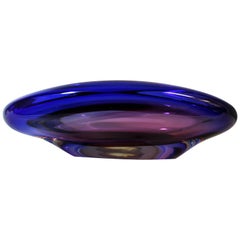
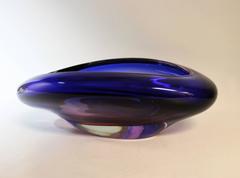
Flavio Poli Murano Glass 'Valva' Centerpiece Bowl for Seguso Vetri d'Arte
By Seguso Vetri d'Arte, Flavio Poli
Located in Hamilton, Ontario
Flavio Poli designed "Valva" large handblown glass centerpiece with submerged layers in
Art Glass
Members of the Seguso family have been leading figures in the manufacture of glass on the Venetian island of Murano since the late 1300s, but for most collectors of vintage design the name evokes two companies formed in the first half of the 20th century. Seguso Vetri d’Arte, born from a small consortium of master glass artisans that included Archimede Seguso (1909–99), thrived under the artistic directorship of Flavio Poli (1900–84), a designer with an eye for modern forms, color and pattern. Vetreria Archimede Seguso, meanwhile, was founded in 1946, when Seguso opened his own atelier in order to employ classical techniques in the making of modern glassware.
The owners of Seguso Vetri d’Arte were justly proud of their skills as craftsmen, but they were not worldly aesthetes — and they knew it. Poli had studied at the Art Institute of Venice, originally working in ceramics before switching mediums and taking up the art of glass. He introduced new simple forms to the genre — the best known of his designs being the Valva, which resembles a clamshell in profile — and employed several novel techniques such as corroso, which gives glass a rough, emery-board-like finish. Poli’s most collectible works are his sommerso pieces, made with a layering process in which clear and colored-glass vessels are “submerged” within one another, producing a kind of nesting-doll effect in striking, elegant vases with bands of separate and overlapped hues.
At his eponymous workshop, Archimede Seguso often favored highly decorative, age-old techniques employed with modern restraint. His layered-glass Losanghe vessels have the look of an abstract checkerboard while his free-form Merletto vases have delicate, lacy patterns created by painstakingly twisting two heated glass straws to create helixes around the walls of the piece.
Though different in their scope and mission, both of these furnaces bearing the Seguso name created some of the most beautiful, alluring and exquisitely crafted works in all of modern design.
Vintage, new and antique decorative bowls have been an important part of the home for centuries, although their uses have changed over the years. While functional examples of bowls date back thousands of years, ornamental design on bowls as well as baskets likewise has a rich heritage, from the carved bowls of the Maya to the plaited river-cane baskets of Indigenous people in the Southeast United States.
Decorative objects continue to bring character and art into a space. An outdoor gathering can become a sophisticated garden party with the addition of a few natural-fiber baskets to hold blankets or fruit on a table, as demonstrated in the interior design work by firms such as Alexander Design.
Elsewhere, Richard Haining’s reclaimed wood vases and bowls can express eco-consciousness. Sculptural handmade cast concrete bowls like those made by the Oakland, California–based UMÉ Studio introduce compelling textures to your dining room table.
Minimalist ceramic decorative bowls of varying colors can evoke a feeling of human connectedness through their association with handmade craftsmanship, such as in the rooms envisioned by South African interior designer Kelly Hoppen. And you can elevate any space with ceramic bowls that match the color scheme.
Browse the 1stDibs collection of decorative bowls and explore the endless options available.