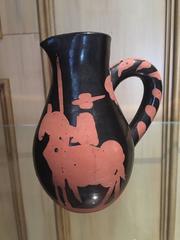
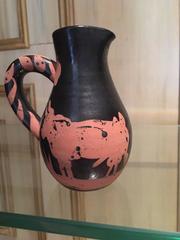
Picasso Madoura Ceramic Ramie 162 Picador
By Pablo Picasso
Located in Boca Raton, FL
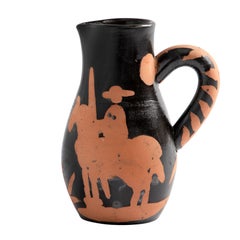
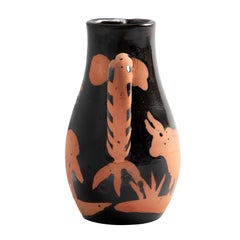
Ramie 162 -- Picador 1952 Edition of 500 Earthenware clay, oxidized paraffin decoration.
Category
Mid-20th Century Cubist Still-life Sculptures
Materials
Ceramic
Picasso Madoura Ceramic Ramie 162 Picador
By Pablo Picasso
Located in Boca Raton, FL
Ramie 162 -- Picador 1952 Edition of 500 Earthenware clay, oxidized paraffin decoration.
Ceramic
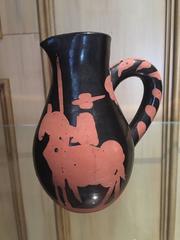
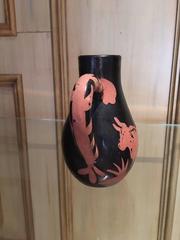
PICADOR (A. Ramié no. 162) Picasso Ceramic
By Pablo Picasso
Located in Boca Raton, FL
PICADOR (A. Ramié no. 162) marked 'Edition Picasso/Madoura' (underneath) partially glazed terracotta pitcher Height: 5¼ in. (13.4 cm.)
Ceramic
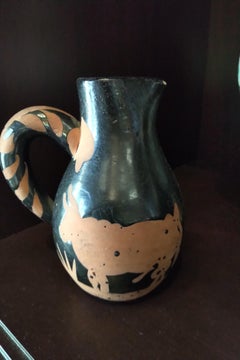
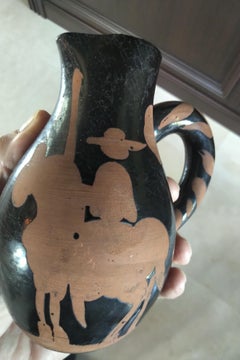
Picasso Madoura Ceramic A.R. 162 Picador
By Pablo Picasso
Located in Boca Raton, FL
Pablo Picasso A.R. 162 Picador 1952, August 5 5.25” high Edition of 500 Red earthenware clay, paraffin decoration, black enamel Ramie 162 is a Madoura ceramic that one rarely sees co...
Ceramic
Sold
H 5.25 in Dm 5.25 in
Pablo Picasso 'Picador' (A. R. 162) Bullfighter Madoura Pitcher 1952
By Pablo Picasso
Located in Miami, FL
PABLO PICASSO (1881-1973) Picador (A. R. 162) Terre de faïence pitcher, 1952, from the edition of 500, incised 'Edition Picasso' and 'Madoura', partially glazed and painted.
Ceramic, Earthenware, Glaze
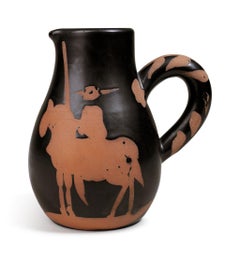
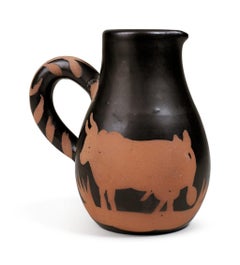
Madoura Ceramic Pitcher 'Picador' Ramié 162
By Pablo Picasso
Located in Miami, FL
This Picasso ceramic plate "Picador, Ramié 162" is made of earthenware clay and partially glazed.
Ceramic, Earthenware, Glaze
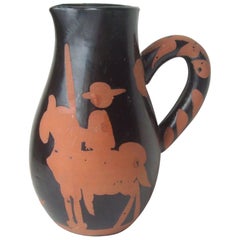
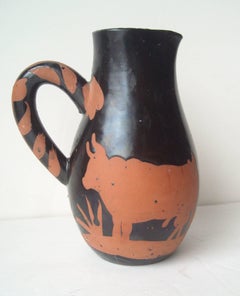
Pablo Picasso Ceramic Pitcher Title "Picador" Madoura, Ramie 162, Year 1952
By Pablo Picasso
Located in Los Angeles, CA
Beautiful ceramic by Pablo Picasso when he worked in Vallauris, France. Signed edition Picasso Madoura in bottom. Edition of 500, made in 1952.
Ceramic
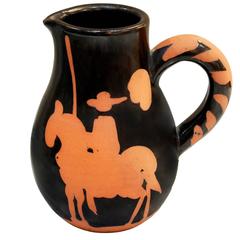

Pablo Picasso Picador Pitcher, 1952
By Pablo Picasso
Located in Fort Lauderdale, FL
Hand-thrown partially glazed terracotta pitcher Picador (Alain Ramie 162) marked 'Edition Picasso/Madoura' on bottom, France 1952 (edition of 500).
Earthenware
One of the most prolific and revolutionary artists the world has ever seen, Pablo Picasso had a tremendous impact on the development of 20th-century modern art. Although he is best known for his association with the Cubist movement, which he founded with Georges Braque, Picasso’s influence extends to Surrealism, neoclassicism and Expressionism.
“Every act of creation is, first of all, an act of destruction,” the Spanish artist proclaimed. In Picasso's Cubist paintings, he emphasizes the two-dimensionality of the canvas, breaking with conventions regarding perspective, foreshortening and proportion. Picasso was inspired by Iberian and African tribal art. One of his most famous pre-Cubist works is Les Demoiselles d’Avignon (1907), a painting considered immoral and shocking at the time for its depiction of nude women whose faces resemble Iberian tribal masks.
Picasso made many portraits in this style, most often of the women in his life, their expressively colored faces composed of geometric shards of surface planes. In Woman in a Hat (Olga), 1935, he painted his first wife as an assemblage of abstract forms, leaving the viewer to decipher the subject through the contrasting colors and shapes. Picasso was a tireless artist, creating more than 20,000 paintings, drawings, prints, ceramics and sculptures. Tracing his life’s work reveals the progression of modern art, on which he had an unparalleled influence.
Browse an expansive collection of Pablo Picasso's art on 1stDibs.