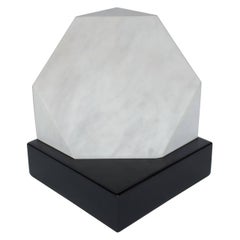
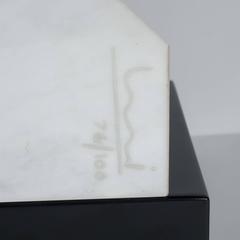
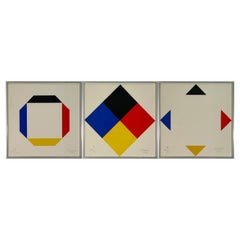
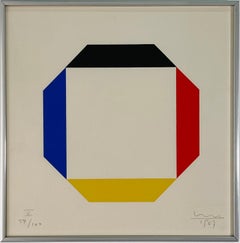
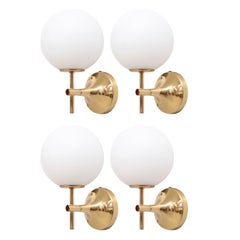
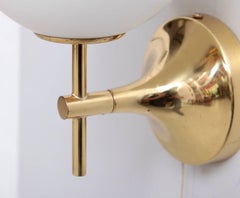
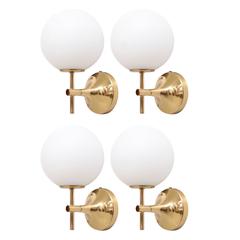
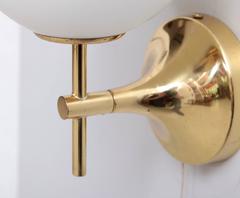
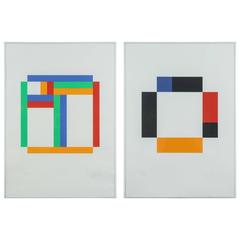
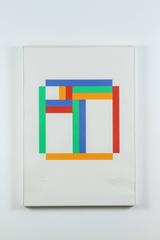
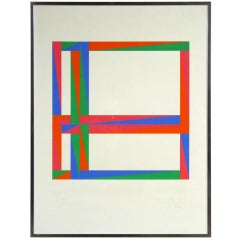
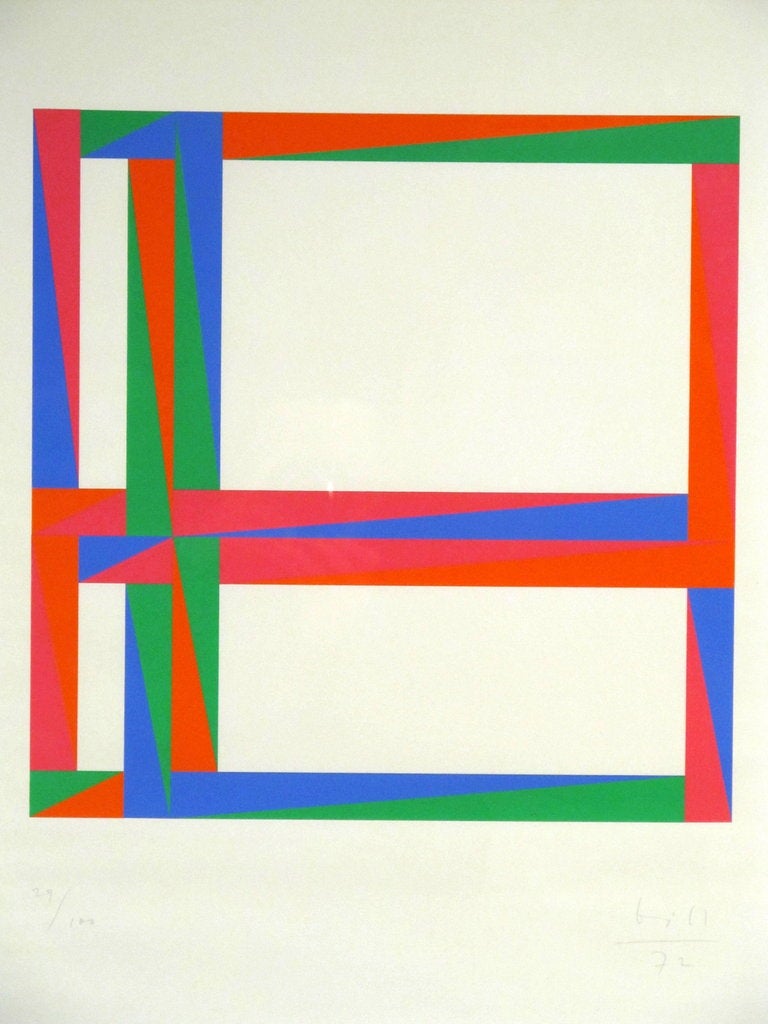
With a vast inventory of beautiful furniture at 1stDibs, we’ve got just the max bill signed you’re looking for. Each max bill signed for sale was constructed with extraordinary care, often using
metal,
glass and
opaline glass. Whether you’re looking for an older or newer max bill signed, there are earlier versions available from the 20th Century and newer variations made as recently as the 20th Century. When you’re browsing for the right max bill signed, those designed in
mid-century modern and
modern styles are of considerable interest. A well-made max bill signed has long been a part of the offerings for many furniture designers and manufacturers, but those produced by
Max Bill,
Geraldo de Barros and
Junghans Uhren GmbH are consistently popular.
Prices for a max bill signed can differ depending upon size, time period and other attributes — at 1stDibs, they begin at $979 and can go as high as $37,200, while the average can fetch as much as $2,568.
Max Bill was born in Winterthur, Switzerland. After an apprenticeship as a silversmith during 1924–27, he took up studies at the Bauhaus in Dessau under many teachers including Wassily Kandinsky, Paul Klee and Oskar Schlemmer from 1927 to 1929, after which he moved to Zurich.
After working on graphic designs for the few modern buildings being constructed, Bill built his first work, his own house and studio (1932–3) in Zurich-Höngg. From 1937 onward he was a prime mover behind the Allianz group of Swiss artists.
Bill is widely considered the single most decisive influence on Swiss graphic design beginning in the 1950s with his theoretical writing and progressive work. His connection to the days of modernism gave him special authority. As an industrial designer, his work is characterized by a clarity of design and precise proportions. Examples are the elegant clocks and watches designed for Junghans, a long-term client. Among Bill's most notable product designs is the Ulmer Hocker of 1954, a stool that can also be used as a shelf element, a speaker's desk, a tablet or a side table. Although the stool was a creation of both Bill's and Ulm School designer Hans Gugelot's, it is often called "Bill Hocker" because the first sketch of it on a cocktail napkin was Bill's work.
As a designer and artist, Bill sought to create forms which visually represent the New Physics of the early 20th century. He sought to create objects so that the new science of form could be understood by the senses: that is as a concrete art. Thus Bill is not a rationalist – as is typically thought – but rather a phenomenologist. He made spare geometric paintings, prints and spherical sculptures, some based on the Möbius strip, in stone, wood, metal and plaster. His architectural work included an office building in Germany, a radio studio in Zurich, and a bridge in eastern Switzerland.
Bill continued to produce architectural designs, such as those for a museum of contemporary art (1981) in Florence and for the Bauhaus Archive (1987) in Berlin. In 1982 he also entered a competition for an addition to the Neue Nationalgalerie in Berlin, built to a design by Ludwig Mies van der Rohe. Pavillon-Skulptur, a large granite sculpture, was installed adjacent to the Bahnhofstrasse, Zürich in 1983. As is often the case with modern art in public places, the installation generated some controversy. Endlose Treppe, a sculpture made of North American granite, was designed for the philosopher Ernst Bloch.
In 1982 he was awarded the Sir Misha Black award and was added to the College of Medallists.
Bill executed many public sculptures in Europe and exhibited extensively in galleries and museums, including a retrospective at the Kunsthaus Zürich in 1968–69. He was the subject of retrospectives at the Albright-Knox Art Gallery in Buffalo and the Los Angeles County Museum of Art in 1974, and the Solomon R. Guggenheim Museum in New York City in 1988.
Find vintage Max Bill stools, lighting, and other furniture on 1stDibs.