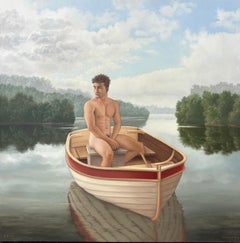
The twelve paintings in the exhibition are imaginary film stills based on on a Science Fiction screenplay, titled Regression, that was supposedly developed in the 1950s. The film was never made and, to Hempel’s knowledge, none of the script survived.
As Hempel tells the story, a crew of astronauts travel to an exoplanet with a tropical Earth-like atmosphere and immediately get separated from each other when they set out to explore. Isolated, they start to rapidly grow younger. Wading in the water seems to slow the regression process. It is later revealed that the planet is a sentient life form that is purposefully regressing them as it can only communicate with minds that are free of dishonesty and aggression. By returning the astronauts to innocence, the planet hopes to establish contact. Constructed from memory, these paintings are Hempel’s musings on what the film might have looked like. There is a playfulness and and absurdity to the paintings. A spaceship hangs over the Hollywood sign next to two dramatically singular palm trees. The figures pose like 1950s film stars in the water while ships loom over their heads and steep cliffs rise behind them. Painted at an intimate scale ranging from 16x16 inches to 20x30 inches, the paintings draw on Hempel’s well-known practice of commenting on assumed narratives of masculinity in art and popular culture and the lack of representation of gay men.
The figures are shirtless and seemingly unaware of the viewer but on a mission. Expressions of concern cross some of their faces while others are lost in thought - a surreal battalion of statuesque young men. Hempel is turning the pop culture trope of half dressed beautiful women on its head and depicting beautiful men in these paintings. With the lost film script as the framework, Hempel uses his immense technical skill to deftly recontextualize the male figure.
Wes Hempel’s paintings forge a provocative dialogue between past and present - asking us to consider the ways in which the dominant narratives depicted in art and pop culture have presented a single viewpoint and lacked significantly in representation.
Wes Hempel was born in El Monte, CA, in 1953. He received his BA from Cal State Northridge in 1985 and his MA from UC Boulder in 1988. He has exhibited extensively throughout the US since 1987 and his paintings are included in numerous private and public collections including the Denver Art Museum, Microsoft Art Collection, and the New Britain Museum of American Art (CT), among others. He lives and work in Colorado.
It could be argued that cave walls were the canvases for the world’s first landscape paintings, which depict and elevate natural scenery through art, but there is a richer history to consider.
The Netherlands was home to landscapes as a major theme in painting as early as the 1500s, and ink-on-silk paintings in China featured mountains and large bodies of water as far back as the third century. Greeks created vast wall paintings that depicted landscapes and grandiose garden scenes, while in the late 15th century and early 16th century, landscapes were increasingly the subject of watercolor works by the likes of Leonardo da Vinci and Fra Bartolomeo.
The popularity of religious paintings eventually declined altogether, and by the early 19th century, painters of classical landscapes took to painting out-of-doors (plein-air painting). Paintings of natural scenery were increasingly realistic but romanticized too. Into the 20th century, landscapes remained a major theme for many artists, and while the term “landscape painting” may call to mind images of lush, grassy fields and open seascapes, the genre is characterized by more variety, colors and diverse styles than you may think. Painters working in the photorealist style of landscape painting, for example, seek to create works so lifelike that you may confuse their paint for camera pixels. But if you’re shopping for art to outfit an important room, the work needs to be something with a bit of gravitas (and the right frame is important, too).
Adding a landscape painting to your home can introduce peace and serenity within the confines of your own space. (Some may think of it as an aspirational window of sorts rather than a canvas.) Abstract landscape paintings by the likes of Korean painter Seungyoon Choi or Georgia-based artist Katherine Sandoz, on the other hand, bring pops of color and movement into a room. These landscapes refuse to serve as a background. Elsewhere, Adam Straus’s technology-inspired paintings highlight how our extreme involvement with our devices has removed us from the glory of the world around us. Influenced by modern life and steeped in social commentary, Straus’s landscape paintings make us see our surroundings anew.
Whether you’re seeking works by the world’s most notable names or those authored by underground legends, find a vast collection of landscape paintings on 1stDibs.