Adolf Constantin Baumgartner-Stoiloff Art

to
1
Overall Width
to
Overall Height
to
1
1
1
1
1
1
1
1
1
1
1
2
10,358
2,785
2,504
1,384
1
1
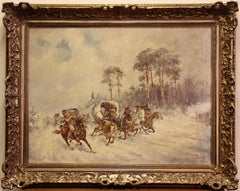
Artist: Adolf Constantin Baumgartner-Stoiloff
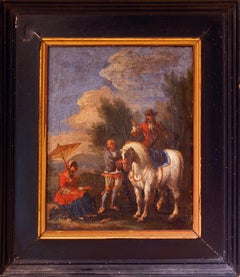
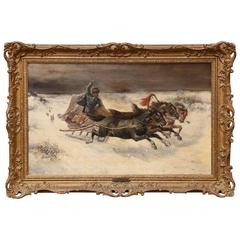
Russian oil painting 'The Chase' signed C. Stoiloff
By Adolf Constantin Baumgartner-Stoiloff
Located in London, GB
Russian oil painting 'The Chase' signed C. Stoiloff Russian, early 20th Century Frame: Height 84cm, width 122cm, depth 7cm Canvas: Height 66cm, wi...
Category

20th Century Old Masters Adolf Constantin Baumgartner-Stoiloff Art

Materials

Canvas, Oil

Related Items
Military Camp Scene and Battle. Pietro Graziani (XVII/XVIII century), entourage
Located in Firenze, IT
Military Camp Scene and Battle. Pietro Graziani (XVII/XVIII century), entourage. A pair ( two) of small paintings. Antique XIX century frames in gilt wood.  In good condition. Oi...
Category

Early 18th Century Old Masters Adolf Constantin Baumgartner-Stoiloff Art

Materials

Canvas, Oil

Military Camp Scene and Battle. Pietro Graziani (XVII/XVIII century), entourage
$2,050 Sale Price
51% Off
H 13.39 in W 10.24 in D 1.19 in
Figures Chatting outside Village Tavern in Mountain Landscape, Period Oil
By 19th century Dutch or Flemish school
Located in Cirencester, Gloucestershire
Dutch/ Flemish School, early 1800's oil on canvas, framed framed: 19 x 24 inches canvas: 13.5 x 18.5 inches provenance: private collection, France condition: good and sound condition...
Category

Early 19th Century Old Masters Adolf Constantin Baumgartner-Stoiloff Art

Materials

Oil, Canvas

Huge 1800's English Oil Painting Man with Horses Resting Panoramic Country View
By Thomas Barker of Bath
Located in Cirencester, Gloucestershire
Pausing for a Rest English School, circa 1800, unsigned the painting is very close to the works of Thomas Barker of Bath (English 1769-1847) oil on canvas, framed framed: 29 x 39 inc...
Category

Early 19th Century Old Masters Adolf Constantin Baumgartner-Stoiloff Art

Materials

Oil, Canvas

VENICE - Gianluca Gorini - Italian Landscape Oil on Canvas Painting
By Giancarlo Gorini
Located in Napoli, IT
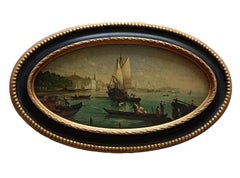
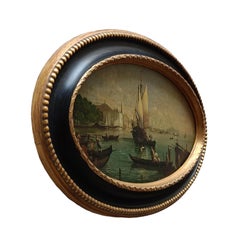
VENICE - Italian landscape oil on canvas oval painting cm.44x74 by Giancarlo Gorini, Italy 2002. Gold gilded wooden frame available o...
Category

Early 2000s Old Masters Adolf Constantin Baumgartner-Stoiloff Art

Materials

Canvas, Oil

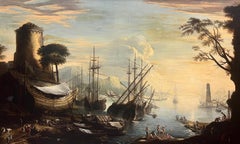
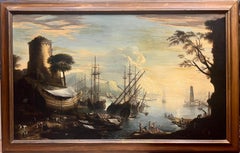
Bustling 17th century harbour landscape with fishermen, visitors and merchants
Located in Aartselaar, BE
A bustling scene of fishermen, merchants, and visitors in a peaceful and picturesque port village This engaging painting offers a vivid and atmospheric glimpse into daily life in th...
Category

17th Century Old Masters Adolf Constantin Baumgartner-Stoiloff Art

Materials

Oil, Canvas

Period Marine Landscape Credited to Warren Sheppard
By Warren W. Sheppard
Located in Roma, IT
This beautiful painting, due to its very high quality of execution, style and era, can be referred to the great artist Warren Sheppard, who specialized in seascapes. Of great evocati...
Category

19th Century Old Masters Adolf Constantin Baumgartner-Stoiloff Art

Materials

Canvas, Oil

Peasants in a Cornfield (Boer in het veld) by David Teniers the Younger
By David Teniers the Younger
Located in Stockholm, SE
Remembering the magic of everyday life moments in the art of David Teniers: The art of David Teniers the Younger (1610–1690) coincided with the heyday of the Flemish Baroque and captured a great variety of motifs of his time. In this painting of a seemingly simple peasant scene lies keys to understanding both the imaginative mind of Teniers as well as why this time period produced some of the most iconic works in all of art history.  As indicated by the name, Teniers was more or less born into his profession. As the son of David Teniers the elder, himself a painter who studied under Rubens, the younger David received training in art from a very young age and had no less than three brothers who also became painters. Because of his father’s frequent financial failures that even at times saw him imprisoned, David the younger helped to rescue the family from ruin through painting copies of old masters. Essentially, the young Teniers was confronted with painting as both a passion and creative expression as well as a necessity during difficult times, an experience that would shape much of his capacity and sensitivity in his coming life. Despite the hardships, the talent and determination of Teniers was recognized and quickly expanded his possibilities. He had already spent time in France and possibly also England when he was hired by his father’s former teacher Rubens to help with a prestigious commission with mythological paintings, now considered lost, for Philip IV the king Spain. In 1644–54 Teniers was appointed dean of the Antwerp Guild of Saint Luke, manifesting his esteemed position within the artistic community. A few years afterwards he took an important step when relocating to Brussels, where Teniers yet again found new career opportunities that would prove to be very successful. As the keeper of the collections of Archduke Leopold Wilhelm, a role similar to what we now refer to as an art advisor, Teniers purchased hundreds of important artworks that manifested the prominent status of the Archduke’s collection while at the same time providing an unusual access to inspiration and knowledge for Teniers himself. Since he kept on painting during the same time, his creative scope must have seemed almost bewildering in the great variety of images and stories that he surrounded himself with.  Regardless of how glamorous and culturally stimulating the career of Teniers was, he was as open to the charm and existential importance of everyday life as he was to works of great masters and luxurious collectibles. In his impressive repertoire of genres with everything from exquisite royal portraits, interiors, landscapes and history paintings he always added something new and inventive, highlighting the possibilities of art and importance of an experimental and intuitive mind. It is difficult to single out one aspect or genre to summarize his legacy, since it lies much more in the broad virtuosity across many motifs, although he is particularly remembered for farm scenes and meticulously depicted interiors where other paintings and artworks are captured with an astonishing precision. However, the fact that he is still today one of the most known and celebrated names of the Dutch Golden Age is a proof to the magic of his work, which continues to spark dialogue and wonder in the contemporary viewer of his works. The farm boy in the field in this painting, which likely dates to the mature part of his career, is a wonderful entry into the mind of Teniers. In the tightly cropped motif, we see him standing right in the middle of the busy harvest when men, women and everyone capable were sent out in the field to collect the crop that formed the very core of their diet and survival. In the background we see a fresh blue sky interspersed with skillfully painted clouds, some trees reaching their autumnal colours and in the far distance the glimpse of a small church and village. The presence of a church in a landscape, so typical of Dutch art, served both a symbolic and visual function as a representation of faith while at the same time defining scale and distance. In the field, the work is in full action with the farmers spread out in various positions, all in the midst of hard and sweaty labour. While they are portrayed as having nothing else than the work on their mind, our farm boy seems to have his attention directed elsewhere. Standing there with his white, half open shirt, flowy curls and strong, sturdy body; his gaze is directed away, out of the picture and the scythes in his hands. He looks almost smirking, expressed with tremendous subtlety in the slight smile of his lips and big eyes, being just in the middle of losing focus on the work. What is it that steals his attention? What has he seen, or realized, or felt – to break him free of the arduous task of harvesting, if but for a moment? Here starts the wondering and the questions that are the hallmark of a great piece of art. Instead of explicitly locking in the motif in overly clear symbolism Teniers has chosen an open ended, subtle yet striking moment for us to consider. While it of course can be related to numerous other farm scene depictions of this time, and clever usages of gazes and real-life scenes to underscore various moral or symbolic meanings, the painting can be much more of a contemplation than an explanation or illustration. The ordinary nature and understated yet emotionally textured composition of the motif gives greater space for our own reactions and thoughts. Has he seen a pretty farm girl just passing by? Is he fed up with the farm life, joyously dreaming away for a minute, imagining another future? Or is he simply in need of distraction, looking away and ready for anything that can steal his attention? One quality that never seem to have escaped Teniers was that of curiosity. During all of his career he constantly investigated, expanded and experimented with not only the style and technique of painting, but with the vision of art itself. Being credited with more or less introducing farm motifs for a broader audience not only tells us of his ability to understand the demand for different motifs, but the sensitivity to transform seemingly ordinary parts of life into deep aesthetic experiences, far beyond their expected reach. The farm boy in this painting is, of course, exactly that. But with the help of one smirk the entire picture is charged with a different energy, awakening many contrasts and relationships between the calm landscape, the hard work and his own breach of effectivity, holding sharp scythes while thinking or seeing something else. It is no wonder Teniers chose to work with farm scenes as a way of investigating these intricate and delicate plays on expectations and surprises, clarity and ambivalence. It invites us to an appreciation of human everyday life that connects us with the people of 17th century...
Category

Late 17th Century Old Masters Adolf Constantin Baumgartner-Stoiloff Art

Materials

Canvas, Oil

View of Ponte Milvio in Rome
Located in Roma, RM
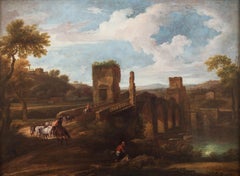
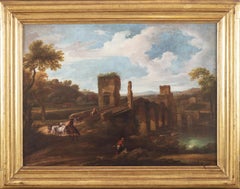
Northern painter active in Rome in the second half of the 17th century, View of Ponte Milvio Oil painting on canvas 73 x 97 cm in coeval Roman Salvator Rosa frame.
Category

18th Century and Earlier Old Masters Adolf Constantin Baumgartner-Stoiloff Art

Materials

Canvas, Oil

View of Ponte Milvio in Rome
$9,650
H 28.75 in W 34.65 in
19th Century English Antique, Two Country farmers drinking beer in a landscape
By George Morland
Located in Woodbury, CT
Attributed to George Morland. 19th Century English Antique, Two Country farmers drinking beer in a landscape. Wonderful early 19th-century original oil on canvas. A classic 'Morland' composition as the painter was a big fan of English Pub scenes...
Category

Early 1800s Old Masters Adolf Constantin Baumgartner-Stoiloff Art

Materials

Canvas, Oil

A pair of 18th century Italian landscapes with classical ruins and figures
By Giovanni Paolo Panini
Located in Bath, Somerset
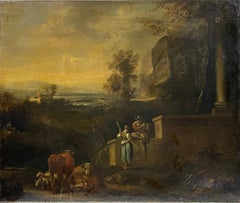
A pair of 18th century Italian landscapes with classical ruins and figures, circa 1750. Circle of Giovanni Panini (1691-1765) Thomas Agnew and Sons, Lo...
Category

18th Century Old Masters Adolf Constantin Baumgartner-Stoiloff Art

Materials

Canvas, Oil

18th Century by Gaspare Diziani Venus With Cupid Oil on Canvas
By Gaspare Diziani
Located in Milano, Lombardia
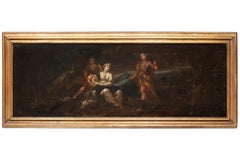
Gaspare Diziani (Belluno, Italy, 1689 - Venice, Italy, 1767) Title: Venus with Cupid Medium: Oil on canvas Dimensions: without frame 50 x 98 cm - with frame 64 x 112 cm Not signed Gilded, carved and sculpted wooden cassetta frame...
Category

Early 18th Century Old Masters Adolf Constantin Baumgartner-Stoiloff Art

Materials

Canvas, Cotton Canvas, Oil

18th Century by Andrea Locatelli Landscape with fisherman Oil on canvas
By Andrea Locatelli
Located in Milano, Lombardia
Andrea Locatelli (Rome, Italy, 1695 – 1741) Title: Landscape with fisherman Medium: Oil on canvas Dimensions: Without frame 27 x 28.5 cm – with frame 35 x 47.6 x 3.5 cm Not signed ...
Category

18th Century Old Masters Adolf Constantin Baumgartner-Stoiloff Art

Materials

Canvas, Oil

Previously Available Items
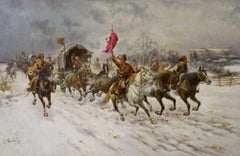
19th Century winter landscape oil painting of Cossacks on horseback
By Adolf Constantin Baumgartner-Stoiloff
Located in Nr Broadway, Worcestershire
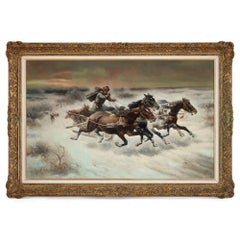
Adolf Constantin Baumgartner-Stoiloff Austrian (1850-1924) The Escort Oil on canvas, signed & inscribed in pencil on stretcher Image size: 26.25 inches x 40.5 inches Size including frame: 32.25 inches x 46.5 inches Provenance: Omell Galleries, 43a Duke Street, London A dynamic scene featuring Cossacks on horseback by Adolf Constantin Baumgartner-Stoiloff. The colourful apparel of the horsemen offers a striking contrast against the snow filled landscape. Adolf Constantin Baumgartner-Stoiloff was born Adolf Baumgartner in Linz, Austria on 10 March, 1850. Little is known about his early life although some sources suggest he was of Bulgarian extraction. He visited Russia during the 1880’s where he studied at the St Petersberg Academy of Fine Arts. He spent time travelling around Russia and Ukraine and began specialising in winter scenes featuring Cossacks on horseback. Many of his paintings depict Cossack military convoys moving at speed across a frozen landscape, as in these fine examples. He also produced animated scenes of horse sleighs...
Category

19th Century Victorian Adolf Constantin Baumgartner-Stoiloff Art
Materials

Canvas, Oil

Adolf Constantin Baumgartner-Stoiloff, Winter Landscape, Russian Riders, Cossack
By Adolf Constantin Baumgartner-Stoiloff
Located in Berlin, DE
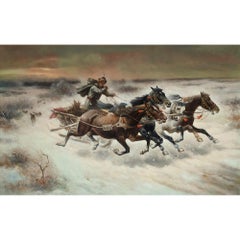
Adolf Constantin Baumgartner-Stoiloff, Winter Landscape with Russian Riders, Cossack and horses. WILD CARRIAGE IN WINTER Russian riders with flags and raised lance, as well as a cha...
Category

19th Century Adolf Constantin Baumgartner-Stoiloff Art
Materials

Canvas, Oil

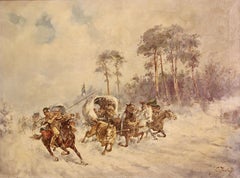
Troyka
By Adolf Constantin Baumgartner-Stoiloff
Located in Houston, TX
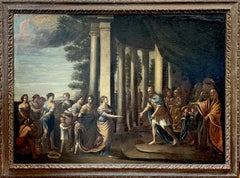
Constantin Stoiloff, also known as Adolf Baumgartner 1850-1924), Bulgarian artist was born in Austria in 1850. Studied at the Academy for Fine Arts in St. Petersburg in Russia in the 1880s. He is mainly known as a fine portraitist of horses and his “Russian” scenes...
Category

Early 20th Century Naturalistic Adolf Constantin Baumgartner-Stoiloff Art
Materials

Oil

Adolf Constantin Baumgartner-stoiloff art for sale on 1stDibs.

Find a wide variety of authentic Adolf Constantin Baumgartner-Stoiloff available for sale on 1stDibs. You can also browse by medium to find art by Adolf Constantin Baumgartner-Stoiloff in canvas, fabric, oil paint and more. Much of the original work by this artist or collective was created during the 19th century and is mostly associated with the Old Masters style. Not every interior allows for large Adolf Constantin Baumgartner-Stoiloff, so small editions measuring 32 inches across are available. Customers who are interested in this artist might also find the work of Charles Towne, Flemish School, 17th Century, and Edward Robert Smythe. Adolf Constantin Baumgartner-Stoiloff prices can differ depending upon medium, time period and other attributes. On 1stDibs, the price for these items starts at $8,886 and tops out at $14,865, while the average work can sell for $10,563.

Artists Similar to Adolf Constantin Baumgartner-Stoiloff