Adriaen van Ostade Art

to
1
10
2
11
11
4
3
1
1
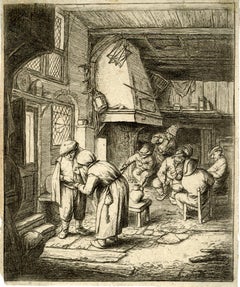
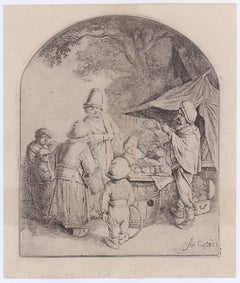
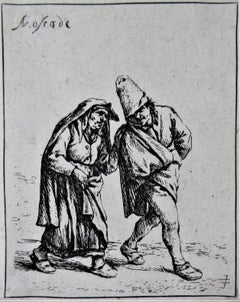
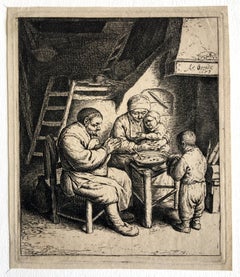
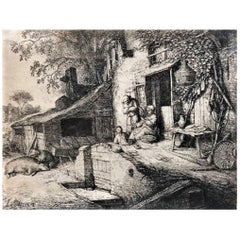
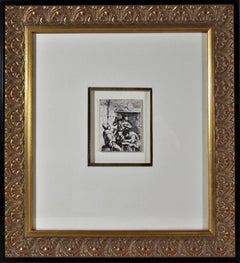
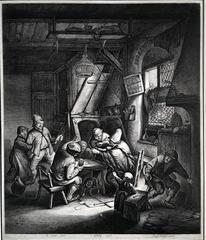
The Quacksalver
The Quacksalver

The Quacksalver

By Adriaen van Ostade

Located in Middletown, NY

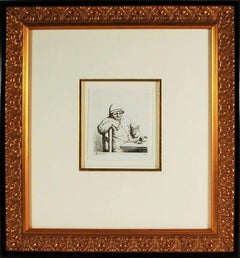
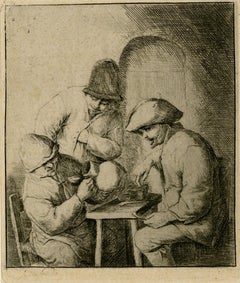
Etching on cream laid paper. 1/4 inch to 1/2 inch margins. In good condition with a band of minor discoloration along top and bottom sheet edge verso. One circular 1.5 inch- sized ar...

Category

Mid-17th Century Old Masters Adriaen van Ostade Art

Materials

Laid Paper, Etching

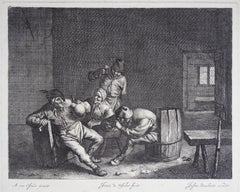
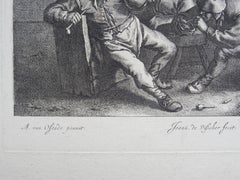
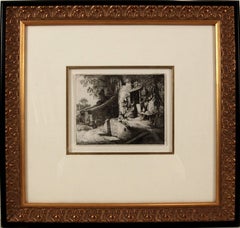
In a tavern. Paper, engraving, 21x25 cm

In a tavern. Paper, engraving, 21x25 cm

By Adriaen van Ostade

Located in Riga, LV

In a tavern. engraver Jan De Visscher (1933-1692) Paper, engraving, 21x25 cm

Category

17th Century Realist Adriaen van Ostade Art

Materials

Paper, Engraving

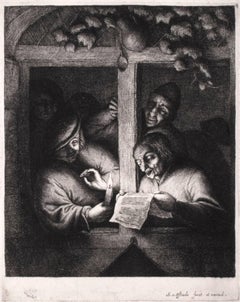
The Singers

The Singers

By Adriaen van Ostade

Located in Chicago, IL

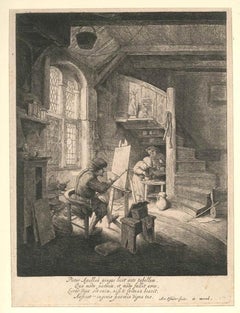
The Singers (4th State), 1667 Etching printed with tone 240 x 190 mm.; 9 1/2 x 7 1/2 inches Provenance: W. Benoni White (Lugt 2592) Karl Herweg (not in Lugt) References: Godefroy 19 IV/VII Hollstein 19 IV/VII Pelletier, Georgia Museum of Art, 1994: nos. 46 and 47 Notes: A very fine impression of the rare 4th state (of seven) of this major Van Ostade. Godefroy illustrates differences between this 4th state and the following 5th state. In the latter state, there are several “escaped lines”, going obliquely from left to right, directly above the central post. These lines are not visible in the 4th state. Ostade was one of the most important of the printmakers within the Rembrandt circle. His prints, avoiding religious subjects, depicted beggars, peasants and artisans. Combining great artistic sensitivity with thorough mastery of the medium of etching, Ostade etchings present a unique artistic panorama of life in seventeenth-century Holland. Pelletier (S. William Pelletier, Adrian Van Ostade...

Category

17th Century Old Masters Adriaen van Ostade Art

Materials

Etching

The Hunchbacked Fiddler (3rd State)

The Hunchbacked Fiddler (3rd State)

By Adriaen van Ostade

Located in Chicago, IL

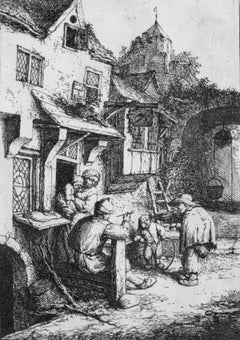
The Hunchbacked Fiddler (3rd State), 1654 Etching 266 x 113 mm.; 6 1/2 x 4 7/16 inches Watermark: Fleur-de-lys in a Crowned Shield References: Godefroy 44 III/VI Hollstein 44 III/VI Pelletier, Adrian van Ostade...

Category

17th Century Old Masters Adriaen van Ostade Art

Materials

Etching

The Peasant Settling His Debt

The Peasant Settling His Debt

By Adriaen van Ostade

Located in Middletown, NY

Etching on thin, cream laid paper 4 x 3 5/8 inches (100 x 90 mm), with narrow margins, trimmed inside the platemark. Adhesive residue at the top right and left corners, and archival ...

Category

17th Century Old Masters Adriaen van Ostade Art

Materials

Etching

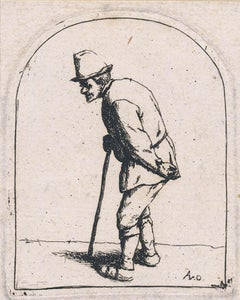
Peasant with a Crooked Back

Peasant with a Crooked Back

By Adriaen van Ostade

Located in Middletown, NY

Etching on on laid paper, adhered along left sheet edge to archival wove paper. A rich inking impression in very good condition. From the Picart Edition of 1710. - Ex-collection Fer...

Category

Late 17th Century Old Masters Adriaen van Ostade Art

Materials

Laid Paper, Etching

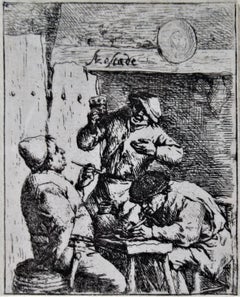
The Smoker and the Drinker

The Smoker and the Drinker

By Adriaen van Ostade

Located in San Francisco, CA

Artist: Adriaen Van Ostade (Dutch, 1610-1685) Title: The Smoker and the Drinker Year: 1650 Medium: Etching Paper: Laid paper Image (plate mark) size...

Category

Late 17th Century Old Masters Adriaen van Ostade Art

Materials

Etching

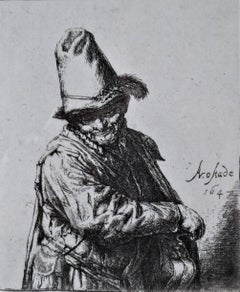
Smoker Leaning on the Back of a Chair

Smoker Leaning on the Back of a Chair

By Adriaen van Ostade

Located in San Francisco, CA

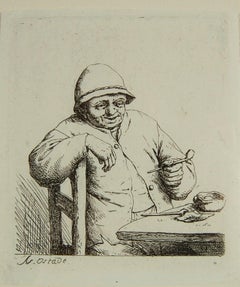
Artist: Adriaen Van Ostade (Dutch, 1610-1685) Title: Smoker Leaning on the Back of a Chair Year: 1672 Medium: Etching Paper: Laid paper Image size: 4.1 x 3.55 inches Signature: Si...

Category

Late 17th Century Old Masters Adriaen van Ostade Art

Materials

Etching

The organ Grinder
The organ Grinder

The organ Grinder

By Adriaen van Ostade

Located in San Francisco, CA

Artist: Adriaen Van Ostade (Dutch, 1610-1685) Title: The Organ Grinder Year: 1647 Medium: Etching Paper: Laid paper Image (plate mark) size: 4.35 x 3.5 i...

Category

Late 17th Century Old Masters Adriaen van Ostade Art

Materials

Etching

The Anglers

The Anglers

By Adriaen van Ostade

Located in New York, NY

Adriaen Van Ostade (1610-1685) etching The Anglers, circa 1647, Godefry 26, Bartsch 26. Very good condition, with small (1/2 inch) margins, on cream laid paper, archival mounting. 4 ...

Category

1640s Old Masters Adriaen van Ostade Art

Materials

Etching

The couple
The couple

The couple

By Adriaen van Ostade

Located in San Francisco, CA

Artist: Adriaen Van Ostade (Dutch, 1610-1685) Title: The Couple Year : 1638 Medium: Etching Paper: Laid paper Image (plate mark): 3.25 x 2.5 inches ...

Category

Mid-17th Century Old Masters Adriaen van Ostade Art

Materials

Etching

Related Items
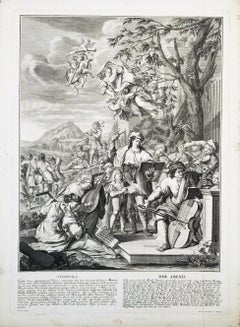
Vespera; Der Abend (Evening; The Evening) /// Johann Daniel Preissler Old Master

Vespera; Der Abend (Evening; The Evening) /// Johann Daniel Preissler Old Master

Located in Saint Augustine, FL

Artist: (after) Johann Daniel Preissler (German, 1666-1737) Title: "Vespera; Der Abend (Evening; The Evening)" Portfolio: Die Vier Tageszeiten (The Four Times of Day) Year: 1723 Medium: Original Etching and Engraving on laid paper Limited edition: Unknown Printer: likely Johann Balthasar Probst, Augsburg, Germany Publisher: Jeremias Wolff (Erben), Augsburg, Germany Sheet size: 22.5" x 16.63" Image size: 17.38" x 13.63" Reference: Le Blanc No. 255, 38; Nagler No. 23 Condition: Soft handling creases and folds to sheet. Some scattered foxmarks in left margin. Two small tears skillfully repaired from verso in margins. Has been professionally stored away for decades. It is otherwise a strong impression in good condition with full margins Extremely rare Notes: Provenance: private collection - Aspen, CO. Engraved by German artist Johann Balthasar Probst (1673-1750) after a drawing by German artist Johann Daniel Preissler (1666-1737). Comes from Preissler's 1723 "Die Vier Tageszeiten (The Four Times of Day)" portfolio of four etchings and engravings. Printed from one copper plate in one color: black. Descriptions of the portrayed image are printed in Latin and German. Biography: Johann Daniel Preissler, or Preisler (1666–1737) was a German painter and director of Nuremberg's Academy of Fine Arts. He was a notable member of a German artistic family, originating in Bohemia. His children included Johann Justin Preissler (1698–1771), Georg Martin Preisler (1700–1754), Barbara Helena Preisler (1707–1758; married to Oeding), Johan Martin Preisler (1715–1794), and Valentin Daniel Preisler (1717–1765), all in their time renowned artists. Most notable for his portraits, nudes and history paintings, Johann Daniel Preissler also produced drawings and frescoes. He was particularly known beyond his native Nuremberg for his "Die durch Theorie erfundene Practic", a sequence of works on art theory – the individual works were translated into several other languages and served as textbooks for students such as the Swiss Salomon Gessner...

Category

1720s Old Masters Adriaen van Ostade Art

Materials

Laid Paper, Engraving, Etching

Chester Cathedral - Drypoint Etching in Ink on Paper

Chester Cathedral - Drypoint Etching in Ink on Paper

Located in Soquel, CA

Chester Cathedral - Drypoint Etching in Ink on Paper Dramatic drypoint etching by J. Alphege Brewer (British, 1881-1946). This composition shows the interior of Chester Cathedral in Brewer's characteristic style - highly detailed and with strong contrast. The scene encompasses the cathedral from floor to ceiling, capturing the immense size of the building. There are several people in the scene which contribute to the sense of scale. Signed by hand "J. Alphege Brewer" in the lower right corner. Titled "Chester Cathedral" in plate, lower left corner. Includes original card with artist's name. Presented in a new black mat with foamcore backing. Mat size: 16"H x 12"W Paper size: 10.75"H x 7.75"W James Alphege Brewer was well known in the early 20th century as a producer of color etchings of European cathedrals and other scenes of church, college, and community. He was born July 24, 1881, in the Kensington section of London, England, the son of Henry W. Brewer, noted artist of historical architecture and prominent convert to the Catholic Church, and the grandson of John Sherren Brewer, Jr., “the brilliant editor of the Calendar of Letters of Henry VIII.” His great uncle was E. Cobham Brewer, the polymath who compiled Brewer’s Dictionary of Phrase and Fable. Among his older siblings were the artist Henry C. Brewer and the organist and writer John Francis Brewer. Brewer attended the Westminster School of Art in London, where his brother Henry also trained. In 1910, he married Florence Emma Lucas, an accomplished painter in oil and watercolor, whose father was the noted landscape artist George Lucas and whose great uncle was David Lucas, the famous engraver for John Constable. Florence's brothers Edwin and George assisted Brewer in the printing of Brewer's etchings. Brewer exhibited at the Royal Academy (RA) and the Royal Institute of Painters in Watercolour (RI), at the Paris Salon of the Académie des Beaux-Arts, and in the shows of the Royal Cambrian Academy (RCA). He became an associate of the Royal Cambrian Academy in 1929 and a full member in the last two years of his life. He was also a member of the Hampstead Society of Artists, the Society of Graphic Art, and the Ealing Arts Club, where he was first Honorary Art Secretary and then Honorary Art Chairman. Most of Brewer's larger etchings were published by Alfred Bell...

Category

Early 20th Century Romantic Adriaen van Ostade Art

Materials

Paper, Ink, Drypoint

The Crucifixion (Christ on the Cross) /// Jesus after Albrecht Dürer Old Masters

The Crucifixion (Christ on the Cross) /// Jesus after Albrecht Dürer Old Masters

Located in Saint Augustine, FL

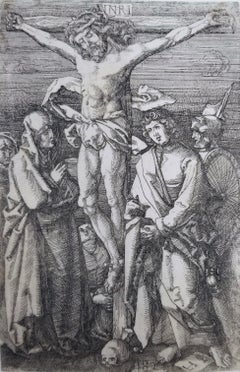
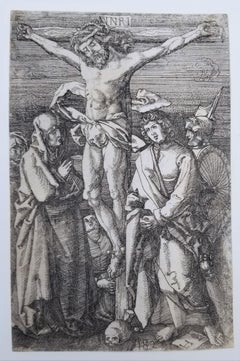
Artist: Lambrecht Hopfer (German, Active c. 1525-1550) Title: "The Crucifixion (Christ on the Cross)" Portfolio: (after) The Engraved Passion *Issued unsigned, though monogram signed by Hopfer in the plate (printed signature) lower right Circa: 1530, (published c. 1690, second state of three) Medium: Original Etching on laid paper Limited edition: Unknown Printer: The Hopfer family, Augsburg, Germany; (David Funck, Nuremberg, Germany) Publisher: The Hopfer family, Augsburg, Germany; (David Funck, Nuremberg, Germany) Framing: Recently framed, the sheet is floated over, and top-matted with a 100% cotton fabric rag mat from Holland in a wood moulding and Museum glass Framed size: 14.88" x 13.88" Sheet size: 5.5" x 3.63" Reference: Bartsch No. VIII.527.12; Hollstein No. 12.II Condition: Trimmed to platemark. A few tiny professional repairs: at elbow of Jesus's right arm and the inside thigh of Jesus. Some light skinning upper right corner and lower right area. It is otherwise a strong impression in good condition Very rare Notes: Provenance: private collection - Green Bay, WI; acquired from Sotheby's, New York, NY in c. 2015. The artist Lambrecht Hopfer's printed monogram signature "LH" lower right. The printer/publisher David Funck's (plate) number "182" lower right. This etching is after Albrecht Dürer’s 1511 engraving "The Crucifixion (Christ on the Cross)", ("Dürer-Katalog" - Meder No. 13, page 73). Printed in black from an iron plate. The image depicts Christ on the cross at center, the Virgin at left, two Maries behind her, St. John standing at right, a Roman solider behind him. It is after the eleventh plate of Dürer's sixteen plates from his 1507-1513 "The Engraved Passion" series, ("Dürer-Katalog" - Meder No. 3-18, page 70-74). "The print was originally designed without the number engraved in the lower margin (First state: Lambrecht Hopfer, c. 1530). The Hopfers' descendant David Funck (Nuremberg, 1642–1705) acquired over two hundred of their original iron plates, engraved numbers into them, and re-printed them around 1686-1700. The "182" indicates that "The Crucifixion" was the 182nd print in Funck’s series (Second state: David Funck, c. 1686-1700). About a century later, 92 of these plates were acquired by Carl Wilhelm Silberberg in Frankfurt and printed for the third and final time in the book "Opera Hopferiana", of which "The Crucifixion" was the 90th print (Third state: Carl Wilhelm Silberberg for "Opera Hopferiana", 1802)". - Elizabeth Upper, Cambridge University Library, University of Cambridge, Cambridge, UK Biography: Lambrecht (Lambert) Hopfer (Active c. 1525-1550) was a German Old Masters printmaker. He was the brother of Hieronymus Hopfer (Active c. 1520-1530) and son of Daniel Hopfer...

Category

16th Century Old Masters Adriaen van Ostade Art

Materials

Etching, Laid Paper
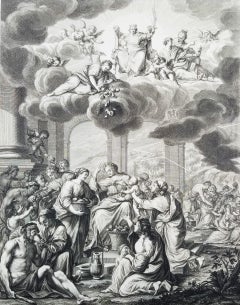
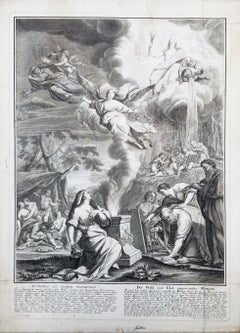
Aurora sive Tempus Matutinum; Der Wohl und Übel angewandte Morgen /// Old Master

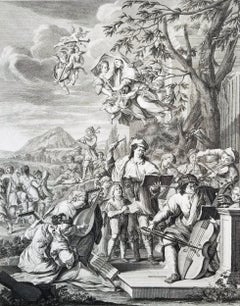
Aurora sive Tempus Matutinum; Der Wohl und Übel angewandte Morgen /// Old Master

Located in Saint Augustine, FL

Artist: (after) Johann Daniel Preissler (German, 1666-1737) Title: "Aurora sive Tempus Matutinum; Der Wohl und Übel angewandte Morgen (Dawn or Morning Time; The Morning Used for Better or For Worse)" Portfolio: Die Vier Tageszeiten (The Four Times of Day) Year: 1723 Medium: Original Etching and Engraving on laid paper Limited edition: Unknown Printer: likely Johann Balthasar Probst, Augsburg, Germany Publisher: Jeremias Wolff (Erben), Augsburg, Germany Sheet size: 22.57" x 16.38" Image size: 17.75" x 14" Reference: Le Blanc No. 255, 38; Nagler No. 23 Condition: Soft handling creases, folds, and scattered faint areas of discoloration to sheet. Three tears skillfully repaired from verso. Has been professionally stored away for decades. It is otherwise a strong impression in good condition with full margins Extremely rare Notes: Provenance: private collection - Aspen, CO. Engraved by German artist Johann Balthasar Probst (1673-1750) after a drawing by German artist Johann Daniel Preissler (1666-1737). Comes from Preissler's 1723 "Die Vier Tageszeiten (The Four Times of Day)" portfolio of four etchings and engravings. Printed from one copper plate in one color: black. Descriptions of the portrayed image are printed in Latin and German. Biography: Johann Daniel Preissler, or Preisler (1666–1737) was a German painter and director of Nuremberg's Academy of Fine Arts. He was a notable member of a German artistic family, originating in Bohemia. His children included Johann Justin Preissler (1698–1771), Georg Martin Preisler (1700–1754), Barbara Helena Preisler (1707–1758; married to Oeding), Johan Martin Preisler (1715–1794), and Valentin Daniel Preisler (1717–1765), all in their time renowned artists. Most notable for his portraits, nudes and history paintings, Johann Daniel Preissler also produced drawings and frescoes. He was particularly known beyond his native Nuremberg for his "Die durch Theorie erfundene Practic", a sequence of works on art theory – the individual works were translated into several other languages and served as textbooks for students such as the Swiss Salomon Gessner...

Category

1720s Old Masters Adriaen van Ostade Art

Materials

Laid Paper, Engraving, Etching

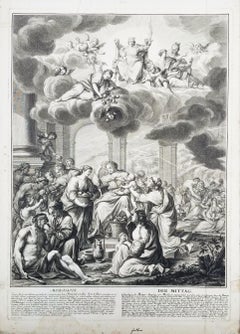
Meridies; Der Mittag (Noon; The Midday) /// Johann Daniel Preissler Old Master

Meridies; Der Mittag (Noon; The Midday) /// Johann Daniel Preissler Old Master

Located in Saint Augustine, FL

Artist: (after) Johann Daniel Preissler (German, 1666-1737) Title: "Meridies; Der Mittag (Noon; The Midday)" Portfolio: Die Vier Tageszeiten (The Four Times of Day) Year: 1723 Medium: Original Etching and Engraving on laid paper Limited edition: Unknown Printer: likely Johann Balthasar Probst, Augsburg, Germany Publisher: Jeremias Wolff (Erben), Augsburg, Germany Sheet size: 22.5" x 16.32" Image size: 18.13" x 14.32" Reference: Le Blanc No. 255, 38; Nagler No. 23 Condition: Soft handling creases and folds to sheet. A few light areas of staining and scattered small areas of discoloration in margins. Two small tears skillfully repaired from verso in margins. Has been professionally stored away for decades. It is otherwise a strong impression in good condition with full margins Extremely rare Notes: Provenance: private collection - Aspen, CO. Engraved by German artist Johann Balthasar Probst (1673-1750) after a drawing by German artist Johann Daniel Preissler (1666-1737). Comes from Preissler's 1723 "Die Vier Tageszeiten (The Four Times of Day)" portfolio of four etchings and engravings. Printed from one copper plate in one color: black. Descriptions of the portrayed image are printed in Latin and German. Biography: Johann Daniel Preissler, or Preisler (1666–1737) was a German painter and director of Nuremberg's Academy of Fine Arts. He was a notable member of a German artistic family, originating in Bohemia. His children included Johann Justin Preissler (1698–1771), Georg Martin Preisler (1700–1754), Barbara Helena Preisler (1707–1758; married to Oeding), Johan Martin Preisler (1715–1794), and Valentin Daniel Preisler (1717–1765), all in their time renowned artists. Most notable for his portraits, nudes and history paintings, Johann Daniel Preissler also produced drawings and frescoes. He was particularly known beyond his native Nuremberg for his "Die durch Theorie erfundene Practic", a sequence of works on art theory – the individual works were translated into several other languages and served as textbooks for students such as the Swiss Salomon Gessner...

Category

1720s Old Masters Adriaen van Ostade Art

Materials

Laid Paper, Engraving, Etching

Don Juan
Don Juan

Louis IcartDon Juan, 1928

$2,800Sale Price|20% Off

H 28 in W 20.5 in

Don Juan

By Louis Icart

Located in Missouri, MO

Aquating Engraving Image Size: approx. 20 1/4 x 13 3/8 Framed Size: 28 x 20.5 inches Pencil Signed Lower Right Louis Justin Laurent Icart was born in Toulouse in 1890 and died in Paris in 1950. He lived in New York City in the 1920s, where he became known for his Art-Deco color etchings of glamourous women. He was first son of Jean and Elisabeth Icart and was officially named Louis Justin Laurent Icart. The use of his initials L.I. would be sufficient in this household. Therefore, from the moment of his birth he was dubbed 'Helli'. The Icart family lived modestly in a small brick home on rue Traversière-de-la-balance, in the culturally rich Southern French city of Toulouse, which was the home of many prominent writers and artists, the most famous being Henri de Toulouse-Lautrec. Icart entered the l'Ecole Superieure de Commerce de Toulouse in order to continue his studies for a career in business, particularly banking (his father's profession). However, he soon discovered the play writings of Victor Hugo (1802-1885), which were to change the course of his life. Icart borrowed whatever books he could find by Hugo at the Toulouse library, devouring the tales, rich in both romantic imagery and the dilemmas of the human condition. It was through Icart's love of the theater that he developed a taste for all the arts, though the urge to paint was not as yet as strong for him as the urge to act. It was not until his move to Paris in 1907 that Icart would concentrate on painting, drawing and the production of countless beautiful etchings, which have served (more than the other mediums) to indelibly preserve his name in twentieth century art history. Art Deco, a term coined at the 1925 Paris Exposition des Arts Decoratifs, had taken its grip on the Paris of the 1920s. By the late 1920s Icart, working for both publications and major fashion and design studios, had become very successful, both artistically and financially. His etchings reached their height of brilliance in this era of Art Deco, and Icart had become the symbol of the epoch. Yet, although Icart has created for us a picture of Paris and New York life in the 1920s and 1930s, he worked in his own style, derived principally from the study of eighteenth-century French masters such as Jean Antoine Watteau, François Boucher and Jean Honoré Fragonard. In Icart's drawings, one sees the Impressionists Degas...

Category

1920s Art Deco Adriaen van Ostade Art

Materials

Engraving, Aquatint

"King of the Friendly Islands" (Tonga); Engraving from Captain Cook's 3rd Voyage

"King of the Friendly Islands" (Tonga); Engraving from Captain Cook's 3rd Voyage

By John Webber

Located in Alamo, CA

"Poulaho, King of the Friendly Islands, Drinking Kava" is an engraving created by William Sharp (1749-1824), from a drawing by John Webber (1752-1793), who was the artist on Captain James Cook's 3rd and final voyage of discovery. It was published in the atlas of "A Voyage to the Pacific Ocean Undertaken by the Command of His Majesty, for Making Discoveries in the Northern Hemisphere", the official British Admirality sanctioned journal published upon completion of the voyage in London in 1784 by Strahan & Cadell. Captain Cook visited Tonga on his 3rd voyage, which he named The Friendly Islands because of the warm welcome he and his crew received, unlike some of the other more hostile Pacific islands. The engraving depicts Cook and his men observed a kava ceremony at the village of Mu’a on Tongatapu. King Paulaho sits in the centre foreground, his back to the spectator with a man kneeling before him. The ceremonial mat depicted behind Paulaho indicates that nobody was allowed to sit behind him. The figure in the centre holds a single cup, referring to the Tongan custom of offering the cup to the king first. Kava is native to the islands of the South Pacific and was first described for English readers in 1768 by Captain James Cook. The kava root has been used for centuries as a central feature of ceremonies and celebrations because it was able to bring about a calming and pleasant social atmosphere. The root was crushed and processed into coconut milk to become the focal ceremonial beverage, simply referred to as kava. This engraving is presented in a Koa wood frame and a white mat. Koa wood is legendary in Hawaii. There are occasional faint spots, but the print is otherwise in very good condition. This amazing Koa wood is native to Hawaii and it is known for the deep rich colors and varied grain pattern. Koa has an honored heritage in Hawaii and is highly revered and sacred. The word “koa” means “warrior” in Hawaiian. The warriors of King Kamehameha the Great, created canoes and weapons from a wood plentiful on the Big Island of Hawaii. This wood became synonymous with the warriors themselves, and it became known as koa. There are three other engravings listed from the official journal of Captain Cook's 3rd voyage available that are presented in identical Koa wood frames and mats (LU117324682422, LU117324684052, LU117324684032). They would make a wonderful grouping for a display of 2, 3 or 4 prints. A discount is available for a grouping depending on the number of items included. Captain Cook is remembered as one of the greatest explorers and navigators in history. His explorations included Australia, New Zealand and islands of the South Pacific and the northwest coast of North America. Hawaii was discovered by Captain Cook during this voyage. Hawaii was originally called The Sandwich Islands in honor of The Earl of Sandwich...

Category

1780s Realist Adriaen van Ostade Art

Materials

Engraving

19th Century Roman Landscape oil on canvas with Giltwood Frame

19th Century Roman Landscape oil on canvas with Giltwood Frame

Located in Rome, IT

Amaizing 19' century Roman landscape depicting a part of Villa Borghese with Trinità dei Monti. With a finely carved gilt wood coeval frame. Measurements with frame cm 65 x78 wit...

Category

19th Century Old Masters Adriaen van Ostade Art

Materials

Oil

The Flight into Egypt

The Flight into Egypt

By Hans Lautensack

Located in Middletown, NY

Etching on handmade cream laid paper with a deckle edge, and an elaborate and large watermark of a crowned figure with a harp, and letters A S, 11 3/4 x 8 inches (298 x 204 mm); shee...

Category

16th Century Old Masters Adriaen van Ostade Art

Materials

Handmade Paper, Laid Paper, Etching

Bust of a Man Wearing a High Cap, The Artist's Father

Bust of a Man Wearing a High Cap, The Artist's Father

By Rembrandt van Rijn

Located in San Francisco, CA

Artist: Rembrandt Van Rijn (Dutch, 1606-1669) Title: Bust of a Man Wearing a High Cap, The Artist's Father Year: 1630 Medium: Etching Paper: Verge paper Image (plate mark) size: ...

Category

Mid-17th Century Old Masters Adriaen van Ostade Art

Materials

Etching

The Sacristan
The Sacristan

The Sacristan

By Harry Morley

Located in New Orleans, LA

This image shows a cleric seated in a church sacristy surrounded by religious statues, croziers, various saints, statues and chalices. It is an origina...

Category

Early 20th Century Modern Adriaen van Ostade Art

Materials

Engraving

Previously Available Items
17th Century Dutch Old Master Painting Adriaen van Ostade (1610-1685)

17th Century Dutch Old Master Painting Adriaen van Ostade (1610-1685)

By Adriaen van Ostade

Located in Vero Beach, FL

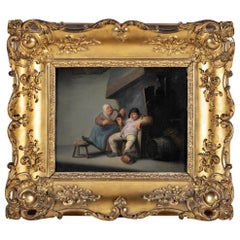
17th Century Dutch Old Master Painting Adriaen van Ostade (1610-1685) Period genre painting in oil on a hand planed oak panel. It depicts a scene of peasants gathering around a musi...

Category

17th Century Dutch Baroque Antique Adriaen van Ostade Art

Materials

Oak

The Empty Jug
The Empty Jug

Adriaen van OstadeThe Empty Jug, 1610

Sold

H 40.16 in W 33.86 in

The Empty Jug

By Adriaen van Ostade

Located in Middletown, NY

Etching on heavy laid paper, 4 x 3 3/8 inches (102 x 86 mm), margins. In good condition with some toning and light uniform discoloration. Likely printed mid 19th century. [Hollbein X...

Category

17th Century Old Masters Adriaen van Ostade Art

Materials

Handmade Paper, Laid Paper, Etching

After Adriaen Van Ostade, Flemish School from the 17th Century, Signed

After Adriaen Van Ostade, Flemish School from the 17th Century, Signed

By Adriaen van Ostade

Located in Madrid, ES

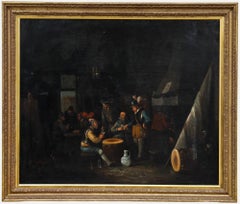
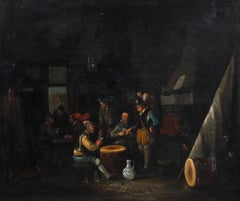
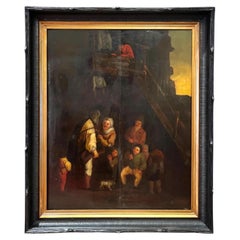
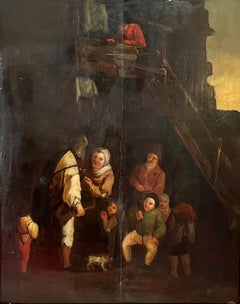
Description Title: Interior of a Tavern Date/Period: XVII century Dimension: 21cm x 25cm measured without frame. With frame + 18cm Materials: Oil on wood Additional Information: After Adriaen Van Ostade, Flemish school from the 17th century, signed. Note: This is a copy of the 17th Century Adriaen van Ostade (baptized as Adriaen Jansz Hendricx 10 December 1610 – buried 2 May 1685) was a Dutch Golden Age painter of genre works. According to Houbraken, he and his brother were pupils of Frans Hals and like him, spent most of their lives in Haarlem. He thought they were "Lubekkers" by birth, though this has since found to be false. He was the eldest son of Jan Hendricx Ostade, a weaver from the town of Ostade near Eindhoven. Although Adriaen and his brother Isaack were born in Haarlem, they adopted the name "van Ostade" as painters. According to the RKD, he became a pupil in 1627 of the portrait painter Frans Hals, at that time the master of Jan Miense Molenaer. In 1632 he is registered in Utrecht (where, like Jacob...

Category

17th Century Dutch Baroque Antique Adriaen van Ostade Art

Materials

Paint

Saying Grace

Adriaen van OstadeSaying Grace, 1653

Sold

H 6.63 in W 5.63 in D 0.01 in

Saying Grace

By Adriaen van Ostade

Located in New York, NY

Adriaen Van Ostade (1610-1685), Saying Grace, etching, 1653. Reference: Louis Godefroy 34, sixth state (of 6), 6 5/8 x 5 5/8 inches. In very good condit...

Category

17th Century Old Masters Adriaen van Ostade Art

Materials

Etching

Adriaen van Ostade, A Spinner, Dutch Etching, XVII Century

Adriaen van Ostade, A Spinner, Dutch Etching, XVII Century

By Adriaen van Ostade

Located in New York, NY

Artist: Adriaen van Ostade (Dutch, 1610 – 1685), Subject: Rural everyday scene with a spinner in the foreground. Medium: Etching on paper, framed Dimensions: H: 14.75”, W: 16” Adriaen van Ostade (Dutch, 1610 – 1685), a prolific painter, draftsman and etcher of peasant life during Holland’s “Golden Age,” Adriaen van Ostade created hundreds of paintings, some 400 drawings and watercolors and 50 etchings durng his five-decade career. Ostade’s father had moved to Haarlem by 1605 from the Eindhoven area, perhaps from the tiny village of Ostade, which may have given Ostade his surname. The third of eight children, Ostade was baptized at Haarlem’s Saint Bavo cathedral on December 10, 1610. Little is known of his artistic training. Arnold Houbraken’s (1660-1719) early 18th-century biography states that Ostade studied with Frans Hals (ca. 1591-1666) around 1627, and that Adriaen Brouwer (1606-1638) studied with Hals about the same time. No substantiation has been found for this claim. Brouwer stayed in Haarlem until about 1631, and Ostade’s early works do show Brouwer’s influence in its depictions of raucous peasant life. Another suggestion is that Ostade studied with the landscape painter Salomon van...

Category

17th Century Dutch Dutch Colonial Antique Adriaen van Ostade Art

Materials

Paper
Le Peintre - Original Etching y Adriaen van Ostade - 1664 ca.

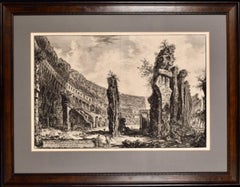
Le Peintre - Original Etching y Adriaen van Ostade - 1664 ca.

By Adriaen van Ostade

Located in Roma, IT

1664 c.a., Original Etching (Godefroy 32, XII/XII). Image Dim: cm 23.6x 17.5; Dim: cm24.6x18.6; Passepartout Dim. cm 60x39.6. Ex-Collection: P. Davidson (Lugt 654), S. Wagner (Lugt 2380). In Very Good condition, except some little and light foxing over the marginal line. Wonderful Proof, with an interesting capture in Latin and Signature on Plate “A.V. Oftado fecit et excud.” Adrian Van Ostade...

Category

1660s Adriaen van Ostade Art

Materials

Etching

17th Century Dutch Oil Painting, Attributed Adriaen Van Ostade Framed

17th Century Dutch Oil Painting, Attributed Adriaen Van Ostade Framed

By Adriaen van Ostade

Located in Vero Beach, FL

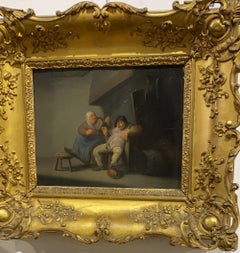
This is an oil painting on a small hand shaved beveled oakwood panel. According to an old label on the back of the panel this painting is attributed to Adriaen van Ostade, known as t...

Category

17th Century Dutch Baroque Antique Adriaen van Ostade Art

Materials

Oak

The woman spinning
The woman spinning

Adriaen van OstadeThe woman spinning, 1652

Sold

H 17.5 in W 18.5 in D 1 in

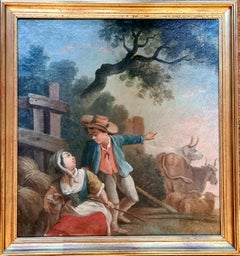
The woman spinning

By Adriaen van Ostade

Located in San Francisco, CA

Artist: Adriaen Van Ostade (Dutch, 1610-1685) Title: Woman Spinning Year: 1652 Medium: Etching Paper: Laid paper image size: (plate mark) 5.35 x 6.85 inches Signature: Signed and ...
Category

17th Century Old Masters Adriaen van Ostade Art

Materials

Etching

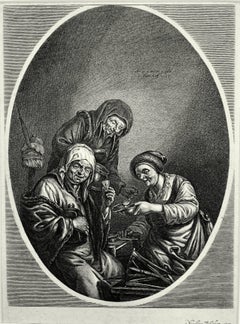
The Three Women (les Parques Hollandaises)

The Three Women (les Parques Hollandaises)

By Adriaen van Ostade

Located in New York, NY

Jonas Suyderhoef 1613-1686), The Three Women (les Parques Hollandaises), c. 1650, engraving and etching, after Adriaen van Ostade (1610-1685). Refere...

Category

Mid-17th Century Old Masters Adriaen van Ostade Art

Materials

Engraving, Etching

The Brawl (after Van Ostade)

The Brawl (after Van Ostade)

By Adriaen van Ostade

Located in New York, NY

Jonas Suyderhoef (1610-1690), La Rixe (The Brawl), after Adriaen Van Ostade (1610-1685), engraving, c. 1660. [with the lettering A. Ostaden pinxit at the bottom left; J. Suyderhoef sculpsit bottom center; and Clemendt de Jonghe...

Category

1660s Old Masters Adriaen van Ostade Art

Materials

Engraving

Adriaen Van Ostade art for sale on 1stDibs.

Find a wide variety of authentic Adriaen van Ostade art available for sale on 1stDibs. You can also browse by medium to find art by Adriaen van Ostade in etching, paper, laid paper and more. Much of the original work by this artist or collective was created during the 18th century and earlier and is mostly associated with the Old Masters style. Not every interior allows for large Adriaen van Ostade art, so small editions measuring 3 inches across are available. Customers who are interested in this artist might also find the work of Cornelis Bega, Marius Bauer, and Jacques Callot. Adriaen van Ostade art prices can differ depending upon medium, time period and other attributes. On 1stDibs, the price for these items starts at $500 and tops out at $20,000, while the average work can sell for $1,400.
Artists Similar to Adriaen van Ostade