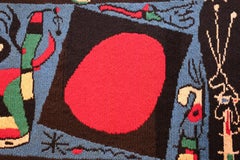
By (after) Joan Miró
Located in New York, NY
Joan Miró (after)
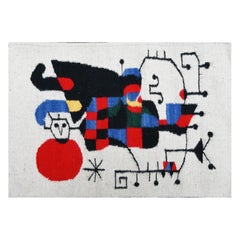
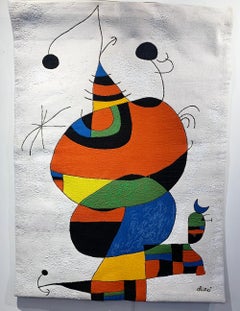
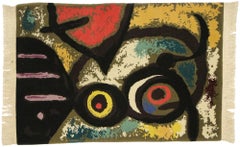
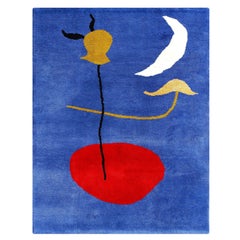
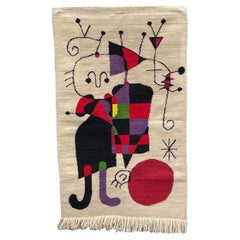
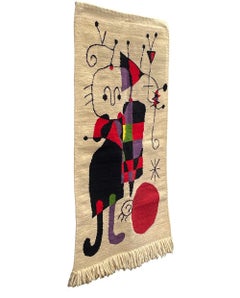
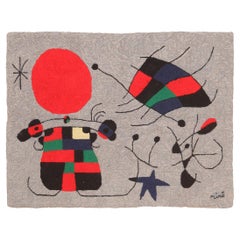
"Danseuse Espagnole"
Design made in 1928, tapestry manufactured in 1965
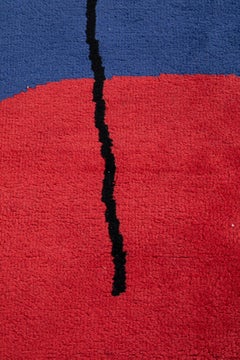
Handwoven Wool Tapestry
81 x 60 in
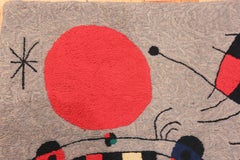
'MIRO' signature woven on reverse
Woven by Marie Cuttoli's Parisian Galerie for Galerie Lucie-Weill Seligmann in Paris
Joan Miró was a versatile artist who explored many mediums, including painting, sculpture and ceramics. But one of the most interesting mediums he used was textile art. Miró created several rugs and fabrics throughout his career, which helped expand his unique aesthetic into new territory.
Miró’s work often included abstracted figures, stars, moons, and other celestial bodies, which he used to create a visual language that was both personal and universal. He frequently incorporated found objects and materials into his work, such as rope, pebbles, and twigs. Miró’s work has been exhibited in numerous museums and galleries around the world, and he is considered one of the most important artists of the 20th century.
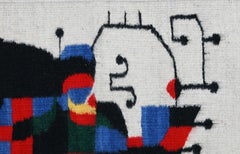
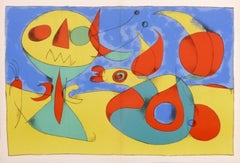
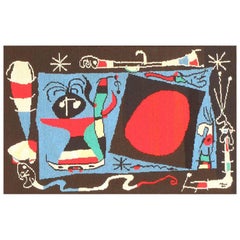
“Danseuse Espagnole," or "Spanish Dancer," was a design created by Joan Miró in 1928. This textile artwork is hand-woven with high-quality wool threads. The composition of the dancer is simple and expressive, with bold geometric shapes and vibrant colors typical of Miro’s style. The dancer is depicted in a dynamic posture, with legs apart and arms raised, evoking Spanish flamenco. The “DANSEUSE ESPAGNOLE” is considered one of the most iconic examples of Miro’s textile...
Category
1960s French Aubusson Vintage (after) Joan Miró Tapestries