Alberico Morena Art

to
2
2
1
1
1
1
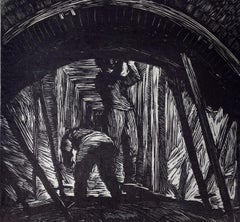
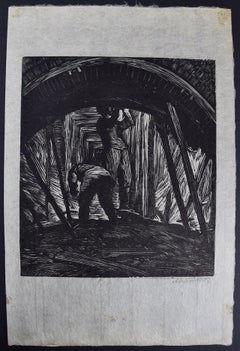
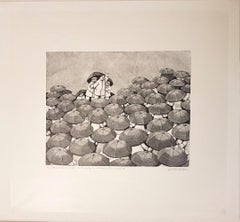
The Orator - Original Woodcut by Alberico Morena - 1971

The Orator - Original Woodcut by Alberico Morena - 1971

By Alberico Morena

Located in Roma, IT

Image dimensions: 24 x 29.5 cm. Beautiful xilograph hand-printed on tissue-paper, 1971. Print representing a political public speech. Hand-signed with pencil on lower-right margin. ...

Category

1970s Alberico Morena Art

Materials

Woodcut

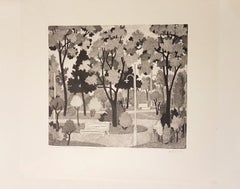
The Garden - Original Woodcut by Alberico Morena - 1958

The Garden - Original Woodcut by Alberico Morena - 1958

By Alberico Morena

Located in Roma, IT

Image dimensions: 28 x 33 cm. Fine xilograph hand-printed on tissue-paper, representing a garden. Hand-signed with pencil on lower-right margin. Signed on plate too, lower-right cor...

Category

1950s Alberico Morena Art

Materials

Woodcut

Related Items
First Snow at Kitano Shrine — Sosaku Hanga Japanese Woodblock, Kyoto

First Snow at Kitano Shrine — Sosaku Hanga Japanese Woodblock, Kyoto

Located in Myrtle Beach, SC

Kamei Tobei, 'First Snow of the Year at Kitano (Kitano Hatsu Yuki)', color woodblock print, c. 1930s. Signed Kamei Tobei in black ink, with the artist red seal Eiichi (the artist’s g...

Category

1930s Showa Alberico Morena Art

Materials

Woodcut

Father Stefan Fridolin, "Schatzbehalter" (Treasury of the True Riches

Father Stefan Fridolin, "Schatzbehalter" (Treasury of the True Riches

Located in Fairlawn, OH

Father Stefan Fridolin, "Schatzbehalter" (Treasury of the True Riches of Salvation): The 30th Figure - Astrological Diagram with Scene of the Nativity Woodcut, 1491 Unsigned, as issued Published by Anton Koberger Diagram has Zodiac signs on outer ring, planets in the lower registers, and Nativity in the center. Condition: Very good for a 15h century woodcut, with the usual slight age stains Sheet size: 11 1/2 x 8 1/4 inches Wogelmut was the teacher of Albrecht Durer and employed young Durer in many project of the last decade of the 15th century. Michel Wolgemut Biography Wolgemut trained with his father Valentin Wolgemut (who died in 1469 or 1470) and is thought to have been an assistant to Hans Pleydenwurff in Nuremberg. He worked with Gabriel Malesskircher in Munich early in 1471, leaving the city after unsuccessfully suing Malesskircher's daughter for breach of contract, claiming she had broken off their engagement. He then returned to his late father's workshop in Nuremberg, which his mother had maintained since Valentin's death. In 1472 he married Pleydenwurff's widow and took over his workshop;[3] her son Wilhelm Pleydenwurff worked as an assistant, and from 1491 a partner, to Wolgemut. Some consider Wilhelm a finer artist than Wolgemut, however he died in January 1494, when he was probably still in his thirties. Wilhelm's oeuvre remains unclear, though works in various media have been attributed to him. Woodcuts Michael Wolgemut, Danse Macabre, 1493 Two large and copiously illustrated books have woodcuts supplied by Wolgemut and his stepson Wilhelm Pleydenwurff; both were printed and published by Germany's largest publisher, the Nuremberger Anton Koberger, who was also Dürer's godfather. The first is the Schatzbehalter der wahren Reichthumer des Heils (1491); the other is the Historia mundi, by Schedel (1493), usually known as the Nuremberg Chronicle...

Category

15th Century and Earlier Old Masters Alberico Morena Art

Materials

Woodcut

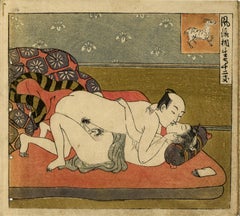
Shunga: Twelve Signs of the Zodiac - Goat

Shunga: Twelve Signs of the Zodiac - Goat

Located in Fairlawn, OH

Shunga: Twelve Signs of the Zodiac - Goat Color woodcut with gauffrage (embossing) Unsigned (as usual) Format: Shikishiban Publisher: Privately produced Unusually well preserved with the fugitive blue still intact Image size: 5-1/8 x 5-3/4" Sheet size: 5 3/8 x 6 1/4" From Wikipedia, the free encyclopedia In this Japanese name, the surname is Isoda. Isoda Koryūsai (礒田 湖龍斎, 1735–1790) was a Japanese ukiyo-e print designer and painter active from 1769 to 1790. Life and career Koryūsai was born in 1735 and worked as a samurai in the service of the Tsuchiya clan. He became a masterless rōnin after the death of the head of the clan and moved to Edo (modern Tokyo) where he settled near Ryōgoku Bridge in the Yagenbori area. He became a print designer there under the art name Haruhiro in 1769, at first making samurai-themed designs. The ukiyo-e print master Harunobu died in 1770, and about that time Koryūsai began making prints in a similar style of life in the pleasure districts. Koryūsai was a prolific designer of individual prints and print series,[1] most of which appeared between 1769 and 1881. In 1782, Koryūsai applied for and received the Buddhist honour hokkyō ("Bridge of the Law") from the imperial court and thereafter used the title as part of his signature. His output slowed from this time, though he continued to design prints until his death in 1790. Works Koryūsai created a total of 2,500 known designs, or an average of four a week. According to art historian Allen Hockley, "Koryūsai may ... have been the most productive artist of the eighteenth century". The series Models for Fashion: New Designs as Fresh Young Leaves (Hinagata wakana no hatsumoyō, 1776–1781) ran for 140 prints, the longest known ukiyo-e print series of beauties. He designed at least 350 hashira-e pillar prints, numerous kachō-e bird-and-flower prints, a great number of shunga erotic prints, and others. Ninety of his nikuhitsu-ga paintings are known, making him one of the most productive painters of the period. Legacy Despite Koryūsai's productivity and popularity—both in his time and amongst later collectors—his work has attracted little scholarship. The first ukiyo-e histories written in the West in the 19th century elevated certain artists as exemplars; Koryūsai's work came to be seen as too indebted to Harunobu, who died in 1770, and inferior to that of Kiyonaga, whose peak period came in the 1880s. An example is Woldemar von Seidlitz's Geschichte des japanischen Farbenholzschnittes ("History of Japanese colour prints", 1897), the most popular of the early ukiyo-e histories, which paints Koryūsai as a successor to Harunobu and a rival of Kiyonaga in the 1770s who slipped into mediocrity and imitation of his rival by the end of the decade.[5] Interest lay mainly in the details of Koryūsai's life—a samurai who received court honours was unusual in the proletarian world of ukiyo-e. In 2021, contemporary woodblock printmaker David Bull...

Category

1770s Other Art Style Alberico Morena Art
Materials

Woodcut

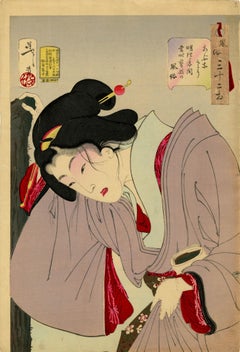
Dangerous: The Appearance of a Contemporary Geisha of the Meiji Era

Dangerous: The Appearance of a Contemporary Geisha of the Meiji Era

By Taiso Yoshitoshi

Located in Fairlawn, OH

Dangerous: The Appearance of a Contemporary Geisha of the Meiji Era Color woodcut, 1888 Plate 28 from the series "Thirty-two Aspects of Customs and Manners" (Fuzoku Sanjuniso) Format...

Category

1880s Alberico Morena Art

Materials

Woodcut

Tamaya Nishi, Hana-murasaki (Purple Flower)

Tamaya Nishi, Hana-murasaki (Purple Flower)

By Keisai Eisen

Located in Fairlawn, OH

Signed: Keisai Eisen ga; Seal: Kiwame Series: Contemporary Scenes in the Pleasure Quarters Publisher: Wakasaya Yoichi Note: This is a famous ...

Category

Early 19th Century Alberico Morena Art

Materials

Woodcut

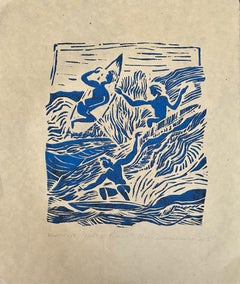
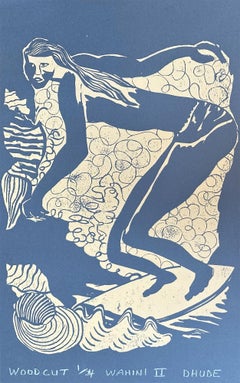
Wahini #2 - Surfing Art - Figurative - Woodcut Print By Marc Zimmerman

Wahini #2 - Surfing Art - Figurative - Woodcut Print By Marc Zimmerman

By Marc Zimmerman

Located in Carmel, CA

Wahini #2 - Surfing Art - Figurative - Woodcut Print By Marc Zimmerman Limited Edition 01/04 This masterwork is exhibited in the Zimmerman Gallery, Carmel CA. Immerse yourself in ...

Category

2010s Contemporary Alberico Morena Art

Materials

Woodcut

Untitled From: The Travels of Sir John Mandeville, printed by Johannes Prüss

Untitled From: The Travels of Sir John Mandeville, printed by Johannes Prüss

Located in Fairlawn, OH

Untitled From: The Travels of Sir John Mandeville, printed by Johannes Prüss Woodcut on 15th cen. laid paper, 1488 Unsigned (as issued) Woodcuts attributed to the "Master of the Berg...

Category

15th Century and Earlier Old Masters Alberico Morena Art

Materials

Woodcut

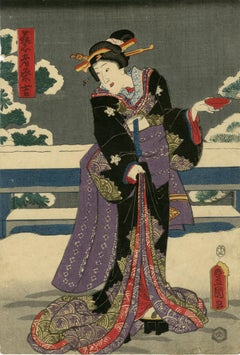
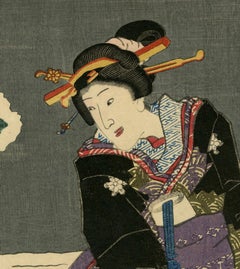
Courtesan Kumekichi
Courtesan Kumekichi

Courtesan Kumekichi

By Utagawa Kunisada (Toyokuni III)

Located in Fairlawn, OH

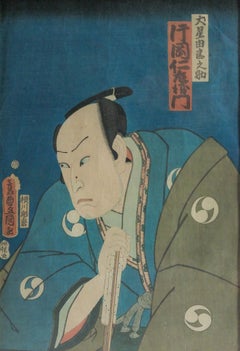
Courtesan Kumekichi Color woodblock, 1858 Kabuki Actor Iwai Kumesaburo III in the role of courtesan Kumekichi, who is standing in snow hold a red sake cup Publisher: Ohkuniya Kinjiro...

Category

1850s Other Art Style Alberico Morena Art
Materials

Woodcut

"Skating on Ladies' Pond Central Park": Winslow Homer 19th C. Woodcut Engraving

"Skating on Ladies' Pond Central Park": Winslow Homer 19th C. Woodcut Engraving

By Winslow Homer

Located in Alamo, CA

This Winslow Homer woodcut engraving entitled "Skating on the Ladies' Skating-Pond in Central Park, New York", was published in Harper's Weekly in the January 28, 1860 edition. It depicts a large number of men, women and children skating on a recently opened pond in Central Park. At the time of publication of this engraving, Central Park was in the early stages of construction. This engraving documents the very early appearance of Frederick Law Olmstead and Calvert Vaux's masterpiece of landscape design. According to Olmsted, the park was "of great importance as the first real Park made in this century – a democratic development of the highest significance". The people of New York were very proud of the plans for their park. It was stated at the time: "Our Park, which is progressing very satisfactorily under the management of the Commissioners, will undoubtedly be, one of these days, one of the finest place of the kind in the world...Those who saw the Park before the engineers went to work on it are amazed at the beautiful sites which have been contrived with such unpromising materials; all fair persons believe that the enterprise is managed with honesty and good taste." Skating was rapidly rising in national popularity in part due to the opening of Central Park’s lake to skaters on a Sunday in December 1858 with 300 participants. The following Sunday it attracted ten thousand skaters. By Christmas Day, a reported 50,000 people came to the park, most of them to skate. There were rules governing who could use the skating pond. “The Ladies’ Pond...

Category

1870s American Impressionist Alberico Morena Art
Materials

Engraving, Woodcut

Modern American Industrial Landscape

Modern American Industrial Landscape

Located in Buffalo, NY

An original woodblock print dated 1965, titled "Our Town" but signed illegibly.

Category

1960s American Modern Alberico Morena Art
Materials

Paper, Woodcut

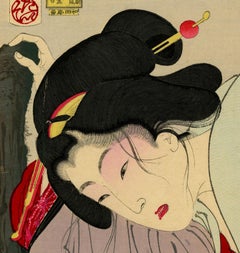
"Dawn Inside the Yoshiwara" Utagawa Hiroshige, Japanese Landscape, Ukiyo-e

"Dawn Inside the Yoshiwara" Utagawa Hiroshige, Japanese Landscape, Ukiyo-e

By Utagawa Hiroshige

Located in New York, NY

Utagawa Hiroshige Dawn Inside the Yoshiwara, circa 1857 Woodblock print 11 x 7 inches Utagawa Hiroshige is recognized as a master of the ukiyo-e woodblock printing tradition, havin...

Category

1850s Naturalistic Alberico Morena Art
Materials

Paper, Ink, Woodcut

'Chion-in Temple Gate' from 'Eight Scenes of Cherry Blossoms' — Jizuri Seal

'Chion-in Temple Gate' from 'Eight Scenes of Cherry Blossoms' — Jizuri Seal

By Hiroshi Yoshida

Located in Myrtle Beach, SC

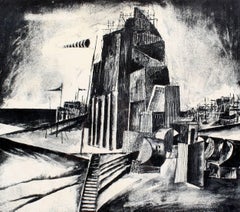
Hiroshi Yoshida, 'Chion-in Temple Gate (Sunset)' from the series 'Eight Scenes of Cherry Blossoms (Sakura hachi dai: Sakura mon)', color woodblock print, 1935. Signed in brush 'Yoshida' and in pencil 'Hiroshi Yoshida'. A superb, early impression, with fresh colors; the full sheet with margins, on cream Japan paper; an area of slight toning in the top right sheet corner, not affecting the image, otherwise in excellent condition. Marked with a jizuri (self-printed) seal, upper left margin. Self-published by the artist. Image size 9 5/8 x 14 3/4 inches (444 x 375 mm); sheet size 10 7/8 x 16 inches (276 x 406 mm). Archivally sleeved, unmatted. Provenance: M. Nakazawa, Tokyo. Literature: Japanese Landscapes of the 20th Century (Hotei Publishing calendar), 2001, May. Collections: Honolulu Museum of Art, Museum of Fine Arts, Boston. ABOUT THE IMAGE Located in Kyoto, Chionin is the main temple of the Jodo sect of Japanese Buddhism, one of the most popular Buddhist sects in Japan, having millions of followers. The Sanmon Gate, Chionin's entrance gate, standing 24 meters tall and 50 meters wide, it is the largest wooden temple gate in Japan and dates back to the early 1600s. Behind the gate, a broad set of stairs leads to the main temple grounds. ABOUT THE ARTIST Painter and printmaker Yoshida Hiroshi (1876-1950) is regarded as one of the greatest artists of the Japanese 'shin hanga' (New Print) movement. Yoshida was born as the second son of Ueda Tsukane in Kurume, Fukuoka Prefecture, a schoolteacher from an old samurai family. In 1891 he was adopted by his art teacher Yoshida Kasaburo in Fukuoka and took his surname. In 1893 he went to Kyoto to study painting, and the following year to Tokyo to join Koyama Shotaro's Fudosha private school; he also became a member of the Meiji Fine Arts Society. These institutions taught and advocated Western-style painting, greatly influencing Yoshida’s artistic development. In 1899 Yoshida had his first American exhibition at Detroit Museum of Art (now Detroit Institute of Art), making the first of many visits to the US and Europe. In 1902 he helped reorganize the Meiji Fine Arts Society, renaming it the Taiheiyo-Gakai (Pacific Painting...

Category

1930s Showa Alberico Morena Art
Materials

Woodcut

Previously Available Items
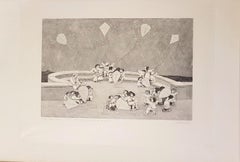
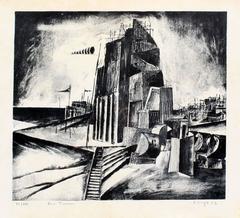
The Kites - Original Woodcut by Alberico Morena - 1960s

The Kites - Original Woodcut by Alberico Morena - 1960s

By Alberico Morena

Located in Roma, IT

Image dimensions: 26 x 40 cm. Beautiful xilograph hand-printed on tissue-paper. Print representing some children playing with kites. Hand-signed with pencil on lower-right margin. T...

Category

1960s Alberico Morena Art
Materials

Woodcut

Alberico Morena art for sale on 1stDibs.

Find a wide variety of authentic Alberico Morena art available for sale on 1stDibs. You can also browse by medium to find art by Alberico Morena in woodcut print and more. Not every interior allows for large Alberico Morena art, so small editions measuring 18 inches across are available. Customers who are interested in this artist might also find the work of Ossi Czinner, Renzo Biasion, and Mario Logli. Alberico Morena art prices can differ depending upon medium, time period and other attributes. On 1stDibs, the price for these items starts at $312 and tops out at $321, while the average work can sell for $316.

Artists Similar to Alberico Morena