Alberico Morena Art

to
1
1
Overall Width
to
Overall Height
to
2
1
1
2
1
2
2
10,164
2,784
2,504
1,382
2
Artist: Alberico Morena
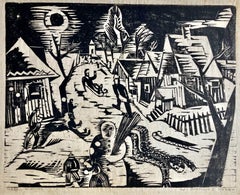
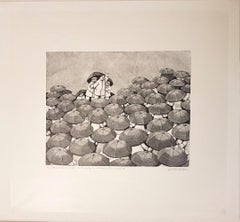
The Orator - Original Woodcut by Alberico Morena - 1971
By Alberico Morena
Located in Roma, IT
Image dimensions: 24 x 29.5 cm. Beautiful xilograph hand-printed on tissue-paper, 1971. Print representing a political public speech. Hand-signed with pencil on lower-right margin. ...
Category

1970s Alberico Morena Art

Materials

Woodcut
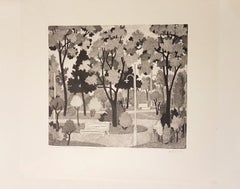
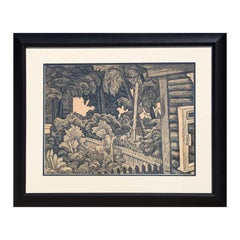
The Garden - Original Woodcut by Alberico Morena - 1958
By Alberico Morena
Located in Roma, IT
Image dimensions: 28 x 33 cm. Fine xilograph hand-printed on tissue-paper, representing a garden. Hand-signed with pencil on lower-right margin. Signed on plate too, lower-right cor...
Category

1950s Alberico Morena Art

Materials

Woodcut
Related Items
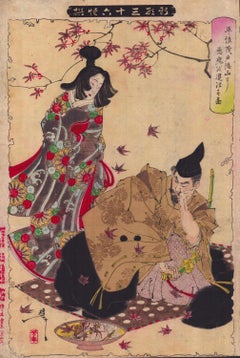
One Hundred Aspects of the Moon, Mt Otawa Moon - Bright God Tamura
By Tsukioka Yoshitoshi
Located in Soquel, CA
"Mount Otawa Moon: Bright God Tamura" - Woodblock on Paper by Tsukioka Yoshitoshi From the series "One Hundred Aspects of the Moon" This piece depicts the general Sakanoe no Tamura...
Category

1880s Edo Alberico Morena Art

Materials

Paper, Ink, Woodcut

Brooklyn Bridge
By Richard Bosman
Located in New York, NY
An exquisitely printed image created by Richard Bosman in 1996, the artist’s iconic Brooklyn Bridge is a woodcut on Japan paper. Measuring 18 x 24 1/2 in. (45.7 x 62.2 cm), unframed,...
Category

20th Century Neo-Expressionist Alberico Morena Art

Materials

Woodcut
'Chion-in Temple Gate' from 'Eight Scenes of Cherry Blossoms' — Jizuri Seal
By Hiroshi Yoshida
Located in Myrtle Beach, SC
Hiroshi Yoshida, 'Chion-in Temple Gate (Sunset)' from the series 'Eight Scenes of Cherry Blossoms (Sakura hachi dai: Sakura mon)', color woodblock print, 1935. Signed in brush 'Yoshida' and in pencil 'Hiroshi Yoshida'. A superb, early impression, with fresh colors; the full sheet with margins, on cream Japan paper; an area of slight toning in the top right sheet corner, not affecting the image, otherwise in excellent condition. Marked with a jizuri (self-printed) seal, upper left margin. Self-published by the artist. Image size 9 5/8 x 14 3/4 inches (444 x 375 mm); sheet size 10 7/8 x 16 inches (276 x 406 mm). Archivally sleeved, unmatted. Provenance: M. Nakazawa, Tokyo. Literature: Japanese Landscapes of the 20th Century (Hotei Publishing calendar), 2001, May. Collections: Honolulu Museum of Art, Museum of Fine Arts, Boston. ABOUT THE IMAGE Located in Kyoto, Chionin is the main temple of the Jodo sect of Japanese Buddhism, one of the most popular Buddhist sects in Japan, having millions of followers. The Sanmon Gate, Chionin's entrance gate, standing 24 meters tall and 50 meters wide, it is the largest wooden temple gate in Japan and dates back to the early 1600s. Behind the gate, a broad set of stairs leads to the main temple grounds. ABOUT THE ARTIST Painter and printmaker Yoshida Hiroshi (1876-1950) is regarded as one of the greatest artists of the Japanese 'shin hanga' (New Print) movement. Yoshida was born as the second son of Ueda Tsukane in Kurume, Fukuoka Prefecture, a schoolteacher from an old samurai family. In 1891 he was adopted by his art teacher Yoshida Kasaburo in Fukuoka and took his surname. In 1893 he went to Kyoto to study painting, and the following year to Tokyo to join Koyama Shotaro's Fudosha private school; he also became a member of the Meiji Fine Arts Society. These institutions taught and advocated Western-style painting, greatly influencing Yoshida’s artistic development. In 1899 Yoshida had his first American exhibition at Detroit Museum of Art (now Detroit Institute of Art), making the first of many visits to the US and Europe. In 1902 he helped reorganize the Meiji Fine Arts Society, renaming it the Taiheiyo-Gakai (Pacific Painting...
Category

1930s Showa Alberico Morena Art

Materials

Woodcut
'Dancers' — 1930s American Modernism
By Charles Turzak
Located in Myrtle Beach, SC
Charles Turzak, 'Dancers', 1939, wood engraving, edition 100. Signed, titled, and numbered 72/100 in pencil. A fine, richly-inked impression, on off-white Japan paper, with full marg...
Category

Mid-20th Century Art Deco Alberico Morena Art

Materials

Woodcut
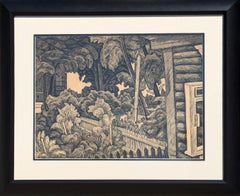
Stevan Dohanos, Backyard
By Stevan Dohanos
Located in New York, NY
Stevan Dohanos was an accomplished draftsman who work was widely known through the Saturday Evening Post. This print 'Backyard,' however, leaves aside the illustrative magazine work ...
Category

1930s American Modern Alberico Morena Art

Materials

Woodcut
19th century woodcut engraving print figurative American forest trees scene
By Winslow Homer
Located in Milwaukee, WI
The present woodcut engraving is an original print designed by Winslow Homer, originally published in Harper's Weekly on April 30, 1859. It is an excellent example of the many prints Homer produced of fashionable people engaged in leisurely activities, in this case along a picturesque countryside lane. The sign reading 'Belmont' on the left indicates this is probably near his home in Belmont Massachusetts. The image presents multiple figures, both men and women, riding horseback: Some in the distance gallop away, toward a town marked by a church steeple beyond. Three others in the foreground, including two equestrian women, gather around a group of children who have been gathering flowers and trapping birds...
Category

1850s Victorian Alberico Morena Art

Materials

Engraving, Woodcut

HAIL AND FAREWELL
By Rockwell Kent
Located in Portland, ME
Kent, Rockwell. HAIL AND FAREWELL. Burne-Jones 55. Wood engraving, 1930. Edition of 120. 8 x 5 1/2 inches, 203 x 140 mm. Signed in pencil. In excellent condition.
Category

1930s American Modern Alberico Morena Art

Materials

Woodcut
HAIL AND FAREWELL
$4,800
H 20 in W 16 in D 2 in
Early 20th Century Wuthering Heights Genre Woodcut -- Death of Earnshaw #28/30
By Clare Leighton
Located in Soquel, CA
Wonderful genre woodcut of a scene from Emily Bronte's "Wuthering Heights" titled "Death of Earnshaw" by Clare Leighton (British/American, 1898 - 198...
Category

1950s Other Art Style Alberico Morena Art

Materials

Paper, Ink, Woodcut

"Various Himochi" Wagashi Festival Japanese Woodblock Print by Utagawa Toyokuni
By Utagawa Toyokuni
Located in Soquel, CA
"Various Himochi" Wagashi Festival Japanese Woodblock Print by Utagawa Toyokuni Rare oversized early 19th century 5-tiered woodblock by Utagawa Ichiyosai Toyokuni, (Japan, 1769-1825), a Japanese lord and wife oversee a sekku festival of food, music, and dolls or toys. '"oshi" is the first day of “Mi (Snake)” in the third month of the lunar calendar. This day, known in modern Japan as the Girls' Festival, originated in China as a form of purification ceremony in which water and drinking peach blossom wine were used to drive away evil. Many kinds of hishi-mochi appear in this picture of hina ningyo (dolls associated with Hinamatsuri, or the Girl’s Day) from Omochae. The custom of eating special dishes at events throughout the year and at milestones in people's lives has existed since ancient times. This paragraph specifically focuses on the annual event called sekku, and life events that involve eating sweets. Joshi is the first day of “Mi (Snake)” in the third month of the lunar calendar. This day, known in modern Japan as the Girls' Festival, originated in China as a form of purification ceremony in which water and drinking peach blossom wine were used to drive away evil. According to the Keiso saijiki, in ancient China, on the third day of the third lunar month, people ate “ryuzetsuhan,” which is the juice of gogyo (Jersey cudweed) mixed with rice flour and nectar. In Japan, there is a record in the Heian period history book Nihon Montoku tenno jitsuroku [839-5] that it was an annual event to make kusamochi using gogyo on the third day of the third month of the lunar calendar, which may have been influenced by Chinese customs. The tradition of eating kusamochi on the third day of the third month of the lunar calendar continued after that. By the Edo period, however, hishimochi had come to be used as a sweet to serve on the third day of the third month. A picture of a hishimochi is included in the Morisada manko , which we mentioned in Part 1. According to it, hishimochi in the Edo period were often three layers of green-white-green instead of the now common red-white-green. However, it is possible to see from our collection that not all hishimochi were made in this way. Omochae published in 1857, is a good example. Omochae is a type of ukiyoe print...
Category

1820s Edo Alberico Morena Art

Materials

Ink, Rice Paper, Woodcut

Modern American Industrial Landscape
Located in Buffalo, NY
An original woodblock print dated 1965, titled "Our Town" but signed illegibly.
Category

1960s American Modern Alberico Morena Art

Materials

Paper, Woodcut

Angel and Skeleton (the rescuing Angel appears to be female)
By Donna Evans
Located in New Orleans, LA
Donna Evans' "Angel and Skeleton" shows an angel reaching out to a skeleton as if to rescue it from a wooded landscape. Donna Evans is one of a group of N...
Category

1980s Contemporary Alberico Morena Art

Materials

Woodcut
Study of Utagawa Hiroshige's "View of Hara-Juku" 53 Stations of the Tokaido Road
By Utagawa Hiroshige
Located in Soquel, CA
Study of Utagawa Hiroshige's "View of Hara-Juku" 53 Stations of the Tokaido Road Hand painted study of Utagawa Hiroshige's "View of Hara-Juku", (by unknown artist), from "53 Station...
Category

1920s Edo Alberico Morena Art

Materials

Paper, Ink, Woodcut

Previously Available Items
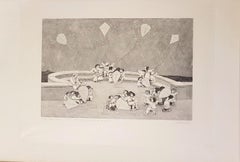
The Kites - Original Woodcut by Alberico Morena - 1960s
By Alberico Morena
Located in Roma, IT
Image dimensions: 26 x 40 cm. Beautiful xilograph hand-printed on tissue-paper. Print representing some children playing with kites. Hand-signed with pencil on lower-right margin. T...
Category

1960s Alberico Morena Art

Materials

Woodcut
Alberico Morena art for sale on 1stDibs.

Find a wide variety of authentic Alberico Morena art available for sale on 1stDibs. You can also browse by medium to find art by Alberico Morena in woodcut print and more. Not every interior allows for large Alberico Morena art, so small editions measuring 18 inches across are available. Customers who are interested in this artist might also find the work of Ossi Czinner, Renzo Biasion, and Mario Logli. Alberico Morena art prices can differ depending upon medium, time period and other attributes. On 1stDibs, the price for these items starts at $312 and tops out at $321, while the average work can sell for $316.

Artists Similar to Alberico Morena