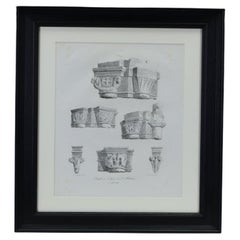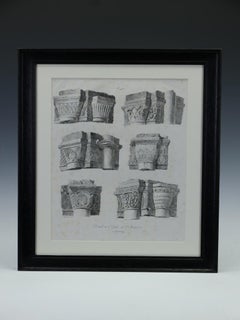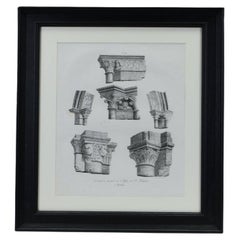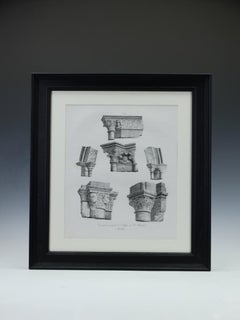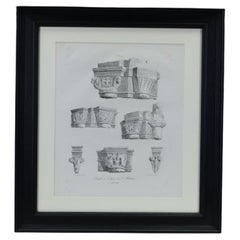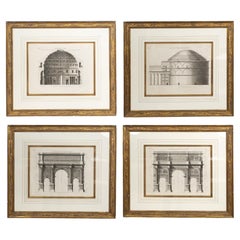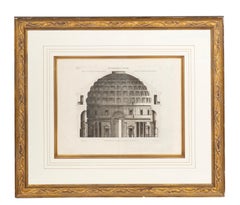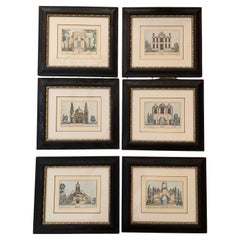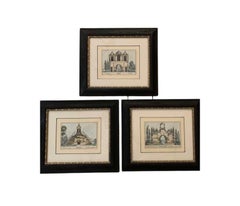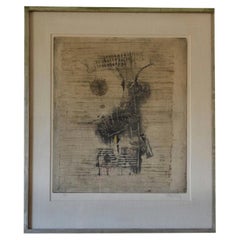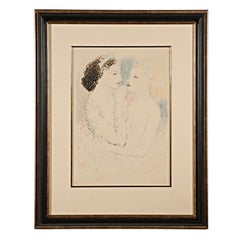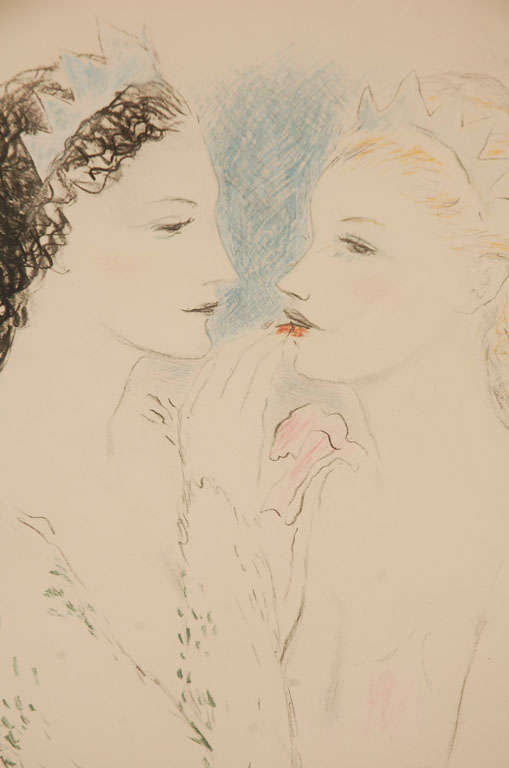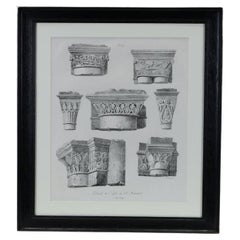
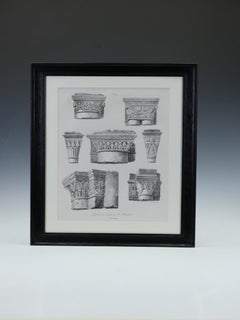
The engraving depicts a classical façade of a building, designed with a series of evenly spaced windows and arches on the ground floor, and rectangular windows on the upper floor. The architectural style is neoclassical, characterized by its symmetry, balanced proportions, and the use of classical elements such as pilasters and pediments. Atop the structure sits a central pediment supported by columns, flanked by statues. This could represent a public building or a grand palatial structure. The precise lines and attention to detail suggest that it was intended for scholarly study or as a record of architectural design. The labeling at the bottom, if any, could provide information on the building's location or the architect, but it's not visible in the image.
The engraving is possible part of a series published around the early 18th century by Joan Blaeu, a renowned Dutch cartographer born in 1599 and who passed away in 1673. His works often featured detailed engravings of notable locations. This particular piece would have been published posthumously, as part of a collection that his heirs continued, which was later reissued by publishers like Pierre Mortier. The exact date of publication for this specific engraving is not provided in the information, but it would be within the timeframe of the early 1700s, given the dates of the reissues mentioned and the info behind the watermark that is visible if you hold the print to the light.
The text appears in the paper is a historical note about the Honig family, prominent in the Dutch paper manufacturing industry during the 17th and 18th centuries. Jan Jbz. Honig (1688-1757), the white paper manufacturer from Zaandijk, was the son of paper manufacturer Jacob Cz. Honig(h) (1648-1709). Jan began his independent work in 1738 and continued until 1757. He was the younger brother of Cornelis Jbz. Honig (1683-1755), and together they started the company C & J HONIG in 1709. Following a division of the family business in 1738, Jan took over the mill 'De Vergulde Bijkorf' and also acquired the mill 'De Eendracht'. He was married to Trijntje Claes Caescoper (1689-1763) and operated with his son Jacob Jsz. Honig (1712-1780) under the name J(an) HONIG & ZOON. Around 1741, this firm produced Pro Patria paper featuring the emblem of the Hollandse Tuin as a watermark. By 1764, under the direction of his son Jacob, J. HONIG & ZOON supplied paper to the Amsterdam Chamber of the Dutch East India Company, using watermarks including the Amsterdam coat of arms...
Category
Early 18th Century Antique Furniture