Angelo Basso Sculptures

b. 1943
"ITALIAN MASTER OF THE MODERN BAROQUE" Angelo Basso is one of Italy's most prominent figurative sculptors -- an heir to the Baroque tradition of the 1600s. Basso captures the lush, assertive style of that period in his evocative female figures. His lithe, confident women miraculously glide through sea waves with the rich flowing movement of the Baroque style. Basso's figures are immortalized in magic moments of life or captured in the delicate grace of a courtly dance. At the age of 18, Basso enjoyed his first solo show in Italy and, since then, has exhibited internationally in Germany, England, Sweden, Denmark, Holland, Switzerland, Japan, Australia and the United States.
to
2
2
1
Overall Width
to
Overall Height
to
3
3
1
3
3
2
1
1
1
1
1
3
3
3
212
163
151
128
3
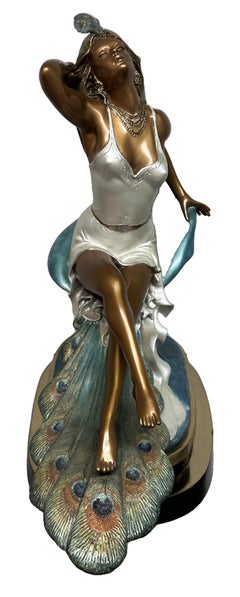
Artist: Angelo Basso
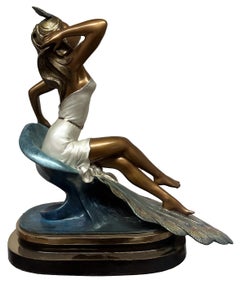
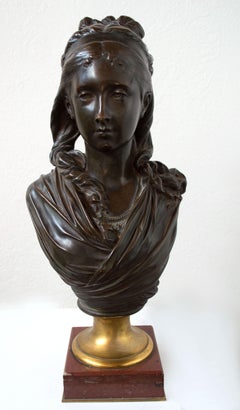
Gabriella Bronze Sculpture

Gabriella Bronze Sculpture

By Angelo Basso 1

Located in Rochester Hills, MI

Angelo Basso (Italy, 1943 – 2011) Gabriella  Dimensions 17.0" W x 18.0" H x 7.0" D This sculpture was cast in the Dyansen Studios Foundry in 1991 under...

Category

1980s Baroque Angelo Basso Sculptures

Materials

Bronze

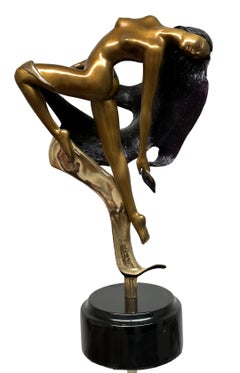
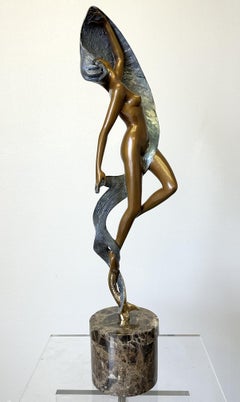
Evolution Painted Bronze Sculpture

Evolution Painted Bronze Sculpture

By Angelo Basso 1

Located in Rochester Hills, MI

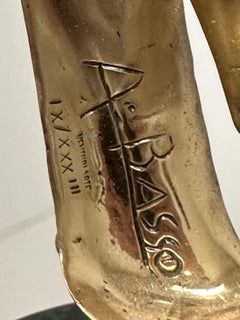
Angelo Basso (Italy, 1943 – 2011) Evolution Signed and marked IX / XXXIII Beauty & Mythology Collection Sculpture 23″ inches tall (Base 5″ Siren 18″) Box size 20″ x 17″ x 27″ ...

Category

1980s Baroque Angelo Basso Sculptures

Materials

Bronze

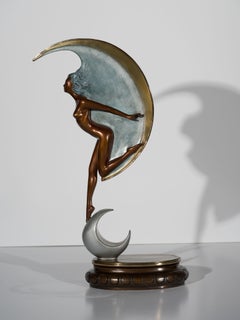
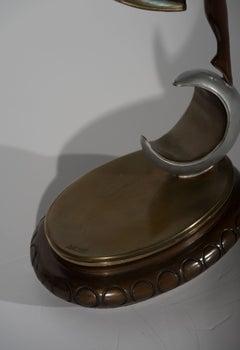
"La Luna (The Moon)" limited edition cast bronze sculpture by Angelo Basso

"La Luna (The Moon)" limited edition cast bronze sculpture by Angelo Basso

By Angelo Basso 1

Located in Boca Raton, FL

"La Luna (The Moon)" cast bronze sculpture in bronze, silver, gold and blue by artist Angelo Basso. Depicts a woman framed by a crescent moon standing on a smaller crescent moon. Fro...

Category

1980s Art Deco Angelo Basso Sculptures

Materials

Bronze

Related Items
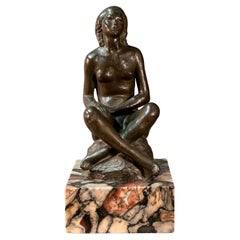
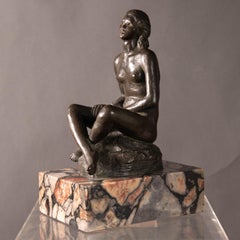
1920s Italian Art Decò Signed Bronze Sculpture Nude of Woman

1920s Italian Art Decò Signed Bronze Sculpture Nude of Woman

By Gaetano Martinez

Located in Roma, IT

Wonderful Italian sculpture representing a seated maiden. The artwork rests on a square marble base Signed on the base “Gaetano Martinez Roma” According a written opinion by Prof. Al...

Category

1920s Art Deco Angelo Basso Sculptures

Materials

Marble, Bronze

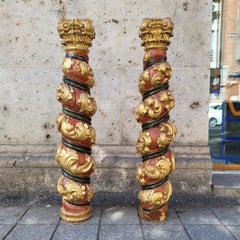
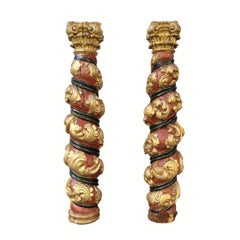
Baroque pair of Solomonic columns from a Altarpiece, giltwood and paint wood

Baroque pair of Solomonic columns from a Altarpiece, giltwood and paint wood

Located in Valladolid, ES

Outstanding pair of Solomonic columns belonging to the decorative structure of an 18th-century Baroque altarpiece. These pieces were originally attached to the altarpiece structure; ...

Category

1780s Baroque Angelo Basso Sculptures

Materials

Wood

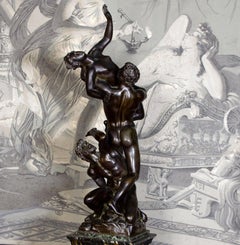
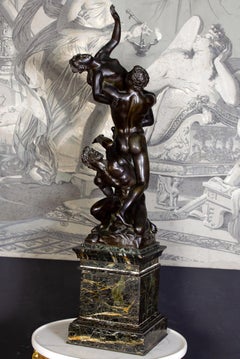
The Rape of Sabine Iconic Bronze Sculpture 1930

The Rape of Sabine Iconic Bronze Sculpture 1930

Located in Rome, IT

Fine Group of Sculptures in Bronze after Jean de Boulogne (Giambologna) The torturously twisting Rape of the Sabine Women is one of the finest and most technically difficult sculpt...

Category

1920s Mannerist Angelo Basso Sculptures

Materials

Bronze

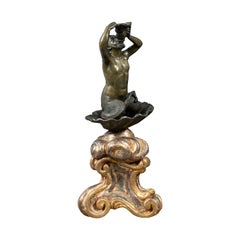
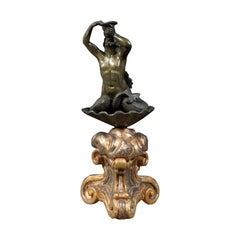
Italian sculptor - 17th-18th century bronze Triton playing a conch shell

Italian sculptor - 17th-18th century bronze Triton playing a conch shell, c.1700

$3,478Sale Price|25% Off

H 20.08 in W 8.67 in D 8.67 in

Italian sculptor - 17th-18th century bronze Triton playing a conch shell

Located in Varmo, IT

Italian sculptor (17th-18th century) - Triton playing a conch shell. 22 x 22 x h 51 cm. Full-length figure in patinated bronze on a rocaille carved and gilded wood base. The trito...

Category

Late 17th Century Baroque Angelo Basso Sculptures

Materials

Bronze

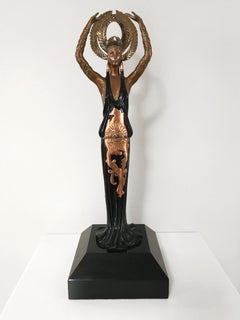
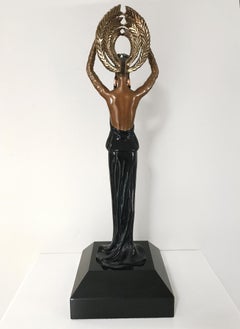
Triumph, Signed and Numbered Art Deco Bronze Sculpture by Erté

Triumph, Signed and Numbered Art Deco Bronze Sculpture by Erté

By Erté

Located in Long Island City, NY

Erté's Triumph celebrates victory and achievement through Art Deco sculptural design with elegant bronze craftsmanship. This striking metal sculpture features the artist’s signature...

Category

1980s Art Deco Angelo Basso Sculptures

Materials

Bronze

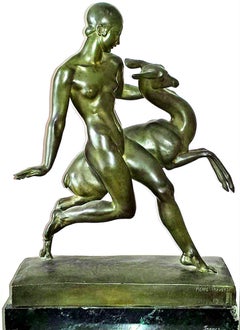
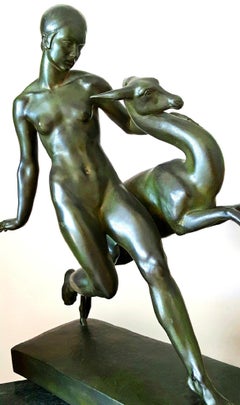
Art Deco Bronze Nude Girl with Fawn, Amazon with Fawn Statue

Art Deco Bronze Nude Girl with Fawn, Amazon with Fawn Statue

By Pierre Traverse

Located in Miami, FL

Signed on base. This was exhibited at the Goldscheider Pavilion at the 1925 Paris Exhibition Marble base has loss to right edge and very small lose to center edge. , Bronze is in ve...

Category

1920s Art Deco Angelo Basso Sculptures

Materials

Bronze

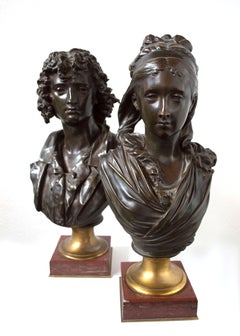
Pair of 19th Century Busts by Albert Ernest Carrier-Belleuse

Pair of 19th Century Busts by Albert Ernest Carrier-Belleuse

By Albert-Ernest Carrier-Belleuse

Located in Santa Fe, NM

Signed: A. Carrier-Belluese Two large bronze matching busts of an unknown male and female 22 x 10 x 11" male 23 x 10 x 9" female Both show signs of wear with their age but are in fa...

Category

19th Century Baroque Angelo Basso Sculptures

Materials

Marble, Bronze

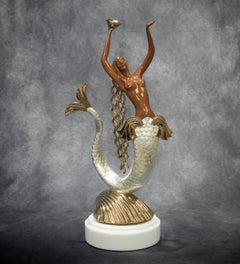
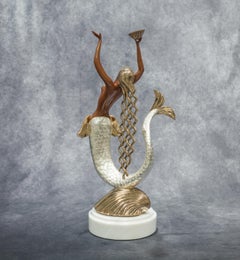
Mermaid
Mermaid

ErtéMermaid, 1990

$11,850

H 20 in W 9 in D 8 in

Mermaid

By Erté

Located in Greenwich, CT

Whether in the draping of a silk gown worn by an opera diva, or in the sparkle of an intricately beaded headdress worn by a woman of society, Erté had an exceptionally acute visual memory of every detail of his early design creations. It was no wonder then that his fashion designs were so adeptly applied to the sculpture format. In Mermaid, we have a fine example of how Erté carried the technical possibilities of the sculpture medium to a new level. This attention to detail added to his legend as one of the Twentieth Century’s foremost artist-designers, with work represented in the collections of the Metropolitan Museum of Art, New York, the Museum of Modern Art, New York, the Paris Opera House, the Smithsonian Institution and the Victoria and Albert Museum, London. Through Mermaid, Erté takes us beyond the female form by choosing the intriguing legendary sea creature whose upper body is that of a woman, and whose lower body is that of an aquatic creature. In quintessential Erté style...

Category

20th Century Art Deco Angelo Basso Sculptures

Materials

Bronze

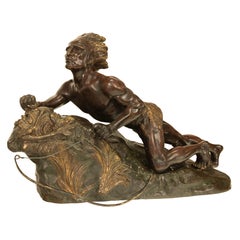
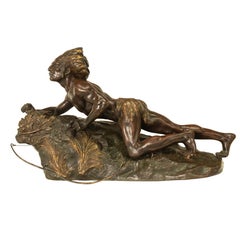
Antique French Art Deco Bronze Sculpture Native American Indian Hunter Scout

Antique French Art Deco Bronze Sculpture Native American Indian Hunter Scout

Located in Portland, OR

A fine & large antique French Art Deco bronze of a Native American scout or brave, by René-André Varnier, circa 1920. This very fine and dynamic antique patinated bronze sculpture de...

Category

Early 20th Century Art Deco Angelo Basso Sculptures

Materials

Bronze

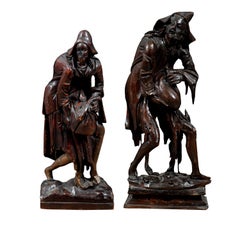
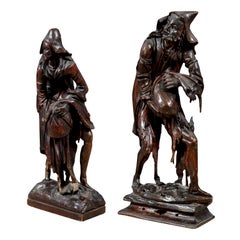
Pair of 18th century Venetian carved wood sculptures, beggar figures Venice

Pair of 18th century Venetian carved wood sculptures, beggar figures Venice

Located in Varmo, IT

Venetian sculptor (18th century) - Two figures of beggars. 12.5 x 7 x h 30 cm (large), 10 x 5 x h 25 cm (small). Full figures in carved wood. The two sculptures each depict a begg...

Category

Mid-18th Century Baroque Angelo Basso Sculptures

Materials

Wood

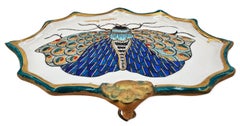
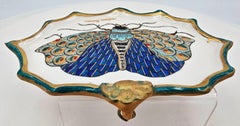
Vintage Moth X (Wall Piece/Dish (hand-painted)

Vintage Moth X (Wall Piece/Dish (hand-painted)

By Melanie Sherman

Located in Kansas City, MO

Melanie Sherman Vintage Moth X (Wall Piece/Dish (hand-painted) Porcelain, Glaze, Overglaze, Chinapaints, 24k German Gold Luster, Brass Wire (for hanging, can be removed) Year: 2025 S...

Category

18th Century Baroque Angelo Basso Sculptures

Materials

Brass, Wire

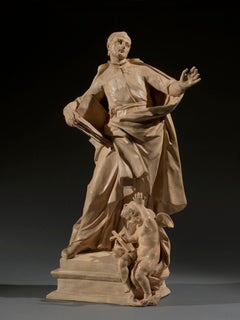
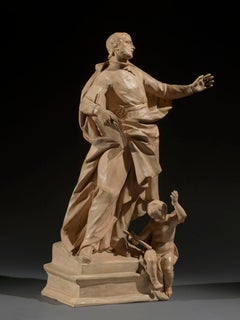
Roman 18th century terracotta model for the sculpture of San Camillo de Lellis

Roman 18th century terracotta model for the sculpture of San Camillo de Lellis

Located in London, GB

This remarkably fluid terracotta bozetto was made in preparation for Pietro Pacilli’s most important public commission, a large-scale marble statue of San Camillo de Lellis for the nave of St Peter’s Basilica in Rome. Expressively modelled, this terracotta sculpture is a rare and significant work made by a major Roman sculptor at a transformative moment of European sculpture. Pacilli began his working life on the great Baroque decorative projects initiated in the seventeenth century, but he found success as a restorer of ancient sculpture working to finish antiquities for a tourist market, becoming an important figure in the emergence of an archaeologically minded Neoclassicism. Pacilli trained Vincenzo Pacetti and provided important decorative work for the Museo Pio-Clementino, at the same time he is recorded restoring some of the most celebrated antiquities excavated and exported during the period. Pacilli was born into a family of Roman craftsmen, his father Carlo was a wood carver, and Pacilli is recorded working with him on the Corsini Chapel in San Giovanni Laternao as early as 1735. In 1738 his terracotta model of Joseph and Potiphar’s Wife won the first prize in the second class of the sculpture concorso at the Accademia di San Luca, this is particularly notable as Bartolomeo Cavaceppi came third. He worked as a carver and stuccoist completing works for the churches of San Marco and SS. Trinita dei Domeniciani Spagnoli. Pacilli operated as a sculptor and restorer of antiquities from his studio at the top of the Spanish Steps, close to Santa Trinita dei Monti, where he is listed as a potential vendor to the Museo Pio-Clementino in 1770. In 1763 Pacilli completed a silver figure of San Venanzio for the treasury of San Venanzio. He is recorded as Pacetti’s first master and it was evidently through Pacilli that he began to acquire his facility as a restorer of ancient sculpture. Pacilli, at his studio ‘poco prima dell’Arco della Regina alla Trinita dei Monti,’ exercised, what the nineteenth-century scholar, Adolf Michaelis called ‘rejuvenating arts’ on several important pieces of classical sculpture, including in 1760 the group of a Satyr with a Flute for the natural brother of George III, General Wallmoden, Hanovarian minister at Vienna. In 1765, Dallaway and Michaelis record that Pacilli was responsible for the restorations, including the addition of a new head, to the Barberini Venus which he had acquired from Gavin Hamilton. The Venus was then sold to Thomas Jenkins, who in turn passed it on to William Weddell at Newby Hall. In 1767 Pacilli exported a series of ancient busts ‘al naturale’ including portraits of Antinous, Julius Ceaser and Marus Aurelius, also a statue of a Muse and a Venus. As early as 1756 Pacilli seems to have been operating as an antiquarian, helping to disperse the collection of the Villa Borrioni. Pacilli supplied sculpture to notable British collectors, including Charles Townley, who on his first trip to Italy purchased the Palazzo Giustiniani statue of Hecate from Pacilli. Pacilli was involved with the Museo Pio Clementino from its conception, supplying busts of Julius Ceaser and a Roman Woman as well as completing stucco putti surmounting the arms of Pope Bendedict XIV to signal the entrance to the new Museo Critiano. In 1750 Il Diario Ordinario del Chracas announced that Pacilli had begun work on a sculpture of San Camillo de Lellis for St Peter’s. Camillo de Lellis founded his congregation, the Camillians, with their distinctive red felt crosses stitched on black habits in 1591. Having served as a soldier in the Venetian army, Camillo de Lellis became a novitiate of the Capuchin friars, he moved to Rome and established a religious community for the purpose of caring for the sick. In 1586 Pope Sixtus V formerly recognised the Camillians and assigned them to the Church of Santa Maria Maddalena in Rome. Camillo de Lellis died in 1614 and was entombed at Santa Maria Maddalena, he was canonised by Benedict XIV on June 26, 1746. It was an occasion that prompted the Camillians to make a number of significant artistic commissions, including two canvases by Pierre Subleyras showing episodes from San Camillo’s life which they presented to Benedict XIV. In 1750 Pacilli was commissioned to fill one of the large niches on the north wall of the nave with a sculpture of San Camillo. The present terracotta bozetto presumably had two important functions, to enable Pacilli to work out his ideas for the finished sculpture and at the same time to show his design to the various commissioning bodies. In this case it would have been Cardinal Alessandro Albani and Monsignor Giovan Francesco Olivieri, the ‘economo’ or treasurer of the fabric of St Peter’s. Previously unrecorded, this terracotta relates to a smaller, less finished model which has recently been identified as being Pacilli’s first idea for his statue of San Camillo. Preserved in Palazzo Venezia, in Rome, the terracotta shows San Camillo with his left hand clutching his vestments to his breast; the pose and action more deliberate and contained than the finished sculpture. In producing the present terracotta Pacilli has expanded and energised the figure. San Camillo is shown with his left hand extended, his head turned to the right, apparently in an attempt to look east down the nave of St Peter’s. The model shows Pacilli experimenting with San Camillo’s costume; prominently on his breast is the red cross of his order, whilst a sense of animation is injected into the figure through the billowing cloak which is pulled across the saint’s projecting right leg. The power of the restrained, axial contrapposto of bent right leg and outstretched left arm, is diminished in the final sculpture where a baroque fussiness is introduced to the drapery. What Pacilli’s terracotta demonstrates, is that he conceived the figure of San Camillo very much in line with the immediate tradition of depicting single figures in St Peter’s; the rhetorical gesture of dynamic saint, arm outstretched, book in hand, head pointed upwards was perhaps borrowed from Camillo Rusconi’s 1733 sculpture of St. Ignatius...

Category

18th Century Baroque Angelo Basso Sculptures
Materials

Terracotta

Previously Available Items
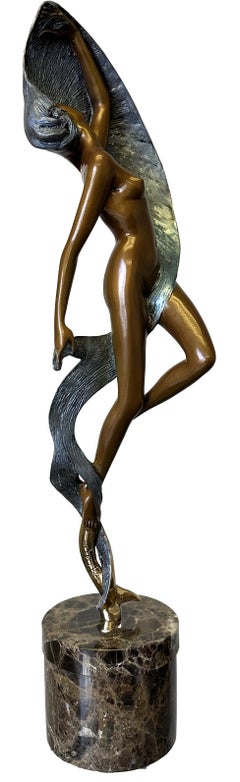
Angelo Basso Siren  Bronze Sculpture

Angelo Basso Siren Bronze Sculpture

By Angelo Basso 1

Located in Rochester Hills, MI

Angelo Basso (Italy, 1943 – 2011) Siren Signed and marked AP Foundry Mark FAA Beauty & Mythology Collection Sculpture 23″ inches tall (Base 5″ Siren 18″) Box size 20″ x 17″ x 27...

Category

1980s Baroque Angelo Basso Sculptures
Materials

Bronze

Angelo Basso sculptures for sale on 1stDibs.
Find a wide variety of authentic Angelo Basso sculptures available for sale on 1stDibs. You can also browse by medium to find art by Angelo Basso in bronze, metal and more. Not every interior allows for large Angelo Basso sculptures, so small editions measuring 12 inches across are available. Angelo Basso sculptures prices can differ depending upon medium, time period and other attributes. On 1stDibs, the price for these items starts at $3,600 and tops out at $11,200, while the average work can sell for $8,400.