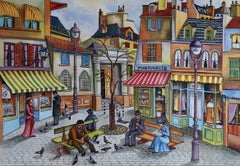
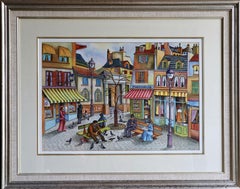
Paris Street Scene
By Ari Gradus
Located in Fort Washington, PA
Medium: Oil on Board Signature: Signed Lower Right
Category
20th Century Ari Gradus Paintings
Materials
Oil, Board
Paris Street Scene
By Ari Gradus
Located in Fort Washington, PA
Medium: Oil on Board Signature: Signed Lower Right
Oil, Board
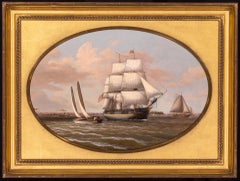
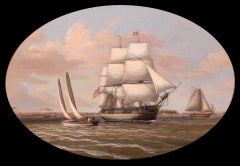
Amercan Merchant Ship in Philadelphia Harbor
By Thomas Birch
Located in Costa Mesa, CA
Thomas Birch is considered one of the earliest American Marine painters of importance both in his own time and historically, forming the foundation of what would become a great American Maritime movement in the successive years of the 19th century. Born in England, Birch started as a landscape painter but after the War of 1812 he turned to marine subjects, taking inspiration from the best of both English and Dutch maritime traditions but refining these techniques into a very recognizable style all his own. The work featured here is a classic of Birch's later period, when he focused specifically on maritime subjects, mainly the busy waterways of Philadelphia Harbor. Here we see one of those scenes- a series of ships plying their trade, all framed by the city as it sits across the Delaware River, with the tall, white spire of what is either Independence Hall or Christ Church to the left of the main vessel. The details of the city are particularly good in this painting, with the wharf building to the left and the long line of buildings all along the shore. The American Merchant Bark at the center of this painting is rendered in excellent detail, from her house flag and pennant, to her rigging and sails, and down to her deck filled with the activity of crewmembers readying the ship to head out, her gilt billet...
Canvas, Oil, Board
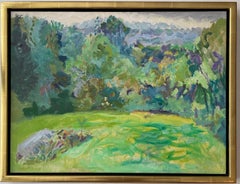
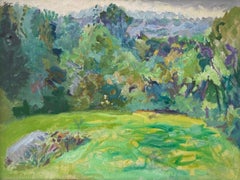
Summer, Quaker Hill oil painting by Nell Blaine
By Nell Blaine
Located in Hudson, NY
This work by Nell Blaine was exhibited at the Poindexter Gallery, as well as the Tibor de Nagy Gallery, both in New York City. It is signed lower left, and signed, titled, and dated ...
Oil, Board
$5,742
H 47.25 in W 31.5 in
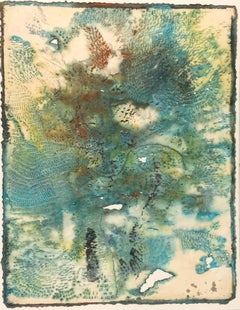
Untitled Jacques Rouby (1953-2019) Contemporary abstract art painted cardboard
By Jacques Rouby
Located in Paris, FR
Painted sculpted cardboard Unique work Coming from the artist's studio Jacques ROUBY, the aesthetics of mystery "Experimental dreamer, passionate about graphic adventures, delibera...
Oil, Cardboard
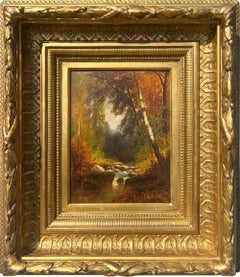
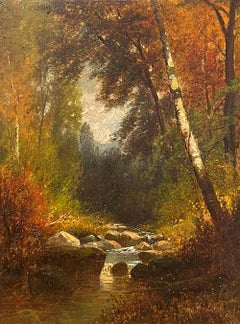
$9,500
H 8.5 in W 6.5 in
Adirondack Stream by Hudson River artist Joseph Antonio Hekking (1830-1903)
By Joseph Antonio Hekking
Located in New York, NY
Painted by Hudson River School artist Joseph Antonio Hekking (1830-1903), "Adirondack Stream in Fall" is oil on board and measures 8.5 x 6.5 inches. The painting is signed at the low...
Oil, Board
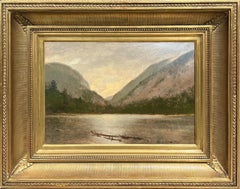
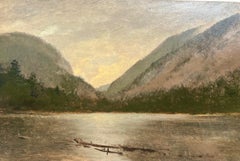
Hudson Highlands by Lockwood DeForest (American, 1850-1932)
By Lockwood DeForest
Located in New York, NY
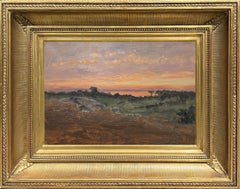
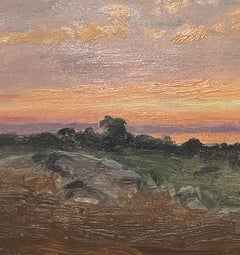
"Hudson Highlands," by Hudson River School painter Lockwood DeForest (American, 1850-1932) is oil on artists card-stock and measures 9.5 x 14 inches. The work is framed in an elegant, period appropriate frame, and ready to hang. Lockwood de Forest was born in New York in 1850 to a prominent family. He grew up in Greenwich Village and on Long Island at the family summer estate in Cold Spring Harbor. As was customary for a cultivated family in the Gilded Age, the de Forests made frequent trips abroad. Excursions to the great museums, which were prominent on the de Forests agenda, deepened the young Lockwood's familiarity with European painting and sculpture. Though he had begun drawing and painting somewhat earlier, it was during a visit to Rome in 1868 that nineteen-year-old de Forest first began to study art seriously, taking painting lessons from the Italian landscapist Hermann David Salomon Corrodi (1844–1905). More importantly, on the same trip, Lockwood met one of America’s most celebrated painters, (and his maternal great- uncle by marriage) Frederic Edwin Church (1826–1900), who quickly became his mentor. DeForest accompanied Church on sketching trips around Italy and continued this practice when they both returned to America in 1869. Early on in his career, de Forest made a habit of recording the date and often the place of his oil sketches, as to create a visual diary of his travels. Lockwood’s profession as a landscape painter can be primarily attributed to Frederic E. Church and his belief in the young artist’s talent. De Forest often visited Church in the Hudson River community of Catskill where, in addition to sketching trips and afternoons of painting, he assisted with the architectural drawings and planning of Olana. In 1872, de Forest took a studio at the Tenth Street Studio Building in New York. During these formative years de Forest counted among his friend’s artists such as Sanford Robinson Gifford (1823–80), George Henry Yewell (1830–1923), John Frederick Kensett (1816–72), Jervis McEntee (1828–91), and Walter Launt Palmer (1854–1932). Over the next decade de Forest experienced success as a painter. He exhibited for the first time at the National Academy of Design in 1872, and made two more painting trips abroad, in 1875–76 and 1877–78, traveling to the major continental capitals but also the Middle East and North Africa. His trip to the Middle East and the library at Church’s home, Olana, established his interest in design during his mid-twenties. From about 1878 to 1902, landscape painting was overshadowed by his activities and preoccupation with East Indian architecture and décor, a style that became quite fashionable in late nineteenth century America. From 1879-1883, de Forest founded Associated Artists along with Louis Comfort Tiffany, Candace Wheeler...
Oil, Board
$15,000
H 9.75 in W 14 in
New England Sunrise, 1910 by Lockwood DeForest (American, 1850-1932)
By Lockwood DeForest
Located in New York, NY
"New England Sunrise," 1910 by Hudson River School painter Lockwood DeForest (American, 1850-1932) is oil on artists card-stock and measures 9.75 x 14 inches. The work is signed by DeForest and dated Sept. 17, 1910 at lower left. The work is framed in an elegant, period appropriate frame, and ready to hang. Lockwood de Forest was born in New York in 1850 to a prominent family. He grew up in Greenwich Village and on Long Island at the family summer estate in Cold Spring Harbor. As was customary for a cultivated family in the Gilded Age, the de Forests made frequent trips abroad. Excursions to the great museums, which were prominent on the de Forests agenda, deepened the young Lockwood's familiarity with European painting and sculpture. Though he had begun drawing and painting somewhat earlier, it was during a visit to Rome in 1868 that nineteen-year-old de Forest first began to study art seriously, taking painting lessons from the Italian landscapist Hermann David Salomon Corrodi (1844–1905). More importantly, on the same trip, Lockwood met one of America’s most celebrated painters, (and his maternal great- uncle by marriage) Frederic Edwin Church (1826–1900), who quickly became his mentor. DeForest accompanied Church on sketching trips around Italy and continued this practice when they both returned to America in 1869. Early on in his career, de Forest made a habit of recording the date and often the place of his oil sketches, as to create a visual diary of his travels. Lockwood’s profession as a landscape painter can be primarily attributed to Frederic E. Church and his belief in the young artist’s talent. De Forest often visited Church in the Hudson River community of Catskill where, in addition to sketching trips and afternoons of painting, he assisted with the architectural drawings and planning of Olana. In 1872, de Forest took a studio at the Tenth Street Studio Building in New York. During these formative years de Forest counted among his friend’s artists such as Sanford Robinson Gifford (1823–80), George Henry Yewell (1830–1923), John Frederick Kensett (1816–72), Jervis McEntee (1828–91), and Walter Launt Palmer (1854–1932). Over the next decade de Forest experienced success as a painter. He exhibited for the first time at the National Academy of Design in 1872, and made two more painting trips abroad, in 1875–76 and 1877–78, traveling to the major continental capitals but also the Middle East and North Africa. His trip to the Middle East and the library at Church’s home, Olana, established his interest in design during his mid-twenties. From about 1878 to 1902, landscape painting was overshadowed by his activities and preoccupation with East Indian architecture and décor, a style that became quite fashionable in late nineteenth century America. From 1879-1883, de Forest founded Associated Artists along with Louis Comfort Tiffany, Candace Wheeler...
Oil, Board
$20,000
H 14 in W 14 in D 2 in
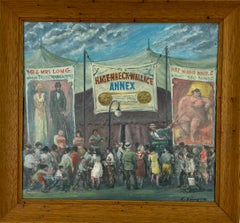
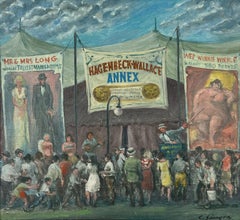
Hagenbeck-Wallace Annex. Circus Oil Painting of Depression Era Columbus, Ohio.
By Clyde Singer
Located in Marco Island, FL
American life is captured in this Clyde Singer painting, Hagenbeck-Wallace Annex (1972), where he depicts a moment in the circus coming to town. Traveling circuses were major events ...
Oil, Board
$8,729
H 23.23 in W 17.92 in
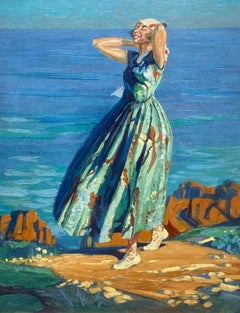
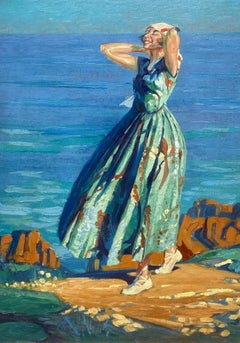
Holiday in Estérel Oil on Cardboard, Art Deco, Circa 1925, Framed
Located in London, GB
Émile Aubry (1880-1964) 'Holiday in Estérel' Oil on cardboard 59 x 45.5 cm, framed Dimensions: 74 x 61.5 cm Circa 1925 Unsigned Aubry’s ‘Holiday in Esterel’ beholds all the sty...
Oil, Cardboard
$4,023
H 19.69 in W 22.05 in D 2.72 in
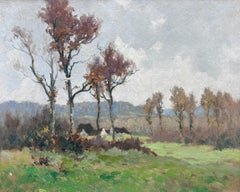
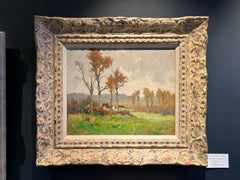
Sous-bois en Automne, Autumnal Landscape Painting
By Alexandre Louis Jacob
Located in London, GB
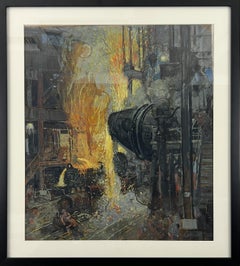
Image dimensions: 33cm x 40cm / 13 inches x 15¾ inches Framed dimensions: 50cm x 56cm / 19.7 inches x 22 inches This beautiful original oil painting by Alexandre Jacob depicts a the...
Oil, Board
$7,500
H 24 in W 21.5 in
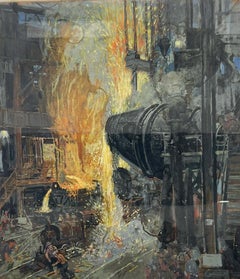
Illustration of Scrapper O'Doon, Saturday Evening Post Steel Mill
By Henry Soulen
Located in Marco Island, FL
Illustrated in the July 22, 1922 Saturday Evening Post, page 22, entitled "Scrapper O"Doon", about a steel mill, written by R.G. Kirk. Henry James Soulen (1888-1965) was a distingui...
Oil, Board
$19,500
H 25 in W 41 in D 2 in
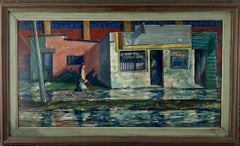
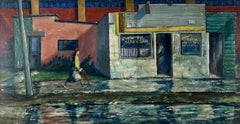
After The Shower-Mid-Century Street Scene Oil Painting. Realist Urban America.
By Clyde Singer
Located in Marco Island, FL
American life is captured in this Clyde Singer painting, After the Shower (1949), where he depicts a woman walking down the street after a storm with her umbrella in hand. An accompl...
Oil, Board
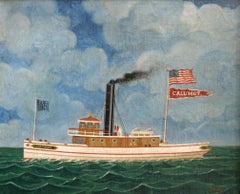
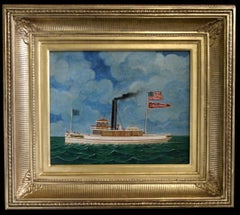
Great Lakes Tugboat CALUMET
By Otto Muhlenfeld
Located in Costa Mesa, CA
An artist who knew the vessels he painted firsthand, Baltimore artist Otto Muhlenfeld has captured the Great Lakes Steam Tug CALUMET in a colorful, working profile. Her American Ensi...
Canvas, Oil, Board