
Fishermen Old and Young
By Arthur Hacker
Located in Belgravia, London, London
Oil on canvas Canvas size: 19.5 x 15.5 inches Framed size: 25.75 x 21.75 inches Signed lower right
Category
19th Century Arthur Hacker Paintings
Materials
Canvas, Oil
Fishermen Old and Young
By Arthur Hacker
Located in Belgravia, London, London
Oil on canvas Canvas size: 19.5 x 15.5 inches Framed size: 25.75 x 21.75 inches Signed lower right
Canvas, Oil
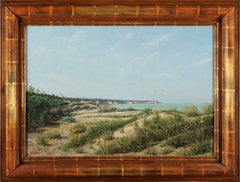
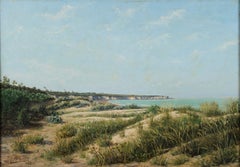
Beach landscape on Atlantic French coast
Located in BELEYMAS, FR
Jean-Georges PASQUET (Périgueux 1851 - 1936) Pointe de Suzac at Saint Georges de Didonne Oil on canvas H. 59 cm; W. 85 cm Signed and dated 1885 lower left Provenance: Private collec...
Oil, Canvas
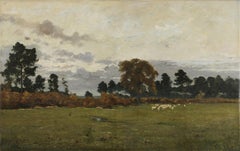
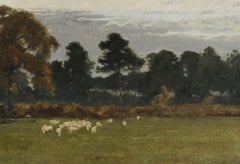
Landscape near Bordeaux
By Louis Alexandre Cabié
Located in BELEYMAS, FR
Louis-Alexandre CABIÉ (Dol-de-Bretagne 1853 - Bordeaux 1939) Landes at Pessac, near Bordeaux - Gironde Oil on canvas H. 126 cm; W. 201 cm Signed lower left Louis Cabié, a renowned a...
Canvas, Oil
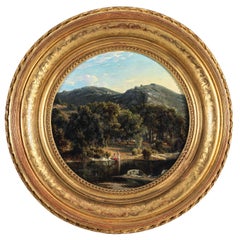
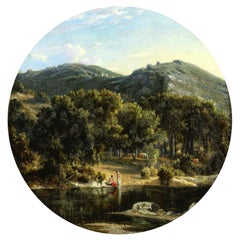
Italian landscape with bathers
Located in BELEYMAS, FR
Félix-Hippolyte LANOÜE (Versailles, 1812 – Versailles, 1872) Italian Landscape with Bathers Oil on canvas, in its original frame D. 41 cm Signed lower right Circa 1840 Trained by Je...
Canvas, Oil
$16,925
H 26.38 in W 42.13 in D 1.58 in
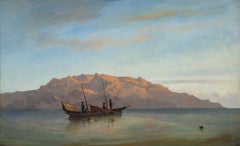
Evening prayers by fishermen under the high coast of Celebes
Located in Amsterdam, NL
Jacob Eduard Van Heemskerck Van Beest (1828-1894) “Avondgebed; Maleidische tripang visschers onder de hoge kust van Celebes” (Ev...
Canvas, Oil
$12,299
H 40.94 in W 57.09 in
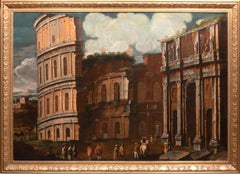
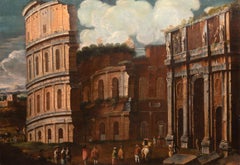
A 17th c. Italian school, Capriccio with the Colosseum, circle of V. Codazzi
Located in PARIS, FR
A capriccio with the Colosseum in Roma 17th century Italian school Circle of Viviano Codazzi (1604-1670) Oil on canvas Dimensions: h. 35.43 in, w. 51.18 in Modern 17th century style ...
Oil, Canvas


Battles of brigands
Located in BELEYMAS, FR
Jacques BERTAUX (attributed to) (c. 1745 Arcis-sur-Aube - 1818) Battle of Brigands Oil on canvas H. 38 cm; W. 45.5 cm Unsigned Certainly a pupil of Jean Pillement, Jacques Bertaux o...
Canvas, Oil


$890
H 18.9 in W 20.08 in
Post War Modern Landscape Pickaxe Man On Hill, Joergen Boberg, 1950's
Located in Frederiksberg C, DK
Landscape painting with working man by renowned Danish artist Joergen Boberg (1940-2009) is 11,8in (H) x 11,8 (B) / 30cm (H) x 30cm (B). Signed 'B' and dated '57' in upper left corn...
Oil, Canvas
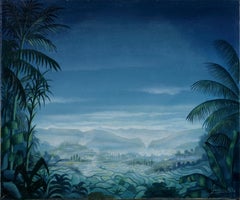
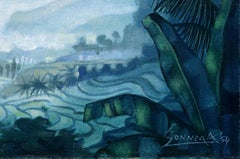
Sawah Landscape
Located in Amsterdam, NL
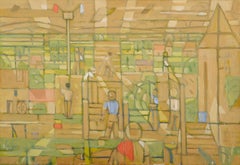
A sawah landscape, Sumatra Signed and dated 'Sonnega '54' (lower right), and annotated 'Voor Jan de Bas 1-1-1970 / R de Bas' (on the reverse) oil on canvas, 50,5x60,5 cm Provenance: - Collection Pieter de Bas (1909-1979) Mr de Bas was head of the MULO school and acting head of the HBS school in Medan. Thence by descent to the present owner. Exhibited: - Hotel de Boer, Medan 1954, where acquired by the first owner. The light I observed everywhere was of a special quality, fluorescent blue, shone from nowhere but radiated from every point, oddly with great depth and intensity. The light in an entirely different dimension came from nowhere and went nowhere shimmering with the glow of a bright blue jewel. The most important thing I discovered was of being omnipresent and able to understand everything at the same time, yes I could fathom creation completely. Auke Sonnega, born March 9, 1910 in Leeuwarden, known as the painter, primarily of young Balinese men and women. Originally raised in the reformed denomination, the parents of Auke apparently practised theosophy and their children, including Auke were taught these principles. The talent for drawing revealed itself at an early stage which in 1926 lead to a 4-year study of textile design at the Academy for Art and Craft in Amsterdam. He completed the academy in 1930 and worked in a carpet factory in Twente until 1934 and then followed in his sister Aafje’s footsteps leaving the Netherlands to go to the Dutch East Indies where in 1935 he started working as a graphic designer with an advertising bureau in Batavia. He was able to travel through Java and Bali on the motorbike that he brought with him from Europe, and was paid for his travelogue, enhanced with his own photo’s which appeared in several Dutch newspapers and magazines. In the 1930’s two Europeans, Walter Spies and Rudolf Bonnet...
Canvas, Oil
$3,610
H 14.97 in W 21.66 in D 1.58 in
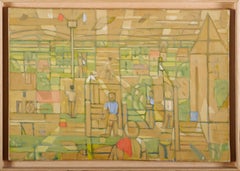
Threshing at La Roque-Gageac in Dordogne in 1948
Located in BELEYMAS, FR
Hans SEILER (Neuchâtel 1907 – 1986) Threshing at La Roque-Gageac Oil on canvas H. 38 cm ; W. 55 cm Signed lower left; titled on the back. 1948 Provenance: Artist’s studio; by descen...
Canvas, Oil


Diana resting
By Eugene Le Poittevin
Located in BELEYMAS, FR
Eugène Modeste LE POITTEVIN (Paris, 1806 - Paris, 1870) Diana Resting Original oil on canvas (E. Picart, 16 rue du Bac) H. 33 cm; W. 40.5 cm Unsigned Red wax seal from the posthumous...
Canvas, Oil
$40,620
H 18.71 in W 24.41 in D 2.37 in
Andean landscape in Cusco, Peru - "Paisaje Andino"
Located in BELEYMAS, FR
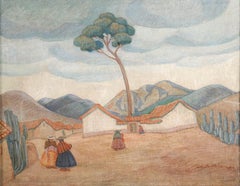
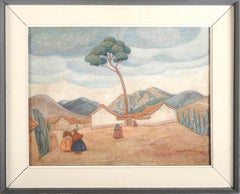
Camilo BLAS (born José Alfonso Sánchez Urteaga) (Cajamarca 1903 – Lima 1985) Andean Landscape – "Paisaje Andino" Oil on canvas H. 47.5 cm; W. 62 cm Signed lower right and dated 1926 Exhibition: Lima, Casino Español, *Exposición de Camilo Blas*, July 1927. Bibliography: - *Variedades*, Lima, July 9, 1927, in the article "La exposición de Camilo Blas," under the heading "Arte Nacional"; reproduced under the title *Paisaje*. - *El Comercio*, Lima, July 24, 2020, in the article "Camilo Blas, 35 years after his death: an assessment of his contribution to Peruvian arts"; reproduced under the title *Paisaje Andino*. A major figure in 20th-century Peruvian *Indigenist* painting, Camilo Blas created a body of work deeply committed to depicting the daily life, landscapes, and people of Peru. The pseudonym Camilo Blas conceals the identity of José Alfonso Sánchez Urteaga, a native of Cajamarca in the northern Peruvian Andes. A painter, draftsman, printmaker, and educator, he belonged to the generation that, during the early decades of the century, helped give rise to a modern Peruvian style of painting rooted in the observation of the country as it truly was. Hailing from a region particularly rich in artistic traditions, Camilo Blas showed an early aptitude for drawing. His maternal uncle, the painter Mario Urteaga, played a pivotal role in his early development, introducing him to the observation of landscapes and rural life. This close connection to peasant life and the traditions of Cajamarca formed one of the foundations of his artistic vision. Before dedicating himself fully to art, Blas began studying law at the University of Trujillo, but his calling as a painter soon asserted itself. In 1922, he moved to Lima and enrolled in the Escuela Nacional de Bellas Artes (National School of Fine Arts), which had been founded a few years earlier. He initially studied under Daniel Hernández before meeting José Sabogal, a central figure in the Peruvian *indigenismo* art movement. This meeting proved decisive. Sabogal recognized a unique sensitivity to Peruvian reality in the young Blas and became his mentor, fellow traveler, and one of his key supporters. Blas thus became part of the *indigenista* movement, which sought to forge a national artistic expression by highlighting the cultures, landscapes, and indigenous and *mestizo* populations of Peru. However, Camilo Blas’s *indigenismo* was not merely an ideological agenda. His originality lay in how he transformed observations of reality into paintings that were vibrant, sensitive, and often humorous. Markets, festivals, processions, street scenes, agricultural work, musicians, artisans, peasants, and city dwellers all became protagonists in a vast visual chronicle of Peru. His gaze encompassed the Andes, the coast, and tropical regions alike, reflecting a desire to traverse and depict the country in all its diversity. His work is distinguished by precise, expressive draftsmanship combined with a luminous, refined palette. Moving beyond strictly documentary representation, Blas infused his compositions with a poetic—and sometimes satirical—dimension. His figures are captured within their environments, amidst the gestures, customs, and communal scenes that lend his paintings a narrative quality. This focus on the daily lives of the people earned him a nickname bestowed by José Sabogal: "the Pancho Fierro of the Sierra"—a reference to the famous 19th-century graphic chronicler of Lima society. Blas’s time in Cusco (1924–1926) marked another significant stage in his career. He traveled with Sabogal and worked in Bolivia before returning to Cusco, where he lived for several years. There, he created paintings, drawings, and prints depicting local life. These experiences informed a body of work that combined easel painting, drawing, watercolor, and printmaking, with a diversity of techniques mirroring the variety of his subjects. His work *La Trilla* (1928) exemplifies this period and is now part of the collection at the Museum of Modern Art in New York. In 1933, he became a professor at the Escuela Nacional de Bellas Artes in Lima. He taught drawing and painting there for many years before eventually becoming the school's director. Through his teaching, he helped pass on an artistic philosophy rooted in the direct observation of the local landscape and the quest for a Peruvian artistic identity. His influence was thus exerted as much through his own creative output as through his role in training several generations of artists. In 1946, he received the Ignacio Merino National Painting Prize, one of Peru’s most prestigious artistic honors. His work continued to evolve around the same fundamental themes: Andean landscapes, scenes of everyday life, religious festivals, trades, portraits, and glimpses of daily existence. This steadfastness regarding his subject matter never implied stagnation; over the decades, Blas refined his pictorial language and evolved his approach to light, color, and composition. Camilo Blas thus holds a unique place in the history of modern Peruvian art. While his name remains closely linked to the *Indigenismo* movement of José Sabogal, his work transcends the confines of any single school or manifesto. Above all, it serves as a vast, evocative record of 20th-century Peru. In his paintings and drawings, the Indigenous and *mestizo* populations are not merely motifs; they become the heart of a pictorial world where landscape, labor, celebration, and community life all converge to form a shared identity. Through the delicacy of his draftsmanship, the richness of his palette, and the deeply human quality of his subjects, Camilo Blas helped elevate everyday Peruvian life into a worthy subject for painting. He died in Lima in 1985, leaving behind a prolific and multidisciplinary body of work that holds a pivotal place in the history of modern Peruvian painting...
Oil, Canvas


The Beekeeper's Daughter 1881 oil painting by Henry Bacon
By Henry Bacon
Located in Hudson, NY
Lovely genre scene by American impressionist Henry Bacon (1839-1912). The Beekeeper's Daughter (1881) Oil on canvas 35" x 36" 42.5" x 33" x 3" framed Signed and dated "Henry Bacon ...
Canvas, Oil
The rest
Located in BELEYMAS, FR
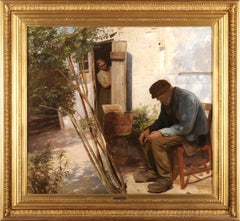
Gustav VERMEHREN (Copenhagen 1863 – Copenhagen 1931) Rest Oil on canvas H. 72 cm; W. 79 cm Signed lower right and dated 1911 (twice) Exhibition: 1963, F...
Canvas, Oil
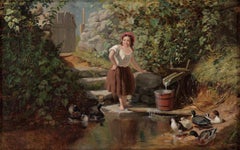
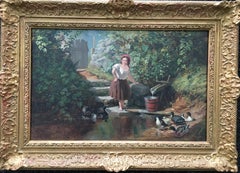
$10,500
H 12 in W 18 in
Pleasant Thoughts oil painting by Arthur Fitzwilliam Tait
By Arthur Fitzwilliam Tait
Located in Hudson, NY
This painting is listed in the W.H. Cadbury and H.F. Marsh book Arthur Fitzwilliam Tait: Artist in the Adirondacks, Newark, Delaware, 1986, no.59.36t. It is hand-signed "AF Tait...
Canvas, Oil


Large river edge with birds in France
By Edmond Yon
Located in BELEYMAS, FR
Edmond YON (Montmartre 1841 – Paris 1897) Riverbank with birds Oil on canvas H. 79.5 cm; L. 130 cm Signed lower right and dated 1876 Original frame Exhibition: 1876, Salon des Artis...
Canvas, Oil


Sold
H 25 in W 16 in D 2 in
Portrait of Victorian lady- British 19thC Impressionist painting female portrait
By Arthur Hacker
Located in Hagley, England
A beautiful colourful Impressionistic portrait painting of a Victorian lady which dates to 1888. A rare and fine oil pastel on paper on panel in excellent condition by Arthur Hacker RA. A real quality British Impressionist painting. It is a superb portrait in a gilded oak frame of the period. Signed upper left. Provenance. South England collection. Housed in a gilded oak gallery frame 32 inches by 23 inches. Excellent condition. Arthur Hacker (1858-1919) was perhaps the most versatile of late Victorian artists and his regular and popular exhibits at the Royal Academy and New Gallery include paintings of contemporary drama, mythological and Biblical narrative, landscapes and still lifes. He also established a lucrative portrait painting practice in the early twentieth century, among his sitters being the artists Frank Short, Onslow Ford, William Goscombe John and Ernest Newton...
Oil Pastel


Sold
H 11 in W 15 in
"Trafalgar Square - Night" Hacker C.19th English Impressionist Figures Landscape
By Arthur Hacker
Located in Marlow, Buckinghamshire
Oil on panel. Signed lower left and titled verso. Framed dimensions are 19 inches high by 24 inches wide. Arthur Hacker was the son of an engraver. He entered the Royal Academy in L...
Canvas, Oil


French schoolgirl
By Arthur Hacker
Located in Sutton Poyntz, Dorset
Available for sale from Big Sky Fine Art; this original oil painting by Arthur Hacker Davis Bell, dating from around the turn of the century. The painting is presented and supplied in a sympathetic and contrasting contemporary frame. The painted surfaces and canvas have benefitted from some restoration, cleaning and conservation, which took place in 2014 on our instructions. Some much older restoration is present. Previously with The Boydell Galleries, 4 North John Street, Liverpool. The painting is signed upper left. Arthur Hacker was perhaps the most versatile of late Victorian artists. As A.L. Baldry upholds in his critique of the artist’s work, ‘A certain disinclination to limit himself to any one type of production has always been an agreeable characteristic of Mr. Hacker’s practice as an artist. His career has been one of wholesome experiment, and has been marked by many changes in his mode of dealing with artistic problems, but it has been full, also, of eminently memorable achievement, and it has been distinguished quite definitely in all its phases’ Hacker excelled in the representation of each and every genre from historical and literary subject matter in a polished, neo‐classical style to depictions of the modern landscape in a personalised Impressionist technique. Hacker was born in London on 25th September 1858, the son of Edward Hacker the engraver. He went to the Royal Academy Schools from 1876‐1880, before studying in Paris at the atelier of Léon Bonnat (1833‐1922), an internationally famous portrait painter and close friend of Degas. He began exhibiting at the Royal Academy at the age of just 20 and attracted public acclaim. He initially excelled in classical and religious subjects and in the 1880s travelled widely in Italy, Spain, Gibraltar and North Africa collecting...
Canvas, Oil