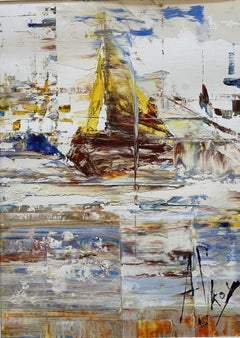
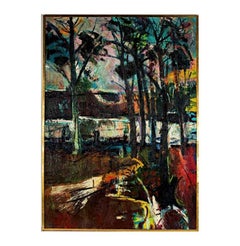
Untitled, 2021
By ASKOY
Located in Atlanta, GA
Artist
Category
21st Century and Contemporary Modern ASKOY Abstract Paintings
Materials
Oil
Untitled, 2021
By ASKOY
Located in Atlanta, GA
Artist
Oil
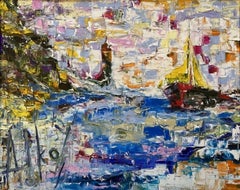
Untitled, 2021
By ASKOY
Located in Atlanta, GA
Artist
Oil
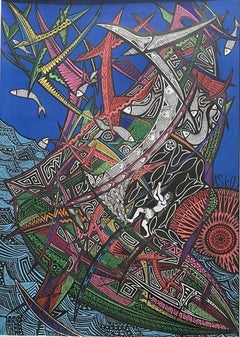
Untitled, 2021
By ASKOY
Located in Atlanta, GA
Artist
Oil
$1,600
H 21 in W 8.5 in
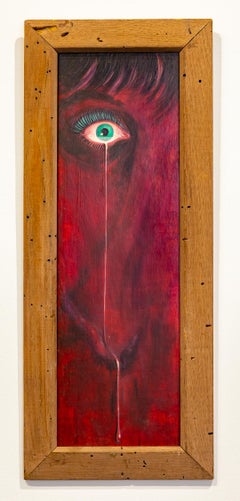
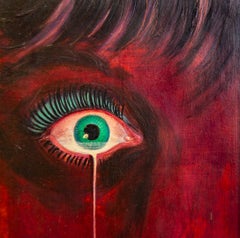
"Don't Cry Long" Abstracted and Distorted Self-Portrait, One Crying Eye
Located in Detroit, MI
"Don't Cry Long" is a self-portrait of the artist and an unusual one at that in which the artist portrays herself shedding tears. Perhaps it is an expression of some grief experienced by Ms. Woodlock, but it also admonishes her to not "Cry Long" while at the same time poking fun because of her elongated face and the one lone "long" tear tracing a pattern down her face. In addition to self-portraits, Ethelyn painted commissioned portraits. In this painting her head is cocked and her famous bangs hang down her forehead. Compare two self-portraits, “Up From Under”, and “M’Eyes" to "Don't Cry Long." The major differences are the close facial view and the brilliant blood red paint that fills the entire canvas. This painting is included in the book, "Dreams Have Wings: An Artist's Journey into Magic and Mystery" printed in the United States, 1985. She describes "Don't Cry Long" as showing how funny looking we are, if we cry too long. Ethelyn Woodlock...
Oil, Masonite

$1,230
H 40 in W 55.2 in
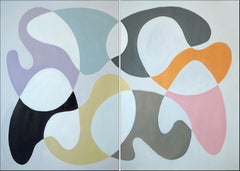
Pastel Dance, Organic Modern, Mid-Century Shapes Diptych in Pastel Tones, Paper
By Ryan Rivadeneyra
Located in Barcelona, ES
Details: Title: Pastel Dance Medium: Acrylic Painting on Watercolor Paper Size: 100x140 cm in total (100x70 cm, each panel), 40x55.2 inches in total (40x28 inches, each panel) Year...
Paper, Oil
$4,200
H 29.5 in W 21.5 in D 1.25 in
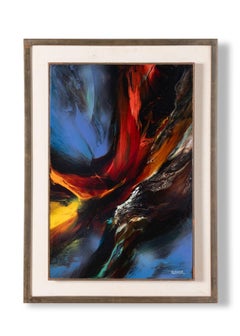
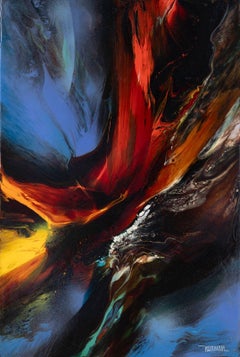
Leonardo Nierman Abstract Oil Painting on Board titled 'Prophesy' 1960s Mexico
By Leonardo Nierman
Located in Dallas, TX
Dramatic abstract oil painting on board by renowned Mexican artist Leonardo Nierman, titled Prophesy. The composition rises with intense vertical energy, evoking a sense of cosmic tu...
Oil

$600
H 40 in W 28 in
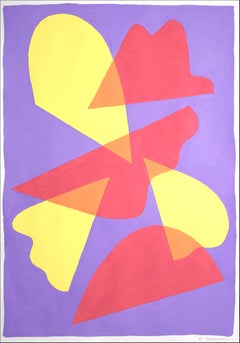
Translucent Streetlights, Yellow, Pink and Purple Mid-Century Abstract Shapes
By Ryan Rivadeneyra
Located in Barcelona, ES
"Translucent Streetlights" is a hand-painted acrylic painting on high-quality 300g paper by artist Ryan Rivadeneyra. These painting, influenced by mo...
Oil Pastel, Oil, Acrylic, Watercolor
$10,500
H 61 in W 43 in D 1.5 in
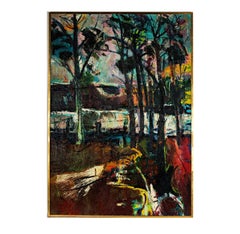
Twilight Trees Oil Painting, Modern Landscape, Signed, 1965, Framed
By Robert Frame
Located in Palm Desert, CA
This is a strong example of Robert Frame's mature gestural style: bold, expressive brushwork with a rich palette of deep blues, earthy browns, and bursts of yellow-green that give th...
Oil
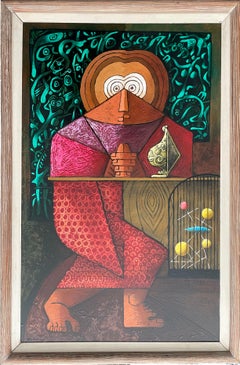
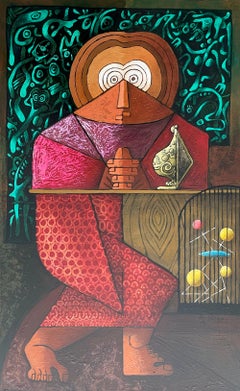
St. Atomic oil and tempera painting by Julio de Diego
By Julio de Diego
Located in Hudson, NY
Julio De Diego’s Atomic Series paintings made an extraordinary statement regarding the shock and fear that accompanied the dawn of the nuclear age. In the artist’s own words, “Scientists were working secretly to develop formidable powers taken from the mysterious depths of the earth - with the power to make the earth useless! Then, the EXPLOSION! . . . we entered the Atomic Age, and from there the neo-Atomic war begins. Explosions fell everywhere and man kept on fighting, discovering he could fight without flesh.” To execute these works, De Diego developed a technique of using tempera underpainting before applying layer upon layer of pigmented oil glazes. The result is paintings with surfaces which were described as “bonelike” in quality. The forms seem to float freely, creating a three-dimensional visual effect. In the 1954 book The Modern Renaissance in American Art, author Ralph Pearson summarizes the series as “a fantastic interpretation of a weighty theme. Perhaps it is well to let fantasy and irony appear to lighten the devastating impact. By inverse action, they may in fact increase its weight.” Exhibited 1950 University of Illinois at Urbana "Contemporary American Painting" 1964 Marion Koogler McNay Art Institute, San Antonio, Texas This work retains its original frame which measures 54" x 36" x 2". About this artist: Julio De Diego crafted a formidable persona within the artistic developments and political struggles of his time. The artist characterized his own work as “lyrical,” explaining, “through the years, the surrealists, the social-conscious painters and the others tried to adopt me, but I went my own way, good, bad or indifferent.” [1] His independence manifested early in life when de Diego left his parent’s home in Madrid, Spain, in adolescence following his father’s attempts to curtail his artistic aspirations. At the age of fifteen he held his first exhibition, set up within a gambling casino. He managed to acquire an apprenticeship in a studio producing scenery for Madrid’s operas, but moved from behind the curtains to the stage, trying his hand at acting and performing as an extra in the Ballet Russes’ Petrouchka with Nijinsky. He spent several years in the Spanish army, including a six-month stretch in the Rif War of 1920 in Northern Africa. His artistic career pushed ahead as he set off for Paris and became familiar with modernism’s forays into abstraction, surrealism, and cubism. The artist arrived in the U.S. in 1924 and settled in Chicago two years later. He established himself with a commission for the decoration of two chapels in St. Gregory’s Church. He also worked in fashion illustration, designed magazine covers and developed a popular laundry bag for the Hotel Sherman. De Diego began exhibiting through the Art Institute of Chicago in 1929, and participated in the annual Chicago Artists Exhibitions, Annual American Exhibitions, and International Water Color Exhibitions. He held a solo exhibition at the Art Institute of Chicago in the summer of 1935. Though the artist’s career was advancing, his family life had deteriorated. In 1932 his first marriage dissolved, and the couple’s young daughter Kiriki was sent to live with friend Paul Hoffman. De Diego continued to develop his artistic vocabulary with a growing interest in Mexican art. He traveled throughout the country acquainting himself with the works of muralists such as Carlos Merida, and also began a collection of small native artifacts...
Masonite, Oil, Tempera
$8,000
H 29 in W 41 in
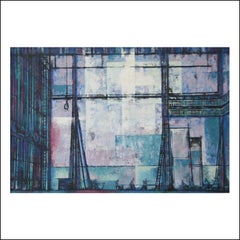
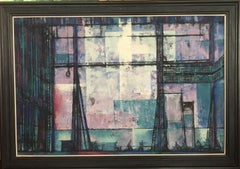
"Backstage, Ambassador" Broadway Theatre NYC Mid-century Modern Modernist Cubist
By Sam Norkin
Located in New York, NY
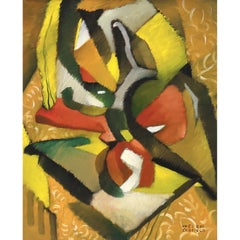
"Backstage, Ambassador" Broadway Theatre NYC Mid-century Modern Modernist Cubist Sam Norkin (1917-2011) Backstage, The Ambassador 24 x 36 inches oil ...
Canvas, Oil
$3,000
H 23.25 in W 31.5 in
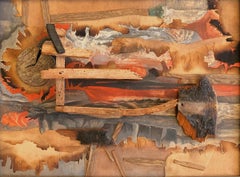
Pyromaniac's Pyre mixed media work by Mary Spencer Nay
Located in Hudson, NY
Signed and dated "Mary Spencer Nay '74" lower left. Titled "Pyromaniac's Pyre" verso. Exhibited: 1976-1977 "Mary Spencer Nay: Recent and Retrospective Works". J.B. Speed Art Museum...
Fabric, Canvas, Rubber, Wood, Oil
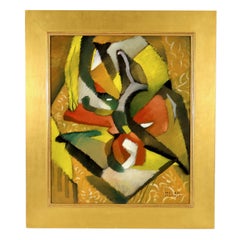
$9,500
H 30.5 in W 26.5 in D 2 in
Exceptional 1930s abstract oil painting by woman artist Helen Clark Oldfield.
By Helen Clark Oldfield
Located in Colfax, CA
Exceptional early American abstract oil painting by California artist Helen Clark Oldfield. Helen Clark Oldfield, (1902–1981), was born in Santa Rosa, CA. She studied art and design...
Oil, Board
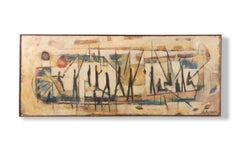
$5,800
H 24.813 in W 60.625 in D 1.375 in
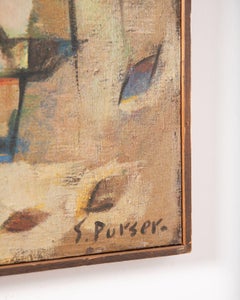
Stuart Robert Purser Five Foot Long Riverboat Oil Painting Mid Century 1949
Located in Dallas, TX
Riverboat (1949) is a striking early example of mid-century American modernism by Stuart Robert Purser. Executed in oil and measuring an impressive 24 x 60 inches, the panoramic form...
Oil
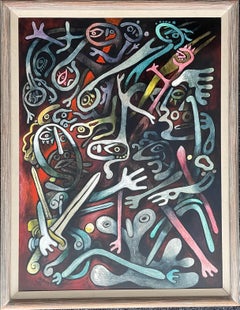
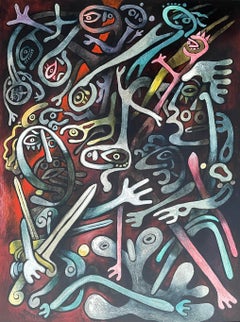
The Magician oil and tempera painting by Julio de Diego
By Julio de Diego
Located in Hudson, NY
Julio De Diego’s Atomic Series paintings made an extraordinary statement regarding the shock and fear that accompanied the dawn of the nuclear age. In the artist’s own words, “Scientists were working secretly to develop formidable powers taken from the mysterious depths of the earth - with the power to make the earth useless! Then, the EXPLOSION! . . . we entered the Atomic Age, and from there the neo-Atomic war begins. Explosions fell everywhere and man kept on fighting, discovering he could fight without flesh.” To execute these works, De Diego developed a technique of using tempera underpainting before applying layer upon layer of pigmented oil glazes. The result is paintings with surfaces which were described as “bonelike” in quality. The forms seem to float freely, creating a three-dimensional visual effect. In the 1954 book The Modern Renaissance in American Art, author Ralph Pearson summarizes the series as “a fantastic interpretation of a weighty theme. Perhaps it is well to let fantasy and irony appear to lighten the devastating impact. By inverse action, they may in fact increase its weight.” Exhibited 1964 Marion Koogler McNay Art Institute, San Antonio, Texas This work retains its original frame which measures 54" x 42" x 2" About this artist: Julio De Diego crafted a formidable persona within the artistic developments and political struggles of his time. The artist characterized his own work as “lyrical,” explaining, “through the years, the surrealists, the social-conscious painters and the others tried to adopt me, but I went my own way, good, bad or indifferent.” [1] His independence manifested early in life when de Diego left his parent’s home in Madrid, Spain, in adolescence following his father’s attempts to curtail his artistic aspirations. At the age of fifteen he held his first exhibition, set up within a gambling casino. He managed to acquire an apprenticeship in a studio producing scenery for Madrid’s operas, but moved from behind the curtains to the stage, trying his hand at acting and performing as an extra in the Ballet Russes’ Petrouchka with Nijinsky. He spent several years in the Spanish army, including a six-month stretch in the Rif War of 1920 in Northern Africa. His artistic career pushed ahead as he set off for Paris and became familiar with modernism’s forays into abstraction, surrealism, and cubism. The artist arrived in the U.S. in 1924 and settled in Chicago two years later. He established himself with a commission for the decoration of two chapels in St. Gregory’s Church. He also worked in fashion illustration, designed magazine covers and developed a popular laundry bag for the Hotel Sherman. De Diego began exhibiting through the Art Institute of Chicago in 1929, and participated in the annual Chicago Artists Exhibitions, Annual American Exhibitions, and International Water Color Exhibitions. He held a solo exhibition at the Art Institute of Chicago in the summer of 1935. Though the artist’s career was advancing, his family life had deteriorated. In 1932 his first marriage dissolved, and the couple’s young daughter Kiriki was sent to live with friend Paul Hoffman. De Diego continued to develop his artistic vocabulary with a growing interest in Mexican art. He traveled throughout the country acquainting himself with the works of muralists such as Carlos Merida, and also began a collection of small native artifacts...
Masonite, Oil, Tempera
$26,000
H 48 in W 30 in
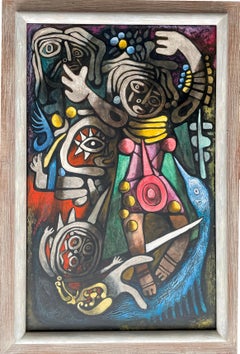
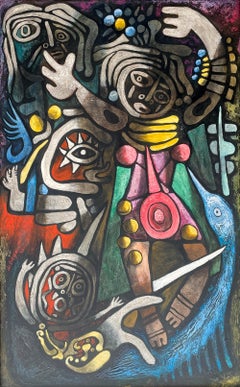
Ceremonial Dancers oil and tempera painting by Julio De Diego
By Julio de Diego
Located in Hudson, NY
Artwork measures 48" x 30" and framed 56 ¼" x 38 ¼" x 3" Provenance: John Heller Gallery, NYC, circa 1975 (label verso) The artist's daughter Corbino Galleries, Sarasota, FL (1990)...
Masonite, Oil, Tempera