By Victor Vasarely
Located in Detroit, MI
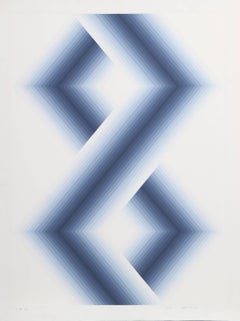
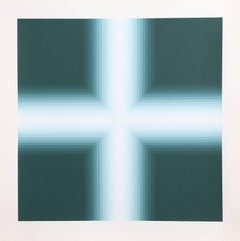
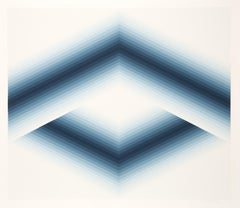
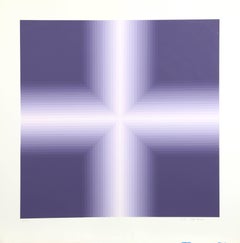
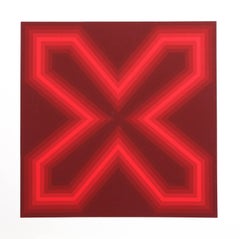
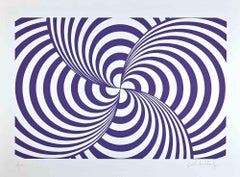
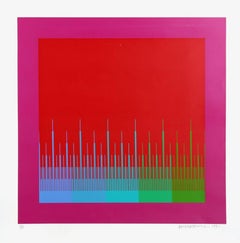
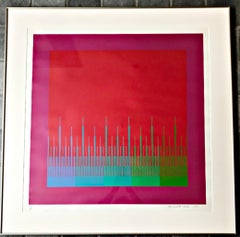
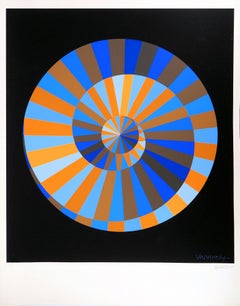
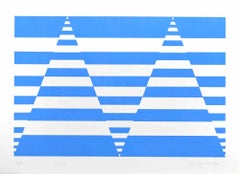
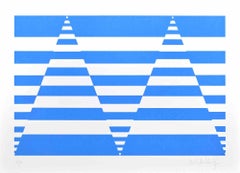
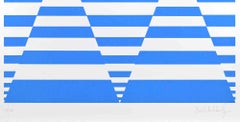
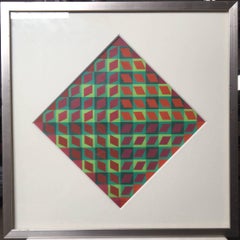
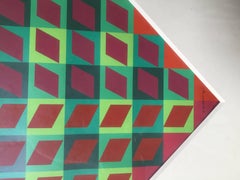
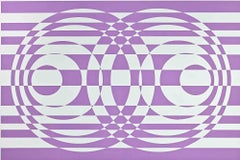
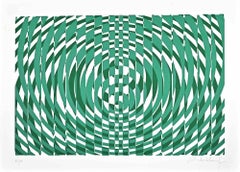
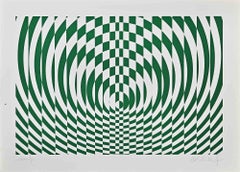
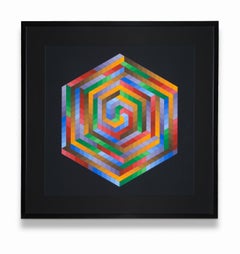
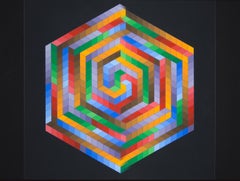
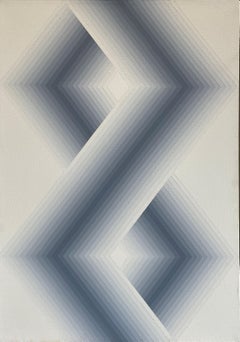
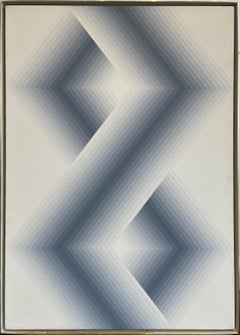
Victor Vasarely born in 1906 was a Hungarian-French artist, who is widely accepted as a "grandfather" and leader of the Op Art movement. Op Art is a form of abstract art that gives the illusion of movement by the precise use of pattern and color, or in which conflicting patterns emerge and overlap. Victor Vasarely and Brigit Riley are its most famous exponents. In its visual balancing act of color and movement from a flat plane to developed continuous flow “Untitled” is a complex arrangement of squares and colors that visually expand and contract. It is one of Vasarely’s most successful Op Art abstract works. The piece is signed on the lower right and number 20/150 on the lower left. The print is behind glass and matted.
Vasarely was born in Pecs and grew up in Slovakia and Budapest, where in 1925, he took up medical studies. Abandoning medicine he turned to traditional academic painting at the private Podolini-Volkmann Academy. In 1928/1929, he enrolled at Sandor Bortnyik’s private art school widely recognized as Budapest's centre of Bauhaus studies. His studies concentrated on applied graphic art and typographical design. In 1929, he painted his Blue Study and Green Study. In 1930, he married his fellow student Claire Spinner (1908–1990). Together they had two sons, Andre and Jean-Pierre. Vasarely became a graphic designer and a poster artist during the 1930s combining patterns and organic images with each other.
Vasarely utilized geometric shapes and colorful graphics, the artist created compelling illusions of spatial depth, as seen in his work Vega-Nor (1969). Vasarely’s method of painting borrowed from a range of influences, including Bauhaus design principles, Wassily Kandinsky, and Constructivism. In the late 1920s, Vasarely enrolled at the Muhely Academy in Budapest, where the syllabus was largely based on Walter Gropius’s Bauhaus school in Germany.
After settling in Paris in 1930, Vasarely worked in advertising agencies to support himself as a graphic artist while creating many works including Zebra (1937), which is considered by some to be one of the earliest examples of Op Art. The artist experimented in a style based in Surrealism and Abstract Expressionism during the 1940s, before arriving at his hallmark checkerboard...
Category
Mid-20th Century Op Art Babe Shapiro Art