Bernard Sejourne Art

Haitian, 1947-2005
Born on November 20, 1947, in Port-au-Prince, Bernard Séjourné began studying art formally after graduating from high school. Painter and sculptor were the best-known artists of the school of art known as the School of Beauty, which honors women. His work depicts beauty, elegance, and grace. His themes were mostly women, and flowers sometimes landscapes. Séjourné liked to paint on large surfaces of Masonite in acrylic to heighten the effect of movement, which he created by his use of fluid lines. His colors range from cool to tropical. "Sejourné's mastery of space and volume create near-abstract works of referential elements." (Peintres Haitiens , Gerald Alexis, Editions Cercle d'Art, 2000.) Séjourné exhibited at Calfou and the Esso Salon in Port-au-Prince in 1965; he participated in the Festival of Black Art held in Dakar in 1956, in Montreal Expo in 1957, at the French Institute of Haiti in 1972. Haitian art collectors have highly valued his work. Since his recent death, he has become one of the highly sought-after collectibles. Baron Philippe de Rothschild commissioned one of his paintings and used it on the label of his 1986 vintage Chateau Mouton-Rothschild, Pauillac wine bottle.
to
1
1
2
2
2
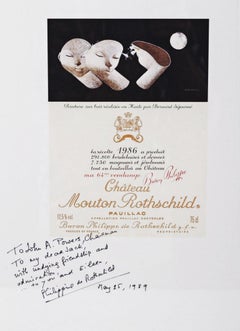
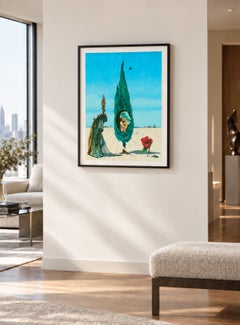
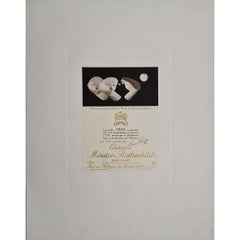
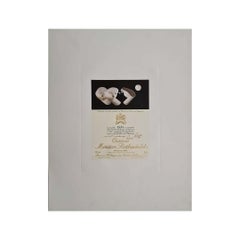
Original 1986 Bernard Séjourné Château Mouton Rothschild Poster

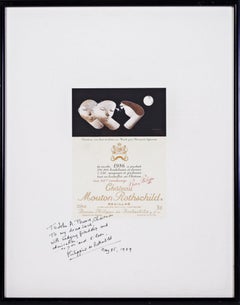
Original 1986 Bernard Séjourné Château Mouton Rothschild Poster

By Bernard Séjourné

Located in PARIS, FR

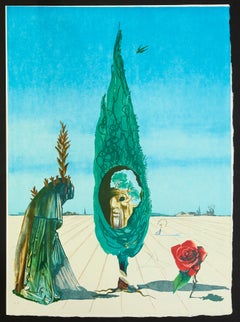
This original poster reproduces the celebrated 1986 Château Mouton Rothschild label, created by French artist Bernard Séjourné for one of Bordeaux's most prestigious First Growth estates. Since 1945, Château Mouton Rothschild has commissioned a different artist each year to create the artwork for its vintage label, transforming every bottle into a meeting point between fine wine and contemporary art. Over the decades, the estate has collaborated with some of the greatest names of the twentieth century, including Pablo Picasso, Joan Miró, Marc Chagall, Salvador Dalí, Andy Warhol, Francis Bacon and Keith Haring. For the 1986 vintage, Baron Philippe de Rothschild selected an artwork by Bernard Séjourné, inspired by a painting on wood executed in Haiti, as indicated by the inscription: "Peinture sur bois réalisée en Haïti par Bernard Séjourné." The composition presents three stylized, dreamlike figures floating against a deep black background beneath a luminous moon. The simplicity of the forms, combined with their sculptural appearance and peaceful expressions, evokes both Haitian folk art traditions and the poetic symbolism characteristic of Séjourné's work. The label also records the remarkable production figures of the vintage: "La récolte 1986 a produit 291.800 bordelaises et demies, 7.250 magnums et jéroboams..." Most importantly, the vintage marked Baron Philippe de Rothschild's 64th harvest at Mouton Rothschild, a fact proudly noted on the label itself: "Ma 64ème vendange." The 1986 vintage therefore occupies a special place in the long history of the château, representing one of the final harvests overseen personally by the visionary Baron who transformed Mouton Rothschild into one of the world's most celebrated wine estates. Widely regarded as one of the finest Bordeaux vintages of the 1980s, the 1986 Mouton Rothschild has become legendary among collectors and wine enthusiasts, further enhancing the historical significance of the label and its accompanying artwork. This poster perfectly illustrates the unique identity of Château Mouton Rothschild, where viticulture, culture and artistic patronage have been inseparably linked for generations. The combination of Bernard Séjourné's poetic imagery, the prestige of Pauillac's First Growth vineyard, and the historical importance of Baron Philippe de Rothschild's long stewardship make this work particularly appealing to collectors of wine memorabilia...

Category

1980s Bernard Sejourne Art

Materials

Paper, Lithograph

Related Items
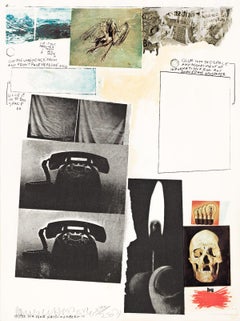
Robert Rauschenberg Untitled (McGovern) 1972 Signed Lithograph Edition of 75

Robert Rauschenberg Untitled (McGovern) 1972 Signed Lithograph Edition of 75

By Robert Rauschenberg

Located in Minneapolis, MN

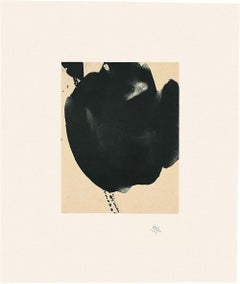
Artist: Robert Rauschenberg Title: Untitled (McGovern) Medium: Offset Lithograph in Colors Edition: 59/75 Image Size: 38.75" × 26.5" Sheet Size: 40" × 30" Year: 1972 Inscription: Sig...

Category

20th Century Bernard Sejourne Art

Materials

Paper, Lithograph
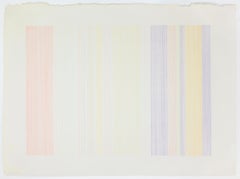
Dusk in August
Dusk in August

Louise NevelsonDusk in August, 1967

$1,500

H 17 in W 22.25 in

Dusk in August

By Louise Nevelson

Located in Indianapolis, IN

Louise Nevelson (1899-1988) Dusk in August (1967) Lithograph with embossing Size: 17 x 22.25 in (43 x 56.4 cm) Frame size: 21.75 x 26.75 in (55.25 x 67.95 cm) Edition of 100, this i...

Category

20th Century Abstract Expressionist Bernard Sejourne Art

Materials

Lithograph

Modern Pair of Oriental Numbered and Signed Etching

Modern Pair of Oriental Numbered and Signed Etching

Located in Roma, IT

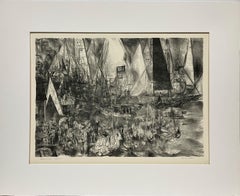
1970s Pair of black and white important numbered and signed etching. Japan 1973. Every item of our Gallery, upon request, is accompanied by a certificate of authenticity issued by S...

Category

1970s Modern Bernard Sejourne Art

Materials

Paper, Lithograph

India Listed artist 19th Century Hand Coloured Lithograph Village scene palms

India Listed artist 19th Century Hand Coloured Lithograph Village scene palms

Located in Norfolk, GB

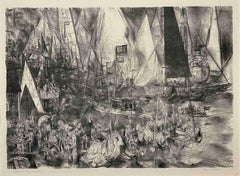
A 19th century, hand coloured lithograph, the colours fresh and in good condition for its age. Artist: Captain Philip Meadows Medium: Hand coloured lithograph Plate 6 Created: 1842 Paper Size: 39 x 32.5 cm Plate Size: 27.5 x 21.2 cm With the description sheet on verso TAYLOR, Captain Philip Meadows (1808-1876). Plate from Sketches in the Deccan. London: published by J McLean 1842 Plate 6 From a series of views of the Deccan, at this time the state of Hyderabad. The suite of plates includes views, scenes and settings of places and buildings at Goa, Arungabad, Tooljapoor, Golcondag, Hyderabad, Ellors, Rozah, and the Tandoor hills, among others. Meadows Taylor arrived in India as a young man to work with a Bombay merchant, but quickly accepted a military commission...

Category

1840s Other Art Style Bernard Sejourne Art

Materials

Paper, Lithograph

Original Vintage Poster Jean Dubuffet Gallery Exhibition Galerie Beyeler Basel

Original Vintage Poster Jean Dubuffet Gallery Exhibition Galerie Beyeler Basel

By Jean Dubuffet

Located in Surfside, FL

Galerie Beyeler Exhibition Poster Signed in plate Jean Philippe Arthur Dubuffet (French, 1901 – 1985) was a French painter and sculptor of the École de Paris (School of Paris). His idealistic approach to aesthetics embraced so-called "low art" and eschewed traditional standards of beauty in favor of what he believed to be a more authentic and humanistic approach to image-making. He is perhaps best known for founding the art brut movement, and for the collection of works—Collection de l'art brut—that this movement spawned. Dubuffet enjoyed a prolific art career, both in France and in America, and was featured in many exhibitions throughout his lifetime. His childhood friends included the writers Raymond Queneau and Georges Limbour. He moved to Paris in 1918 to study painting at the Académie Julian, becoming close friends with the artists Juan Gris, André Masson, and Fernand Léger. Six months later, upon finding academic training to be distasteful, he left the Académie to study independently. During this time, Dubuffet developed many other interests, including free noise music, poetry, and the study of ancient and modern languages. Dubuffet also traveled to Italy and Brazil, and upon returning to Le Havre in 1925, he married for the first time and went on to start a small wine business in Paris. He took up painting again in 1934 when he made a large series of portraits in which he emphasized the vogues in art history. In 1942, Dubuffet decided to devote himself again to art. He often chose subjects for his works from everyday life, such as people sitting in the Paris Métro or walking in the country. Dubuffet painted with strong, unbroken colors, recalling the palette of Fauvism, as well as the Brucke painters, with their juxtaposing and discordant patches of color. In 1943, the writer George Limbour, a friend of Dubuffet from childhood, took Jean Paulhan to the artist's studio. Dubuffet's work at that time was unknown. Paulhan was impressed and the meeting proved to be a turning point for Dubuffet. His first solo show came in October 1944, at the Galerie Rene Drouin in Paris. This marked Dubuffet's third attempt to become an established artist In 1945, Dubuffet attended and was strongly impressed by a show in Paris of Jean Fautrier paintings in which he recognized meaningful art which expressed directly and purely the depth of a person. Emulating Fautrier, Dubuffet started to use thick oil paint mixed with materials such as mud, sand, coal dust, pebbles, pieces of glass, string, straw, plaster, gravel, cement, and tar. This allowed him to abandon the traditional method of applying oil paint to canvas with a brush; instead, Dubuffet created a paste into which he could create physical marks, such as scratches and slash marks. The impasto technique of mixing and applying paint was best manifested in Dubuffet's series 'Hautes Pâtes' or Thick Impastoes, which he exhibited at his second major exhibition, entitled Microbolus Macadam & Cie/Hautes Pates in 1946 at the Galérie René Drouin. His use of crude materials and the irony that he infused into many of his works incited a significant amount of backlash from critics, who accused Dubuffet of 'anarchy' and 'scraping the dustbin'. He did receive some positive feedback as well—Clement Greenberg took notice of Dubuffet's work and wrote that '[f]rom a distance, Dubuffet seems the most original painter to have come out of the School of Paris since Joan Miro...' Greenberg went on to say that 'Dubuffet is perhaps the one new painter of real importance to have appeared on the scene in Paris in the last decade.' Indeed, Dubuffet was very prolific in the United States in the year following his first exhibition in New York (1951). After 1946, Dubuffet started a series of portraits, with his own friends Henri Michaux, Francis Ponge, George Limbour, Jean Paulhan and Pierre Matisse serving as 'models'. He painted these portraits in the same thick materials, and in a manner deliberately anti-psychological and anti-personal, as Dubuffet expressed himself. A few years later he approached the surrealist group in 1948, then the College of Pataphysique in 1954. He was friendly with the French playwright, actor and theater director Antonin Artaud, he admired and supported the writer Louis-Ferdinand Céline and was strongly connected with the artistic circle around the surrealist André Masson. In 1944 he started an important relationship with the resistance-fighter and French writer and publisher Jean Paulhan who was also strongly fighting against "intellectual terrorism", as he called it. Reception in America Corps de dame jaspé [Marbleized Body of a Lady] (1950) at the National Gallery of Art in 2022 Dubuffet achieved very rapid success in the American art market, largely due to his inclusion in the Pierre Matisse exhibition in 1946. His association with Matisse proved to be very beneficial. Matisse was a very influential dealer of contemporary European Art in America, and was known for strongly supporting the School of Paris artists. Dubuffet's work was placed among the likes of Pablo Picasso, Georges Braque, and Henri Rouault at the gallery exhibit, and he was one of only two young artists to be honored in this manner. A Newsweek article dubbed Dubuffet the 'darling of Parisian avant-garde circles,' and Greenberg wrote positively about Dubuffet's three canvases in a review of the exhibit. In 1947 Dubuffet had his first solo exhibition in America, in the same gallery as the Matisse exhibition. Reviews were largely favorable, and this resulted in Dubuffet having at least an annual, if not a biannual exhibition at that gallery. His reception in America was very closely linked to and dependent upon the New York art world's desire to create its own avant-garde environment. Specific examples of American artists interested in Dubuffet’s art were Alfonso Ossorio and Joseph Glasco. At the end of 1949, while Pierre Matisse was preparing Dubuffet’s January 1950 show, Alfonso Ossorio had traveled to Paris to meet Dubuffet and buy some of his paintings. Then in 1950, at Ossorio’s urging, his young friend Joseph Glasco left New York for Paris to meet Dubuffet. Glasco credited this encounter as having had an influence on his own art, and Dubuffet frequently asked about “Jackson Pollock and Glasco” in his letters to Ossorio. Between 1947 and 1949, Dubuffet took three separate trips to Algeria—a French colony at the time—in order to find further artistic inspiration. In this sense, Dubuffet is very similar to other artists such as Delacroix, Matisse, and Fromentin. However, the art that Dubuffet produced while he was there was very specific insofar as it recalled Post-War French ethnography in light of decolonization. Dubuffet was fascinated by the nomadic nature of the tribes in Algeria—he admired the ephemeral quality of their existence, in that they did not stay in any one particular area for long, and were constantly shifting. The impermanence of this kind of movement attracted Dubuffet and became a facet of art brut. In June 1948, Dubuffet, along with Jean Paulhan, Andre Breton, Charles Ratton, Michel Tapie, and Henri-Pierre Roche, officially established La Compagnie de l'art brut in Paris. This association was dedicated to the discovery, documentation and exhibition of art brut. Dubuffet later amassed his own collection of such art, including artists Aloïse Corbaz and Adolf Wölfli...

Category

1960s Abstract Bernard Sejourne Art

Materials

Offset

Düsseldorf (German Cities) by Dieter Roth monuments vintage postcard light blue

Düsseldorf (German Cities) by Dieter Roth monuments vintage postcard light blue

By Dieter Roth

Located in New York, NY

Düsseldorf (German Cities), 1970 24 x 33.8 in. / 61 x 86 cm Screen print in one color on offset lithograph, black on white card. “for Paul” written in pencil lower middle. Signed and...

Category

1960s Abstract Bernard Sejourne Art

Materials

Lithograph, Screen

I Promise To Love You, Framed

I Promise To Love You, Framed

By Tracey Emin

Located in London, GB

2014 Colour offset lithograph on 250 gsm glossy wove paper 70 x 50 cm Edition of 500 Signed and dated in pen by Tracey Emin Published by Emin International Framed Excellent condition...

Category

2010s Contemporary Bernard Sejourne Art

Materials

Paper, Lithograph, Offset

Untitled - Lithograph by Giuseppe Capogrossi - 1960s

Untitled - Lithograph by Giuseppe Capogrossi - 1960s

By Giuseppe Capogrossi

Located in Roma, IT

Untitled is a print realized by Giuseppe Capogrossi (Rome, 1900 - 1972). Lithograph on paper Hand-signed lower right, numbered, edition lower left, 56/80 prints. Embossing stamp of...

Category

1960s Abstract Bernard Sejourne Art

Materials

Paper, Lithograph

Stones III (~22% OFF LIST PRICE)

Avraham InlenderStones III (~22% OFF LIST PRICE), 2003

$58Sale Price|21% Off

H 5.9 in W 5.5 in

Stones III (~22% OFF LIST PRICE)

Located in Kansas City, MO

Avraham Inlender Stones III Color Offset Lithograph Year: 2003 Size: 5.9 x 5.5 inches (15 x 14 cm) Signed in pencil COA provided Avraham Inlender (1932–2003) was a Polish-born arti...

Category

Early 2000s Abstract Bernard Sejourne Art

Materials

Lithograph, Offset

Bernard Séjourné art for sale on 1stDibs.

Find a wide variety of authentic Bernard Séjourné art available for sale on 1stDibs. You can also browse by medium to find art by Bernard Séjourné in lithograph, offset print and more. Much of the original work by this artist or collective was created during the 1980s and is mostly associated with the abstract style. Not every interior allows for large Bernard Séjourné art, so small editions measuring 17 inches across are available. Bernard Séjourné art prices can differ depending upon medium, time period and other attributes. On 1stDibs, the price for these items starts at $5,500 and tops out at $5,500, while the average work can sell for $5,500.