Calle Serveware, Ceramics, Silver and Glass
to
1
1
1
1
1
1
1
1
1
1
1
1
560
416
403
382
Creator: Calle
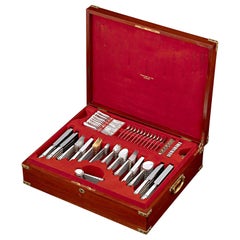
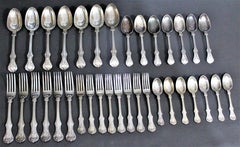
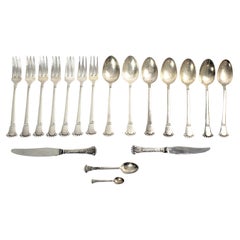
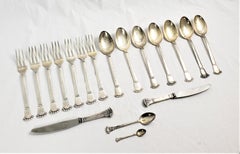
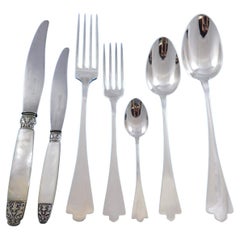
Arts & Crafts by Albert & Andre Calle French 950 Silver Flatware Set Service
By Calle
Located in Big Bend, WI
Incredible 950 French silver flatware service in Arts and Crafts style by Albert Joseph Ernest Calle and son Andre Calle - 84 pieces. This flatware service features engraved arts and...
Category
20th Century French Calle Serveware, Ceramics, Silver and Glass
Materials
Sterling Silver
Related Items
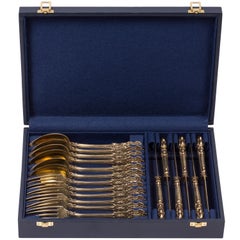
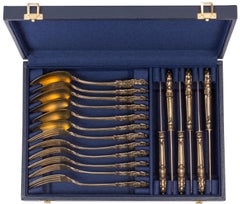
19th Century French Silver Vermeil Flatware Dessert Set for Six, 18 Pieces
Located in Madrid, ES
This charming 19th century French 18-piece cased dessert silverware / flatware set, with its unique, slightly grotesque satyr mask motif and warm ve...
Category
19th Century French Antique Calle Serveware, Ceramics, Silver and Glass
Materials
Vermeil, Silver
$2,470 / set
H 7.29 in W 1.38 in D 0.99 in
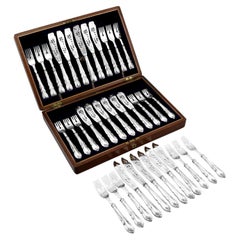
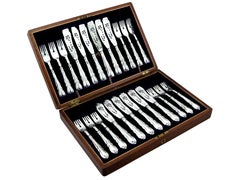
Victorian Sterling Silver Fish Service for Eighteen Persons
By John Gilbert & Sons
Located in Jesmond, Newcastle Upon Tyne
An exceptional, fine and impressive antique Victorian English sterling silver Lily pattern fish cutlery set for eighteen persons - boxed; an addition to our dining silverware collection
This exceptional antique Victorian sterling silver flatware...
Category
19th Century English Victorian Antique Calle Serveware, Ceramics, Silver and Glass
Materials
Silver, Sterling Silver
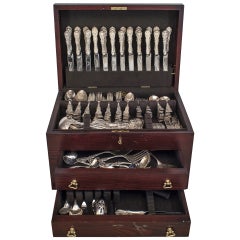
Tiffany & Co. San Lorenzo Silver Flatware Service, 248 Pieces
By Tiffany & Co.
Located in New Orleans, LA
This extensive 248-piece sterling silver flatware service was crafted by the legendary Tiffany & Co. in the classic San Lorenzo pattern. Inspired by and named after the famous Florentine Church of San Lorenzo, the motif displays a highly architectural design that is typical of the Renaissance Revival style. From the fine piercing to the gilt accents, the care and attention given to the crafting of each piece embodies Tiffany's commitment to extraordinary craftsmanship. The complete service for 12 is housed in its two-tiered, custom-fitted Tiffany & Co. chest.
The silver flatware of Tiffany & Co. is among the finest in the world, as well as the most enduring. Each hand-finished piece incorporates the timeless designs and quality craftsmanship that makes Tiffany one of the world's leading silversmiths. Since their first international recognition at the 1867 Paris World's Fair, Tiffany has supplied silver to numerous royal families throughout Europe, as well as elite American families including the Astors and Vanderbilts.
Each piece is marked "Tiffany & Co. Sterling Pat. 1916" with the date letter "m" for the directorship of John C. Moore, which dates this service between 1907 and 1947.
Chest: 23 1/2" wide x 19 1/4" deep x 6 1/4" high
This service comprises:
12 entree knives
12 luncheon knives
12 dessert knives
12 entree forks
12 salad forks
12 oyster forks
12 luncheon forks
12 fish forks
12 ice cream forks
24 teaspoons
12 tablespoons
12 gumbo spoons
12 cream / bouillon spoons
12 demitasse spoons
12 salt cellar spoons...
Category
Early 20th Century American Renaissance Revival Calle Serveware, Ceramics, Silver and Glass
Materials
Sterling Silver
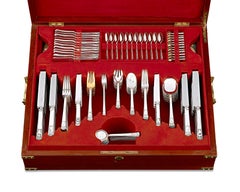
Bloch & Eschwege - 273pc. Antique French 950 Sterling Silver Flatware Set, Chest
By Jorgen Bloch, Maison Bloch Eschwege 1
Located in Wilmington, DE
Bloch & Eschwege 273pc. Flatware Set – Description 1st Dibs
Direct from Paris, A Stunning 273pc. Privately Commissioned Napoleon III Sterling Silver Flatware Set with Rare Mother-of-Pearl Handled Knives, Original 5 Drawer Lockable Storage Chest and 25 Amazing Serving Pieces by Two of France's Premier Silversmiths "Bloch & Eschwege" Silversmiths to the French Elite, in Superb Condition - circa 1930s. The history of silver-smithing in France is rich and illustrious, and many prominent firms have contributed to its legacy. Among these, Bloch & Eschwege stands out as an exemplar of craftsmanship, innovation, and artistic excellence. Founded in the 19th century, this renowned silversmith firm has left an indelible mark on the world of decorative arts.
Bloch & Eschwege was established in the mid-19th century by two remarkable artisans, Joseph-Alexandre Bloch and Emile-Robert Eschwege. Both men were passionate about the art of silver-smithing, and their partnership laid the foundation for a firm that would set new standards of excellence in the craft. Joseph-Alexandre Bloch was born in 1828 in the heart of Paris, a city renowned for its artistic heritage. As a young man, Bloch exhibited an exceptional talent for metalwork, earning an apprenticeship with a prominent Parisian silversmith. This experience provided him with valuable training in the art of working with silver and other precious metals. Bloch's dedication and skill earned him recognition in the silversmithing community, setting the stage for his future partnership with Eschwege. Emile-Robert Eschwege, born in 1832, hailed from a family of skilled metalworkers. His upbringing was steeped in the traditions of silver-smithing, and he showed a remarkable aptitude for the craft from a young age. Eschwege's family background and his own determination to master the art of silver-smithing made him a formidable candidate to join forces with Bloch.
In 1855, Bloch and Eschwege joined hands to establish their silversmith firm in Paris. Their partnership was not only rooted in a shared passion for the craft but also a vision to create exceptional pieces that would capture the essence of French artistic expression. The early works of Bloch & Eschwege were characterized by a fusion of traditional silversmithing techniques and innovative designs. Their creations included intricately designed flatware, tableware, and decorative pieces that showcased their mastery over silver, gold, and other precious metals. Their creations soon gained recognition among the elite of Parisian society, attracting a growing client base. Bloch & Eschwege's reputation grew rapidly due to their dedication to artistic excellence and innovation. The firm's artisans continuously pushed the boundaries of silver-smithing, employing novel techniques and materials to create one-of-a-kind pieces.
As Bloch & Eschwege's reputation continued to grow, they attracted the attention of European royalty and aristocracy. Their works found their way into the homes of kings, queens, and nobles, solidifying their status as one of the premier silversmith firms in Europe. The firm's most prestigious commissions came from members of the French royal family, including Emperor Napoleon III and Empress Eugénie. These commissions included exquisite pieces such as ornate candelabras, intricately designed tea sets, and opulent dining services. Bloch & Eschwege's creations not only adorned the palaces of the Tuileries and Compiègne but also graced the tables of state banquets and diplomatic events. Bloch & Eschwege's works were showcased at various international exhibitions, earning them accolades and awards. Notable exhibitions included the 1867 Exposition Universelle in Paris and the 1873 World's Fair in Vienna. The firm's contributions to these events highlighted their role in elevating French silver-smithing to the world stage.
Each stunning sterling piece in this amazing set is skillfully handcraft with the fine workmanship that has made the "House of Bloch & Eschwege" a favorite amongst the French Elite. Renowned for their elegant styling and the legendary quality of their flatware sets, this set is an exemplary testament to the quality and luxury typical of early 20th century France - La Belle Epoque !
This set is in extraordinarily good condition. Each sterling piece bears the hallmark of Master French Silversmith "Bloch & Eschwege" in addition to the French Government's Head of the Minerva 1 hallmark certifying a minimum of 950 sterling silver. The sterling silver knive blades are by Charles Marseille. This set is of exceptional quality and craftsmanship - check the weights and measures below, all weights and measures approximate:
18 Dinner Knives - Mother of Pearl Handes 24.70 cm. 48 grams
18 Dinner Forks 21.50 cm. 82 grams
18 Tablespoons 21.50 cm. 88 grams
18 Luncheon Knives - Mother of Pearl Handles 20.20 cm. 28 grams
18 Luncheon / Dessert Forks 18.50 cm. 46 grams
18 Luncheon / Dessert Spoons 18.50 cm. 54 grams
18 Dessert Knives - Mother of Pearl Handles & Sterling Silver Blades 20.20 cm. 34 grams
18 Fish Knives 21.00 cm. 54 grams
17 Fish Forks 18.20 cm. 53 grams
17 Oyster Forks 12.00 cm. 22 grams
18 Ice Cream Spoons 13.00 cm. 20 grams
17 Teaspoons 12.50 cm. 19 grams
17 Cake Forks 13.50 cm. 22 grams
18 Knife Blade Rests - Sterling Silver 7.00 cm. 18 grams
1 Berry Serving Spoon 18.00 cm. 55 grams
1 Small "bonbon" Serving Knife 15.20 cm. 23 grams
1 Small Berry Serving Spoon 13.70 cm. 32 grams
1 Small Tart Server 13.20 cm. 25 grams
1 Small "bonbon" Serving Fork 13.70 cm. 23 grams
1 Cheese Serving Knife 19.50 cm. 35 grams
1 Butter Serving Knife...
Category
Early 20th Century French Napoleon III Calle Serveware, Ceramics, Silver and Glass
Materials
Sterling Silver
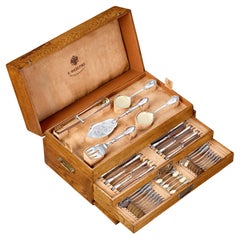
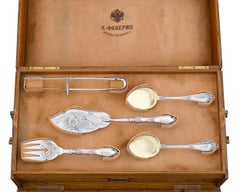
Fabergé Silver Flatware Service
By Fabergé
Located in New Orleans, LA
This exceptional 77-piece complete service by Fabergé is a rare treasure from the world-renowned firm. Enclosed in its original oak chest, the exquisite service remains complete and in pristine condition—a feat given the rarity of Fabergé silver from this era. Featuring specialty items for an elaborate fish service, this flatware set is a testament to the unparalleled elegance of Fabergé.
This exemplary set epitomizes the height of Fabergé silver craftsmanship, with each piece and its original fitted chest meticulously hallmarked with the Fabergé seal...
Category
19th Century Russian Antique Calle Serveware, Ceramics, Silver and Glass
Materials
Silver
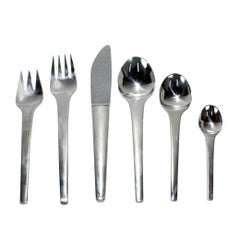
75 Pc. Georg Jensen Caravel Sterling Silver Flatware Dinner Service for 12
By Georg Jensen
Located in Philadelphia, PA
A very fine 75-piece Georg Jensen sterling silver flatware set.
Designed by Henning Koppel.
In the Caravel pattern.
Set comprises:
12 Dinner Forks (7 3/8")
12 Salad Forks (6 1/2")
12 Tea Spoons (5 15/16")
12 Place Spoons...
Category
Mid-20th Century Danish Mid-Century Modern Calle Serveware, Ceramics, Silver and Glass
Materials
Sterling Silver
$16,500 / set
H 8.63 in W 1 in D 0.3 in
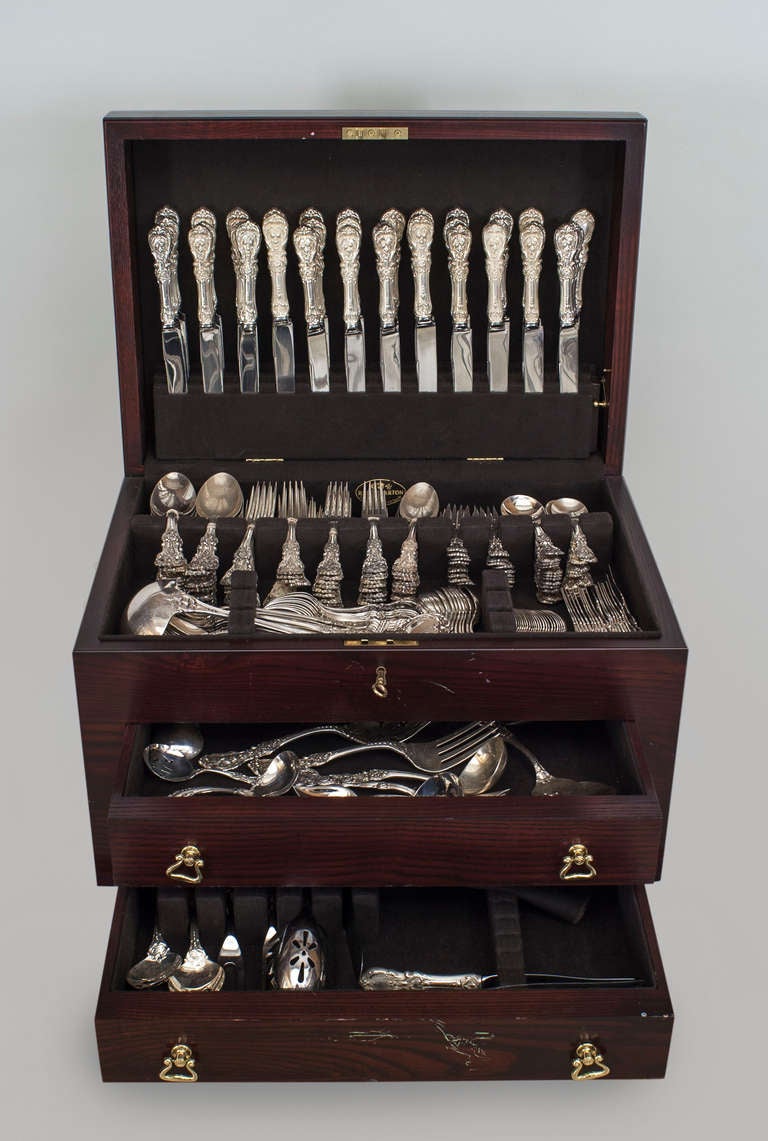
Louis XV Reed & Barton Silver Flatware Set
By Reed & Barton
Located in Queens, NY
French "Francis 1st pattern" 1920s sterling silver flatware dinner service set for 18 with a rococo floral design in a mahogany case. 250 pieces. (REED & B...
Category
Early 20th Century French Baroque Calle Serveware, Ceramics, Silver and Glass
Materials
Sterling Silver, Brass
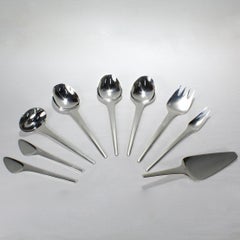
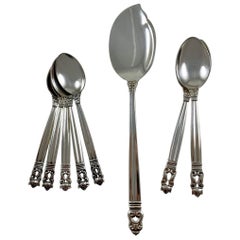
Georg Jensen Sterling Silver Acorn Pattern Breakfast Spoon Service Mixed Set / 8
By Georg Jensen
Located in Philadelphia, PA
An assembled sterling silver breakfast service, consisting of a pastry server, two jam spoons and five mocha spoons - a set of eight in the Classic acorn pattern.
Measure: One pasty server 6.5 in. L x 1 3/8 W
Five mocha spoons 3.75 in. L x .75 in. H. Initialed with a B on the verso.
Two jam spoons 4 3/8 in. L x 1 in. H
Designed by Johan Rodhe for Jensen and introduced in 1915, the Acorn pattern is iconic of the European Arts & Crafts movement of the early 1900s.
The mocha and jam spoons are showing the Georg Jensen, Denmark mark used circa 1933-1944. The pastry server is marked, USA Royal Danish International Silver...
Category
Early 20th Century Norwegian Scandinavian Modern Calle Serveware, Ceramics, Silver and Glass
Materials
Sterling Silver
$1,265 / set
H 1 in W 1.38 in D 6.5 in
Sterling Midcentury Flatware Set Service for 24/5 Piece Setting /120 Pieces
By Towle Silversmiths
Located in Brooklyn, NY
Wow, this is an incredible find. A sterling silver flatware set, service for 24, 5 piece setting in mint condition. This is midcentury at its finest. Look at the curvy shape of each piece; a modernist paradise. Each piece is tapered with the center being a tad bit wider than the top and bottom. This is not your grandmothers ornate and heavy looking flatware; this set is young and modern. Comes with a wooden flatware chest...
Category
1950s American Mid-Century Modern Vintage Calle Serveware, Ceramics, Silver and Glass
Materials
Sterling Silver
$10,800 / set
H 9 in Dm 2 in
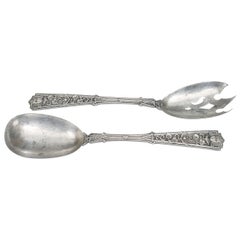
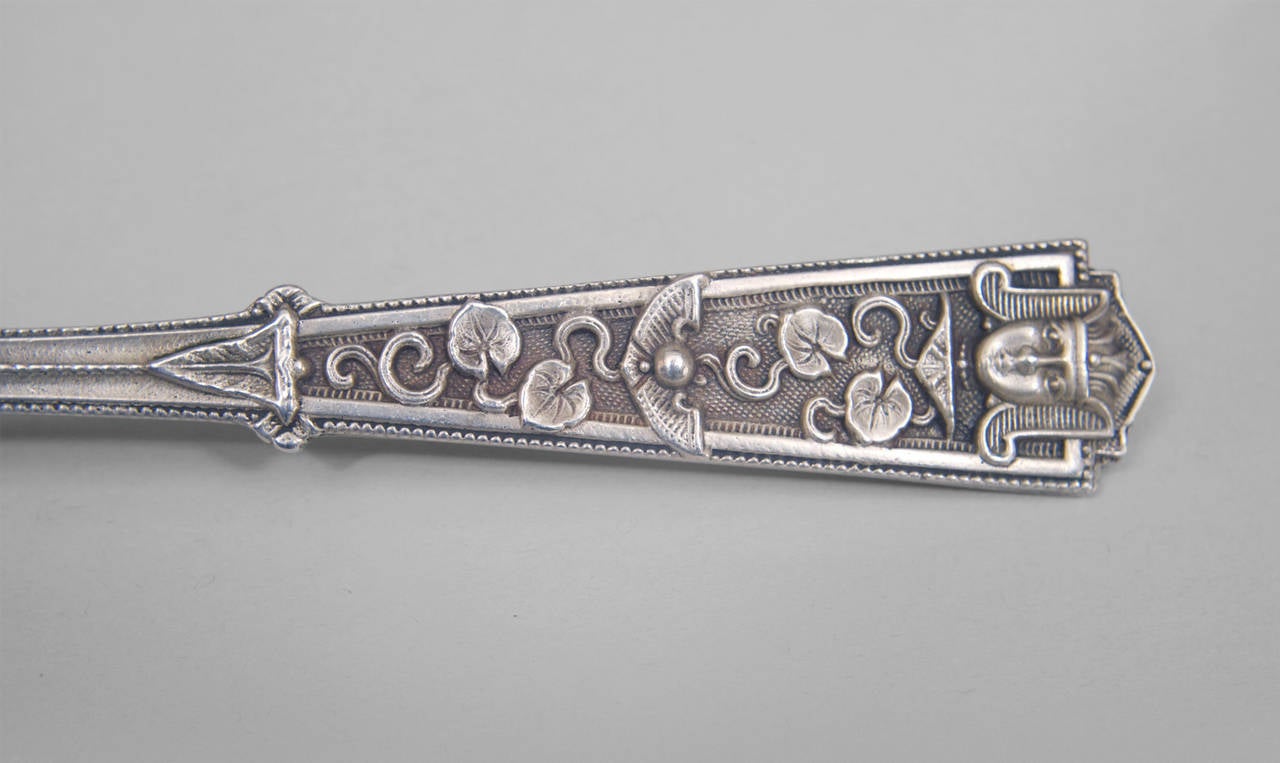
Pair of English Arts & Crafts Egyptian Revival Silver Spoons
Located in Queens, NY
Pair of English Arts & Crafts Egyptian Revival sterling silver serving fork and spoon with sphinx head and floral design. (PRICED AS Pair)
Category
Late 19th Century British Egyptian Revival Antique Calle Serveware, Ceramics, Silver and Glass
Materials
Sterling Silver
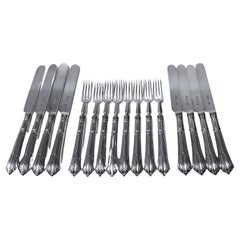
Christian F. Hiese 18 Piece Danish Arts & Crafts Sterling Silver Flatware Set
Located in Hamilton, Ontario
This eighteen piece set of flaware was made by the well known Christian F. Hiese of Denmark in approximately 1905 in the period Arts and Crafts style. This hand hammered set is compo...
Category
Early 20th Century Danish Arts and Crafts Calle Serveware, Ceramics, Silver and Glass
Materials
Sterling Silver
On Hold
$1,495 / set
H 0.75 in W 8.25 in D 1.75 in
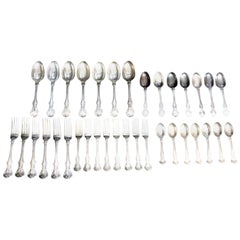
George Adams Antique Victorian English Sterling Silver Flatware Set
By George Adams
Located in Hamilton, Ontario
A total of 35 pieces of early Victorian sterling silver English flatware by George Adams, London, dated 1878 in a very rare pattern. Ornately decorated an...
Category
Early 19th Century English Victorian Antique Calle Serveware, Ceramics, Silver and Glass
Materials
Sterling Silver
On Hold
$4,950 / set
H 1 in W 2 in D 9.2 in
Calle serveware, ceramics, silver and glass for sale on 1stDibs.
Calle serveware, ceramics, silver and glass are available for sale on 1stDibs. These distinctive items are frequently made of sterling silver and are designed with extraordinary care. If you’re looking for additional options, many customers also consider serveware, ceramics, silver and glass by Cardeilhac, Jean Puiforcat, and Puiforcat. Prices for Calle serveware, ceramics, silver and glass can differ depending upon size, time period and other attributes — on 1stDibs, these items begin at $17,500 and can go as high as $17,500, while a piece like these, on average, fetch $17,500.
Creators Similar to Calle
Manufacture Nationale de Sèvres
Questions About Calle Serveware, Ceramics, Silver and Glass
- Why is it called a sconce?1 Answer1stDibs ExpertMay 30, 2024A light that hangs on a wall is called a sconce due to its linguistic history. The term originated from the Old French term esconce, which means "lantern" or "hiding place." In turn, the word sconce has its roots in the Latin root word for "to hide," abscondere. On 1stDibs, explore a selection of sconces.
- Why is it called a Huntboard?1 Answer1stDibs ExpertApril 5, 2022A huntboard is a compact table at a height that it would be comfortable to eat around while standing. The term ‘huntboard’ came into use in the early 1900s, as this piece of furniture, previously called a slab table, was rebranded in a Romantic light. Legends were told that it was used to serve refreshments to fox hunters. Shop a collection of vintage huntboards from top sellers on 1stDibs.
- Why is it called a watch?1 Answer1stDibs ExpertFebruary 13, 2024The portable timepiece worn on the wrist is called a watch due to its original purpose. Although they have become status symbols and fashion accessories, it is believed that early watches were the first tools used by town watchmen, who used them to track the start and end times of their shifts. Find a large collection of antique, vintage and contemporary watches on 1stDibs.
- Why is it called a paperweight?1 Answer1stDibs ExpertMarch 3, 2023A paperweight is called by that name because its original purpose was to hold down papers on desktops so that they did not slip off or become disorganized. Today, some people use paperweights as decorative objects rather than to weigh down papers. Shop an assortment of paperweights on 1stDibs.
- Why is it called Medieval?1 Answer1stDibs ExpertFebruary 22, 2021The word “medieval” comes from the Latin phrase medium aevum, which means “middle age.” The Middle Ages refer to the era in Europe that lasted from the fifth century to the Renaissance.
- Why is it called couture?1 Answer1stDibs ExpertSeptember 23, 2024Why it's called couture is owed to the origin of the word. In French, couture means "dressmaking" or "sewing." The term fits couture fashion because it refers to pieces that are designed and tailored to order. On 1stDibs, find a wide range of apparel from some of the world's top boutiques.
- Why is it called an armoire?1 Answer1stDibs ExpertSeptember 23, 2024Why it is called an armoire likely relates to the original purpose of the furniture. When armoires first emerged during the Middle Ages, people often stored armor and weapons in them. In Latin, the name for an armor storage chest is "armonium," so the term armoire may have come from that. Although people now use armoires to store clothing, home theater systems and other items rather than suits of armor, the name persists. On 1stDibs, explore a diverse assortment of armoires.
- Why is it called a credenza?1 Answer1stDibs ExpertApril 22, 2024Why it is called a credenza relates to historic lore about the furniture. In Italian, credenza is a word for “trust” or “belief.” During the 16th century, food and drink was often tested by a servant for a prominent person to see if it contained poison. The sideboard where this tasting took place came to be called a credenza. From there, a cabinet used to hold drinkware, plates and other items became known by the term as well. Although credenzas are now general storage furniture used in homes and offices, the original name remains. On 1stDibs, explore a variety of credenzas.
- Why is it called a nightstand?1 Answer1stDibs ExpertAugust 16, 2019
The origin of the word nightstand is the result of its function. Nightstands are placed near the bed to hold things and typically used at night.
- Why is it called a Tantalus?1 Answer1stDibs ExpertApril 5, 2022The name ‘Tantalus’ is a reference to the character in Greek mythology. A tantalus in furniture is a small wooden cabinet, with two or three decanters and complete with a lock and a key. Shop a collection of Tantalus pieces from some of the world’s top sellers on 1stDibs.
- Why is it called a hutch?1 Answer1stDibs ExpertJune 30, 2023Why a hutch is called that is due to the history of the English language. In Old English, the word for a box or chest is hwiċe or hwiċċe. Eventually, over time, the word became hutch, which refers to a type of case good that features a set of shelves or cabinets placed on top of a lower structure that is outfitted with drawers or additional cabinets. Hutches are most often found in dining rooms or kitchens. Shop a collection of hutches on 1stDibs.
- Why is it called a Papasan?1 Answer1stDibs ExpertApril 5, 2022The bowl-shaped papasan chair originated in South East Asia, but it is believed that Americans who first became familiar with the chair during the world wars dubbed it a papasan. The word papasan is a Japanese term that means honouring the father. There is no explanation why this particular word was attached to this bowl-shaped wicker chair. Shop a collection of wicker furniture from some of the world’s top sellers on 1stDibs.
- Why are they called Fauves?1 Answer1stDibs ExpertAugust 15, 2024Artists Henri Matisse, André Derain, Albert Marquet, Maurice de Vlaminck, Kees van Dongen and others were called Fauves because of the words of an art critic. After viewing a Fauvist exhibition at the Salon d'Automne in Paris, France, in 1905, critic Louis Vauxcelles wrote a scathing review of the colorful, bold paintings he saw. In it, he called the artists “fauves,” which is French for wild beasts. Although he meant it as an insult, the artists embraced the term, seeing it as a sign that their rejection of the conventions of painting was having the intended effect on viewers. On 1stDibs, shop a selection of Fauvist art.
- Why is it called Bulgari?1 Answer1stDibs ExpertNovember 13, 2024Why it is called Bulgari relates to founder Sotirios Voulgaris's source of inspiration: Rome. The Greek silversmith arrived in the Italian capital in 1881 and set up his shop there in 1884, calling it Bulgari, an Italianization of his last name. In the brand's logo it's styled BVLGARI, using the classical Latin alphabet in a nod to ancient Roman culture. Since then, Bulgari has looked to Rome as a source of reference for its fanciful and decidedly romantic necklaces, bracelets, earrings and other accessories. On 1stDibs, shop a selection of Bulgari jewelry and watches.
- What are nightstands called?1 Answer1stDibs ExpertApril 5, 2022A nightstand can also be called a bedside table or a daystand. It is a small table used for storing personal items beside the bed, and is characterized by either shelves or drawers or both. Shop a collection of nightstands from some of the world’s top sellers on 1stDibs.
- Why is it called a lavalier?1 Answer1stDibs ExpertApril 5, 2022The lavalier necklace is believed to be named after Duchess Louise de La Vallière who was the mistress of the King of France, Louis XIV, in the 1600s. This elegant pendant-like necklace much later inspired the name of a microphone that clips at the neckline. Shop a range of lavalier jewelry from top boutiques on 1stDibs.
- Why is it called a chair?1 Answer1stDibs ExpertFebruary 13, 2024Why the furniture used for seating is called a chair has to do with the history of language. The word comes from the 13th-century English word chaer, which in turn can be traced back to the Latin word cathedra, meaning seat. If that word reminds you of the word cathedral, it's no accident. The word cathedral gets its name from the fact that a cathedral is where the bishop of a parish has his seat. On 1stDibs, shop a wide range of chairs.
- Why is it called Fauvism?1 Answer1stDibs ExpertSeptember 23, 2024The story of why it is called Fauvism traces back to an art critic who reacted negatively when he first viewed examples of Fauvist art. After touring the Salon d'Automne in Paris, France, in 1905, critic Louis Vauxcelles said that the colorful work of Henri Matisse, André Derain, Albert Marquet and the other Fauvists looked as if it had been made by "fauves," or "wild beasts" in English. The Fauvists embraced the term as descriptive of their boldly colored, dramatically avant-garde art. Shop an assortment of Fauvist art on 1stDibs.
- Why is it called Impressionism?2 Answers1stDibs ExpertSeptember 25, 2019
The term Impressionism comes from the title of Claude Monet’s painting Impression, Sunrise, from which an art critic derived what he considered an insulting name for the entire movement.
1stDibs ExpertFebruary 22, 2021It is called Impressionism because this type of art aims to capture a reflection, or impressionism of real life. Impressionism depicts a visual impression of a moment, paying particular attention to the shifting effect of light and color. - Why is it called Balenciaga?1 Answer1stDibs ExpertNovember 13, 2024Why it is called Balenciaga is because the luxury fashion house shares its founder's name. However, the original name that Cristóbal Balenciaga chose for his label was Eisa, which was his mother's name. When the Spanish Civil War put a hold on his prospects in Spain, the designer moved to Paris, opening a house on Avenue Georges V in 1937 under the name Balenciaga. From there, the brand evolved to transform the landscape of women’s fashion with shapes and contours during the middle of the 20th century that were nothing less than groundbreaking. Today, Balenciaga is as venturesome as ever and is well known for its shoes, handbags, sneakers, streetwear and other clothing and accessories. On 1stDibs, find a variety of Balenciaga apparel and accessories.