Carlton Theodore Chapman Art
American, 1860-1925
Born in New London, OH on Sept. 18, 1860, Carlton Chapman studied in New York City at the National Academy of Design and the Art Students League, and in Paris at Académie Julian. He was a resident of Los Angeles in 1912-18. He died in New York City on Feb. 12, 1925. Member: National Academy and California Art Club. Exhibition: World's Columbian Expo (Chicago), 1893 (award); Atlanta Expo, 1895 (award); Pan-American Expo, Buffalo, 1901 (medal); Albright Gallery (Buffalo), 1906; Kanst Gallery (LA), 1912. Collections: Toledo Museum; Brooklyn Institute.
to
2
Overall Width
to
Overall Height
to
2
1
2
2
1
1
1
1
1
1
1
1
1
1
2
1
1
1
1
2
10,733
2,827
2,495
1,414
2
2
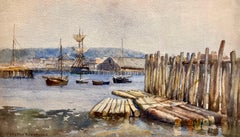
Artist: Carlton Theodore Chapman
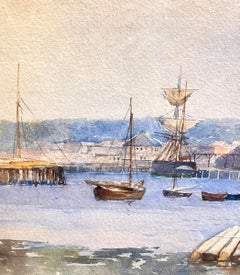
New England Fort
New England Fort

New England Fort

By Carlton Theodore Chapman

Located in Fredericksburg, VA

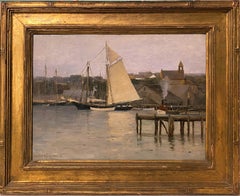
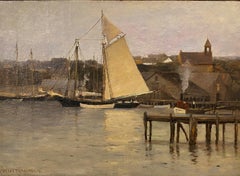
This c. 1900 watercolor by Carlton T. Chapman depicts a quiet harbor scene with moored sailing vessels and weathered wooden docks extending into calm blue water. Known for his mariti...

Category

Early 20th Century American Impressionist Carlton Theodore Chapman Art
Materials

Paper, Watercolor

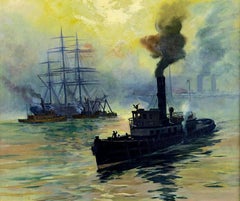
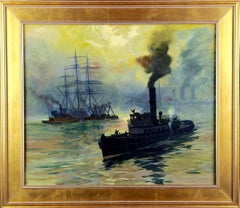
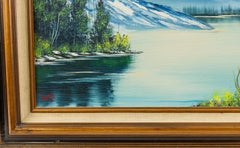
Ships in Harbor
Ships in Harbor

Ships in Harbor

By Carlton Theodore Chapman

Located in Fort Washington, PA

Signature: Signed Lower Right

Category

20th Century Carlton Theodore Chapman Art
Materials

Canvas, Oil

Related Items
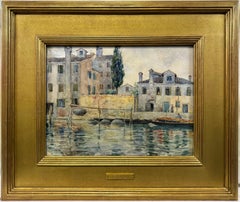
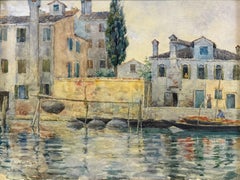
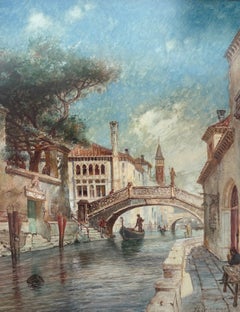
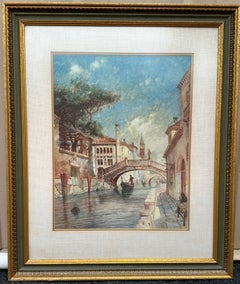
“Venice, 1889” San Pietro di Castello Canals American Impressionist Watercolor

“Venice, 1889” San Pietro di Castello Canals American Impressionist Watercolor

Located in Yardley, PA

“Venice, 1889” by Louis Ritter (American, 1854-1892). A fantastic example of Ritter’s renowned European watercolors. This beautifully poised composition captures the sun-washed faça...

Category

1880s American Impressionist Carlton Theodore Chapman Art
Materials

Paper, Watercolor

"Train Station, " Max Kuehne, Industrial City Scene, American Impressionism

"Train Station, " Max Kuehne, Industrial City Scene, American Impressionism

By Max Kuehne

Located in New York, NY

Max Kuehne (1880 - 1968) Train Station, circa 1910 Watercolor on paper 8 1/4 x 10 1/4 inches Signed lower right Provenance: Private Collection, Illinois Max Kuehne was born in Halle, Germany on November 7, 1880. During his adolescence the family immigrated to America and settled in Flushing, New York. As a young man, Max was active in rowing events, bicycle racing, swimming and sailing. After experimenting with various occupations, Kuehne decided to study art, which led him to William Merritt Chase's famous school in New York; he was trained by Chase himself, then by Kenneth Hayes Miller. Chase was at the peak of his career, and his portraits were especially in demand. Kuehne would have profited from Chase's invaluable lessons in technique, as well as his inspirational personality. Miller, only four years older than Kuehne, was another of the many artists to benefit from Chase's teachings. Even though Miller still would have been under the spell of Chase upon Kuehne's arrival, he was already experimenting with an aestheticism that went beyond Chase's realism and virtuosity of the brush. Later Miller developed a style dependent upon volumetric figures that recall Italian Renaissance prototypes. Kuehne moved from Miller to Robert Henri in 1909. Rockwell Kent, who also studied under Chase, Miller, and Henri, expressed what he felt were their respective contributions: "As Chase had taught us to use our eyes, and Henri to enlist our hearts, Miller called on us to use our heads." (Rockwell Kent, It's Me O Lord: The Autobiography of Rockwell Kent. New York: Dodd, Mead and Co., 1955, p. 83). Henri prompted Kuehne to search out the unvarnished realities of urban living; a notable portion of Henri's stylistic formula was incorporated into his work. Having received such a thorough foundation in art, Kuehne spent a year in Europe's major art museums to study techniques of the old masters. His son Richard named Ernest Lawson as one of Max Kuehne's European traveling companions. In 1911 Kuehne moved to New York where he maintained a studio and painted everyday scenes around him, using the rather Manet-like, dark palette of Henri. A trip to Gloucester during the following summer engendered a brighter palette. In the words of Gallatin (1924, p. 60), during that summer Kuehne "executed some of his most successful pictures, paintings full of sunlight . . . revealing the fact that he was becoming a colorist of considerable distinction." Kuehne was away in England the year of the Armory Show (1913), where he worked on powerful, painterly seascapes on the rocky shores of Cornwall. Possibly inspired by Henri - who had discovered Madrid in 1900 then took classes there in 1906, 1908 and 1912 - Kuehne visited Spain in 1914; in all, he would spend three years there, maintaining a studio in Granada. He developed his own impressionism and a greater simplicity while in Spain, under the influence of the brilliant Mediterranean light. George Bellows convinced Kuehne to spend the summer of 1919 in Rockport, Maine (near Camden). The influence of Bellows was more than casual; he would have intensified Kuehne's commitment to paint life "in the raw" around him. After another brief trip to Spain in 1920, Kuehne went to the other Rockport (Cape Ann, Massachusetts) where he was accepted as a member of the vigorous art colony, spearheaded by Aldro T. Hibbard. Rockport's picturesque ambiance fulfilled the needs of an artist-sailor: as a writer in the Gloucester Daily Times explained, "Max Kuehne came to Rockport to paint, but he stayed to sail." The 1920s was a boom decade for Cape Ann, as it was for the rest of the nation. Kuehne's studio in Rockport was formerly occupied by Jonas Lie. Kuehne spent the summer of 1923 in Paris, where in July, André Breton started a brawl as the curtain went up on a play by his rival Tristan Tzara; the event signified the demise of the Dada movement. Kuehne could not relate to this avant-garde art but was apparently influenced by more traditional painters — the Fauves, Nabis, and painters such as Bonnard. Gallatin perceived a looser handling and more brilliant color in the pictures Kuehne brought back to the States in the fall. In 1926, Kuehne won the First Honorable Mention at the Carnegie Institute, and he re-exhibited there, for example, in 1937 (Before the Wind). Besides painting, Kuehne did sculpture, decorative screens, and furniture work with carved and gilded molding. In addition, he designed and carved his own frames, and John Taylor Adams encouraged Kuehne to execute etchings. Through his talents in all these media he was able to survive the Depression, and during the 1940s and 1950s these activities almost eclipsed his easel painting. In later years, Kuehne's landscapes and still-lifes show the influence of Cézanne and Bonnard, and his style changed radically. Max Kuehne died in 1968. He exhibited his work at the National Academy of Design, the Art Institute of Chicago, the Carnegie Institute in Pittsburgh, the Memorial Art Gallery of the University of Rochester, and in various New York City galleries. Kuehne's works are in the following public collections: the Detroit Institute of Arts (Marine Headland), the Whitney Museum (Diamond Hill...

Category

1910s American Impressionist Carlton Theodore Chapman Art
Materials

Paper, Watercolor

"Monhegan Island, Maine, " Edward Dufner, American Impressionism Landscape View

"Monhegan Island, Maine, " Edward Dufner, American Impressionism Landscape View

By Edward Dufner

Located in New York, NY

Edward Dufner (1872 - 1957) Monhegan Island, Maine Watercolor on paper Sight 16 x 20 inches Signed lower right With a long-time career as an art teacher and painter of both 'light' and 'dark', Edward Dufner was one of the first students of the Buffalo Fine Arts Academy to earn an Albright Scholarship to study painting in New York. In Buffalo, he had exchanged odd job work for drawing lessons from architect Charles Sumner. He also earned money as an illustrator of a German-language newspaper, and in 1890 took lessons from George Bridgman at the Buffalo Fine Arts Academy. In 1893, using his scholarship, Dufner moved to Manhattan and enrolled at the Art Students League where he studied with Henry Siddons Mowbray, figure painter and muralist. He also did illustration work for Life, Harper's and Scribner's magazines. Five years later, in 1898, Dufner went to Paris where he studied at the Academy Julian with Jean-Paul Laurens and privately with James McNeill Whistler. Verification of this relationship, which has been debated by art scholars, comes from researcher Nancy Turk who located at the Smithsonian Institution two 1927 interviews given by Dufner. Turk wrote that Dufner "talks in detail about Whistler, about how he prepared his canvasas and about numerous pieces he painted. . . A great read, the interview puts to bed" the ongoing confusion about whether or not he studied with Whistler. During his time in France, Dufner summered in the south at Le Pouleu with artists Richard Emil Miller...

Category

Early 20th Century American Impressionist Carlton Theodore Chapman Art
Materials

Paper, Watercolor

"Cape Cod Sunset" - Watercolor on Paper

"Cape Cod Sunset" - Watercolor on Paper

Located in Soquel, CA

"Cape Cod Sunset" - Watercolor on Paper Colorful sunset painting by San Francisco and Provincetown artist Robert Morgan (American, 20th C). A house sits on top of a hill lit up in orange and yellow reflecting the colors of the set sky in this impressionist watercolor. Cape Cod, a popular summertime destination, sits on the hook-shaped peninsula of the U.S. state of Massachusetts. Signed by the artist in the lower right corner, "Robert Morgan" Frame size: 17.5"H x 21.75"W Image size: 11.75"H x 17.25"W Info provided on the back by the artist: Robert Morgan "Cape Cod Sunset" Watercolor, 12x18", '99 Presented in a wooden frame with a light gray mat. After graduating from the Kansas City Art Institute and moving to San Francisco, Robert Morgan (American, 20th/21st Century) returned to Provincetown to study watercolor with the late Lee Boynton at the Cape Cod School of Art. He then began taking workshops at the Fine Arts Work Center with Jim Peters, Robert Henry and Gregory Amenoff, among others. He now sells his artworks through the Alden Gallery, opened by film writer and Banner Arts Editor Howard Karren and business partner, Stephen Syta, in 2007. Morgan’s subject matter is largely influenced by Provincetown, mostly consisting of men in relationship to the beach, the town and each other. Education San Francisco State University, MA (Painting), 1984 San Francisco Art Institute, 1974–76 Kansas City Art Institute, BFA, 1972 Publications “A Feeling for Light and Air and the Human Figure,” The Palette Magazine, Issue No. 12 (Dec. 2005/Jan 2006) “ArtSeen,” by Patrick King, Genre, August 1998, pp. 76-77 Awards Gold Award, Painting, Art of California Magazine, 1993 Exhibitions 2017 - Alden Gallery, “Ed Christie, Robert Morgan and Laurence Young: New Work” Alden Gallery, “Wall” Metro Pictures, New York, “Postcards from the Edge 2017” Provincetown Art Association and Museum, Members’ Juried Exhibition (curated by Sarah Johnson, Cahoon Museum of American Art) 2016 - Alden Gallery, “Robert Morgan and Sean McCabe: New Work” Alden Gallery, “Meme” 2015 - Alden Gallery, “Kevin Cyr, Raul Gonzalez...

Category

1990s American Impressionist Carlton Theodore Chapman Art
Materials

Paper, Watercolor

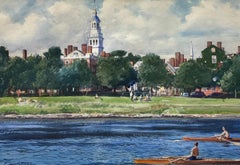
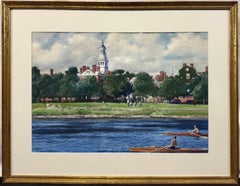
“Rowing on the Charles River, Harvard University” Boston, Cambride, MA Cityscape

“Rowing on the Charles River, Harvard University” Boston, Cambride, MA Cityscape

By Aiden Lassell Ripley

Located in Yardley, PA

“Rowing on the Charles River, Harvard University” by Aiden Lassell Ripley (American, 1896-1969) A fantastic, rare view of Harvard University and the Charles River by renowned Americ...

Category

20th Century American Impressionist Carlton Theodore Chapman Art
Materials

Paper, Watercolor

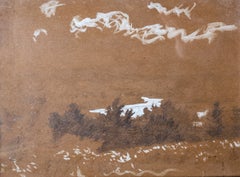
An Old Military Road, The Road over Dovrefjell, Norway

An Old Military Road, The Road over Dovrefjell, Norway

By Carl Oscar Borg

Located in Stockholm, SE

Carl Oscar Borg (1879–1947) An Old Military Road, The Road over Dovrefjell, Norway gouache on paper, ca. 1900 signed sheet 12.5 cm x 17.5 (4.9 x 6.9 in) framed 23 × 28 cm (9 × 11...

Category

1890s American Impressionist Carlton Theodore Chapman Art
Materials

Paper, Gouache

Gathered by the Easter Fire, Dalsland

Gathered by the Easter Fire, Dalsland

By Carl Oscar Borg

Located in Stockholm, SE

A rare and atmospheric work from Carl Oscar Borg’s early years in Sweden, this evocative gouache captures the tradition of Easter fires (påskeldar) in the rural region of Dalsland. A...

Category

Late 19th Century American Impressionist Carlton Theodore Chapman Art
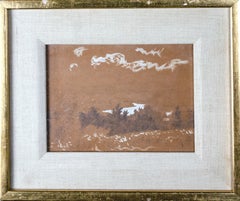
Materials

Paper, Gouache

Boat Scene
Boat Scene

Fairfield PorterBoat Scene, 1958

$26,000

H 14.5 in W 22.5 in

Boat Scene

By Fairfield Porter

Located in Miami, FL

Watercolor on heavy paper work is unframed Signed by artist in pencil, lower right verso. Property from the estate of Anne E. C. Porter, with the estate stamp, verso. ...

Category

1950s American Impressionist Carlton Theodore Chapman Art
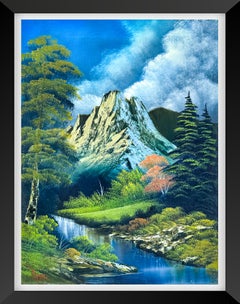
Materials

Watercolor, Paper

A pair of Indonesian Landscapes, by Charles Legrain (19th century)

A pair of Indonesian Landscapes, by Charles Legrain (19th century)

Located in Amsterdam, NL

Charles Legrain, (19th century) Two Javanese landscapes Both signed Legrain Ch. and one dated 1857 Both oil on canvas, size: 95 x 114 cm In rich gilt-gesso frame. (2x).

Category

Mid-19th Century Romantic Carlton Theodore Chapman Art
Materials

Canvas, Oil

'Moss Beach, Monterey, California', Pacific Coastal Landscape, ASL NYC, Benezit

'Moss Beach, Monterey, California', Pacific Coastal Landscape, ASL NYC, Benezit

By Elmer Wachtel

Located in Santa Cruz, CA

An early-20th-century, landscape showing a view of the coastline at Moss Beach in Monterey County with slate-blue skies overhead and a view towards a stand of windswept Monterey Cypress with a view of the cobalt blue ocean beyond. A particularly fresh and bright example, kept until recently in a portfolio. Monogrammed lower right, "EW", dated "X-mas 1909", signed verso, "Elmer Wachtel", and inscribed lower left, "Moss Beach, Monterey County, California". A prominent California landscape painter of the late 19th and early 20th-century, Elmer Wachtel specialized in panoramic coastal scenes and desert and mountain landscapes using impressionist brushstrokes. His early works were tonalist in mood, and his later paintings were more decorative and light hearted. Elmer Wachtel was an American artist who holds a high place in the early California school of Impressionism. He was born in Baltimore, Maryland on January 21, 1864 -- he received his artistic training at the Art Students' League of New York under William Merritt Chase, and the Art School in London 1901-02. While in California he resided and maintained studios in Los Angeles and Pasadena. In 1904 Elmer Wachtel married the artist Marion Kavanaugh (1876-1954) in Chicago. Husband and wife were frequently seen painting the Southern California landscape -- they were known to have traveled by horseback over the San Marcos Pass to the Santa Inez Valley -- they traversed and painted the coastline between Gaviota and Conception Lighthouse (just north of Santa Barbara, California), the Cooper Ranch (north of Santa Barbara), Matilija Canyon and Ojai, California. Venturing south the couple made it to the San Luis Rey River (near present day Oceanside) and the Cerisa Loma Ranch (near San Diego). In 1908 they trekked to the arid deserts of Arizona and New Mexico painting...

Category

Early 1900s American Impressionist Carlton Theodore Chapman Art
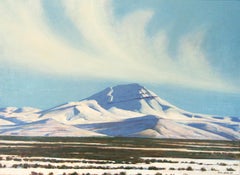
Materials

Paper, Watercolor, Gouache

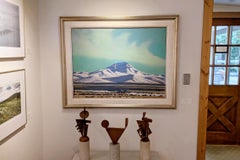
Mount Monadnock
Mount Monadnock

Gifford BealMount Monadnock

$4,900

H 26.38 in W 36.38 in D 3 in

Mount Monadnock

By Gifford Beal

Located in Milford, NH

A fine monochromatic watercolor landscape painting of Mount Monadnock in New Hampshire by American artist Gifford Beal (1879-1956). Beal was b...

Category

Mid-20th Century American Impressionist Carlton Theodore Chapman Art
Materials

Paper, Watercolor

Previously Available Items
Gloucester Harbor
Gloucester Harbor

Gloucester Harbor

By Carlton Theodore Chapman

Located in Milford, NH

A fine marine painting of Gloucester Harbor by American artist Carleton Theodore Chapman (1860-1925). Chapman was born in Ohio. As a boy, he spent hi...

Category

Late 19th Century American Realist Carlton Theodore Chapman Art
Materials

Canvas, Oil

Carlton Theodore Chapman art for sale on 1stDibs.

Find a wide variety of authentic Carlton Theodore Chapman art available for sale on 1stDibs. You can also browse by medium to find art by Carlton Theodore Chapman in canvas, fabric, oil paint and more. Not every interior allows for large Carlton Theodore Chapman art, so small editions measuring 24 inches across are available. Customers who are interested in this artist might also find the work of Jason Berger, Ralph Eugene Della-Volpe, and Felicie Howell. Carlton Theodore Chapman art prices can differ depending upon medium, time period and other attributes. On 1stDibs, the price for these items starts at $12,000 and tops out at $12,000, while the average work can sell for $12,000.

Artists Similar to Carlton Theodore Chapman