Charles Philips Art

to
1
1
Overall Width
to
Overall Height
to
2
2
1
1
2
2
2
1
1
2
2
1
1
2
10,368
2,808
2,500
1,414
1
2
Artist: Charles Philips
A group portrait of the Southwell family with a Negro Page and Macaw

A group portrait of the Southwell family with a Negro Page and Macaw

By Charles Philips

Located in Taunton, GB

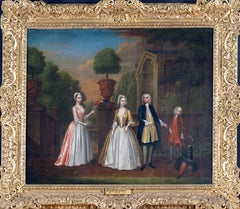
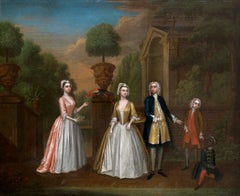
A group portrait of the Southwell family on the terrace with a negro page and Macaw. Oil on canvas Signed and dated 1731 Canvas size 25 x 30 ¼ inches 63.5 x 77 cms Frame exterior 32 x 37 ¼ inches 81 x 94.5 cms This evocative family portrait offers a glimpse into the life of 18th Century English nobility. The Southwells are a noble family whose roots go back to the early 17th Century. In 1776 Edward Southwell III was granted the Barony of de Clifford (a title in abeyance at the time), and the line extends to today, with the 28th Baron de Clifford sitting in the House of Lords. Charles Phillips (1708-1747) was a leading portraitist of his time, having painted many noble and royal portraits. Two of his paintings are part of the Royal Collection Trust. In this portrait, signed and dated 1731, we see Edward Southwell Sr (1671-1730) and his family on the grounds of their Estate, Kings Weston House near Bristol. On the far left is Mrs. Helena Le Grand (Edward’s sister). Next to her is Mrs. Southwell (Edward’s second wife, the first having died in 1709). On the right is Edward Southwell Jr (1705-1755), Edward’s son by his first marriage and next to him a “Negro Page” (in the euphemistic words of an old label on the painting; more on him below.) Phillips has arranged the figures in an arc, anchoring the composition. The arc stretches from Mrs. Le Grand’s red dress on the left, through the colourful parrot, onward to the heads of Mr. and Mrs. Southwell, down again to the younger Southwell and finishing on the right with the enslaved boy. As Edward Sr. died in 1730, this must be a posthumous portrait, making it especially poignant. (Presumably Phillips used another portrait to capture his likeness.) One can imagine the late Edward’s family looking affectionately at the portrait, remembering the time spent with him on the grounds of Kings Weston House. Southwell stands between wife and son, eyes directed toward one, hand pointed toward the other, symbolically balancing the needs of both. Devoted husband and father? Perhaps. Slave-owner as well. English noble families of the 18th Century often had financial and practical connections with the slave trade. The Southwells themselves were granted a tract of land by the Crown in 1766, which Edward Southwell III (1738-1777) – the son of the younger Southwell in the portrait – developed with partners into a plantation worked by slave labour. This portrait shows us that slave ownership was not always a matter for distant colonies. This young boy, likely deprived of his freedom from birth (born to enslaved parents), was made to serve the Southwell family in their home. We see him here sitting half cross-legged, wearing a house servant’s uniform and a faint smile. He gaze is turned upward; at first we think is looking at his Master, then we realise he must be in fact enjoying the sight of the parrot eating from the hand of his Master’s sister. Phillips has placed him on the ground, beneath the rest of the family in pose as in station. Yet here he is in this portrait just the same, as if he were a member of the family. Was the family fond of him? Was he a playmate of the younger Southwell? Or was he simply there in the Garden that day to serve them their refreshments? The answers to these questions must remain unanswered, known only to the sitters frozen in time by Phillips’ paintbrush. Three centuries later we are fortunate to have this portrait as a snapshot of 18th Century England, both its nobility and its baseness. Charles Philips, the son of a portraitist, likely acquired his artistic skills from his father. He specialised primarily in painting small portraits and conversation pieces. George Vertue observed that in painting small figure portraits and conversation scenes, Philips gained significant recognition and patronage among fashionable circles, including members of the Royal Family. In 1732, he produced conversation works for the Duchess of Portland and the Duke of Somerset. During the 1730s, his conversation pieces became increasingly complex, featuring more numerous subjects engaged in a greater variety of activities. Following the precedent set by contemporaries such as Philippe Mercier and William Hogarth, both prominent painters of small-scale conversation pieces, Philips transitioned into the more lucrative field of portrait painting later in the decade. His career peaked in 1737 when he painted full-length portraits of the Prince and Princess of Wales. The Prince of Wales was renowned for his patronage of the arts, particularly towards immigrant artists including Jacopo Amigoni and Philippe Mercier, who were principal influences on Philips. Two of Philips' paintings in the Royal Collection depict fashionable London clubs not recorded elsewhere. The first, from 1732, shows Frederick...

Category

18th Century Charles Philips Art

Materials

Oil

Portrait of a King's Messenger, 18th Century English Artist, Original Frame

Portrait of a King's Messenger, 18th Century English Artist, Original Frame

By Charles Philips

Located in London, GB

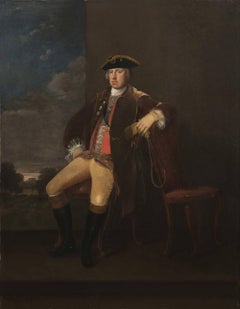
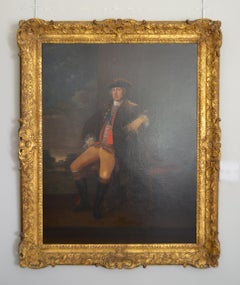
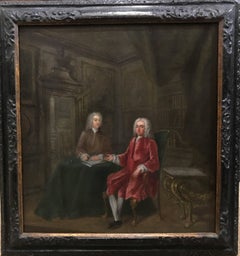
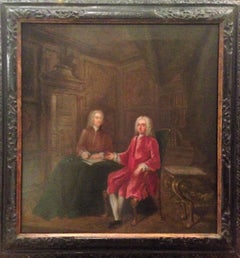
Charles Philips 1703 - 1747 Portrait of a King's Messenger Oil on canvas Image size: 35 ¾ x 28 inches Original gilt frame King's Messenger The job of a King's Messenger was that of a diplomatic courier, hand-carrying important and secret documents around the world. Some say that the history of the sovereigns' messengers goes back to 1199, but the first known messenger was John Norman, who in 1485 earned 4d (1½ pence) per day for carrying the state papers of Richard III. The silver greyhound on the messenger's badge dates back to Charles II. In 1660, during his exile at Breda, Netherlands, Charles II issued a declaration of amnesty to all those who had opposed him and his father. He used messengers to make his intentions known. In answer to the messenger's question "How will they know me?", Charles reached forward to a silver bowl on the table in front of him. This bowl, with four decorative greyhounds standing proud above the rim, was well known to all courtiers. Charles broke off a greyhound and gave it to the messenger as a guarantee that the message came from him. From that date, the King's Messenger always wore a silver greyhound around his neck. Later, dating from George II or III, a badge with the Royal Arms in enamel, with the greyhound suspended beneath, was worn. A George III example of the King's Messenger Badge, pre 1800, sold for over £30,000 pounds some years ago. The silver greyhounds were minted for each new reign, except the brief one of King Edward VIII. The sovereign's messengers were originally controlled by the Lord Chamberlain, being Messengers of the Great Chamber. When the Foreign Office was created in 1782, the messengers remained common to the three Secretaries of State. Charles Philips was an English artist known for painting a number of portraits and conversation pieces for noble and Royal patrons in the mid-eighteenth century. Philips was baptised in the combined parish of St Mildred, Poultry with St Mary...

Category

18th Century Charles Philips Art

Materials

Canvas, Oil

Related Items
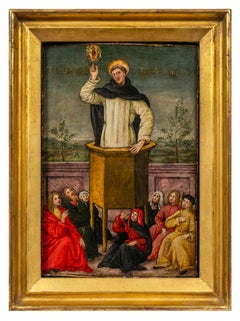
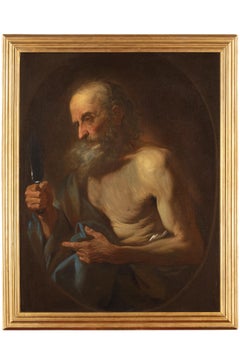
Italian 18th Century Oval Religious Oil on Canvas Painting with Saint Dominic

Italian 18th Century Oval Religious Oil on Canvas Painting with Saint Dominic

By Francesco de Mura

Located in Firenze, IT

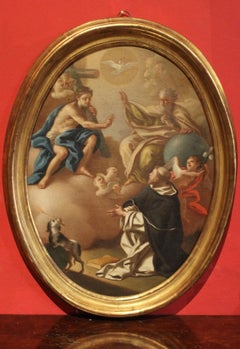
This beautiful Italian 18th Century old masters oil painting on oval canvas with giltwood frame is attributed to Solimena and features a religious scene. In this splendid oval-shaped painting are depicted Saint Dominic...

Category

18th Century Old Masters Charles Philips Art

Materials

Canvas, Oil

Male and female portrait, both in silk kimono, possibly textile dealers

Male and female portrait, both in silk kimono, possibly textile dealers

By Christoffel Lubieniecki

Located in Amsterdam, NL

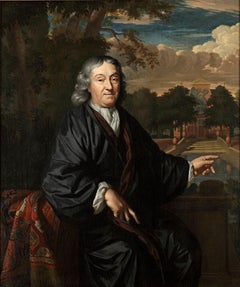
CHRISTOFFEL LUBIENIECKI (1659-1729) Pair of portraits of a gentleman and a lady, both in silk kimono, before a country house (circa 1680) Indistinctly signed “C.......” on a box under the man’s left hand Oil on canvas, 79.5 x 67 cm each Both sitters are portrayed wearing a silk “Japanese” coat. During the second half of the seventeenth the Japanese silk coat, an adapted Japanese kimono, became a real vogue in the Dutch elite. The exclusive Dutch trade contacts with Japan can explain the popularity of the kimono-style silk coats in the Netherlands. Everybody who could afford one, dressed in such a fashionable and comfortable coat and, like the present sitters, some proud owners had themselves portrayed in a “Japanese” coat often together with an oriental carpet to underline their standing and international connections. These portraits are the work of the Polish-born portraitist Christoffel Lubieniecki (also known as Lubienitski, Lubinitski or Lubiniecki) Lubieniecki was first trained in Hamburg under Julian Stuhr and after 1675 in Amsterdam under Adriaen Backer and Gerard de Lairesse. He specialized in landscapes, generally of an Italianate character, and in portraits. The loving execution of these contented burghers, enjoying the garden vistas of their country house, places him alongside Amsterdam portraitists such as Constantijn Netscher and Michiel van Musscher...

Category

1680s Old Masters Charles Philips Art

Materials

Canvas, Oil

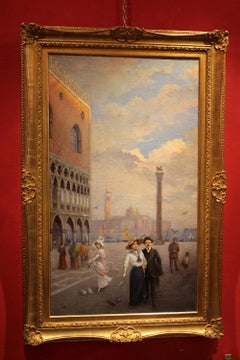
Venice Landscape Italian Oil on Canvas Painting in Gilt Wood Frame, Belle Epoque

Venice Landscape Italian Oil on Canvas Painting in Gilt Wood Frame, Belle Epoque

Located in Firenze, IT

This delightful turn of the century (early 20th century) oil on canvas painting represents an Italian landscape with one of the most famous squares in the world: Piazza San Marco in ...

Category

Early 20th Century Impressionist Charles Philips Art

Materials

Canvas, Oil

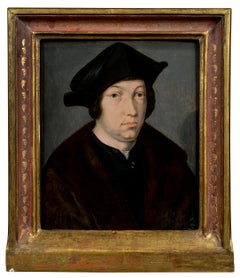
Portrait of a Man
Portrait of a Man

Quentin MassysPortrait of a Man

$52,500

H 11 in W 9 in

Portrait of a Man

Located in New York, NY

Provenance: with Leo Blumenreich and Julius Böhler, Munich, 1924 Dr. Frederic Goldstein Oppenheimer (1881-1963), San Antonio, Texas; by whom given to: Abraham M. Adler, New York, until 1985; thence by descent to the present owners While old inscriptions on the verso of this panel propose its author to be Hans Holbein and the sitter Sir John More—a lawyer, judge, and the father of Sir Thomas More—this fine portrait has long been recognized to be by a Flemish hand. Max Friedländer gave the painting to Bernard van Orley (1487/1491 – 1541) in 1924, but did not include it in the volume dedicated to the artist in his Early Netherlandish Paintings...

Category

16th Century Old Masters Charles Philips Art

Materials

Oil, Panel

Self-Portrait
Self-Portrait

John Hamilton MortimerSelf-Portrait, 1758

$225,446

H 30.01 in W 25.12 in

Self-Portrait

By John Hamilton Mortimer

Located in London, GB

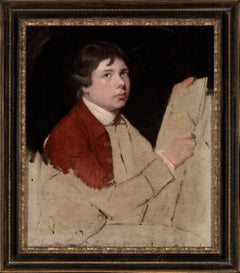
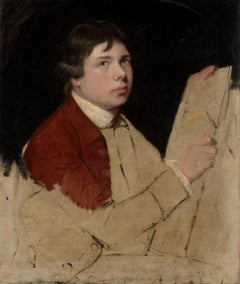
Oil on canvas 30 x 25 ⅛ inches; 762 x 638 mm Verso: after Sir Joshua Reynolds, a self-portrait Not signed Painted c. 1758 Collections: Philip Gell (1775–1842), Hopton Hall, Derbyshire; By inheritance at Hopton Hall to his daughter, Isabella, who married William Pole Thornhill, who renounced Hopton and its contents in favour of his kinsman, Henry Chandos-Pole-Gell (1829–1902); By descent to his son, Brigadier General Harry Chandos-Pole-Gell (1872–1934), who sold Hopton Hall in 1918 and moved the family to Newnham Hall, Northamptonshire; By descent to his son, Lt Colonel John Chandos-Pole (1909–1993), Newnham Hall; Thence by descent until 2015, when acquired By descent to 2015; Lowell Libson & Jonny Yarker Ltd. Literature: Algernon Graves and Walter V. Cronin, A History of the works of Sir Joshua Reynolds P.R.A., London, 1901, IV, p. 1394. David Manning...

Category

18th Century Old Masters Charles Philips Art

Materials

Canvas, Oil

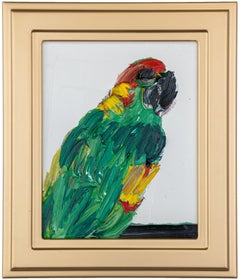
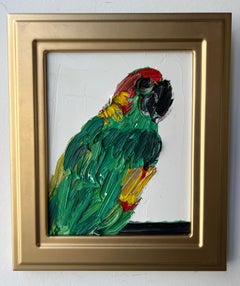
Hunt Slonem "Mexican Red Head" Multicolor Amazon Parrot

Hunt Slonem "Mexican Red Head" Multicolor Amazon Parrot

By Hunt Slonem

Located in Houston, TX

Hunt Slonem "Mexican Red Head" Multicolor Amazon Parrot A single bird gestured in yellow, red and green on a white background in a vintage frame Unframed: 10 x 8 inches Framed: 13 x...

Category

2010s Neo-Expressionist Charles Philips Art

Materials

Oil, Panel

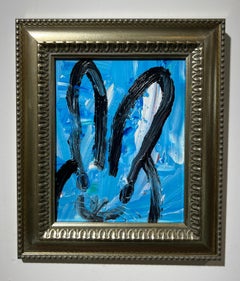
Hunt Slonem "Cloud 9" White and Blue Mottled Bunny

Hunt Slonem "Cloud 9" White and Blue Mottled Bunny

By Hunt Slonem

Located in Houston, TX

Hunt Slonem "Cloud 9" White and Blue Mottled Bunny A single rabbit gestured in black on a mottled white and blue background in a vintage frame Unframed: 10 x 8 inches Framed: 14.5 x...

Category

21st Century and Contemporary Neo-Expressionist Charles Philips Art

Materials

Oil, Panel

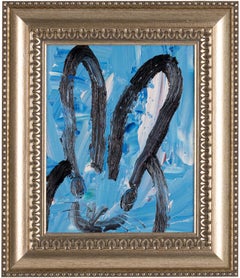
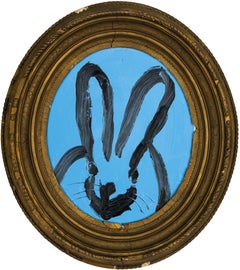
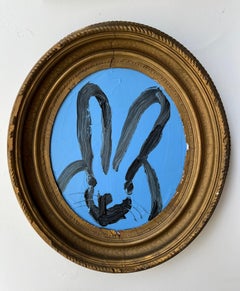
Hunt Slonem "Sky Light" Blue Oval Bunny

Hunt Slonem "Sky Light" Blue Oval Bunny

By Hunt Slonem

Located in Houston, TX

Hunt Slonem "Sky Light" Blue Oval Bunny A single rabbit gestured in black on a light blue background in a vintage frame Unframed: 12 x 10 inches Framed: 17.5 x 15.5 inches *Painting...

Category

21st Century and Contemporary Neo-Expressionist Charles Philips Art

Materials

Oil, Panel

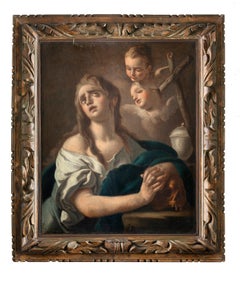
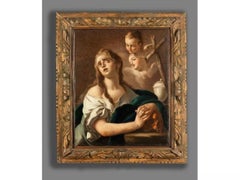
18th Century by Pietro Bardellino Mary Magdalene Painting Oil on Canvas

18th Century by Pietro Bardellino Mary Magdalene Painting Oil on Canvas

By Pietro Bardellino

Located in Milano, Lombardia

Pietro Bardellino (Naples, Italy, 1731 – 1806) Title: Mary Magdalene Medium: Oil on canvas Dimensions: without frame 75 x 60 cm – with frame 97 x 82 cm Antique shaped and carved wood...

Category

Mid-18th Century Old Masters Charles Philips Art

Materials

Canvas, Oil

17th Century by Giovanni Battista Beinaschi Saint Bartholomew Oil on Canvas

17th Century by Giovanni Battista Beinaschi Saint Bartholomew Oil on Canvas

By Giovanni Battista Beinaschi

Located in Milano, Lombardia

Giovanni Battista Beinaschi (Fossano, Italy, 1636 - Naples, Italy, 1688) Title: Saint Bartholomew Medium: Oil on canvas Dimensions: without frame 9...

Category

Mid-17th Century Old Masters Charles Philips Art

Materials

Oil, Canvas

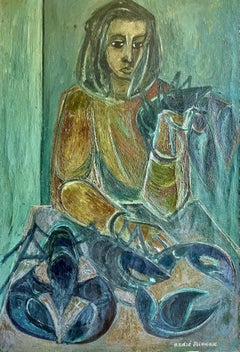
"Femme et Homards" (Woman with Lobsters), 1948 -André Minaux (French, 1923-1986)

"Femme et Homards" (Woman with Lobsters), 1948 -André Minaux (French, 1923-1986)

By Andre Minaux

Located in Berlin, MD

Behold a mid-century marvel by André Minaux, a titan of the French School whose stylized Social Realist visions continue to captivate the art world. Painted in 1948, “Femme et Homard...

Category

Mid-20th Century French School Charles Philips Art

Materials

Cotton Canvas, Oil

Previously Available Items
2nd Marquess of Bath

2nd Marquess of Bath

By Charles Philips

Located in London, GB

Charles Philips 1708 - 1747 Oil on Canvas 27 x 25.75 inches framed 21 x 22 ½ inches, 53.5 x 57 cm Provenance: B. Thynne Esq., Westlands, West Grinste...

Category

18th Century Old Masters Charles Philips Art

Materials

Oil

Charles Philips art for sale on 1stDibs.

Find a wide variety of authentic Charles Philips art available for sale on 1stDibs. You can also browse by medium to find art by Charles Philips in canvas, fabric, oil paint and more. Not every interior allows for large Charles Philips art, so small editions measuring 28 inches across are available. Customers who are interested in this artist might also find the work of Neysa McMein, Stephen Scott Young, and Spencer Douglass Crockwell. Charles Philips art prices can differ depending upon medium, time period and other attributes. On 1stDibs, the price for these items starts at $46,012 and tops out at $46,012, while the average work can sell for $46,012.

Artists Similar to Charles Philips