Doulton Stoneware Jar and Cover in Form of an Owl, Marked for Mark V. Marshall
By Doulton Lambeth
Located in Downingtown, PA
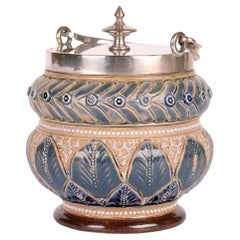
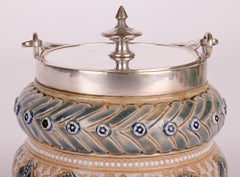
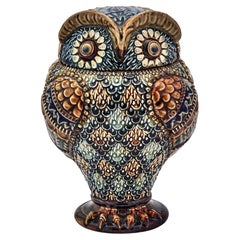
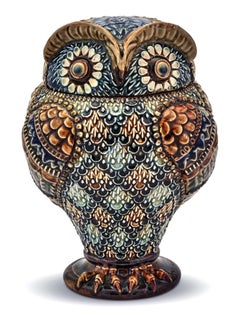
Doulton stoneware jar and cover in form of an owl,
Marked for Mark V. Marshall,
Dated 1883.
A striking tobacco jar and cover in the form of an owl with diamond pattern designs acoss the body and eyes like daisy's.
Dimensions: 7 1/2 inches high (19.05cm) high
See Wiener Museum of Decorative Arts, "What a Hoot Newsletter, July 16,2022By Louise Irvine, "A Parliament of Owls
In Victorian times, owls were popular as functional items for gentlemen’s studies, including tobacco jars, match holders, jugs and lamps. Doulton artist, Mark V. Marshall, created stylized stoneware jars with swivel heads referencing the owl’s uncanny ability to rotate its head to 270 degrees left or right. Marshall worked originally with the Martin Brothers who made several owl jars as part of their range of anthropomorphic birds. Robert Wallace Martin’s character birds with removable heads in turn inspired British studio potters, Andrew Hull and David Burnham Smith."
Mark V. Marshall (1842-1913)
Mark V. Marshall: Defining the Original
......Marshall, like George Tinworth, trained at the Lambeth School of Art. From there, he went on to work at a local stonemasons yard. Here, he carved decorations for neo-gothic churches.
For a brief period, he worked for the Martin Brothers, art potters whose London workshop represented the changes from Victorian to more modern ceramics. They specialized in eccentric designs and were known for their famous birds. These early experiences shaped Marshall’s taste for weird and wonderful Doulton designs, like his reptiles and dragons which circle his vases, and the grotesque masks which embellish his jugs.
It was during this period that his unique style of fantastic animals, sometimes half hidden in foliage, established a pattern of decorative art for him. Indeed, many of his pieces bring to mind the medieval cathedral builders and their stone and wooden carvings of imaginary animals and caricatures of people. His work includes one example where a strange dragon-like creature climbs around the vase with its young ones hiding in the foliage.
Doulton
Marshall joined Doulton in 1874, and he brought his very personal style with him. His early vases (and there are many of them) tend to have fanciful animals sculpted in high relief perhaps hiding amongst the leaves. But he was influenced by the recent discoveries made at the time – eg by Charles Darwin, who had published his “Origin of the Species” in 1859. He, too, was fascinated by the relationship between animals and humans. He produced items showing animals dressed as humans, such as the two fully-dressed rabbits facing opposite ways on opposite sides of a container in his “The Waning of the Honeymoon”.
He also drew on literature, notably Edward Lear and Lewis Carroll. He produced stoneware pieces inspired by Tenniel’s illustration for Alice’s Adventures in Wonderland and Through the Looking Glass...
Category
1880s English Arts and Crafts Antique Doulton Lambeth Ceramics
MaterialsPottery, Stoneware