Edward H. Bohlin More Art

American, 1895-1980

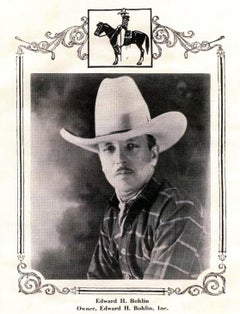
Edward Bohlin was born in 1895 in Sweden.He ran away from home at age 15, working his way to America on a huge four-mast schooner with dreams of Buffalo Bill Cody's Wild West in his head. Bohlin worked cattle drives around Montana before opening his first saddle shop in Cody in Wyoming, where he did rope tricks in front of his shop to draw business. He met Tom Mix while performing at the Pantages Theatre in Hollywood and Mix convinced Ed to stay and produce silver and leather items in the Los Angeles area. From his humble beginnings to his fame in Hollywood for high-end pieces, he crafted more than 12,000 Bohlin saddles, including many grand silver outfits of Tournament of Roses Parade fame. He also dressed many silver screen heroes and horses with his grand style of buckles, spurs and gun belts. His company was without equal among western style silversmiths building a reputation on flawless workmanship. The Edward H Bohlin company, which operated from the early 1920s through the 1980s (under Ed's watchful eye but continues to operate under other ownership), reached its apex in the 1930s, when the Hollywood cowboys reigned supreme. Bohlin was a stickler for details and employed the finest silver and leather workers of his era to satisfy discriminating clients, including Mae West, Hopalong Cassidy, Monte Hale, Lyndon Johnson and Ronald Reagan. Bohlin Saddles Roy Roger's Diamond Special Bohlin Saddle Ed Bohlin was known for his beautifully crafted parade saddles.

A perfectionist for good and bad, he never accepted anything less than the best craftsmanship. The leather on his saddles still squeaks after 60 years. The silver requires only a cloth to clean because he used the highest grade of sterling. He and his artisans made many of the pieces by hand, especially the gold figures on his saddles. His carving was stunning and recognizable. Many of High Noon's customers remember going into Bohlin's shop as children while their fathers purchased saddles, buckles, belts, bolos and money clips. Some time the kids got a special gift, too, from their dads. A few child's saddles (The Jackie Cooper model) were made to match their fathers' for parades. The Tim McCoy model and others were made for the stars of the era. Fiesta was truly a work of art, both in the silver and the pictorial carving. The Murietta was one of his brilliant models, mounted with Indian and Tepee design with distant hills all done in three shades of gold. The Dicksons were used many times for riders who wanted to twinkle with silver in parades.

Bohlin saddles have always been valued higher than any other maker and have kept their value throughout the years. Both riders and collectors of Western Americana still clamor for Bohlin, whether they plan to ride using them or only to display them proudly in their offices or living rooms as art. Bohlin Buckles Edward H. Bohlin's filigree gold buckle Ed wanted the riders of his saddles to look elegant and match the beauty and artistry of the outfit. He made fine matching vests, chaps, belts, gunbelts, bolos, hat bands and buckles to dress his riders. The most personal of Bohlin's buckles were made, some by his hand. He made buckles to honor horses, longhorns, rodeos, ranches and women. He used sterling silver, gold (in 3 colors) rubies and diamonds. He cut the metals to form lacy overlays and bound the edges to look like rope. Matching gun belts were made of the same fine leather of the saddles with the same elegant silver spots and engraving. Special gun grips were fastened to Colts and other pistols and shotguns, all sterling silver and gold with matching buckles. Bohlin spurs are also highly coveted.

Bohin made magic with plain Crockett blanks, when he covered them with fine silver and gold, making leather straps and conchos to match. The same for bits, which were highly sought after and matched the headstalls and breast collars of the parade outfits. Bohlin also had a sense of humor and would make anything the clients wanted. Mae West was a favorite and he fashioned a sterling silver telephone for her use. He made silver picture frames, pins, conchos, bolos, satchels and desk sets. Bohlin loved his customers and they loved him. Memories of Bohlin in his shop are still vivid whenever you slip that leather belt around your waist and cinch it up with that Bohlin buckle.

to
1
Overall Width
to
Overall Height
to
1
1
1
1
1
1
1
293
225
125
117
1
Artist: Edward H. Bohlin
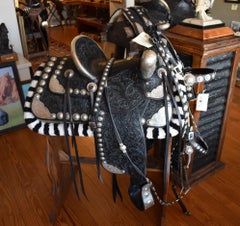
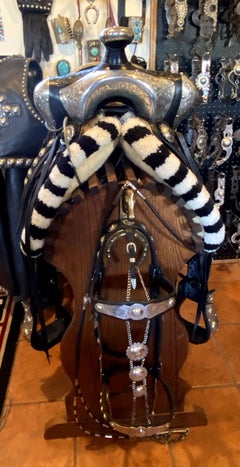
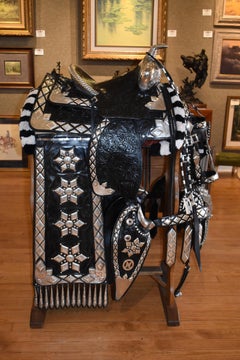
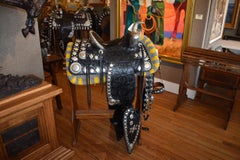
EDWARD BOHLIN 1920s-1930s SILVER ART PARADE SADDLE HOLLYWOOD WESTERN ARTIST VAIL

EDWARD BOHLIN 1920s-1930s SILVER ART PARADE SADDLE HOLLYWOOD WESTERN ARTIST VAIL

By Edward H. Bohlin

Located in San Antonio, TX

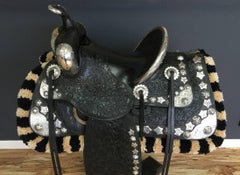
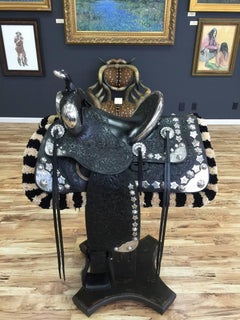
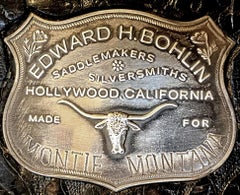
Circa Late 1920s - Early 1930s. It is all Bohlin made and marked to include the saddle, the headstall and the breast collar. All made in Hollywood California. The only non-Bohlin item is the bit which appears to also be early California. There is some interesting provenance of the fine saddle. It was commissioned by Charles R. Bell, married to Margaret Vail Bell who was the daughter of Walter Vail. On the Bolin nameplate it has engraved, Vail Ranch as well as made for Charles Bell. Charles Bell Died in 1939. The Vail Ranch has some great Western History which I will go into a little detail. You see, not only am I selling Saddles, but I’m also selling History. If you want to skip the history lesson you can just scroll down past the following info to images of the saddle. It’s no secret that ranching runs in the family blood. There is no greater example of that than California Rangeland Trust CEO Nita Vail. On April 14, 2018 Nita had the opportunity to witness her great-grandfather Walter L. Vail’s induction into the Hall of Great Westerners at the National Cowboy & Western Heritage Museum. This high honor is bestowed by the Museum to “exceptional individuals who have made an indelible impact upon the history of the great West.” A pivotal figure in early California and Arizona ranching, Walter Vail joins just over only 200 individuals who have been inducted into this esteemed hall. The Vail legacy of advocacy and ranching lives on strongly through his descendants, including Nita. All these years later, Nita carries the mantle of advocacy for ranchers in her own work at the California Rangeland Trust. Reflecting on her great-grandfather’s induction ceremony in Oklahoma, Nita says, “Witnessing my great-grandfather’s induction with family and friends was an incredible experience and a reminder of why I do what I do. Ranching plays an integral role in the culture, economy, and quality of life in California. Generations later, I get to honor Walter L. Vail’s legacy in my work with the California Rangeland Trust every day, preserving those open spaces for new generations and partnering with ranchers to continue to sustain life on the range in California.” Walter Vail History A native of Liverpool, Nova Scotia, Walter Vail purchased the 160-acre Empire Ranch southeast of Tucson, Arizona in 1876, along with an Englishman named Herbert Hislop. In 1882, the Empire Land & Cattle Company was formed with Walter L. Vail as principal shareholder. Over the years Vail, along with various partners, expanded the original land holdings to include over one million acres. The year after Walter purchased the Empire Ranch, the Southern Pacific Railroad built a railroad line, which was great news for the Vail family as it provided a means for them to ship their cattle. Edward L. Vail, George Scholefield and Bird at the mouth of Rosemont Canyon ca. 1896-1898 Standing Up for Ranchers In the fall of 1889, the Southern Pacific Railroad announced they would raise cattle freight rates by 25 percent. They ignored loud protests from ranchers who had already been hit hard by depressed cattle prices. In response, the Vails made a plan to drive the cattle overland themselves without the railroad. They knew that, if they were successful, they could break the railroad’s monopoly on the ranchers and force prices down. Walter’s brother Edward Vail and foreman Tom Turner volunteered to drive the almost 1,000 steers on the 300-mile trip to the Warner Ranch in San Diego. The journey ahead would be grueling. Most of their trip was through desert with water sources 15 to 30 miles apart. The ranchers would face a slew of obstacles—a stampede, a chaotic Colorado River crossing, an encounter with a group of horse thieves. In spite of all the dangers and challenges, they reached their destination. Just 71 days after leaving Arizona, the Empire cowboys arrived at the Warner Ranch. They had only lost 30 steers. The historic Empire Ranch Trail Drive of 1890 inspired other Arizona ranchers to make similar drives as a stand against the railroad. That fall, a group of Arizona cattlemen met and agreed to fund improvements to establish a safe cattle trail from Tucson to California. In response to the united stand of the ranchers, sparked by the Vails, the railroad finally agreed to restore the old freight rate—on the condition that the cattlemen would make no more cattle drives. Walter Vail led by example, but he was also an active representative of ranching interests in the legislature. He served in the 10th Arizona Territorial Legislature in 1878 and in 1884 on the Pima County Board of Supervisors. He introduced two significant bills: One proposing the creation of Apache County in the northeastern corner or Arizona Territory, and the other calling for the repeal and replacement of a Pima County fencing ordinance. Elected to the Arizona Stock Growers Association in 1884, Walter L. Vail advocated for levying fines on outfits that brought diseased cattle into the Territory, proposed a system of recording brands and earmarks, and requested the establishment of the livestock sanitary commission to oversee quarantines on infectious diseases, and tighter trespass laws. Moving to California In the late 1880s when a long drought hit Arizona, the Vails began leasing California pastures and shipping increased numbers of their cattle there to fatten. This marked the beginning of Walter’s efforts to purchase land in Temecula Valley. Vaqueros (Mexican cowboys) at the Empire Ranch in Arizona In 1890, with growing corporate holdings in California, Walter Vail established his headquarters in downtown Los Angeles and moved his family there. By this time, he had pieced together four Mexican land grants—Pauba Rancho, Santa Rosa Rancho, Temecula Rancho and Little Temecula Rancho—to form the Pauba Ranch. Eventually, the Vails would own more than 87,500 acres surrounding the little town of Temecula. In 1892 they leased Catalina Island and in 1901-1902 in partnership with J. V. Vickers, they purchased most of the interests in Santa Rosa from the estate of A.P. More. In March of 1894, Vail and Gates joined Vickers in setting up a third cattle company, the Panhandle Pasture Company, with the hopes of expanding new markets in the east. The Panhandle Pasture Company bought seven thousand acres of grassland in Sherman County, Texas, and an equal amount across the line in Beaver County, Indian Territory (later Oklahoma). Walter Vail was tragically killed in a Los Angeles streetcar accident in 1906. After his death, the Empire Land & Cattle Company (later renamed the Vail Company) assumed control of all his ranches and other real estate holdings. Walter had five sons and they would all have a hand in running the various ranches and the Vail Company as whole throughout their lives. The Empire Ranch in Arizona was sold in 1928. The Temecula area ranches continued to operate until it was sold in 1965. Santa Rosa Island, the last of Walter Vail’s holdings, was sold to the National Park Service in 1986, and ranching operations shut down there in 1998. Walter Lennox Vail (May 13, 1852 - December 2, 1906) was an American businessman, cattle dealer, and politician. He is known for his Empire Land & Cattle Company (later the Vail Company), which spanned over one million acres throughout five states.[1] Vail has been called "a pivotal figure in early California and Arizona ranching." Early life Vail was born in Liverpool, Nova Scotia on May 13, 1852, to Mahlon Vail, Sr. and Eliza Vail. Career Empire Ranch The headquarters of the Empire Ranch in the modern day Vail left his family's Plainfield, New Jersey house in the middle of 1875 to pursue riches in the West. He worked for a few months in Virginia City, Nevada as a mine's timekeeper, but in November he wrote of his intention to get involved in Arizona's sheep business. He, along with an Englishman named Herbert R. Hislop, then purchased the Empire Ranch along with its 612 cattle on August 22, 1876. The purchase from Edward Nye Fish and Simon Silverberg cost $1,174 at the time and was only 0.25 square miles (0.65 km2). Vail had met Hislop for the first time in August of that year, at the Lick House in San Francisco. Vail also became the main shareholder of the Empire Land & Cattle Company, which was formed in 1882. Politics Vail additionally served in the House of Representatives on the 10th Arizona Territorial Legislature for two years, starting in 1879. He was one of five representatives from Pima County. There, he proposed the creation of Apache County in the northeast. In 1884, Vail was elected to the Arizona Stock Growers Association, where he introduced many laws relating to cattle farming. California Vail moved his main operations to California in the late 1880s due to a long drought in Arizona. He started leasing Californian land mainly in Temecula Valley, but established his headquarters in downtown Los Angeles. By this time, he had already bought four ranches: the northern half of Rancho Little Temecula, Rancho Pauba, Rancho Santa Rosa, and Rancho Temecula. Later, Vail would own over 135 square miles (350 km2) surrounding the city of Temecula. He also leased Santa Catalina Island and Purchased Santa Rosa Island in 1892 and 1901, respectively. Vail, along with Carroll W. Gates and J.V. Vickers, set up the Panhandle Pasture Company, which bought about 22 square miles (57 km2) in Sherman County, Texas and Beaver County, Oklahoma. Personal life Vail married Margaret "Maggie"[a] Newhall in 1881, with them having five children: Nathan Russel, Mahlon, Mary, Walter Lennox Jr., and William Banning (who used his middle name) together. In 1890, a Gila monster bit Vail on his middle finger, and for years thereafter he experienced bleeding and swelling in his throat, which was thought to be caused by the venom from the bite. Death Vail died at 54 on December 2, 1906, due to complications from a tram (Trolley Car) accident in Los Angeles. He was cremated, then buried at the Hollywood Forever Cemetery on December 6. Legacy Vail's sons took over the company after his death, renaming it to the Vail Company. The Empire Ranch was sold in 1928, and the Temecula ranches were bought by a syndicate of companies, including Kaiser Aluminum, Kaiser Industries, and Macco Realties in 1965. Santa Rosa Island was acquired by the National Park Service in 1986, and ranching ceased in 1998. Vail was inducted into the Hall of Great Westerners at the National Cowboy & Western Heritage Museum in 2018.[2] Various properties have been named after the Vail family including: Vail Headquarters, an outdoor shopping mall, Vail Lake, and Vail, Arizona. In 1867, German immigrant, Louis Wolf, and his Chumash wife, Ramona, built a small adobe trading post next to Temecula Creek. Their Wolf Store helped launch the Temecula community, serving as a saloon, livery stable, legal services, hotel, general store, stagecoach stop, post office, school and employment agency. After Louis and Ramona’s deaths, their land and other Ranchos were purchased by Arizona cattle baron Walter Vail. By 1905, the 87,000-acre Vail Ranch became one of the largest cattle operations in California, stretching from Camp Pendleton to Vail Lake to Murrieta. It operated through the late 1970’s when it was sold to build Temecula’s housing. Some of the ranch’s oldest buildings survived in a cluster around the long-vacant Wolf Store. Together they would wait more than 40 years to be restored and once again become a center for community life in the Temecula Valley. ​ In 1905 after his death, Wolf’s Temecula was purchased by Arizona cattle baron Walter Vail, along with three other Ranchos totaling 87,500 acres. The sprawling Vail Ranch spread from South of Highway 79 to South of Clinton Keith Road, East to Vail Lake Resort and West to Camp Pendleton and continued operations through the late 1970’s when it was sold for housing subdivisions. The remaining buildings that comprised the Vail Ranch Headquarters, several having been demolished, have sat mostly vacant since then awaiting their restoration and re-use. John N. Harvey, Edward L. Vail, Walter L. Vail, 1879 Ned Joins the Partnership - May 1879 In May of 1879 Walter’s older brother, Edward Lang Vail, known as Ned, joined the Empire Ranch partnership. He had no ranching experience but quickly learned. The Empire Ranch herds were finally sufficiently developed for sale, and the Empire Ranch found a ready market in the town of Tombstone and its nearby mines. Walter finally had sufficient funds to begin to pay off some of the loans from his Uncle Nathan and Aunt Anna. North end of the original four rooms of the Empire Ranch House. Empire Ranch Census Records - 1880 The 1880 U.S. Census documents that eight men were living full time at the Empire: the partners, Walter Vail, John Harvey and Ned Vail; John Randolph Vail, Uncle Nathan and Aunt Anna’s son; John Milton Requa, nephew of Isaac Requa who hired Walter in Virginia City; John Dillon, who was instrumental in locating the Total Wreck Mine; Tomás Lopez, a herder; and Mon Ta, the cook. Section of Official Map of Pima County by Roskruge 1893. The Southern Pacific Railroad Arrives in Pantano - April 1880 In 1880 the Southern Pacific Railroad finally reached Tucson and by April it was extended to Pantano, north of the Empire Ranch. The availability of rail transportation was a major boom to the Empire Ranch as it was now possible to sell cattle and beef to markets beyond Southern Arizona. The railroad also increased the availability of goods in Tucson and allowed for much quicker and safer transportation to California and the East. Empire Ranch land acquisitions are highlighted in red. Courtesy of Dave Tuggle Land Holdings Expand-1881-1882 Starting in 1881 the land holdings of the Empire Ranch expanded considerably. They acquired Charles and Agnes Paige’s Happy Valley Ranch near the Rincon Mountains in 1881. 1882 saw the addition of Don Alonzo Sanford’s Stock Valley Ranch totaling over twenty-eight square miles of grassland between the Whetstone and Empire Mountains. Charles Bell Bohlin Saddle. All of the leather has been professionally cleaned and conditioned. All of the sterling has been professionally polished as are all of my saddles. THE BOHLIN BRAND IS AS ICONIC AS THE FAMED WESTERN STARS that wore it. The late actor Richard Farnsworth sported a recognizable gold steer-head Bohlin buckle...

Category

1930s Realist Edward H. Bohlin More Art
Materials

Silver

Related Items
Else FÜRST (1873-1943), Fasane Foundry stamp of the Berlin foundry Kraas

Else FÜRST (1873-1943), Fasane Foundry stamp of the Berlin foundry Kraas

Located in Berlin, DE

Else Fürst was a German sculptor and medalist who was murdered by the Nazis. Biographical data: Bronze signed Foundry stamp of the Berlin foundry Kraas. 25 x 73 cm Born: June 25,...

Category

1930s Realist Edward H. Bohlin More Art
Materials

Bronze

Die Trinkende Bronze Sculpture, Realist Style, Circa 1900, Unframed

Die Trinkende Bronze Sculpture, Realist Style, Circa 1900, Unframed

By Victor Heinrich Seifert

Located in New York, NY

Victor Heinrich Seifert (1870 – 1953) Die Trinkende, c. 1900, cast 1906 H 26.25 in. x W 8 in. x D 11.38 inch Bronze with brown patina Original stone pedestal with 1906 inscribed on ...

Category

Early 1900s Realist Edward H. Bohlin More Art

Materials

Bronze

Glove. Sculpture by Sergey Oganov. 2012. Bronze

Glove. Sculpture by Sergey Oganov. 2012. Bronze

Located in Riga, LV

Sergey Oganov was born in 1974 in the family of the famous Belarusian sculptor Lev Oganov. Sergey began his first steps in the world of art while still being a schoolboy, helping hi...

Category

2010s Realist Edward H. Bohlin More Art

Materials

Granite, Bronze

The Blacksmith of Solingen / - The Double-edged Sword -

The Blacksmith of Solingen / - The Double-edged Sword -

Located in Berlin, DE

Wilhelm Albermann (1835 Werden an der Ruhr - 1913 Cologne), The Blacksmith of Solingen, after 1895. Bronze-color patinated zinc cast on plinth, 47 cm (height) x 20 cm (width) x 16 cm (depth), weight 5.5 kg. Signed “Albermann.” on the plinth and identified as a cast by “AKT.[TIEN] GES.[ELLSCHAFT] GLADENBECK BERLIN”. Dedication on the front: “Mr. Ing. F. Kuhlmann to the wedding. Management and officials of the Hannoversche Waggonfabrik. Aircraft construction department". - The zinc showing through in spots, the patina somewhat stained, the right upper arm under the sleeve retouched in black. - The Double-edged Sword - The figure is a reduction of Wilhelm Albermann's 1895 fountain figure of the armourer of Solingen, who has always been identified with the historical blacksmith Peter Hahn. In 1839, Karl Simrock wrote the poem “The Blacksmith of Solingen" and thus coined the legendary figure. The first and penultimate verses read: A blacksmith spoke to Solingen With every bayonet, That came to his diligence: "Oh, that Fritz had it!" The war took its course, Many battles were fought, Which often made him fearful and anxious In his soul. The blacksmith had given up his trade to fight for Frederick the Great. Not least because of his strength and will to fight, the battles were won. With his fountain sculpture, Albermann has given the legendary blacksmith a figurative form and at the same time created a landmark for the city of Solingen, which was once famous for the art of sword forging and today still stands for the production of high-quality knives. During the bombing raid in November 1944, the fountain was destroyed along with the entire old town of Solingen. Only the head remained. The broad-shouldered blacksmith stands securely behind his anvil, his leather apron tied around him, and has just finished a sword blade with his own "weapon" - the blacksmith's hammer. His entire body shows the strength with which he wields the hammer, but also the strain of this activity, as evidenced by the wide open shirt, the somewhat 'untidy' apron, and especially the furrowed face. However, the blacksmith does not look at the finished work, but resolutely and at the same time thoughtfully into the distance, in line with the quoted verse from Simrock's poem that the battles "often made him fearful and anxious in his soul". There is certainly something melancholy in his gaze, fed by the knowledge of the necessity of forging swords and taking up arms and their deadly use - experiences Albermann had to make during his own war missions. The flowing full beard gives his gaze into the distance an almost prophetic character. In keeping with the craft of the perfectly formed art of blacksmithing, the detailed casting reproduces the respective materials depicted in perfect form: the leather apron convincingly conveys the impression of leather and lies - also in the back view - like a second formed layer over the body, while the shirt and trousers illustrate their own textile qualities. Due to its masterful execution and profound content, the “Blacksmith of Solingen”, which has survived in its cast reproductions, remains Albermann's most famous work to this day. About the artist The son of a carpenter, Wilhelm Albermann began an apprenticeship as a joiner, but then followed his artistic calling and trained as a sculptor in Elberfeld. In 1855, at the age of twenty, he was drafted into the army in Berlin, where he served until 1857. Albermann attended the Berlin Art Academy on the side and began regular studies after his service. While still a student, he completed commissioned works for his teachers August Fischer and Hugo Hagen. His first independent commissions followed, enabling him to establish a flourishing sculpture studio in Cologne in 1865. His artistic activities were repeatedly interrupted by military service, and he took part in the German-Danish War in 1864, the war against Austria in 1866, and the Franco-Prussian War in 1870/71. After his last war service, Albermann, already a respected artist, founded a commercial drawing school at the request of the city government, where he taught the modeling class and served as director until 1896. In 1890 he also worked for the "Society for the Promotion of Sculpture in the Rhineland and Westphalia". Albermann was one of the most prolific sculptors in Cologne in the second half of the 19th century. He created numerous monuments, fountains, tomb sculptures, architectural ornaments, and domestic statues. At its peak, his workshop employed up to thirty sculptors and stonemasons at a time. GERMAN VERSION Wilhelm Albermann (1835 Werden an der Ruhr - 1913 Köln), Der Schmied von Solingen, nach 1895. Bronzefarben patinierter Zinkguss auf gegossener Plinthe, 47 cm (Höhe) x 20 cm (Breite) x 16 cm (Tiefe), Gewicht 5,5 kg. Auf der Plinthe mit „Albermann.“ signiert und als Guss der „AKT.[TIEN] GES.[ELLSCHAFT] GLADENBECK BERLIN“ ausgewiesen. Schauseitige Widmung: „Herrn Ing. F. Kuhlmann zur Vermählung. Direktion und Beamte der Hannoverschen Waggonfabrik. Abt. Flugzeugbau“. - Punktuelles Durchscheinen des Zinks, Patina etwas fleckig, der rechte Oberarm unter dem Ärmel schwarz retuschiert. - Die Zweischneidigkeit des Schwertes - Die Figur ist eine Reduktion von Wilhelm Albermanns 1895 geschaffener Brunnenfigur des Waffenschmieds von Solingen, der seit jeher mit dem historischen Schmied Peter Hahn identifiziert wurde. 1839 hatte Karl Simrock das Gedicht „Der Schmied von Solingen“ verfasst und damit die legendäre Figur geprägt. Die erste und die vorletzte Strophe lauten: Zu Solingen sprach ein Schmied Bei jedem Bajonette, Das seinem Fleiß geriet: »Ach, daß der Fritz es hätte!« Der Krieg ging seinen Gang, Man schlug noch viele Schlachten, Die oft ihm angst und bang' In seiner Seele machten. Der Schmied hatte sein Handwerk ruhen lassen, um selbst für Friedrich den Großen zu kämpfen. Nicht zuletzt durch seine Kraft und seinen Kampfeswillen verliefen die Schlachten siegreich. Dem legendären Schmied verlieht Albermann mit seiner Brunnenskulptur eine bildliche Gestalt und schuf damit zugleich ein Wahrzeichen der Stadt Solingen, die einst für die Kunst des Schwerterschmiedens berühmt war und bis heute für die Herstellung qualitätvoller Messer einsteht. Beim Bombenangriff im November 1944 wurde mit der gesamten Solinger Altstadt auch der Brunnen zerstört. Einzig der Kopf blieb erhalten. Mit sicherem Stand und umgebundener Lederschürze steht der breitschultrige Schmied hinter seinem Amboss und hat gerade mit seiner eigenen ‚Waffe‘ – dem Schmiedehammer – eine Schwertklinge fertiggestellt. Seinem gesamten Körper ist die Kraft abzulesen, mit der er den Hammer führt, aber auch die Anstrengung dieser Tätigkeit, wovon das weit geöffnete Hemd, die etwas ‚unordentlich‘ arrangierte Schürze und vor allem das zerfurchte Gesicht zeugen. Der Schmied schaut aber nicht auf das vollendete Werk, sondern entschlossen und zugleich sinnierend in die Ferne, entsprechend der zitierten Zeile von Simrocks Gedicht, dass die Schlachten „oft ihm angst und bang‘ in seiner Seele machten“. Der Blick hat durchaus etwas Melancholisches, dass sich aus dem Wissen um die Notwendigkeit, Schwerter zu schmieden und zu den Waffen zu greifen und deren tödlichem Einsatz speist – Erfahrungen, die Albermann bei seinen eigenen Kriegseinsätze machen musste. Der wallende Vollbart verleiht dem in die Ferne schauenden Blick einen beinahe prophetischen Charakter. Dem Handwerk der formvollendenden Schmiedekunst entsprechend, gibt der detaillierte Guss die jeweils dargestellten Materialien in vollendeter Ausformung wieder: Die Lederschürze vermittelt überzeugend den Eindruck des Leders und liegt – auch in der Rückenansicht – wie eine zweite ausgeformte Schicht über dem Körper, während das Hemd und die Hose...

Category

1890s Realist Edward H. Bohlin More Art

Materials

Metal

The Victorious David / - The melancholy of the radiant hero -

The Victorious David / - The melancholy of the radiant hero -

Located in Berlin, DE

Henri Honoré Plé (1853 Paris - 1922 Paris), The Victorious David, around1890. Red-brown and brown patinated bronze with terrain plinth mounted on a round base. 42 cm (total height) x...

Category

1890s Realist Edward H. Bohlin More Art

Materials

Bronze

Nude model. vintage collectible sculpture, cast bronze, 1987

Nude model. vintage collectible sculpture, cast bronze, 1987

Located in Zofingen, AG

realism, academism manner, vintage collectible sculpture, cast bronze, "I create this sculpture at the very beginning of my career. I sculpted it from a real model. The girl was ver...

Category

1980s Realist Edward H. Bohlin More Art

Materials

Bronze

Aida
Aida

Gaston LerouxAida, 1890

$9,800

H 23 in W 11 in D 10 in

Aida

By Gaston Leroux

Located in New York, NY

GASTON LEROUX "Aida" Modeled scantily clad in a robe and head garment seated on a sculpted head of an Egyptian Pharoah, with a tambourine in her hand, with a green and brown patina, ...

Category

19th Century Realist Edward H. Bohlin More Art

Materials

Bronze

Soaring Eagle / - With eagle eyes -

Soaring Eagle / - With eagle eyes -

$454

H 9.45 in W 11.42 in D 4.73 in

Soaring Eagle / - With eagle eyes -

Located in Berlin, DE

Anonymous, Soaring Eagle, mid-20th century Patinated cast metal mounted on quartz block. 24 cm (total height) x 29 cm (width) x 12 cm (depth). - Patina heavily rubbed in places, screw connections between sculpture and stone...

Category

Mid-20th Century Realist Edward H. Bohlin More Art

Materials

Metal

Crusader with shield and mace / - Ready to strike -

Crusader with shield and mace / - Ready to strike -

Located in Berlin, DE

Josef Moest (1873 Cologne - 1914 Rath), Crusader with shield and mace, around 1910. Bronze on a black marble pedestal (19 cm high). 57.5 cm (total height) x 21 cm (width) x 12 cm (de...

Category

1910s Realist Edward H. Bohlin More Art

Materials

Bronze

"Eve"
"Eve"

Katib Mamedov"Eve", 2011

$25,000

H 64.57 in W 24.41 in D 20.87 in

"Eve"

By Katib Mamedov

Located in Edinburgh, GB

The sculpture "Eve" embodies the image of a primitive woman, a symbol of the beginning of humanity, the harmony of nature and life. Made of bronze, it has classical proportions that ...

Category

21st Century and Contemporary Realist Edward H. Bohlin More Art

Materials

Bronze

'Sitting Ballerina' Cast Bronze Figure on Granite Base

'Sitting Ballerina' Cast Bronze Figure on Granite Base

$500Sale Price|50% Off

H 7.75 in W 7.25 in D 5.5 in

'Sitting Ballerina' Cast Bronze Figure on Granite Base

Located in Toronto, ON

Bronze sculpture of a ballerina taking a rest. Her leotard is patinated to a lovely green shade to contrast with the bronze colour of the rest of her figure. Ballet slippers are visi...

Category

21st Century and Contemporary Realist Edward H. Bohlin More Art

Materials

Granite, Bronze

Previously Available Items
EDWARD BOHLIN 1930S SILVER MOUNTED PARADE SADDLE  HOLLYWOOD WESTERN ARTIST

EDWARD BOHLIN 1930S SILVER MOUNTED PARADE SADDLE HOLLYWOOD WESTERN ARTIST

By Edward H. Bohlin

Located in San Antonio, TX

Edward Bohlin silver mounted parade saddle. 14 inch seat. Black. Great Bohlin Stamp. Cowboy Saddle, Western Saddle. 1930s his most desirable period. Bohlin of Hollywood California. He made all of the saddles and other related western gear for the movies. The Corona is original. The Corona was custom made using the original Corona as the sample to copy. Biography Edward Bohlin (1895-1980) Edward H Bohlin Company Saddlery-Saddle Maker 1895-1980 BP: Sweden LKL: Hollywood, CA. Born in Sweden in 1895, Edward Bohlin ran away from home at age 15, working his way to America on a huge four-mast schooner with dreams of Buffalo Bill Cody's Wild West in his head. Ed worked cattle drives around Montana before opening his first saddle shop in Cody, Wyoming where he did rope tricks in front of his shop to draw business. He met Tom Mix while performing at the Pantages Theatre in Hollywood and Mix convinced Ed to stay and produce silver and leather items in the Los Angeles area. From his humble beginnings to his fame in Hollywood for high-end pieces, Ed crafted more than 12,000 Bohlin saddles including many grand silver outfits of Tournament of Roses Parade fame. He also dressed many silver screen heroes and horses with his grand style of buckles, spurs and gun belts. His company was without equal among western style silversmiths building a reputation on flawless workmanship. The Edward H Bohlin company, which operated from the early 1920s through the 1980s (under Ed's watchful eye but continues to operate under other ownership), reached its apex in the 1930s when the Hollywood cowboys reigned supreme. Bohlin was a stickler for details and employed the finest silver and leather workers of his era to satisfy discriminating clients including Mae West, Hopalong Cassidy, Monte Hale, Lyndon Johnson and Ronald Reagan. Bohlin Saddles Roy Roger's Diamond Special Bohlin Saddle Ed Bohlin was known for his beautifully crafted parade saddles. A perfectionist, for good and bad, he never accepted anything less than the best craftsmanship. The leather on his saddles still squeak after 60 years. The silver requires only a cloth to clean because he used the highest grade of sterling. He and his artisans made many of the pieces by hand, especially the gold figures on his saddles. His carving was stunning and recognizable. Many of High Noon's customers remember going into Bohlin's shop as children while their fathers purchased saddles, buckles, belts, bolos and money clips. Some time the kids got a special gift, too, from their dads. A few child's saddles (The Jackie Cooper model) were made to match their fathers' for parades. The Tim McCoy model and others were made for the stars of the era. Fiesta was truly a work of art, both in the silver and the pictorial carving. The Murietta was one of his brilliant models, mounted with Indian and Tepee design with distant hills all done in three shades of gold. The Dicksons were used many times for riders who wanted to twinkle with silver in parades.Bohlin saddles have always been valued higher than any other maker and have kept their value throughout the years. Both riders and collectors of Western Americana still clamor for Bohlin, whether they plan to ride using them or only to display them proudly in their offices or living rooms as art. Bohlin Buckles...

Category

1930s Realist Edward H. Bohlin More Art

Materials

Silver

Edward H. Bohlin more art for sale on 1stDibs.

Find a wide variety of authentic Edward H. Bohlin more art available for sale on 1stDibs. You can also browse by medium to find art by Edward H. Bohlin in animal skin, leather, metal and more. Not every interior allows for large Edward H. Bohlin more art, so small editions measuring 54 inches across are available. Customers who are interested in this artist might also find the work of Hunt Slonem, John Van Alstine, and Ben Fenske. Edward H. Bohlin more art prices can differ depending upon medium, time period and other attributes. On 1stDibs, the price for these items starts at $18,850 and tops out at $18,850, while the average work can sell for $18,850.