By Eric Edward Esper
Located in Chicago, IL
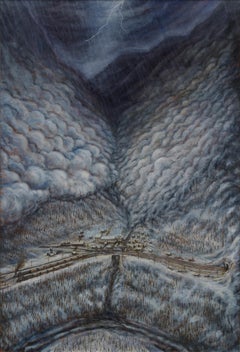
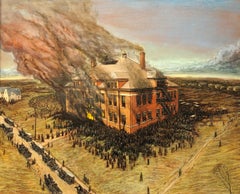
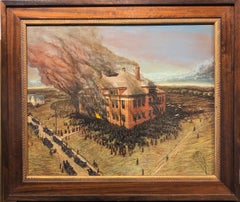
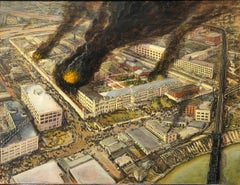
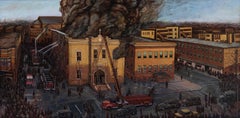
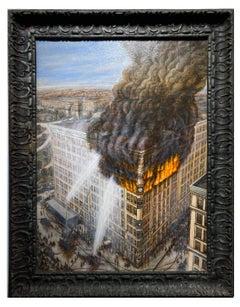
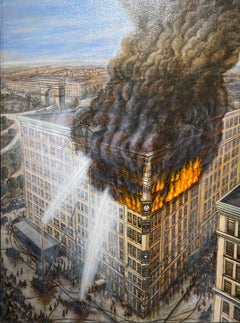
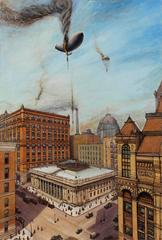
After 100 years of brutal history at the Ohio State Penitentiary, the botched escape attempt of 3 prisoners caused the deaths of 322 men. On April 21, 1930, a crude wick did not start a planned (by the 3 escapees) fire in 2 empty cellblocks under construction until after 5:00 p.m. when all the prisoners were locked in their cells. At 5:53 p.m., all electrical power went out and the phones went dead. By 6:00 p.m., the roof was engulfed in flames that soon spread to the occupied cellblocks where men were burned alive while locked in their cells. The roof then collapsed, crushing the trapped prisoners.
The Ohio militia and guardsmen were called to control the prisoners, but the local fire department was not called until it was too late to control the fire, which blazed until 7:30 p.m. There were many accounts of the heroic efforts of the prison guards, and prisoners alike, who risked their lives attempting to save others. But, unfortunately, in a structure designed to imprison men like this, rescue was difficult.
Eric Edward Esper
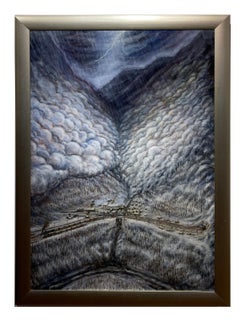
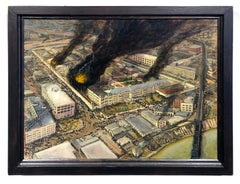
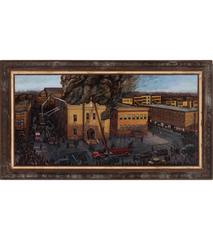
The Ohio State Penitentiary Fire of 1930, 2018
oil on canvas
26h x 34w in
66.04h x 86.36w cm
FRAMED DIMENSIONS
30.50h x 38w in
EEE009
Eric Edward Esper
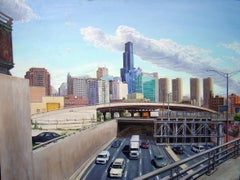
After obtaining my BFA in Illustration from Northern Michigan University in 1996 I relocated to Chicago to pursue my artistic endeavors. Here, I began exclusively oil painting and have assembled a body of paintings chronicling scenes of Chicago done primarily in plein air.
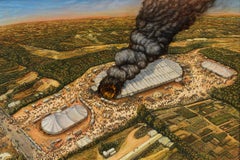
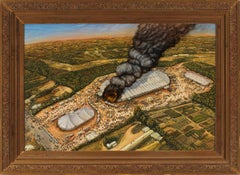
Capturing parts of the city’s landscape during its cultural evolution had been my way of conveying history as a painter. My fascination with landscapes and history has led me to create oil paintings of scenes that have affected us in dramatic ways. Recently I have begun painting aerial views of locations that have interesting historical significance, encapsulating true stories that are hard to imagine and harder to forget. My latest paintings capture these places and depict them with historically accurate attention to detail. Using various sources I recreate these scenes with as many photographs of every angle of the incident and research the stories, submersing myself in the event. My newest body of paintings depicts events with a more historically tragic significance, depicting scenes of the darkest hours in America’s Midwest history, where the landscape became the backdrop for tragedy and calamity. These events that irrevocably altered so many lives are important to remember, not only for the people lost and how it affected our culture, but also to remind us that disaster can occur at any time, anywhere.
Eric Edward Esper
EDUCATION
1995 BFA, Illustration, Northern Michigan University, Marquette, Michigan
SELECT EXHIBITIONS
2013 Chicago Catastrophes, Conflagrations, and Calamities, Solo show, Linda Warren Projects, Chicago, Illinois 2012 Group show, Metropolitan Capital Bank, Chicago, Illinois
2012 Ten year anniversary show, Sulzen Fine Art Studio, Chicago, Illinois
2010 Group show, Concordia University, River forest, Illinois
2009 Holiday Show, Sulzen Fine Art Studio, Chicago, Illinois
2008 Somewhere, Elsewhere, Group show, Linda Warren Gallery, Chicago, Illinois
2008 Scene in Chicago, Group show, Judy Saslow Gallery, Chicago, Illinois
2007 Holiday Show, Sulzen Fine Art Studio, Chicago, Illinois
2007 Cityscapes, Solo Exhibition, Oculus Gallery, Chicago, Illinois
2006 Solo exhibition, Meztli Gallery, Chicago, Illinois
2005 Around the Coyote 2005, Biannual Art Festival, Chicago, Illinois
2004 Chicago Art Open 2004, Chicago Artists' Coalition annual exhibit. Chicago, Illinois
2004 Chicago Images, Group show, Frederick Baker Inc. Chicago, Illinois
2004 Around the Coyote Winter Festival, Curator's Choice Show, Biannual art festival, Chicago, Illinois 2003 Landscape Unlimited, Group show, Fine Arts Building Gallery, Chicago, Illinois
2002 Chicago Art Open 2002, Chicago Artists' Coalition annual exhibit, Chicago, Illinois
1998 Shoe Show, Group show, Ariana Gallery, Royal Oak, Michigan
1998 Art and Design Alumni Exhibit, Lee Hall...
Category
21st Century and Contemporary Contemporary Eric Edward Esper Art