Felician Myrbach Art

1853-1940

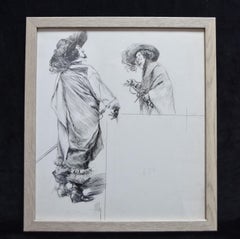
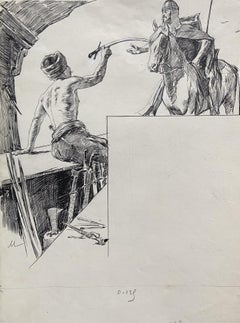
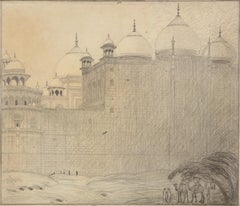
Felician Myrbach was born on February 19th, 1853, in Zalishchyky. He was an Austrian painter, graphic designer and illustrator. He was a founding member of the Vienna Secession and the director of the University of Applied Arts Vienna and was instrumental in the creation of the Wiener Werkstätte. Myrbach's father was Franz Myrbach, the Administrator of Bukovina in 1865–70. His older brother Franz Xaver was an economist and professor at the University of Innsbruck. Myrbach attended the Theresian Military Academy in 1868–71, graduating as a Lieutenant, then at the Academy of Fine Arts, Vienna under August Eisenmenger. In 1875, he joined the 19th Feldjäger Battalion, and in 1877 became an Oberleutnant in the Military Geographic Institute, then, after campaigning in Bosnia in 1878, he taught drawing at the Infantry Cadet School in Vienna. He continued his artistic studies under C R Huber. In 1881, Myrbach went on military leave and moved to Paris, retiring totally from the military in 1884 as a Hauptmann, 2nd Class. He stayed in Paris until 1897, working as an illustrator, including illustrating the works of Alphonse Daudet, Victor Hugo and Jules Verne. Myrbach was a founding member of the Vienna Secession in 1897. In the same year, he became a professor of the Applied Arts School at the Museum of Art and Industry; Arthur von Scala, another reformer Modernist, was made head of the Museum. In 1889, Myrbach became the director of the school. He brought an enthusiastic Modernist attitude and encouraged integration between art, design and production. He added Koloman Moser and Josef Hoffmann to the staff, amongst other Secession artists. This had lead to the foundation of the Wiener Werkstätte in 1903. Myrbach leaned more towards an aesthetic approach than von Scala, but both worked together to bring about their combined vision of successful, popular Austrian applied art. Myrbach was a voice for reform towards Modernist ideals in the School, which was started in 1899 with the support of Alfred Roller, and completed by 1901. The reform of the school has been described as his "lasting merit". Ludwig Hevesi called Myrbach "probably the best (illustrator) in Vienna", partially for his work (with Moser) in the Secession magazine Ver Sacrum. Myrbach visited America on a state-funded study trip in 1904, part of which was to represent the Applied Arts School at the 1904 World's Fair in St Louis; from California, he submitted his resignation to the school due to ill health. He moved abroad in 1905, first returning to Paris and providing illustrations for Hachette, and then from 1914 living in Spain, mainly in Barcelona but also spent time in Bilbao. He returned to Austria in 1936. Myrbach created many scenes of military life, as well as bucolic pictures of farmers, horses and forests; as well, his work showed touches of Orientalism. Until 1898, he employed algraphy in his work; he painted in oil, watercolor and tempera. Myrbach passed away on January 14th, 1940.

to
6
4
4
4
2
2
1
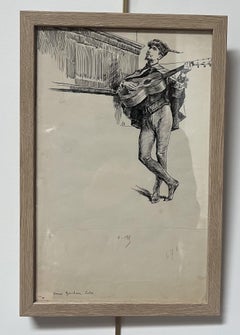
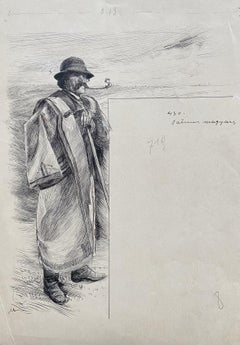
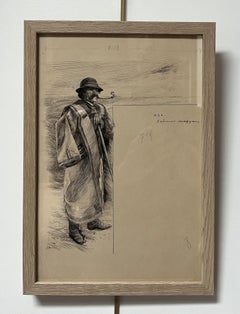
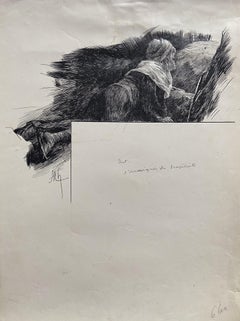
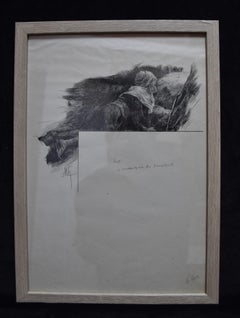
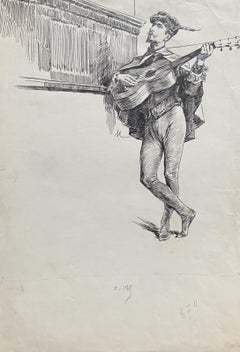
Felician Myrbach (1853-1940) Poèmes magyars original drawing

Felician Myrbach (1853-1940) Poèmes magyars original drawing

By Felician Myrbach

Located in Paris, FR

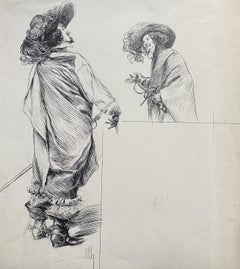
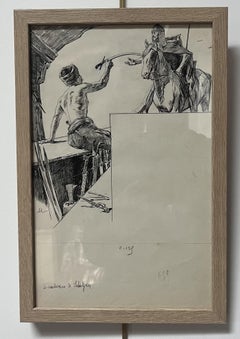
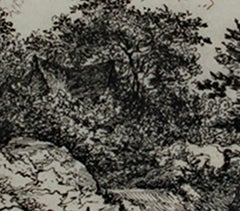
Felician Myrbach (1853-1940) Poèmes magyars, Magyar poems bears the monogram "M" on the lower left, titled in the upper right Ink on paper 29,8 x 19,8 cm in good condition, the sheet is slightly yellowed In a modern frame : 33 x 23 cm This is an illustration project by Felician Myrbach for François Coppée's work, "Poèmes magyars". He leaves the space to be occupied by the text blank on the sheet and arranges his composition accordingly. It is interesting to see the artist imagine his drawing with this constraint. Felician Myrbach (also Felicien de Myrbach, Felician von Myrbach, from 1919 Freiherr von Rheinfeld) was born on 9 February 1853 in Zalishchyky, he died 14 January 1940 in Klagenfurt He was an Austrian painter, graphic designer and illustrator. He was a founding member of the Vienna Secession and the director of the Applied Arts School in Vienna (now the University of Applied Arts Vienna), and was instrumental in the creation of the Wiener Werkstätte. Myrbach's father was Franz Myrbach (1818–1882), the Administrator of Bukovina in 1865–70. His older brother Franz Xaver (1850–1919) was an economist and professor at the University of Innsbruck. He attended the Theresian Military Academy in 1868–71, graduating as a Leutnant, then at the Academy of Fine Arts, Vienna under August Eisenmenger. In 1875, he joined the 19th Feldjäger Battalion, and in 1877 became an Oberleutnant in the Military Geographic Institute, then, after campaigning in Bosnia in 1878, he taught drawing at the Infantry Cadet School in Vienna. He continued his artistic studies under C R Huber. In 1881, he went on military leave and moved to Paris, retiring totally from the military in 1884 as a Hauptmann, 2nd Class. He stayed in Paris until 1897, working as an illustrator, including illustrating the works of Alphonse Daudet, Victor Hugo and Jules Verne. Myrbach was a founding member of the Vienna Secession in 1897. In the same year, he became the a professor of the Applied Arts School at the Museum of Art and Industry; Arthur von Scala, another reformer Modernist, was made head of the Museum. In 1889, Myrbach became the director of the school. He brought an enthusiastic Modernist attitude and encouraged an integration between art, design and production. He added Koloman Moser and Josef Hoffmann to the staff, amongst other Secession artists. This would lead to the foundation of the Wiener Werkstätte in 1903. Myrbach leant more towards an aesthetic approach than von Scala, but both worked together to bring about their combined vision of successful, popular Austrian applied art. Myrbach was a voice for reform towards Modernist ideals in the School, which was started 1899 with the support of Alfred Roller, and completed by 1901.The reform of the school has been described as his "lasting merit". Ludwig Hevesi called Myrbach "probably the best [illustrator] in Vienna", partially for his work (with Moser) in the Secession magazine Ver Sacrum. Myrbach visited America on a state-funded study trip in 1904, part of which was to represent the Applied Arts School at the 1904 World...

Category

Early 1900s Art Nouveau Felician Myrbach Art
Materials

Ink

Related Items
Summer Forest Landscape, 1915 / - The Forest Walk -

Summer Forest Landscape, 1915 / - The Forest Walk -

Located in Berlin, DE

Stanislas Warnie (1879-1958), Summer Forest Landscape, 1915. Watercolor, 31.5 cm x 45 cm (passepartout), 50.5 cm x 63.5 cm (frame), signed "S. Warnie" at lower left and dated "1915"....

Category

1910s Art Nouveau Felician Myrbach Art

Materials

Watercolor

Rhodotorulic Acid. Woodcut in colors. Signed.

Rhodotorulic Acid. Woodcut in colors. Signed.

By Damien Hirst

Located in Paris, FR

HIRST Damien (1965 - ) Rhodotorulic Acid. Woodcut in colors. Signed. Provenance : DTR Modern Gallery, New York. About Damien Hirst (Artist) British artist Damien Hirst is widely considered the enfant terrible of contemporary art. He is the most prominent of the so-called Young British Artists, or YBAs, a group, largely composed of Hirst’s classmates at Goldsmiths, in London, that began exhibiting together in warehouses and factories after 1988 and is known for the use of unconventional materials and “shock tactics.” In the 1990s, Hirst said, “I can’t wait to get into a position to make really bad art and get away with it.” And indeed, he is notorious for piquing critics and baffling the public with such pieces as his signature glass vitrines containing dead sheep or sharks in formaldehyde, and his diamond-encrusted skull, For the Love of God. Working primarily in sculpture, Hirst takes after French modernist master Marcel Duchamp in his use of ready-made objects and materials, which he combines to ironic effect. He often creates in series, as with The Cure (Violet) and The Cure (Turquoise), both from 2014, which are among several pill paintings...

Category

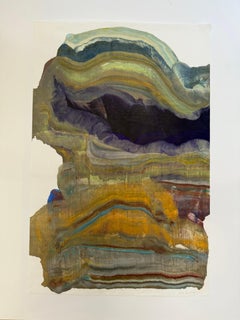
2010s Abstract Felician Myrbach Art

Materials

Paper

The Agam Passover Haggadah - Gold Edition

The Agam Passover Haggadah - Gold Edition

By Yaacov Agam

Located in Jerusalem, IL

A Passover Haggadah, made by the artist Yaacov Agam. 58 original serigraphs, pulled by hand on Rivs 270 Gr. (Arjomarie-Prioux) by Atelier Arcay in Paris, 1985. All color separations ...

Category

1980s Kinetic Felician Myrbach Art

Materials

Paper, Color

Jean Jansem (1920-2013), Les trois masques, 1980, Lithograph on paper

Jean Jansem (1920-2013), Les trois masques, 1980, Lithograph on paper

By Jean Jansem

Located in Les Acacias GE, GE

Jean Jansem (1920-2013), Les trois masques, 1980, Lithographie sur papier Arches justifiée Signée en bas à droite 76 x 55 cm CR Jansem, 1984, n°451 "Dans mes dernières lithograp...

Category

Late 20th Century Expressionist Felician Myrbach Art

Materials

Paper, Lithograph

Bouteilles – lithograph, hand-signed and numbered

Bouteilles – lithograph, hand-signed and numbered

By Le Corbusier

Located in Zurich, CH

Together with "Les Musiciennes" one of the largest and most sought after lithographs by Le Corbusier – a purist still-life –, printed by Mourlot on Arches after a collage by LC. Pr...

Category

Mid-20th Century Modern Felician Myrbach Art

Materials

Paper

untitled
untitled

untitled

By Richard Howard Hunt

Located in New York, NY

untitled 2023 lithograph by Richard Hunt. Published by Procuniar Workshop, this stone lithograph is signed (lower right recto) and numbered (lower l...

Category

2010s Abstract Felician Myrbach Art

Materials

Archival Ink, Archival Paper, Lithograph

Les Musiciennes – lithograph, hand-signed and numbered

Les Musiciennes – lithograph, hand-signed and numbered

By Le Corbusier

Located in Zurich, CH

Together with "Bouteilles" one of the largest and most sought after lithographs by Le Corbusier, printed by Mourlot on Arches after a collage by LC....

Category

Mid-20th Century Modern Felician Myrbach Art

Materials

Paper

General Dynamics, Exploring the Universe, Sub-Atomic Worlds – Original Poster

General Dynamics, Exploring the Universe, Sub-Atomic Worlds – Original Poster

By Erik Nitsche

Located in Zurich, CH

A poster belonging to Erik Nitsche's second series for General Dynamics, promoting its nuclear research. Founded 1952, General Dynamics hired Nitsche as Art Director – a Swiss (1908 – 1998) educated at the Collège Classique in his birth town Lausanne and at the Kunstgewerbeschule in Munich. 1934 he emigrated to the United States and became an incredibly versatile graphic designer whose work became exemplary modernist. General Dynamics for its part focused on – amongst others – aerodynamics, aerospace, electronics and nuclear power. So here the company had a problem: Only a few years after Hiroshima and Nagasaki it wasn’t exactly the simplest thing to explore nuclear energy and not to be suspected of developing weapons of mass destruction. The International Conference on the Peaceful Uses of Atomic Energy 1955 in Geneva was a great opportunity to be seen as a provider of peaceful technology. The guys in charge chose Erik Nitsche to communicate this message. He created four poster series. Atoms for Peace was the first consisting of eleven posters. The second was made for the Conference 1958; these posters are titled Exploring the Universe and represent different aspects of technological research. The third series promoted General Dynamics’ departments. The last series of six smaller posters...

Category

Mid-20th Century Modern Felician Myrbach Art

Materials

Paper

Previously Available Items
Felician Myrbach (1853-1940) Maritime pines, signed Ink drawing

Felician Myrbach (1853-1940) Maritime pines, signed Ink drawing

By Felician Myrbach

Located in Paris, FR

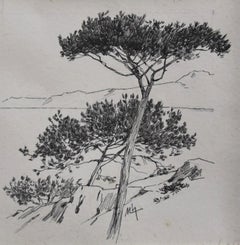
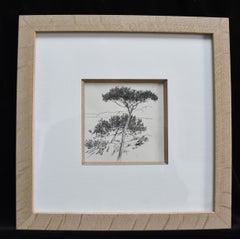
Felician Myrbach (1853-1940) Maritime pines Ink on paper 9 x 9 cm (window) Signed with the monogram lower middle In a modern frame : 24.5 x 24.5 cm in good condition, except a small foxing in the lower part (see photographs please) It's interesting to see the influence of japan art in this composition and how characteristic it is with very few efforts of the Art nouveau and Secession styles. Everything is suggestion, suggestion of the sea and and of a mediterranean landscape, all this with two lines of ink behind the pines.... Felician Myrbach (also Felicien de Myrbach, Felician von Myrbach, from 1919 Freiherr von Rheinfeld) was born on 9 February 1853 in Zalishchyky, he died 14...

Category

Early 1900s Art Nouveau Felician Myrbach Art
Materials

Ink

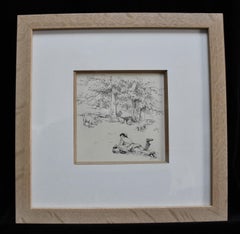
Felician Myrbach (1853-1940) A little sheppard and his pigs, signed Ink drawing

Felician Myrbach (1853-1940) A little sheppard and his pigs, signed Ink drawing

By Felician Myrbach

Located in Paris, FR

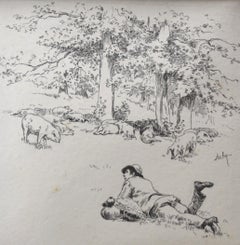
Felician Myrbach (1853-1940) A little sheppard and his pigs Ink on paper 11 x 11 cm (window) Signed with the monogram on the right In a modern frame : 26.5 x 26.5 cm in good condition, except a small foxing in the lower left part (see photographs please) Felician Myrbach (also Felicien de Myrbach, Felician von Myrbach, from 1919 Freiherr von Rheinfeld) was born on 9 February 1853 in Zalishchyky, he died...

Category

Early 1900s Art Nouveau Felician Myrbach Art
Materials

Ink

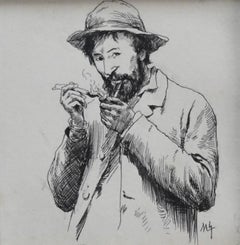
Felician Myrbach (1853-1940) A man lighting his pipe, signed Ink drawing

Felician Myrbach (1853-1940) A man lighting his pipe, signed Ink drawing

By Felician Myrbach

Located in Paris, FR

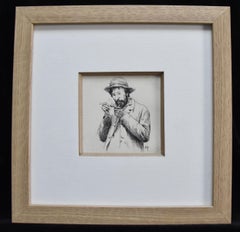
Felician Myrbach (1853-1940) A bearded man lighting his pipe Ink on paper 8 x 8 cm (window) Signed with the monogram lower right In a modern frame : 23.5 x 23.5 cm Felician Myrbach (also Felicien de Myrbach, Felician von Myrbach, from 1919 Freiherr von Rheinfeld) was born on 9 February 1853 in Zalishchyky, he died 14...

Category

Early 1900s Realist Felician Myrbach Art
Materials

Ink

Felician Myrbach (1853-1940) Le Capitaine Scrapouchinat, Ink drawing

Felician Myrbach (1853-1940) Le Capitaine Scrapouchinat, Ink drawing

By Felician Myrbach

Located in Paris, FR

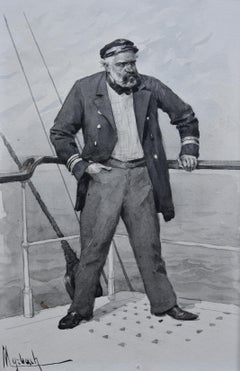
Felician Myrbach (1853-1940) Le Capitaine Scrapouchinat, study for an illustration of Alphonse Daudet's Port Tarascon (1890) Ink and Ink wash on paper 24 x 15.5 cm Signed lower left...

Category

1890s Realist Felician Myrbach Art
Materials

Ink

Felician Myrbach art for sale on 1stDibs.
Find a wide variety of authentic Felician Myrbach art available for sale on 1stDibs. You can also browse by medium to find art by Felician Myrbach in ink, paper and more. Not every interior allows for large Felician Myrbach art, so small editions measuring 8 inches across are available. Customers who are interested in this artist might also find the work of Lucien-Victor Guirand de Scévola, Louis Moe, and Marcel Bloch. Felician Myrbach art prices can differ depending upon medium, time period and other attributes. On 1stDibs, the price for these items starts at $305 and tops out at $890, while the average work can sell for $305.
Artists Similar to Felician Myrbach