Francesco Graziani Art

Italian

Francesco Graziani was best known as "Ciccio Napoletano" and “Napoletan Ciccio” and was always associated with military art.

to
2
2
2
2
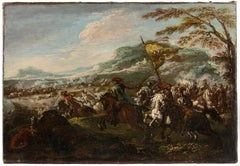
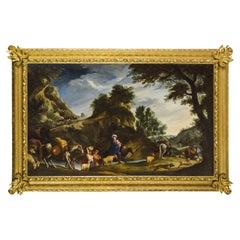
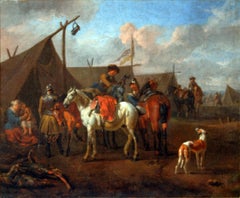
Battle of Cavalries - Oil Paint by F. Graziani (Ciccio Napoletano) - Late 1600

Battle of Cavalries - Oil Paint by F. Graziani (Ciccio Napoletano) - Late 1600

By Francesco Graziani

Located in Roma, IT

Fascinating scene of battle between cavalries with the typical broad and concise brush stroke by Graziani, who is able to create brilliant points of colour. This composition is very ...

Category

Late 17th Century Francesco Graziani Art

Materials

Oil

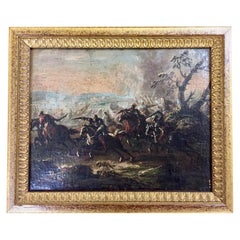
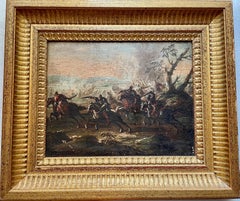
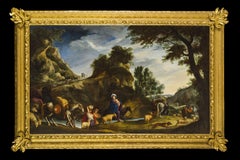
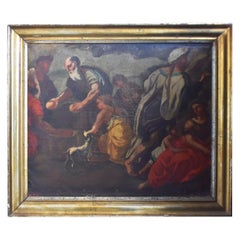
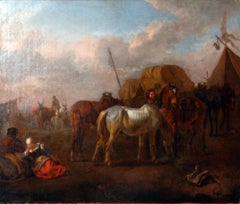
Francesco Graziani, Called Ciccio Napoletano, 17th Century

Francesco Graziani, Called Ciccio Napoletano, 17th Century

By Francesco Graziani

Located in CH

Francesco Graziani, called Ciccio Napoletano Active in Naples and Rome, second half of the 17th century Francesco Graziani, known as Ciccio Napoletano, was an Italian painter activ...

Category

Late 17th Century Italian Baroque Antique Francesco Graziani Art

Materials

Canvas

Related Items
Flemish School 17th Century

Flemish School 17th Century

$5,252

H 33.08 in W 29.14 in D 1.97 in

Flemish School 17th Century

Located in Madrid, ES

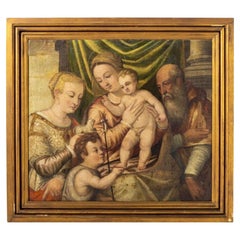
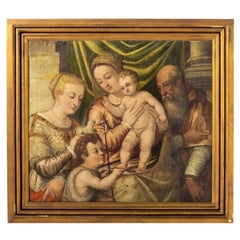
Flemish school 17th century "Our Lady with the Child Jesus, St. John, St. Elizabeth and Zacarias". Oil on canvas Relined. Dimensions: 74 x 84 cm good conditions.

Category

17th Century Dutch Baroque Antique Francesco Graziani Art

Materials

Paint

"Woman Reading in an Interior" Vaclav Vytlacil, Loose Brushwork Portrait

"Woman Reading in an Interior" Vaclav Vytlacil, Loose Brushwork Portrait

By Vaclav Vytlacil

Located in New York, NY

Vaclav Vytlacil Woman Reading in an Interior, circa 1915 Signed lower right Oil on canvas 16 x 20 inches As a child, Vytlacil had taken art classes at the Art Institute of Chicago....

Category

1910s Impressionist Francesco Graziani Art

Materials

Canvas, Oil

"View of Arizona Desert near Wickenberg" Will Foote, Impressionist Western Scene

"View of Arizona Desert near Wickenberg" Will Foote, Impressionist Western Scene

Located in New York, NY

Will Foote View of Arizona Desert near Wickenberg, circa 1927 Signed lower center; titled and dated on the reverse Oil on artist's board 12 x 16 inches Foote was born on June 29, 1874 in Grand Rapids, Michigan, and died on January 27, 1965, in Sarasota, Florida. He was in Old Lyme, 1901-65; and in Cos Cob, 1903. Will Howe Foote was one of the earliest artists at Old Lyme and one who adopted the town as home. He first went there the summer of 1901 with his uncle, William H. Howe, a painter of cattle, who had been told about the beauties of the countryside by Henry Ward Ranger. Foote had himself heard of Old Lyme when he had met Clark Voorhees in France. He and his uncle were both from Grand Rapids, Michigan, where Foote's father was an executive in the furniture industry that made the city famous. Encouraged to be an artist by his father, he began his professional training at the Art Institute of Chicago in 1894. He became friends there with a fellow Michigan student, Frederick Frieseke, who would study with him again at the Art Students League in New York, where Foote worked in 1895-96 under H. Siddons Mowbray and Kenyon Cox. In 1897 he and Frieseke went to the Academic Julian in Paris, where Foote studied under Jean-Paul Laurens and Benjamin Constant. He was at Julian's until 1900, except for an Italian trip, summers at Laren, Holland, or Etaples, France, and a short period at Whistler's school in Paris. He exhibited twice at the Old Salon, and when he returned to the United States in 1900, he had a one-man exhibition in his hometown. Will Howe Foote's paintings were well received on his return from abroad. He exhibited frequently at the National Academy of Design and became an associate member in 1910. His awards included a bronze medal at the St. Louis Exposition in 1904 and a silver medal at the Panama-Pacific Exposition in San Francisco in 1915. Once he visited Old Lyme, Foote returned every summer. In 1902 he was hired as assistant to Frank DuMond at the Lyme Summer School of Art, which was sponsored by the Art Students League of New York. Sometime in 1903 he also taught a session in Cos Cob. After 1906, when the League moved its Lyme classes to Woodstock, New York, Foote continued in Old Lyme as a private instructor. In 1907 he was married to Helen Kirtland Freeman, whom he had met a year or two earlier when she had come to the Lyme art colony as a student of Henry Rankin Poore. Fellow artist William Chadwick was best man at the wedding. The Footes began building a house on Sill Lane in Old Lyme and upon its completion in 1909 spent every spring, summer and fall there, where Foote devoted full time to painting. The Gregory Smiths, old friends from Grand Rapids, arrived in Old Lyme in 1910 and became neighbors. Foote's early works in Connecticut, such as A Summer's Night reflect the artist's interest in soft, atmospheric scenes dominated by a single, overriding tone. The arrival of Childe Hassam and Walter Griffin...

Category

1920s American Impressionist Francesco Graziani Art

Materials

Oil, Board

"Day at the Beach, " Nikol Schattenstein, Sunny Seaside Belgian Figurative Scene

"Day at the Beach, " Nikol Schattenstein, Sunny Seaside Belgian Figurative Scene

By Nikol Schattenstein

Located in New York, NY

Nikol Schattenstein (1877 - 1954) Day at the Beach Oil on canvas 27 3/4 x 33 1/2 inches Signed lower left Provenance: Descended in the family of the artist Estate of Howard Aronso...

Category

Early 20th Century Impressionist Francesco Graziani Art

Materials

Canvas, Oil

"Working Laborers, " Francis Bevilacqua, Soviet Cold War Art

"Working Laborers, " Francis Bevilacqua, Soviet Cold War Art

Located in New York, NY

Francis Bevilacqua (American, b. 1911) Working Laborers, n.d. Oil and pigment on black granite 44 x 21 inches Signed lower right Born in 1911, Francis Bevilacqua was predominantly influenced by the 1930s. The period of the 1930s is epitomized by the conflict between many political ideologies, including Marxist Socialism, Capitalist Democracy, and the Totalitarianism of both Communism and Fascism. In the Soviet Union, Stalin’s government needed urgent funds to implement the rapid industrialization demanded by the first Five Year Plan. It initiated a secret strategy to sell off treasures from the State Hermitage Museum in Leningrad (St. Petersburg), including a primary list of two hundred and fifty irreplaceable paintings by the Old Masters, a number of which ended up in the collection of Andrew Mellon...

Category

Mid-20th Century Realist Francesco Graziani Art

Materials

Granite

17th Century, Italian Painting by Pier Francesco Cittadini, Jacob and his Family

17th Century, Italian Painting by Pier Francesco Cittadini, Jacob and his Family

Located in IT

Pier Francesco Cittadini (Milan, 1616-Bologna, 1681) "Jacob and his family go to Egypt" Oil on canvas, cm 109 x 190 (canvas only) The valuable painting, made in oil on canvas, depicts Jacob and his family go to Egypt and we believe it can be, given the high quality painting, autograph work of Italian Pier Francesco Cittadini (Italy Milan, 1616 - Bologna, 1681) made after 1647. The work, in excellent condition is accompanied by a coeval frame in wood finely carved and golden. The scene depicted, which was confused with the Flight to Egypt in the past years, is instead identified with the biblical episode of Jacob’s journey. In the foreground, reading the painting from left to right, we see a caravan composed of animals, including donkeys, dromedaries, goats, dogs and horses and people, women, men and slaves, who carry on their journey along the banks of a river, following a path that to the right, would seem to lead to the through of a bridge. In addition to the watercourse is described an environment characterized by large rocks and impervious come far to cover the entire verticality of the canvas. On the left, in the distance, we see the tail of the caravan that runs along the steep path. Large trees enliven and harmonize the environment, as well as white and grey clouds characterize the predominantly clear sky and illuminated on the right by sunlight. The story is told in the Bible, Book of Genesis, 30, 25, passage in which is described the flight of Jacob from Haran after the contrasts with Laban, father of his wife Rachel. Jacob is the third great patriarch of the Bible. From his descendants originate the twelve generations of the people of Israel. He is the son of Isaac and Rebekah, who led him to flee from the wrath of Esau to Haran to seek refuge from his brother, Laban. At his uncle’s house Jacob met his daughter Rachel. As soon as he saw his cousin, Jacob was taken. Jacob will stay seven years in the service of Laban to marry his beloved Rachel. But Laban, with a deception, will give him in marriage first Lia, the least beautiful eldest daughter, and only after another seven years the splendid Rachel. From his first wife he will have several children, while Rachel will give birth to the beloved son, Joseph, who will become viceroy of Egypt. After years of service, Jacob asked to be paid with every dark-coloured garment among the sheep and every spotted and dotted garment among the goats. Laban accepted and sent away from his sons all the leaders of that kind. So Jacob took fresh branches of poplar, almond and plane tree, and flayed them, and put them in the troughs. The optical suggestion induced the goats and the sheep to conceive and give birth to dark, striped and dotted garments. He also ensured that all the strongest and healthiest leaders of the flock of Laban would drink near the barked branches, thus assuring a genetic superiority to his part of the flock. His flocks grew numerous and strong and he became richer than his relative, arousing envy. It was clear that Laban would not respect him much longer. At the suggestion of the Lord, Jacob decided to return to Canaan. Trying to avoid any possible dispute, he left with his family while Laban was absent for shearing sheep. But when, three days later, his uncle returned home, he became angry, feeling offended because Jacob had gone secretly and had not allowed him to greet his daughters and grandchildren. In addition, his teraphim, statuettes, or idols, which depicted the family deities, had disappeared. After 7 days of pursuit, Laban and his men reached Jacob’s group on Mount Gilead, in the mountainous region west of the Euphrates River, where his uncle and grandson had a stormy conversation. The younger man was outraged at being accused of stealing idols and told Labano to rummage through his family’s tents at will. Neither of them could know or even imagine that it was Rachel who took the idols and hid them in the saddle of the camel. During the search, she sat down firmly on the saddle, apologizing for not being able to get up, «because I usually have what happens to women» (Gen 31:35). So the loot wasn’t discovered. The author of this work was inspired by the composition of an engraving by Stefano Della Bella (1610-1664) of circa 1647. The engraving by Stefano della Bella bears the title "Iacob sur ses vieux jours quitte sans fascherie pour voir son filz Ioseph, sa terre et sa patrie" and is signed on the bottom left "Stef. of the Beautiful In. et fe." while on the right it is declared "Cum privil. Regis", that is with license of the king. Stefano Della Bella (Italy - Florence, May 18, 1610-Florence, July 12, 1664) was born in a family of painters, sculptors and goldsmiths and was left early orphan of his father sculptor, he dedicated himself first to the art of goldsmith at the school of Giovanni Benedetto Castiglione and Gasparo Mola, then turning his attention to drawing and engraving. He soon began drawing figures and copying the etchings of Jacques Callot, which inspired his early works. Under the protection of the Medici, in particular of Don Lorenzo, cadet son of Grand Duke Ferdinand I, Della Bella has the opportunity to make study trips to Rome, where he stayed from 1633-1636; In Rome he met French engravers and publishers of prints such as Israël Henriet and François Langlois, who influenced his decision to move to Paris in 1639, four years after the death of Callot. In Paris he soon reached, thanks to the engravings commissioned by Cardinal Richelieu, the success also worldly; he frequented courtiers, theatre artists and writers, while refusing too oppressive honors. In 1646-1647 he continued his travels in the Netherlands to Amsterdam, Antwerp and Dordrecht. He returned to Florence in 1650 and resumed working under the protection of the Medici court, working for his patrons. In 1656 he became a member of the Academy of Apatists. The painting object of this study is reasonably attributable to Pier Francesco Cittadini, or Pierfrancesco Cittadini, called the Milanese or the Franceschino (Italy - Milan, 1616-Bologna, 1681) as some exemplary stylistic comparisons proposed to follow can prove. Pier Francesco Cittadini was an Italian baroque painter, mainly active in Bologna. His artistic training first took place with the painter Daniele Crespi...

Category

Mid-17th Century European Baroque Antique Francesco Graziani Art

Materials

Canvas, Giltwood
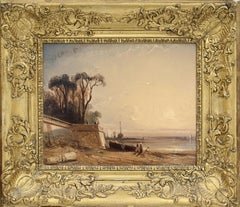
17th Century Italian School Biblical Scene

17th Century Italian School Biblical Scene

$3,734

H 27.56 in W 31.11 in D 3.94 in

17th Century Italian School Biblical Scene

Located in Marseille, FR

17th century oil on canvas representation of the "Feeding of the 4,000" of Italian school.

Category

17th Century French Baroque Antique Francesco Graziani Art

Materials

Canvas

17th-18th Century Venetian Painting

17th-18th Century Venetian Painting

$9,500Sale Price|39% Off

H 34 in W 51.5 in D 2.5 in

17th-18th Century Venetian Painting

Located in Pembroke, MA

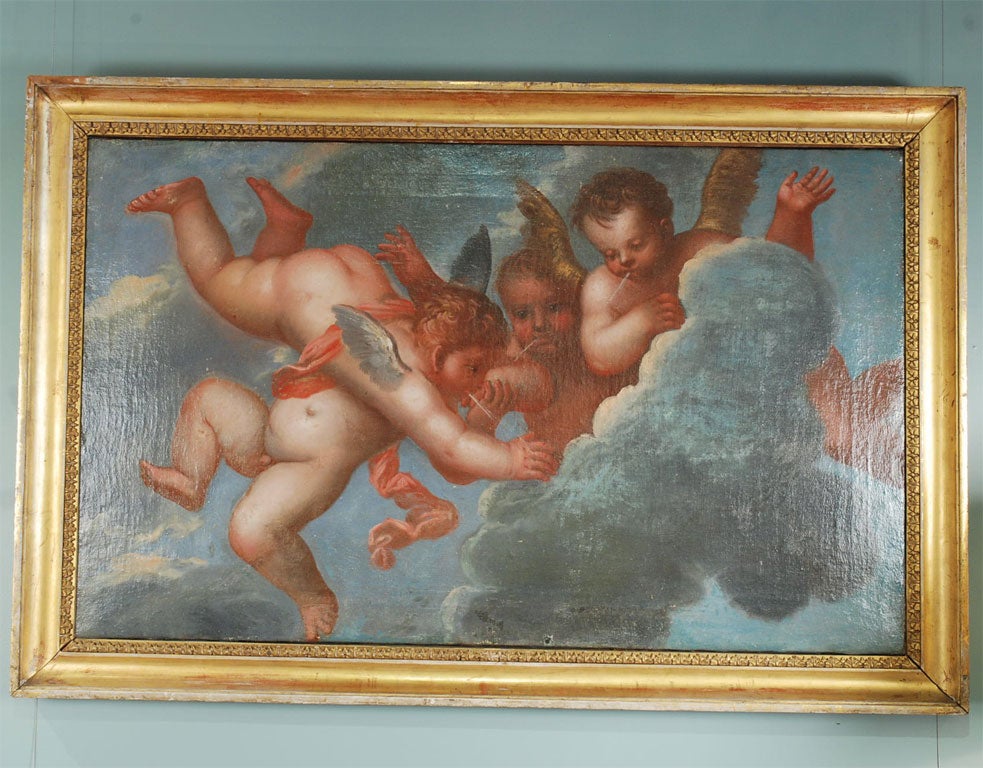
Venetian School painting of four angels, allegorically depicting the variable winds of change and time. Unsigned, believed to be by a follower of Pietro Li...

Category

17th Century Italian Baroque Antique Francesco Graziani Art

Materials

Giltwood, Canvas

"Stone Wharf, Brittany" Jane Peterson, American Impressionist, Boats in Canal

"Stone Wharf, Brittany" Jane Peterson, American Impressionist, Boats in Canal

By Jane Peterson

Located in New York, NY

Jane Peterson Stone Wharf, Brittany, circa 1910 Signed lower right Oil on canvas 18 x 24 inches Provenance Private Collection, New York Born Jennie Christine in Elgin, Illinois, s...

Category

1910s American Impressionist Francesco Graziani Art

Materials

Canvas, Oil

17th Century Painting

17th Century Painting

$25,000

H 28 in W 24 in D 2.5 in

17th Century Painting

Located in Miami, FL

17th century painting J.Castano 17th century Spain

Category

17th Century Baroque Antique Francesco Graziani Art

Materials

Canvas

Francesco Graziani art for sale on 1stDibs.

Find a wide variety of authentic Francesco Graziani art available for sale on 1stDibs. You can also browse by medium to find art by Francesco Graziani in oil paint, paint and more. Not every interior allows for large Francesco Graziani art, so small editions measuring 19 inches across are available. Customers who are interested in this artist might also find the work of Sir Godfrey Kneller, David Rucli, Flemish School, and 17th Century. Francesco Graziani art prices can differ depending upon medium, time period and other attributes. On 1stDibs, the price for these items starts at $7,130 and tops out at $7,130, while the average work can sell for $7,130.