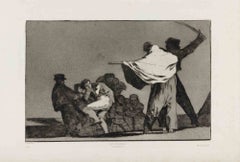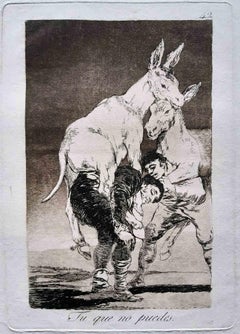
Francisco Goya

Spanish, 1746-1828
Francisco José de Goya y Lucientes (1746-1828) was a Spanish romantic painter and printmaker. He is considered the most important Spanish artist of the late 18th and early 19th centuries. His works often contained a social message, like in his "Disasters of War" series. Immensely successful in his lifetime, Goya is often referred to as both the last of the Old Masters and the first of the moderns. He was also one of the great portraitists of his time.
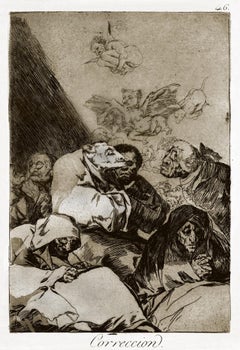
Correccion  - Etching and Aquatint by Francisco Goya - 1868

Correccion - Etching and Aquatint by Francisco Goya - 1868

By Francisco Goya

Located in Roma, IT

Correccion is an original artwork realized by Francisco Goya and published for the first time in 1799. Etching on wove paper. This artwork belongs to the Third Edition published in...

Category

1860s Old Masters Francisco Goya

Materials

Etching, Aquatint

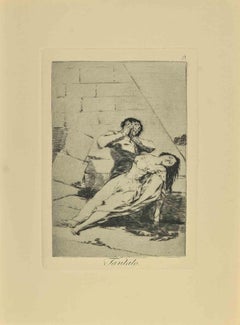
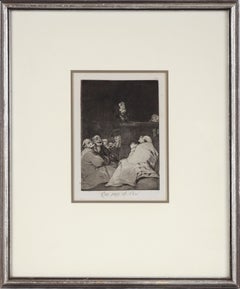
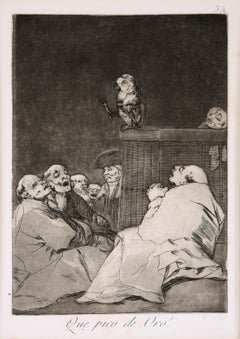
"Que pico de Oro" (What a Golden Beak) - Etching and Aquatint on Paper

"Que pico de Oro" (What a Golden Beak) - Etching and Aquatint on Paper

By Francisco Goya

Located in Soquel, CA

"Que pico de Oro" (What a Golden Beak) - Etching and Aquatint on Paper 5th or 8th edition print of "Que pico de Oro" from the Los Caprichos with burnished aquatints, drypoints etchi...

Category

1790s Northern Renaissance Francisco Goya

Materials

Engraving, Etching, Aquatint, Laid Paper

One Can't Tell Why - Proof from the Disasters of War

One Can't Tell Why - Proof from the Disasters of War

By Francisco Goya

Located in New York, NY

Francisco José de Goya y Lucientes (1746 Fuendetodos – Bordeaux 1828), No se puede saber por qué – One can’t tell why ca. 1808–1814, etching, burnished aquatint, drypoint, and ...

Category

1810s Old Masters Francisco Goya

Materials

Drypoint, Etching, Aquatint

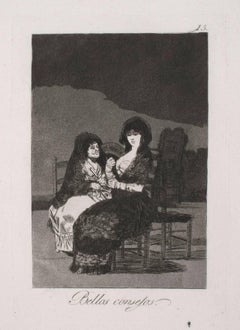
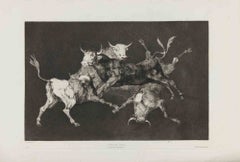
Disparate de Carnaval Etching, Aquatint, Goya, Circa 1875, Unframed

Disparate de Carnaval Etching, Aquatint, Goya, Circa 1875, Unframed

By Francisco Goya

Located in Roma, IT

Disparate de Carnaval - from Los Proverbios is an original black and white etching realized by Francisco Goya (1746-1828). The artwork is the plate n. ...

Category

1870s Old Masters Francisco Goya

Materials

Etching, Aquatint

La Lealtad Original Etching, Aquatint, Goya, Circa 1875, Unframed

La Lealtad Original Etching, Aquatint, Goya, Circa 1875, Unframed

By Francisco Goya

Located in Roma, IT

La lealtad - from Los Proverbios is an original black and white etching realized by Francisco Goya (1746-1828). The artwork is the plate n. 17 from of...

Category

1870s Old Masters Francisco Goya

Materials

Etching, Aquatint

Otras Leyes por el Pueblo - Etching and and Aquatint by Francisco Goya - 1877

Otras Leyes por el Pueblo - Etching and and Aquatint by Francisco Goya - 1877

By Francisco Goya

Located in Roma, IT

Otras Leyes por el Pueblo is a  modern artwork realized by Francisco Goya. Etching and Aquatint, from the Series "Los Proverbios", realized in 1815. This copy belongs to the editio...

Category

1860s Modern Francisco Goya

Materials

Etching
Tan Barbara la Seguridad Como el Delito - Etching by Francisco Goya - 1867

Tan Barbara la Seguridad Como el Delito - Etching by Francisco Goya - 1867

By Francisco Goya

Located in Roma, IT

The custody is as barbarous as the crime (Tan barbara la seguridad como el delito) is an artwork realied by Francisco Goya y Lucientes, 1867. Paris: Delâtre, 1867. Etching and burin. cm. 10.5x8.4.Sheet 21x16.2. Excellent proof of III state and first edition after the appearance of the letter and the bevel of the plate, published in the Gazette des Beau-Arts, vol. XXII, p. 196. Ref. Harris 26 Intact sheet with wide margins. Slight exposure yellowing around image. Francisco José de Goya y Lucientes (Fuendetodos, March 30, 1746 - Bordeaux, April 16, 1828) was a Spanish painter and engraver. Considered the pioneer of modern art, he was one of the greatest Spanish painters who lived between the late eighteenth and early nineteenth centuries. His paintings, drawings and etchings of him reflected the ongoing historical upheavals and influenced the most important contemporary and following century painters. Goya is often referred to as the last of the old masters and the first of the moderns. Born into a middle-class family in 1746 in Aragon, he was a pupil of painting from the age of 14 to José Luzán y Martínez, later moving to Madrid to study with Anton Raphael Mengs. In 1786 he became court painter to the Spanish crown and this first part of his career was characterized by numerous portraits of members of the Spanish aristocracy and royal family, as well as by the production of rococo tapestries for the royal palace. In 1793 he suffered from an undiagnosed serious illness which left him deaf, after which his work became progressively darker and more pessimistic. His subsequent paintings seem to reflect a bleak vision of existence, which contrasts with his resounding social ascent: in 1799, in fact, he became Primer Pintor de Cámara (First Court Painter), the highest rank for a Spanish court painter . In late 1799, commissioned by Godoy, he completed his Maja desnuda, a remarkably bold nude for the time and clearly inspired by the style of Diego Velázquez. In the early 19th century he painted The Family of Charles IV, again influenced by Velázquez. In 1807, Napoleon led the Grand Army in the Peninsular War against Spain. During the conflict Goya remained in Madrid and, although he never expressed his thoughts in public, it seems that these facts affected him deeply, as can be seen from some of his works such as The Disasters of War, The 2nd of May 1808, The 3rd May 1808. Other works of his maturity include a wide variety of paintings concerning madness, asylums, witches, fantastic creatures, and religious and political corruption, which suggest that he feared for his mental and physical health. His later period culminates with the Black Paintings of 1819-1823, made in the Quinta del Sordo, his home on the outskirts of Madrid where he lived, disillusioned by political and social developments in Spain, in a situation of almost isolation. Finally, in 1824, Goya decided to abandon Spain to retire to the French city of Bordeaux...

Category

1860s Modern Francisco Goya

Materials

Etching
Browse all Art from Francisco Goya
Shop Now

Francisco Goya Sale Prices

Sold DateSold PriceCategoryMediumCreation Year
2026$565Figurative PrintsEtching1881
2026$400Figurative PrintsEtching1881
2026$490Figurative PrintsEtching1881
2026$786Figurative PrintsEtching1881
2025$480Figurative PrintsEtching1881
2025$450Figurative PrintsEtching1881
2025$1,000Figurative PrintsEtching, Aquatint1868
2025$718Figurative PrintsEtching1881
2025$3,000Figurative PrintsAquatint1799
$898
Average sold price of items in the past 12 months
$400-$3,000
Sold price range of items in the past 12 months

Artists Similar to Francisco Goya

Francisco Goya art for sale on 1stDibs.

Find a wide variety of authentic Francisco Goya art available for sale on 1stDibs. You can also browse by medium to find art by Francisco Goya in etching, aquatint, paper and more. Much of the original work by this artist or collective was created during the 19th century and is mostly associated with the Old Masters style. Not every interior allows for large Francisco Goya art, so small editions measuring 5 inches across are available. Customers who are interested in this artist might also find the work of Giovanni Battista Piranesi, Frans Hogenberg, and Giovanni Elia Morghen. Francisco Goya art prices can differ depending upon medium, time period and other attributes. On 1stDibs, the price for these items starts at $400 and tops out at $135,000, while the average work can sell for $1,800.
Questions About Francisco Goya
  • 1stDibs ExpertJanuary 10, 2025
    The meaning of the Los Caprichos painting varies from piece to piece, as the work is not actually a single painting but rather a series of 80 prints. Francisco Goya created the aquatint and etching series during the late 18th century. Generally, each print serves as a critique of Spanish society. Some specific themes Goya explored through the series include superstition, hypocrisy and ignorance. On 1stDibs, find a variety of Francisco Goya art.
  • 1stDibs ExpertJanuary 10, 2025
    The titles of two of Goya's famous paintings are The Third of May, 1808 and Saturn Devouring His Son. Painted in 1814, The Third of May, 1808 depicts the execution of Spanish troops by Napoleon's forces. Goya produced the second painting later in his life, and many historians believe the violent abstracted portrayal of Saturn represents the artist's struggles with physical and mental illness. Both paintings are on view at the Museo del Prado in Madrid, Spain. On 1stDibs, shop a diverse assortment of Francisco Goya art.
  • 1stDibs ExpertApril 5, 2022
    Francisco José de Goya y Lucientes was best known as a painter, but he was also a printmaker. His art is considered some of the most important Spanish art of his era as it successfully straddled movements. He is considered both an Old Master and the first modern artist. On 1stDibs, find a variety of original artwork from top artists.