Frederick William MacMonnies Art

American, 1863-1937
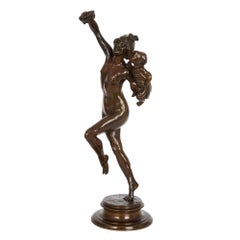
A sculptor of classical figures, American-born Frederick MacMonnies had fame in the United States and Europe in the later half of the 19th century and early 20th century. He occasionally returned to America but lived most of his life as in expatriate in France. He was especially known for his lithe bronze figures, especially ones titled Diana. The classical names of these figures allowed him the appearance of propriety but gave him the opportunity to model svelte nudes. Frederick MacMonnies was one of the first American sculptors to recognize the potential market of the middle class. He copyrighted his works and then contracted with foundries to mass produce some of his figures such as Diana in smaller sizes. MacMonnies was born in Brooklyn, New York, and was a child prodigy at carving stone. At age 18, he worked in the studio of Augustus Saint-Gaudens, and then persuaded him to become his assistant, keeping models damp and covered, running errands, and cleaning the studio. Evenings he studied at the Art Students League, Cooper Union, and the National Academy of Design. In Saint-Gaudens' studio, he met many of the wealthy people who shared Saint-Gaudens Beaux-Arts based ideas that art and architecture should be unified in order to create public art in America equal to that of classical antiquity or Renaissance Europe. Among the men that MacMonnies met through Saint-Gaudens who later furthered his career were architects Stanford White and Charles McKim and John LaFarge, decorator of mansions of the wealthy including the Vanderbilts. After four years of study and work in New York, MacMonnies left for Paris, opting for the more modernist techniques he could learn there over the more traditional sculpture teaching in Rome. One of his first teachers was Alexandre Falguiere, who had been an instructor of Saint-Gaudens and who injected a degree of contemporary realism into his classical figures. MacMonnies mingled with many upper class American expatriates and met his future wife, Mary Fairchild, a painter. MacMonnies came home briefly to help Saint-Gaudens with a project and then gained admittance in Paris to the Ecole des Beaux Arts, where he did numerous classical figures inspired by the style of small bronzes of Renaissance Florence, Italy. In 1889, he established his reputation with his sculpture of "Diana" at the Paris Salon. The execution of his nude sculpture was a challenge for a sculptor such as himself who strove for slim, well proportioned figures---the "aestheticizing of the nude". (Katz 12) In those days, most of the female models were poor peasants who were stocky with poor figures, distorted feet and often unbathed. However, MacMonnies found Marie Caira as the model for his Diana figures, and she, from a professional family of models, had the figure and social stature that met his criteria. Although he chose to live in Paris, many of his public and private sculpture commissions in future years, with the help of Saint-Gaudens and also architect, Stanford White, were in the United States.
to
1
3
2
2
1
1
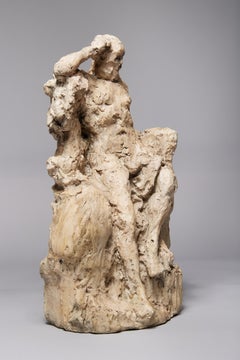
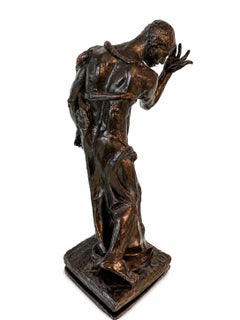
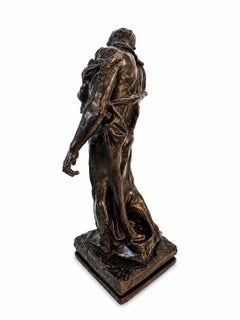
Model Study for Truth Sculpture at NY Public Library of Seated Man

Model Study for Truth Sculpture at NY Public Library of Seated Man

By Frederick William MacMonnies

Located in Beachwood, OH

Frederick William MacMonnies (American, 1863-1937) Model Study for Truth, c. 1910-14 Painted plaster 16.5 x 9.25 x 7.5 inches For the 1920 sculpture for the New York Public Library ...

Category

1910s Frederick William MacMonnies Art

Materials

Plaster

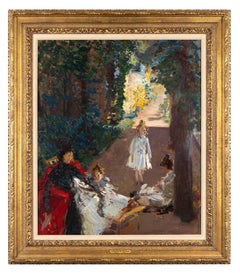
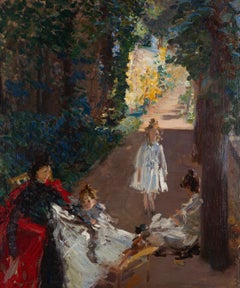
Les Jardin Du Giverny

Les Jardin Du Giverny

By Frederick William MacMonnies

Located in Sheffield, MA

Frederick William MacMonnies American, 1863-1937 Les Jardin Du Giverny Oil on Canvas 21 by 25 in, w/ frame 27 ⅞ by 31 ⅞ in A sculptor of classical figures, American-born Frederick ...

Category

Early 20th Century Expressionist Frederick William MacMonnies Art

Materials

Oil

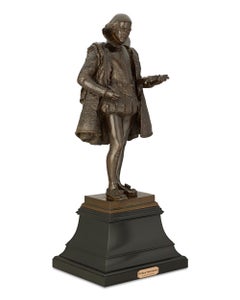
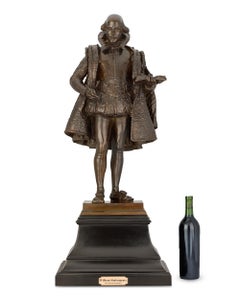
Patinated Bronze Statuette of William Shakespeare

Patinated Bronze Statuette of William Shakespeare

By Frederick William MacMonnies

Located in New Orleans, LA

Frederick William MacMonnies 1863–1937 American William Shakespeare Signed "F. MacMonnies" and foundry-marked "E. Gruet Jeune, Fondeur, Paris" Bronze Frederick William MacMonnies...

Category

19th Century Academic Frederick William MacMonnies Art

Materials

Bronze

Related Items
Jean-Léon Gérôme  La Danseuse au Cerceau - Gilt Bronze Statue of a Hoop Dancer

Jean-Léon Gérôme La Danseuse au Cerceau - Gilt Bronze Statue of a Hoop Dancer

By Jean-Léon Gérôme

Located in New York, NY

Jean-Léon Gérôme French 1824 - 1904 La Joueuse De Cerceau - The Hoop Dancer A mini gilt bronze female figural statue of a young hoop dancer inspired by a trove of ancient terraco...

Category

19th Century Academic Frederick William MacMonnies Art

Materials

Bronze

Emile Albert Gruppe Bass Rocks 36x30

Emile Albert Gruppe Bass Rocks 36x30

By Emile Albert Gruppe

Located in Dallas, TX

Emile Albert Gruppe (American, 1896-1978) Bass Rock, 1967 Oil on canvas 30 x 36 inches (76.2 x 91.4 cm) Signed lower right: Emile A. Gruppe Signed, dated, and titled on the stretcher...

Category

1960s Expressionist Frederick William MacMonnies Art

Materials

Canvas, Oil

"Pioneer Family" WPA American Modernism Plaster Maquette Realism 20th Century

"Pioneer Family" WPA American Modernism Plaster Maquette Realism 20th Century

By William Zorach

Located in New York, NY

"Pioneer Family," 23 1/2 x 16 1/4 x 10 3/4 inPlaster. c. 1927. Unsigned. Realism The Smithsonian has a cast of this sculpture in its collection. Pictured on the cover of “The Sculpt...

Category

1920s American Modern Frederick William MacMonnies Art

Materials

Plaster

Expressive Castilian Landscape Oil Painting with Olive Trees and Impasto Spain

Expressive Castilian Landscape Oil Painting with Olive Trees and Impasto Spain

By Ulpiano Carrasco

Located in Sitges, Barcelona

Expressive Castilian Landscape Oil Painting with Olive Trees and Impasto Artist: Ulpiano Carrasco Title: Verano en Castillejo Year: 1998 Technique: Oil on canvas Artwork dimensions: 54 × 65 cm / 21.26 × 25.59 in Framed dimensions: 78 × 89 cm / 30.71 × 35.04 in Signature: Signed and dated on the reverse Inscription: Titled “Verano en Castillejo” on the reverse Framing: Framed Condition: Good overall condition, with rich original impasto and visible pictorial texture Description A vibrant expressive landscape by Spanish artist Ulpiano Carrasco, titled Verano en Castillejo and dated 1998 on the reverse. This oil on canvas represents a powerful Castilian landscape, built through dense impasto, energetic brushwork and a luminous palette of greens, yellows, blues, whites and earthy reds. The composition captures an open rural panorama with olive trees, rolling cultivated fields and distant hills, transforming the Spanish countryside into an intense chromatic experience. Carrasco does not approach landscape as simple topography. His painting turns nature into matter, rhythm and emotion. The fields appear almost sculpted with paint, while the olive trees emerge as dark, expressive forms against the vibrating surface of the land. The result is a landscape full of movement, heat and Mediterranean-Castilian atmosphere. The work is especially attractive for collectors of Spanish contemporary landscape painting, expressive impasto painting, Mediterranean landscapes, olive tree paintings...

Category

1990s Expressionist Frederick William MacMonnies Art

Materials

Oil

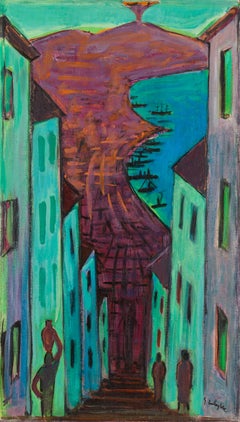
Mediterranean Village of Mallorca oil on canvas painting

Mediterranean Village of Mallorca oil on canvas painting

Located in Sitges, Barcelona

Artist: Bernat Sanjuan i Tarré (Barcelona, 1915 – Deià, Mallorca, 1979) Title: Mediterranean Village of Mallorca Medium: Oil on canvas Dimensions: 65 × 92 cm (25.6 × 36.2 in) Framed:...

Category

1950s Expressionist Frederick William MacMonnies Art

Materials

Canvas, Oil

Seated Mercury Life-Size Bronze Sculpture, Italian, Late 19th Century

Seated Mercury Life-Size Bronze Sculpture, Italian, Late 19th Century

Located in Palm Beach, FL

Seated Mercury (Hermes) — Grand Tour Life-Size Bronze Italian School (possibly Naples) Italy, Late 19th–Early 20th Century This commanding life-size Grand Tour bronze depicts Mercury (Hermes) seated in quiet repose upon a rock, rendered with classical authority and exceptional refinement. The youthful god’s finely modeled anatomy, serene, introspective expression, and distinctive winged sandals draw directly from the celebrated ancient prototype, creating a sculpture of enduring presence and balance. Fully restored and ready to place, the bronze presents beautifully for interior display or garden installation, where its patinated surface responds richly to natural light. The composition derives from the renowned Seated Mercury discovered on August 3, 1758, in the peristyle garden of the Villa dei Papiri at Herculaneum. The ancient original—now housed in the Museo Archeologico Nazionale di Napoli—became a touchstone of classical taste and a must-see for Grand Tour travelers of the 18th and 19th centuries, admired for its harmony, restraint, and technical mastery. Cast in richly toned bronze and finished with a nuanced patina, this example exemplifies the Neapolitan tradition of Grand Tour bronzes, prized for archaeological fidelity and sculptural finesse. Its impressive scale and poised silhouette make it a significant focal point in both modern and classical settings—an object that bridges antiquity and the cultivated collecting culture of the Grand Tour. Notable Related Examples: Getty Villa · Kunsthistorisches Museum · Villa San Michele...

Category

Late 19th Century Academic Frederick William MacMonnies Art

Materials

Bronze

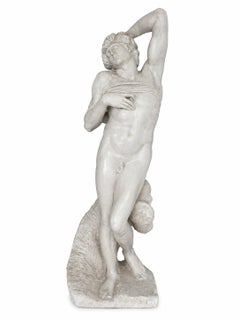
Marsyas Life-Size Plaster Cast Sculpture, 19th Century, Good Condition

Marsyas Life-Size Plaster Cast Sculpture, 19th Century, Good Condition

By Brussels Atelier de Moulages

Located in Palm Beach, FL

A compelling life-size plaster cast depicting Marsyas, the ill-fated satyr of Greek mythology renowned for his mastery of the aulos. According to classical legend, Marsyas dared chal...

Category

Mid-19th Century Frederick William MacMonnies Art

Materials

Plaster

Antique Bronze Dog "Whippet with a Butterfly" Arthur Waagen (1833-1898) 1 of 2

Antique Bronze Dog "Whippet with a Butterfly" Arthur Waagen (1833-1898) 1 of 2

By Arthur Waagen

Located in SANTA FE, NM

Antique Bronze Dog Portrait “La Levrette au Papillon” or “Whippet (Greyhound) with a Butterfly”   Arthur Waagen (Germany, France 1833-1898) Circa 1860’s 11 x 8 x 4  inches (1 of 2. ...

Category

1860s Academic Frederick William MacMonnies Art

Materials

Bronze

"Horses in the field"  with yellow popular trees

"Horses in the field" with yellow popular trees

By André Brasilier

Located in New York, NY

"Horses in the field" is unique by the artist, because of the location where they are grazing among the yellow popular trees.

Category

Early 2000s Expressionist Frederick William MacMonnies Art

Materials

Oil

Ana
Ana

Juan Gomez QuirozAna, c. 1975

$5,750

H 24 in W 20 in D 12 in

Ana

By Juan Gomez Quiroz

Located in North Clarendon, VT

Ana, a striking mixed medea sculpture by Juan Manuel Gomez-Quiroz. From the estate of the artist. Painter and printmaker and sculptor Juan Manuel Gomez-Quiroz was born in Santiago d...

Category

1980s Post-Modern Frederick William MacMonnies Art

Materials

Plaster, Mixed Media

Previously Available Items
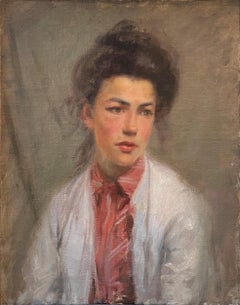
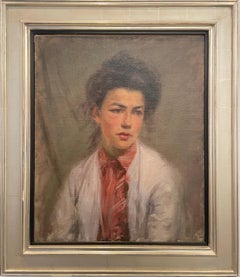
"Marion Jones Farquhar" Frederick William Macmonnies, Tennis Olympian Portrait

"Marion Jones Farquhar" Frederick William Macmonnies, Tennis Olympian Portrait

By Frederick William MacMonnies

Located in New York, NY

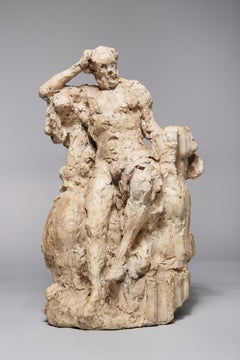
Frederick William Macmonnies Marion Jones Farquhar, 1905-11 Oil on canvas 24 x 20 inches Provenance: William Clerk Private Collection, New York Literature: Mary Smart, A Flight with Fame: The Life and Art of Frederick MacMonnies, with a Catalogue Raisonne of Sculpture and a Checklist of Paintings by E. Adina Gordon, Madison, Connecticut, 1996, no. 90. The work depicts Marion Jones Farquhar who, was an American tennis player who competed during the late 19th century and early 20th century. She won the singles titles at the 1899 and 1902 U.S championships and was the first American woman to medal at the Olympics placing Bronze in singles. Additionally, she was the artist's sister-in-law who often played and competed with MacMonnies in golf and tennis. MacMonnies would often study the movements of her form referenced in his sculpture. When MacMonnies won a doubles golf tournament he said "Marion dragged my dead weight thro' and won us the tournament, showing what great Generalship can do." A sculptor of classical figures, American-born Frederick MacMonnies had fame in the United States and Europe in the later half of the 19th century and early 20th century. He occasionally returned to America but lived most of his life as in expatriate in France. He was especially known for his lithe bronze figures, especially ones titled Diana. The classical names of these figures allowed him the appearance of propriety but gave him the opportunity to model svelte nudes. Frederick MacMonnies was one of the first American sculptors to recognize the potential market of the middle class. He copyrighted his works and then contracted with foundries to mass produce some of his figures such as Diana in smaller sizes. MacMonnies was born in Brooklyn, New York, and was a child prodigy at carving stone. At age 18, he worked in the studio of Augustus Saint-Gaudens, and then persuaded him to become his assistant, keeping models damp and covered, running errands, and cleaning the studio. Evenings he studied at the Art Students League, Cooper Union, and the National Academy of Design. In Saint-Gaudens' studio, he met many of the wealthy people who shared Saint-Gaudens Beaux-Arts based ideas that art and architecture should be unified in order to create public art in America equal to that of classical antiquity or Renaissance Europe. Among the men that MacMonnies met through Saint-Gaudens who later furthered his career were architects Stanford White and Charles McKim...

Category

Early 1900s American Impressionist Frederick William MacMonnies Art
Materials

Canvas, Oil

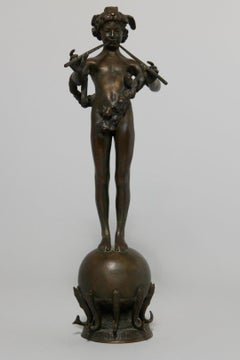
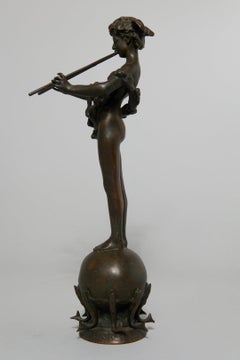
Pan of Rohallion, 1889-90 classical bronze sculpture

Pan of Rohallion, 1889-90 classical bronze sculpture

By Frederick William MacMonnies

Located in Beachwood, OH

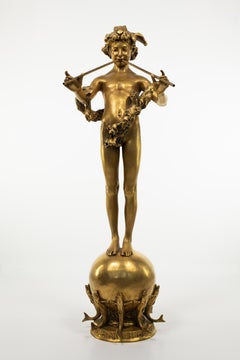
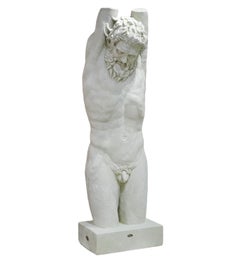
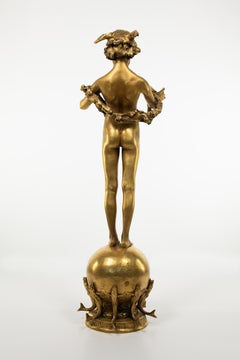
Frederick W. MacMonnies (American, 1863-1937) Pan of Rohallion, 1889-90 (Garden 22) Bronze Signed on base, 'ROMAN BRONZE WORKS NY' at base 14.25 x 4 x 6 inches A sculptor of classical figures, American-born Frederick MacMonnies...

Category

1880s Frederick William MacMonnies Art
Materials

Bronze

Frederick William Macmonnies art for sale on 1stDibs.
Find a wide variety of authentic Frederick William MacMonnies art available for sale on 1stDibs. You can also browse by medium to find art by Frederick William MacMonnies in bronze, metal and more. Not every interior allows for large Frederick William MacMonnies art, so small editions measuring 4 inches across are available. Customers who are interested in this artist might also find the work of Bela Bacsi, Doris Caesar, and Margot Homan. Frederick William MacMonnies art prices can differ depending upon medium, time period and other attributes. On 1stDibs, the price for these items starts at $7,000 and tops out at $40,500, while the average work can sell for $23,750.

Artists Similar to Frederick William MacMonnies