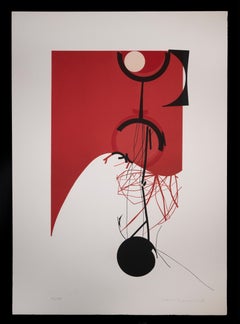
Gianni Polidori Art

to
1
5
4
4
Related Items
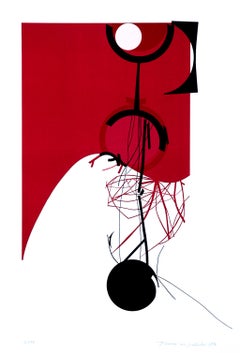
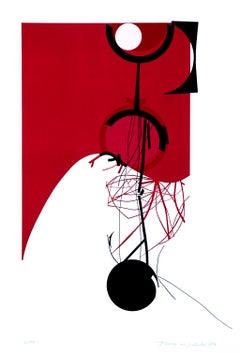
Tableau, Japanese, limited edition lithograph, black, white, red, signed, number

Tableau, Japanese, limited edition lithograph, black, white, red, signed, number

By Toko Shinoda

Located in Santa Fe, NM

Tableau, Japanese, limited edition lithograph, black, white, red, signed, number Shinoda's works have been collected by public galleries and museums, including the Museum of Modern Art, Solomon R. Guggenheim Museum, Brooklyn Museum and Metropolitan Museum (all in New York City), the National Museum of Modern Art in Tokyo, the British Museum in London, the Art Institute of Chicago, Arthur M. Sackler Gallery of the Smithsonian in Washington, D.C., the Singapore Art Museum, the National Museum of Singapore, the Kröller-Müller Museum in Otterlo, Netherlands, the Albright–Knox Art Gallery in Buffalo, New York, the Cincinnati Art Museum, and the Yale University Art Gallery in New Haven, Connecticut. New York Times Obituary, March 3, 2021 by Margalit Fox, Alex Traub contributed reporting. Toko Shinoda, one of the foremost Japanese artists of the 20th century, whose work married the ancient serenity of calligraphy with the modernist urgency of Abstract Expressionism, died on Monday at a hospital in Tokyo. She was 107. Her death was announced by her gallerist in the United States. A painter and printmaker, Ms. Shinoda attained international renown at midcentury and remained sought after by major museums and galleries worldwide for more than five decades. Her work has been exhibited at, among other places, the Metropolitan Museum of Art and the Museum of Modern Art in New York; the Art Institute of Chicago; the British Museum; and the National Museum of Modern Art in Tokyo. Private collectors include the Japanese imperial family. Writing about a 1998 exhibition of Ms. Shinoda’s work at a London gallery, the British newspaper The Independent called it “elegant, minimal and very, very composed,” adding, “Her roots as a calligrapher are clear, as are her connections with American art of the 1950s, but she is quite obviously a major artist in her own right.” As a painter, Ms. Shinoda worked primarily in sumi ink, a solid form of ink, made from soot pressed into sticks, that has been used in Asia for centuries. Rubbed on a wet stone to release their pigment, the sticks yield a subtle ink that, because it is quickly imbibed by paper, is strikingly ephemeral. The sumi artist must make each brush stroke with all due deliberation, as the nature of the medium precludes the possibility of reworking even a single line. “The color of the ink which is produced by this method is a very delicate one,” Ms. Shinoda told The Business Times of Singapore in 2014. “It is thus necessary to finish one’s work very quickly. So the composition must be determined in my mind before I pick up the brush. Then, as they say, the painting just falls off the brush.” Ms. Shinoda painted almost entirely in gradations of black, with occasional sepias and filmy blues. The ink sticks she used had been made for the great sumi artists of the past, some as long as 500 years ago. Her line — fluid, elegant, impeccably placed — owed much to calligraphy. She had been rigorously trained in that discipline from the time she was a child, but she had begun to push against its confines when she was still very young. Deeply influenced by American Abstract Expressionists like Jackson Pollock, Mark Rothko and Robert Motherwell, whose work she encountered when she lived in New York in the late 1950s, Ms. Shinoda shunned representation. “If I have a definite idea, why paint it?,” she asked in an interview with United Press International in 1980. “It’s already understood and accepted. A stand of bamboo is more beautiful than a painting could be. Mount Fuji is more striking than any possible imitation.” Spare and quietly powerful, making abundant use of white space, Ms. Shinoda’s paintings are done on traditional Chinese and Japanese papers, or on backgrounds of gold, silver or platinum leaf. Often asymmetrical, they can overlay a stark geometric shape with the barest calligraphic strokes. The combined effect appears to catch and hold something evanescent — “as elusive as the memory of a pleasant scent or the movement of wind,” as she said in a 1996 interview. Ms. Shinoda’s work also included lithographs; three-dimensional pieces of wood and other materials; and murals in public spaces, including a series made for the Zojoji Temple in Tokyo. The fifth of seven children of a prosperous family, Ms. Shinoda was born on March 28, 1913, in Dalian, in Manchuria, where her father, Raijiro, managed a tobacco plant. Her mother, Joko, was a homemaker. The family returned to Japan when she was a baby, settling in Gifu, midway between Kyoto and Tokyo. One of her father’s uncles, a sculptor and calligrapher, had been an official seal carver to the Meiji emperor. He conveyed his love of art and poetry to Toko’s father, who in turn passed it to Toko. “My upbringing was a very traditional one, with relatives living with my parents,” she said in the U.P.I. interview. “In a scholarly atmosphere, I grew up knowing I wanted to make these things, to be an artist.” She began studying calligraphy at 6, learning, hour by hour, impeccable mastery over line. But by the time she was a teenager, she had begun to seek an artistic outlet that she felt calligraphy, with its centuries-old conventions, could not afford. “I got tired of it and decided to try my own style,” Ms. Shinoda told Time magazine in 1983. “My father always scolded me for being naughty and departing from the traditional way, but I had to do it.” Moving to Tokyo as a young adult, Ms. Shinoda became celebrated throughout Japan as one of the country’s finest living calligraphers, at the time a signal honor for a woman. She had her first solo show in 1940, at a Tokyo gallery. During World War II, when she forsook the city for the countryside near Mount Fuji, she earned her living as a calligrapher, but by the mid-1940s she had started experimenting with abstraction. In 1954 she began to achieve renown outside Japan with her inclusion in an exhibition of Japanese calligraphy at MoMA. In 1956, she traveled to New York. At the time, unmarried Japanese women could obtain only three-month visas for travel abroad, but through zealous renewals, Ms. Shinoda managed to remain for two years. She met many of the titans of Abstract Expressionism there, and she became captivated by their work. “When I was in New York in the ’50s, I was often included in activities with those artists, people like Mark Rothko, Jackson Pollock, Motherwell and so forth,” she said in a 1998 interview with The Business Times. “They were very generous people, and I was often invited to visit their studios, where we would share ideas and opinions on our work. It was a great experience being together with people who shared common feelings.” During this period, Ms. Shinoda’s work was sold in the United States by Betty Parsons, the New York dealer who represented Pollock, Rothko and many of their contemporaries. Returning to Japan, Ms. Shinoda began to fuse calligraphy and the Expressionist aesthetic in earnest. The result was, in the words of The Plain Dealer of Cleveland in 1997, “an art of elegant simplicity and high drama.” Among Ms. Shinoda’s many honors, she was depicted, in 2016, on a Japanese postage stamp. She is the only Japanese artist to be so honored during her lifetime. No immediate family members survive. When she was quite young and determined to pursue a life making art, Ms. Shinoda made the decision to forgo the path that seemed foreordained for women of her generation. “I never married and have no children,” she told The Japan Times in 2017. “And I suppose that it sounds strange to think that my paintings are in place of them — of course they are not the same thing at all. But I do say, when paintings that I have made years ago are brought back into my consciousness, it seems like an old friend, or even a part of me, has come back to see me.” Works of a Woman's Hand Toko Shinoda bases new abstractions on ancient calligraphy Down a winding side street in the Aoyama district, western Tokyo. into a chunky white apartment building, then up in an elevator small enough to make a handful of Western passengers friends or enemies for life. At the end of a hall on the fourth floor, to the right, stands a plain brown door. To be admitted is to go through the looking glass. Sayonara today. Hello (Konichiwa) yesterday and tomorrow. Toko Shinoda, 70, lives and works here. She can be, when she chooses, on e of Japans foremost calligraphers, master of an intricate manner of writing that traces its lines back some 3,000 years to ancient China. She is also an avant-garde artist of international renown, whose abstract paintings and lithographs rest in museums around the world. These diverse talents do not seem to belong in the same epoch. Yet they have somehow converged in this diminutive woman who appears in her tiny foyer, offering slippers and ritual bows of greeting. She looks like someone too proper to chip a teacup, never mind revolutionize an old and hallowed art form She wears a blue and white kimono of her own design. Its patterns, she explains, are from Edo, meaning the period of the Tokugawa shoguns, before her city was renamed Tokyo in 1868. Her black hair is pulled back from her face, which is virtually free of lines and wrinkles. except for the gold-rimmed spectacles perched low on her nose (this visionary is apparently nearsighted). Shinoda could have stepped directly from a 19th century Meji print. Her surroundings convey a similar sense of old aesthetics, a retreat in the midst of a modern, frenetic city. The noise of the heavy traffic on a nearby elevated highway sounds at this height like distant surf. delicate bamboo shades filter the daylight. The color arrangement is restful: low ceilings of exposed wood, off-white walls, pastel rugs of blue, green and gray. It all feels so quintessentially Japanese that Shinoda’s opening remarks come as a surprise. She points out (through a translator) that she was not born in Japan at all but in Darien, Manchuria. Her father had been posted there to manage a tobacco company under the aegis of the occupying Japanese forces, which seized the region from Russia in 1905. She says,”People born in foreign places are very free in their thinking, not restricted” But since her family went back to Japan in 1915, when she was two, she could hardly remember much about a liberated childhood? She answers,”I think that if my mother had remained in Japan, she would have been an ordinary Japanese housewife. Going to Manchuria, she was able to assert her own personality, and that left its mark on me.” Evidently so. She wears her obi low on the hips, masculine style. The Porcelain aloofness she displays in photographs shatters in person. Her speech is forceful, her expression animated and her laugh both throaty and infectious. The hand she brings to her mouth to cover her amusement (a traditional female gesture of modesty) does not stand a chance. Her father also made a strong impression on the fifth of his seven children:”He came from a very old family, and he was quite strict in some ways and quite liberal in others.” He owned one of the first three bicycles ever imported to Japan and tinkered with it constantly He also decided that his little daughter would undergo rigorous training in a procrustean antiquity. “I was forced to study from age six on to learn calligraphy,” Shinoda says, The young girl dutifully memorized and copied the accepted models. In one sense, her father had pushed her in a promising direction, one of the few professional fields in Japan open to females. Included among the ancient terms that had evolved around calligraphy was onnade, or woman's writing. Heresy lay ahead. By the time she was 15, she had already been through nine years of intensive discipline, “I got tired of it and decided to try my own style. My father always scolded me for being naughty and departing from the traditional way, but I had to do it.” She produces a brush and a piece of paper to demonstrate the nature of her rebellion. “This is kawa, the accepted calligraphic character for river,” she says, deftly sketching three short vertical strokes. “But I wanted to use more than three lines to show the force of the river.” Her brush flows across the white page, leaving a recognizable river behind, also flowing.” The simple kawa in the traditional language was not enough for me. I wanted to find a new symbol to express the word river.” Her conviction grew that ink could convey the ineffable, the feeling, "as she says, of wind blowing softly.” Another demonstration. She goes to the sliding wooden door of an anteroom and disappears in back of it; the only trace of her is a triangular swatch of the right sleeve of her kimono, which she has arranged for that purpose. A realization dawns. The task of this artist is to paint that three sided pattern so that the invisible woman attached to it will be manifest to all viewers. Gen, painted especially for TIME, shows Shinoda’s theory in practice. She calls the work “my conception of Japan in visual terms.” A dark swath at the left, punctuated by red, stands for history. In the center sits a Chinese character gen, which means in the present or actuality. A blank pattern at the right suggests an unknown future. Once out of school, Shinoda struck off on a path significantly at odds with her culture. She recognized marriage for what it could mean to her career (“a restriction”) and decided against it. There was a living to be earned by doing traditional calligraphy:she used her free time to paint her variations. In 1940 a Tokyo gallery exhibited her work. (Fourteen years would pass before she got a second show.)War came, and bad times for nearly everyone, including the aspiring artist , who retreated to a rural area near Mount Fuji and traded her kimonos for eggs. In 1954 Shinoda’s work was included in a group exhibit at New York City’s Museum of Modern Art. Two years later, she overcame bureaucratic obstacles to visit the U.S.. Unmarried Japanese women are allowed visas for only three months, patiently applying for two-month extensions, one at a time, Shinoda managed to travel the country for two years. She pulls out a scrapbook from this period. Leafing through it, she suddenly raises a hand and touches her cheek:”How young I looked!” An inspection is called for. The woman in the grainy, yellowing newspaper photograph could easily be the on e sitting in this room. Told this, she nods and smiles. No translation necessary. Her sojourn in the U.S. proved to be crucial in the recognition and development of Shinoda’s art. Celebrities such as actor Charles Laughton and John Lewis of the Modern Jazz Quartet bought her paintings and spread the good word. She also saw the works of the abstract expressionists, then the rage of the New York City art world, and realized that these Western artists, coming out of an utterly different tradition, were struggling toward the same goal that had obsessed her. Once she was back home, her work slowly made her famous. Although Shinoda has used many materials (fabric, stainless steel, ceramics, cement), brush and ink remain her principal means of expression. She had said, “As long as I am devoted to the creation of new forms, I can draw even with muddy water.” Fortunately, she does not have to. She points with evident pride to her ink stone, a velvety black slab of rock, with an indented basin, that is roughly a foot across and two feet long. It is more than 300 years old. Every working morning, Shinoda pours about a third of a pint of water into it, then selects an ink stick from her extensive collection, some dating back to China’s Ming dynasty. Pressing stick against stone, she begins rubbing. Slowly, the dried ink dissolves in the water and becomes ready for the brush. So two batches of sumi (India ink) are exactly alike; something old, something new. She uses color sparingly. Her clear preference is black and all its gradations. “In some paintings, sumi expresses blue better than blue.” It is time to go downstairs to the living quarters. A niece, divorced and her daughter,10,stay here with Shinoda; the artist who felt forced to renounce family and domesticity at the outset of her career seems welcome to it now. Sake is offered, poured into small cedar boxes and happily accepted. Hold carefully. Drink from a corner. Ambrosial. And just right for the surroundings and the hostess. A conservative renegade; a liberal traditionalist; a woman steeped in the male-dominated conventions that she consistently opposed. Her trail blazing accomplishments are analogous to Picasso’s. When she says goodbye, she bows. --by Paul Gray...

Category

1990s Contemporary Gianni Polidori Art

Materials

Lithograph

Untitled
Untitled

Hans BurkhardtUntitled, 1948

$1,250

H 10.825 in W 14.675 in

Untitled

By Hans Burkhardt

Located in New York, NY

Lithograph, 1948. Signed by the artist and dated in pencil, lower right. Numbered 4/12 in pencil, lower left.

Category

1940s American Modern Gianni Polidori Art

Materials

Lithograph

A Long Silence

Marlene DumasA Long Silence, 1989

$3,000

H 10.25 in W 10 in

A Long Silence

By Marlene Dumas

Located in New York, NY

An early and scarce impression of this color lithograph, printed in black and light beige on white wove Zerkall paper. This print has full margins and is signed and dated in pencil b...

Category

1980s Contemporary Gianni Polidori Art

Materials

Black and White, Color, Lithograph

James Siena at PACE poster Hand signed by James Siena complex linear abstraction

James Siena at PACE poster Hand signed by James Siena complex linear abstraction

By James Siena

Located in New York, NY

James Siena at PACE Gallery, 2019 Offset lithograph exhibition invitation (Hand signed by James Siena) 19 1/2 × 14 1/2 inches Unframed This exquisite fold...

Category

2010s Abstract Geometric Gianni Polidori Art

Materials

Offset, Graphite, Pencil, Lithograph

Evening Singers, limited edition color lithograph, kachinas, katsina, Hopi, red

Evening Singers, limited edition color lithograph, kachinas, katsina, Hopi, red

By Dan Namingha

Located in Santa Fe, NM

Evening Singers, limited edition color lithograph, kachinas, katsina, Hopi, red signed, titled, and numbered by the artist at the bottom limited edition of 50 unframed The Galle...

Category

1980s Contemporary Gianni Polidori Art

Materials

Lithograph

Offset Lithograph signed & warmly Inscribed to African American Arts prof Framed

Offset Lithograph signed & warmly Inscribed to African American Arts prof Framed

By Sam Gilliam

Located in New York, NY

Sam Gilliam Offset Lithograph Warmly Inscribed to Renowned African American Arts Educator, 1988 Offset Lithograph Card Hand written, signed and inscribed card with a warm personal message from the artist Frame Included Hand written, signed and inscribed offset lithograph card with a warm personal message from Sam Gilliam to Lindsay Waldorf Patterson. Measurements: Frame: 14 7/8 x 12 x 1/2 inches Card: 8 x 5 inches The inscription reads: To Lindsay: With Warmest Regards Sam Gilliam Lindsay Waldorf Patterson was an American English literature educator and author as well as a MacDowell Colony fellow (3 awards); Edward Albee Foundation fellow (2 awards); recipient award National Foundation on Arts & Humanities. Hand signed on the front Provenance: From the estate of Lindsay Waldorf Patterson. Lindsay Waldorf Patterson was an American English literature educator and author as well as an MacDowell Colony fellow (3 awards); Edward Albee Foundation fellow (2 awards); recipient award National Foundation on Arts & Humanities. Formerly an account executive, Harrison Advertising Agency, New York City, 1964; feature writer and columnist assistant to Langston Hughes, Associated Negro Press, 1965; special feature writer (film) Uptight,, Paramount Pictures, 1968; co-host Celebrity Hour program, Station WRVR-FM, New York City, 1974-1977; co-host Black Conversations program, Station WPIX-television, New York City, 1976-1979; assistant Professor of English, Queens College, Flushing, New York, since 1990. Adjunct Professor Afro-American & Caribbean literature, black theater...

Category

1980s Abstract Expressionist Gianni Polidori Art

Materials

Lithograph, Offset, Ink

Les Champs Élysées
Les Champs Élysées

Les Champs Élysées

By Henri Edmond Cross

Located in New York, NY

Color lithograph. From the edition of 1100. From "Pan." Sheet size 10 x 14, with full margins.

Category

1890s Pointillist Gianni Polidori Art

Materials

Color, Lithograph

Shago series abstract

Ed MosesShago series abstract

$2,320Sale Price|29% Off

H 30.5 in W 23 in

Shago series abstract

By Ed Moses

Located in Palm Desert, CA

Ed Moses has been a prominent figure in the Los Angeles art scene for almost six decades.

Category

20th Century Abstract Expressionist Gianni Polidori Art

Materials

Lithograph

Imago Galleries exhibition poster, Palm Desert, CA (Hand Signed by Peter Halley)

Imago Galleries exhibition poster, Palm Desert, CA (Hand Signed by Peter Halley)

By Peter Halley

Located in New York, NY

Peter Halley Peter Halley, Imago Galleries, Palm Desert, CA (Hand Signed), 2006 Offset lithograph poster (hand signed by Peter Halley) 25 1/2 × 18 1/4 inches Provenance; Acquired directly from the artist Unframed Alpha 137 Gallery is honored to offer this offset lithograph, published on the occasion of legendary American artist Peter Halley's 2006 one-man exhibition at Imago Galleries, Palm Desert, California which the artist hand signed in black marker. Scroll images for a photograph of our director Nadine Witkin with the artist. Below is Peter Halley's official biography. What it doesn't mention is that Andy Warhol famously painted his portrait in 1986! Peter Halley is that legendary. According to Halley, he didn't realize until after Warhol's death that the polaroids Warhol took of him with his famous "big shot" camera were made into an original painting. Warhol's painting of Peter Halley was included in the recent Andy Warhol retrospective "Andy Warhol - from A to B and Back Again" at the Whitney. PETER HALLEY BIOGRAPHY Peter Halley, born 1953, New York City, is an American artist who came to prominence as a central figure of the Neo-Conceptualist movement of the 1980s. His paintings redeploy the language of geometric abstraction to explore the organization of social space in the digital era. Since the 1980s, Halley’s lexicon has included three elements: “prisons” and “cells,” connected by “conduits,” which are used in his paintings to explore the technologically determined space and pathways that regulate daily life. Using fluorescent color and Roll-a-Tex, a commercial paint additive that provides readymade texture, Halley embraces materials that are anti-naturalistic and commercially manufactured. In the mid 1990s Halley pioneered the use of wall-sized digital prints in his site-specific installations. He has executed installations at Museo Nivola, Orani, Sardinia (2021); Greene Naftali, New York (2019); Venice Biennale (2019); Lever House, New York (2018); Schirn Kunsthalle, Frankfurt (2016); Disjecta, Portland (2012); the Gallatin School, New York University, (2008, 2017); the Museum of Modern Art, New York (1997); and the Dallas Museum of Art (1995). In 2005, Halley was also commissioned to create a monumental painting for Terminal D at the Dallas/Fort Worth International Airport, Texas. Halley served as professor and director of the MFA painting program at the Yale School of Art from 2002 to 2011. From 1996 to 2005, Halley published INDEX Magazine, which featured interviews with figures working in a variety of creative fields. Halley is also known for his essays on art and culture, written in the 1980s and 1990s, in which he explores themes from French critical theory and the impact of burgeoning digital technology. His Selected Essays, 1981 – 2001, was published by Edgewise Press, New York, in 2013.Halley’s writings have been translated into Spanish, French, and Italian. A catalogue raisonné, PETER HALLEY: Paintings of the 1980s, was published in 2018 by JRP Ringier. Halley’s work can be found in the collections of the Museum of Modern Art, New York; Whitney Museum of American Art, New York; Solomon R. Guggenheim Museum, New York; Broad Art Foundation, Los Angeles; Museum of Contemporary Art, Los Angeles; San Francisco Museum of Modern Art; Boston Museum of Fine Arts; Dallas Museum of Art; Albright-Knox Art Gallery, Buffalo; Tate Modern, London; Stedelijk Museum, Amsterdam; Sammlung Marx, Berlin; Museo Nacional Centro de Arte Reina Sofia, Madrid; Museum of Contemporary Art, Tokyo; Seoul Museum of Art, among others. More about Peter Halley Peter Halley was born in 1953 in New York. He began his formal training at Phillips Academy in Andover, Massachusetts, from which he graduated in 1971. During that time, Halley read Josef Albers’s Interaction of Color (1981), which would influence him throughout his career. From 1973 to 1974 Halley lived in New Orleans, where he absorbed the vibrant cultural influences of the city, began using commercial materials in his art, and first became acquainted with the writings of earthwork artist Robert Smithson. In 1975 the artist graduated from Yale University, New Haven, with a degree in art history. After Yale, Halley returned to New Orleans, where he received an MFA in painting from the University of New Orleans in 1978. He had his first solo exhibition at the Contemporary Art Center, New Orleans, that same year. In 1978 Halley spent a semester teaching art at the University of Louisiana, Lafayette. He has continued to teach throughout his career. In 1980, Halley moved back to New York and had his first solo exhibition in the city at PS122 Gallery. At this time, Halley was drawn to the pop themes and social issues addressed in New Wave music. Inspired by New York’s intense urban environment, Halley set out to use the language of geometric abstraction to describe the actual geometricized space around him. He also began his iconic use of fluorescent Day-Glo paint. In 1984, Halley started to exhibit with the International With Monument gallery, becoming closely associated with the organization and its artists, who exhibited conceptually rigorous work in a market-savvy, coolly presented space that stood in stark contrast to the bohemian, Neo-Expressionist flair of the East Village art scene at the time. In 1986, an exhibition of four artists from International With Monument at the Sonnabend Gallery in New York heralded the group’s growing success. By the late 1980s, Halley was exhibiting with prominent galleries in the United States and Europe. In 1989, an exhibition of his paintings traveled to the Museum Haus Esters, Krefeld, Germany; Maison de la culture et de la communication de Saint-Étienne, France; and Institute of Contemporary Arts, London. From 1991 to 1992, a retrospective toured Europe, with presentations at the CAPC Musée d’art contemporain de Bordeaux, France; Musée d’art contemporain, Lausanne, Switzerland; Museo nacional centro de arte Reina Sofía, Madrid; and Stedelijk Museum, Amsterdam. In 1992, the Des Moines Art Center hosted his first solo exhibition at a U.S. museum. While developing his visual language, Halley became interested in French post-structuralist writers, including Jean Baudrillard, Guy Debord, Michel Foucault, and Paul Virillio, all of whom shared his concern with the character of social spaces in a post-industrial society. In 1981, he published his first essay “Beat, Minimalism, New Wave, and Robert Smithson” in Arts, a New York–based magazine that would publish eight of his essays before the decade’s end. Halley’s writings became the basis for Neo-Geometric Conceptualism (also known as Neo-Geo), the offshoot of Neo-Conceptualism associated with the work of Ashley Bickerton, Halley, and Jeff Koons. In 1988, the artist’s writings were anthologized in Collected Essays, 1981–1987, and again in 1997 in a second anthology, Recent Essays, 1990–1996. In the mid-1990s, Halley began to produce site-specific installations for museums, galleries, and public spaces. These characteristically brought together a range of imagery and mediums, including paintings, wall-size flowcharts, and digitally generated wallpaper prints. Halley has executed permanent installations at the Dallas/Fort Worth International Airport, Texas, and the Gallatin School of Individualized Study at New York University. In 2011, his installation of digital prints Judgment Day...

Category

Early 2000s Abstract Geometric Gianni Polidori Art

Materials

Offset, Lithograph

Original Stone Garden - psychedelic pop-art 1960s vintage poster

Original Stone Garden - psychedelic pop-art 1960s vintage poster

Located in Spokane, WA

The original Stone Garden vintage psychedelic 1960s poster is in excellent condition. The artist is Wilfred Satty (1939 – 1982). German-born collage artist and graphic designer ...

Category

1960s Modern Gianni Polidori Art

Materials

Lithograph

Ibram Lassaw, (Abstraction)

Ibram Lassaw, (Abstraction)

By Ibram Lassaw

Located in New York, NY

This print was made for the American Abstract Artists Portfolio, 1937. All the images were lithographs made on zinc plates. Usually they were signed in the image -- on the plate, as this one is. As a group they explored abstraction in the 1930s, while maintaining their individual styles. The plan was to make an edition of 500 portfolios although it seems highly unlikely that this was accomplished. Ibram Lassaw (1913-2003) was primarily known for his sculpture. Born in Egypt to a Russian family...

Category

1930s Abstract Gianni Polidori Art

Materials

Lithograph

Gianni Polidori art for sale on 1stDibs.

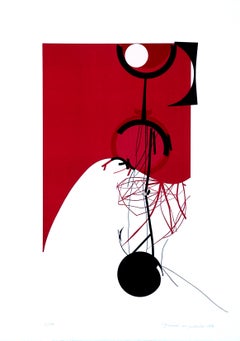
Find a wide variety of authentic Gianni Polidori art available for sale on 1stDibs. If you’re browsing the collection of art to introduce a pop of color in a neutral corner of your living room or bedroom, you can find work that includes elements of red and other colors. You can also browse by medium to find art by Gianni Polidori in lithograph and more. Much of the original work by this artist or collective was created during the 20th century and is mostly associated with the abstract style. Not every interior allows for large Gianni Polidori art, so small editions measuring 1 inch across are available. Customers who are interested in this artist might also find the work of Luigi Gheno, Claudio Verna, and Elio Marchegiani. Gianni Polidori art prices can differ depending upon medium, time period and other attributes. On 1stDibs, the price for these items starts at $225 and tops out at $302, while the average work can sell for $297.

Artists Similar to Gianni Polidori