H. W. Standing Art

to
3
Overall Width
to
Overall Height
to
2
1
3
3
2
1
1
1
3
3
2
3
10,218
2,810
2,500
1,398
3
3
Artist: H. W. Standing
Related Items
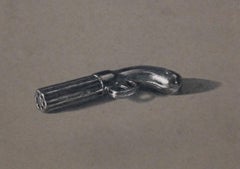
Gun from Clue
Gun from Clue

A.J. FriesGun from Clue, 2016

$1,200

H 11 in W 14 in

Gun from Clue

By A.J. Fries

Located in Buffalo, NY

An original mixed media drawing by American artist A.J. Fries.

Category

21st Century and Contemporary Realist H. W. Standing Art

Materials

Gouache, Graphite, Paper

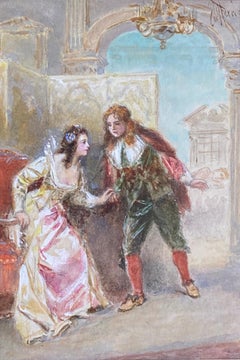
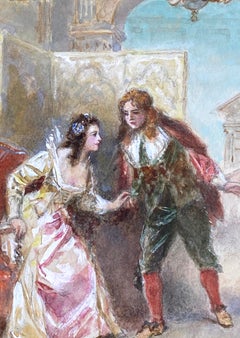
“A Page of Love”
“A Page of Love”

Jean Leon Gerome Ferris“A Page of Love”, Circa 1890

$1,200Sale Price|35% Off

H 5.5 in W 3.75 in D 1.25 in

“A Page of Love”

By Jean Leon Gerome Ferris

Located in Southampton, NY

Here is a wonderful original watercolor and gouache depicting a scene from Emile Zola book “A Page of Love” by the American artist, Jean Leon Gerome Ferris....

Category

1890s Victorian H. W. Standing Art

Materials

Watercolor, Gouache, Archival Paper

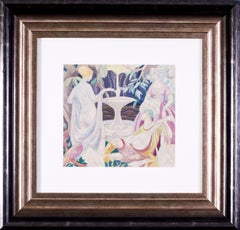
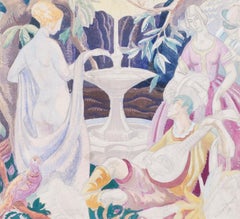
A musical idyll; and The masked ball (a pair)

A musical idyll; and The masked ball (a pair)

Located in Petworth, West Sussex

Walpole Champneys (British, 1879 – 1961) A musical idyll; and The masked ball (a pair) The former signed and dated ‘W.CHAMPNEYS /.28.’ Pencil and watercolour and gouache on paper The...

Category

Early 20th Century Art Deco H. W. Standing Art

Materials

Paper, Watercolor, Gouache, Pencil

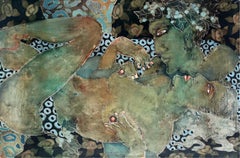
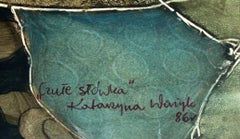
Tender words - XX Century, Mixed Media Figurative Painting, Nude, Couple

Tender words - XX Century, Mixed Media Figurative Painting, Nude, Couple

By Katarzyna Wazyk

Located in Warsaw, PL

Gabryela Wasowicz is a Polish painter born in 1947. She studied at the Academy of Fine Arts of Warsaw and then at the Gerrit Rietveld Akademie in Amsterdam. Once she graduated in 197...

Category

1980s Contemporary H. W. Standing Art

Materials

Paper, Pastel, Watercolor, Gouache

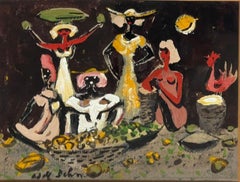
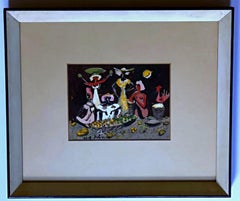
Adolf Dehn, Haitian Scene A, signed painting, Associated American Artists, 1950s

Adolf Dehn, Haitian Scene A, signed painting, Associated American Artists, 1950s

By Adolf Arthur Dehn

Located in New York, NY

Adolf Arthur Dehn Haitian Scene A, ca. 1951 Watercolor gouache on board Signed on the front Frame included: held in vintage modern frame Measurements: Framed: 11 inches vertical by 13 inches horizontal by .75 Painting 4.5 inches by 6 inches Watercolor gouache, hand signed; framed with AAA Gallery label verso Signed on the front bearing the original label on the verso of Dehn's longtime gallery, the prestigious Associated American Artists Gallery, New York City. Provenance Associated American Artists Frame included: held in vintage frame with original label as provenance Dehn, an influential artist and teacher (and author of the definitive textbook of his era on watercolor painting) joined Associated American Artists gallery in 1941. Although this painting is undated, it is likely circa early 1950s, as in 1951 Dehn won a Guggenheim Fellowship, which enabled him to travel to Haiti -- the subject of this work. It was part of a series inspired by Dehn's visit to Haiti. Dehn, an influential artist and teacher (and author of the definitive textbook of his era on watercolor painting) joined Associated American Artists gallery in 1941. Although this painting is undated, it is likely circa early 1950s, as in 1951 Dehn won a Guggenheim Fellowship, which enabled him to travel to Haiti. ADLOF DEHN Adolf Dehn, American Watercolorist and Printmaker, 1895-1968 Adolf Dehn was an artist who achieved extraordinary artistic heights, but in a very particular artistic sphere - not so much in oil painting as in watercolor and lithography. Long recognized as a master by serious print collectors, he is gradually gaining recognition as a notable and influential figure in the overall history of American art. In the 19th century, with the invention of the rotary press, which made possible enormous print runs, and the development of the popular, mass-market magazines, newspaper and magazine illustration developed into an artistic realm of its own, often surprisingly divorced from the world of museums and art exhibitions, and today remains surprisingly overlooked by most art historians. Dehn in many regards was an outgrowth of this world, although in an unusual way, since as a young man he produced most of his illustrative work not for popular magazines, such as The Saturday Evening Post, but rather for radical journals, such as The Masses or The Liberator, or artistic "little magazines" such as The Dial. This background established the foundation of his outlook, and led later to his unique and distinctive contribution to American graphic art. If there’s a distinctive quality to his work, it was his skill in introducing unusual tonal and textural effects into his work, particularly in printmaking but also in watercolor. Jackson Pollock seems to have been one of many notable artists who were influenced by his techniques. Early Years, 1895 - 1922 For an artist largely remembered for scenes of Vienna and Paris, Adolf Dehn’s background was a surprising one. Born in Waterville, Minnesota, on November 22, 1895, Dehn was the descendent of farmers who had emigrated from Germany and homesteaded in the region, initially in a one-room log cabin with a dirt floor. Adolf’s father, Arthur Clark Dehn, was a hunter and trapper who took pride that he had no boss but himself, and who had little use for art. Indeed, during Adolf’s boyhood the walls of his bedroom and the space under his bed were filled with the pelts of mink, muskrats and skunks that his father had killed, skinned and stretched on drying boards. It was Adolf’s mother, Emilie Haas Dehn, a faithful member of the German Lutheran Evangelical Church, who encouraged his interest in art, which became apparent early in childhood. Both parents were ardent socialists, and supporters of Eugene Debs...

Category

1950s Modern H. W. Standing Art

Materials

Watercolor, Gouache, Board

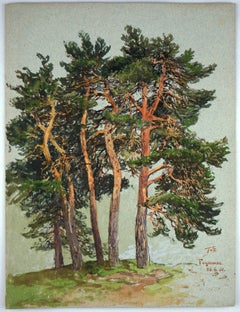
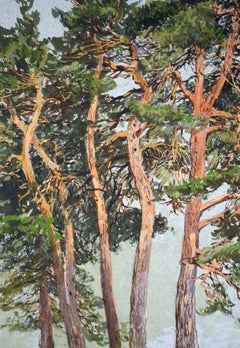
Norwegian Pine Grove - The inner glow of the trees -

Norwegian Pine Grove - The inner glow of the trees -

Located in Berlin, DE

Themistokles von Eckenbrecher (1842 Athens - 1921 Goslar), Norwegian pine grove, 1901. Watercolor on blue-green paper, 30 x 22 cm. Signed, dated and inscribed in his own hand "TvE. Fagermes [i.e. Fagermes]. 26.6.[19]01." - Slight crease throughout at left margin, otherwise in good condition. About the artwork Themistokles von Eckenbrecher often traveled to Norway to study the nature that fascinated him there. On June 26, 1901, near the southern Norwegian town of Fagernes, in the summer evening sun, he saw a small pine grove, which he immediately captured in a watercolor. He exposed the trees growing on a small hill in front of the background, so that the pines completely define the picture and combine to form a tense motif. The tension comes from the contrast of form and color. The trunks, growing upward, form a vertical structure that is horizontally penetrated by the spreading branches and the pine needles, which are rendered as a plane. This structural tension is further intensified by the color contrast between the brown-reddish iridescent trunks and branches and the green-toned needlework. Themistokles von Eckenbrecher, however, does not use the observed natural scene as an inspiring model for a dance of color and form that detaches itself from the motif and thus treads the path of abstracting modernism. Its inner vitality is to be brought to light and made aesthetically accessible through the work of art. It is precisely in order to depict the inner vitality of nature that von Eckenbrecher chooses the technique of watercolor, in which the individual details, such as the needles, are not meticulously worked out, but rather a flowing movement is created that unites the contrasts. The trees seem to have formed the twisted trunks out of their own inner strength as they grew, creatingthose tense lineations that the artist has put into the picture. The inner strength continues in the branches and twigs, culminating in the upward growth of the needles. At the same time, the trunks, illuminated by the setting sun, seem to glow from within, adding an almost dramatic dimension to the growing movement. Through the artwork, nature itself is revealed as art. In order to make nature visible as art in the work, von Eckenbrecher exposes the group of trees so that they are bounded from the outside by an all-encompassing contour line and merge into an areal unity that enters into a figure-ground relationship with the blue-greenish watercolor paper. The figure-ground relationship emphasizes the ornamental quality of the natural work of art, which further enforces the artwork character of the group of trees. With the presentation of Themistokles von Eckenbrecher's artistic idea and its realization, it has become clear that the present watercolor is not a study of nature in the sense of a visual note by the artist, which might then be integrated into a larger work context, but a completely independent work of art. This is why von Eckenbrecher signed the watercolor. In addition, it is marked with a place and a date, which confirms that this work of nature presented itself to him in exactly this way at this place at this time. At the same time, the date and place make it clear that the natural work of art has been transferred into the sphere of art and thus removed from the time of the place of nature. About the artist Themistocles' parents instilled a life of travel in their son, who is said to have spoken eleven languages. His father, who was interested in ancient and oriental culture, was a doctor and had married Francesca Magdalena Danelon, an Italian, daughter of the British consul in Trieste. During a stay in Athens - Gustav von Eckenbrecher was a friend of Heinrich von Schliemann and is said to have given him crucial clues as to the location of Troy - Themistokles saw the light of day in 1842. After an interlude in Berlin, where Themistokles was educated at the English-American School, the journey began again. From 1850 to 1857 the family lived in Constantinople, after which the father opened a practice in Potsdam, where Themistokles, who wanted to become a painter, was taught by the court painter Carl Gustav Wegener. In 1861 the von Eckenbrechers left Potsdam and settled in Düsseldorf. There Themistokles received two years of private tuition from Oswald Aschenbach, who greatly admired the talented young artist. After his artistic training, he undertook extensive travels, often accompanied by Prince Peter zu Sayn-Wittgenstein, which took him to northern and eastern Europe, but above all to the Middle East and even to South America. The paintings that resulted from these journeys established his artistic reputation and led to his participation in large panoramas such as the 118 x 15 metre Entry of the Mecca Caravan into Cairo, painted for the City of Hamburg in 1882. 1882 was also the start of a total of 21 study trips to Scandinavia, most of them to Norway, and the unique Norwegian landscape with its rugged fjords became a central motif in his work. Along with Anders Askevold and Adelsteen Normann...

Category

Early 1900s Naturalistic H. W. Standing Art
Materials

Watercolor

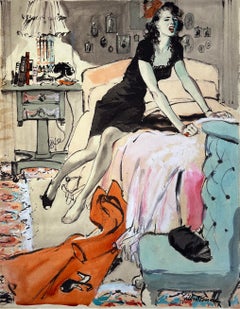
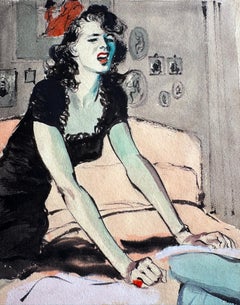
Love Hurts Mid Century Woman's Magazine Illustration Cosmopolitan Magazine

Love Hurts Mid Century Woman's Magazine Illustration Cosmopolitan Magazine

Located in Miami, FL

Love hurts. A young, attractive woman is captured in a moment of peak drama. She is leaning on her bed in her room, crying, her face grim with despair. A tear drop is seen below he...

Category

1940s American Modern H. W. Standing Art
Materials

Paper, Watercolor, Gouache, Pencil

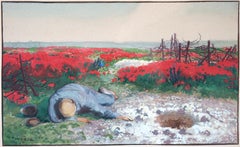
Red blooming war landscape with dead soldier - Bleeding flowers -

Red blooming war landscape with dead soldier - Bleeding flowers -

Located in Berlin, DE

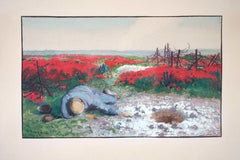
Johannes Friedrich Heinrich Hänsch (1875-1945), Red blooming war landscape with dead soldier, 1918. Watercolor and gouache on paper, 15 x 24.5 cm (image), 27 x 37 cm (sheet size / frame), monogrammed and dated "19JH18" at lower left. - Paper slightly darkened About the artwork Despite the relatively small format, the watercolor with an internal frame depicts a panoramic view of a flat landscape stretching to the horizon. As far as the eye can see, the poppies bloom in flaming red. The flowers are not rendered individually, however, creating an almost cohesive red surface. The bright red is interspersed with vegetal green. A complementary contrast that creates an intense color effect. In this color contrast, a white area breaks through from the middle ground, widening towards the foreground and surrounding a brown hole. Next to it, in blue, is the actual protagonist of the painting, the first thing that catches the eye: a dead soldier. Next to him is his helmet, revealing the empty interior. The brown, hollow shape corresponds to the hole in the ground. A shell funnel is surrounded by bright ash, which, like the inverted helmet, becomes a sign of death. The soldier's arms point to the funnel, while the empty helmet paraphrases the calotte of the skull and, like the funnel, thematizes the empty darkness of death. The soldier's body, however, is intact and not - as in Otto Dix's triptych "The War" - a dismembered corpse. Instead, Johannes Hänsch activates the landscape, especially the color, to illustrate a blooming landscape of death that extends from the shell funnel in the foreground to the rising column of smoke on the horizon. If the soldier's body is intact, the tangle of barbed wire emblematically placed over the empty helmet also appears tattered. On the right side of the picture, the barbed wire even seems to stretch its arms to the sky in horror. Against the background of this allegory, the content of the bright red also becomes clear: the landscape is drenched in blood, literally a sea of blood, and the single unknown soldier stands pars pro toto for all those who died on the battlefield. Dying in war is not dying in community, but in solitude. In order to emphasize the isolation in death, Johannes Hänsch has set the blue of the soldier in the axis given by his body in the middle ground of the picture into the red sea. A master of landscape painting, Hänsch succeeds in creating a natural-looking landscape allegory that illustrates the horror and death of war, without depicting the brutality of war itself. This singular 'war memorial' of the unknown soldier is the opposite of heroization and yet the dignity of the deceased soldier is preserved through the integrity of his body. About the artist As the son of the sculptor Adolf Haensch, the young Johannes received his first artistic training in his father's Berlin studio. However, he eventually decided to become a painter, and in 1897 he entered the Berlin Academy of Arts. He initially studied under Paul Vorgang and Eugen Bracht, and was particularly influenced by Bracht's increasingly colourful landscape painting. In 1901 he moved to the class of Friedrich Kallmorgen, with whom he spent several weeks on excursions into nature. In 1905 he became a master pupil of Albert Hertel, who taught him watercolour painting. From 1903 to 1933 he exhibited annually at the Great Berlin Art Exhibition, the exhibitions of the Berlin Artists' Association and the Munich Glaspalast. In 1905 he was awarded the Carl Blechen...

Category

1910s Realist H. W. Standing Art
Materials

Watercolor

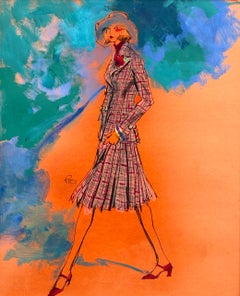
“Woman in Plaid”
“Woman in Plaid”

“Woman in Plaid”

By Kenneth Paul Block

Located in Southampton, NY

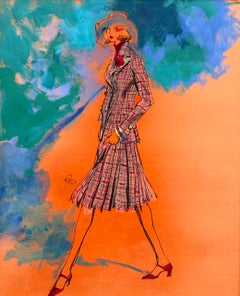
Here for your consideration is an original watercolor and gouache with traces of acrylic paint fashion illustration by the world renowned fashion artist, Kenneth Paul Block. Painted ...

Category

1960s American Modern H. W. Standing Art
Materials

Acrylic, Watercolor, Gouache, Archival Paper

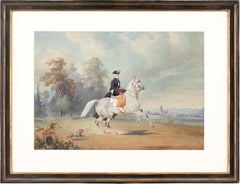
C.1860 Austrian School Lady Riding A Grey Horse In Landscape, Watercolour

C.1860 Austrian School Lady Riding A Grey Horse In Landscape, Watercolour

Located in Cheltenham, GB

This charming mid-19th-century European watercolour depicts a young lady riding a grey mare before a view of Berg Perchtoldsdorf, Austria. During the 19th century, aristocratic wome...

Category

1860s Victorian H. W. Standing Art
Materials

Paper, Watercolor, Gouache

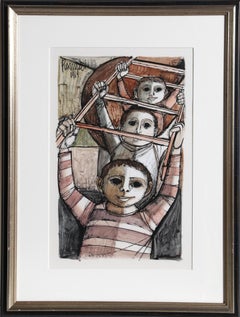
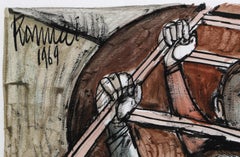
Three Boys, Modern Gouache Painting by Lucio Ranucci

Three Boys, Modern Gouache Painting by Lucio Ranucci

By Lucio Ranucci

Located in Long Island City, NY

Artist: Lucio Ranucci, Italian (1925 - ) Title: Three Boys Year: 1969 Medium: Gouache, signed and dated Image Size: 19 x 11.5 inches Frame Size: 29.5 x 22 inches

Category

1960s Modern H. W. Standing Art
Materials

Gouache

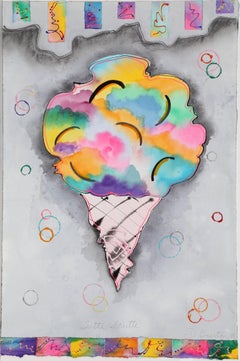
Tutti Frutti, Pop Art Watercolor and Mixed Media Artwork by D. Burton

Tutti Frutti, Pop Art Watercolor and Mixed Media Artwork by D. Burton

By D. Burton

Located in Long Island City, NY

Artist: D. Burton, American Title: Tutti Frutti Year: 1988 Medium: Watercolor and Mixed Media on Paper, signed and dated in pencil Size: 30 x 20 in. (76.2 x 50.8 cm)

Category

1980s Pop Art H. W. Standing Art
Materials

Mixed Media, Watercolor

H. W. Standing art for sale on 1stDibs.

Find a wide variety of authentic H. W. Standing art available for sale on 1stDibs. If you’re browsing the collection of art to introduce a pop of color in a neutral corner of your living room or bedroom, you can find work that includes elements of orange and other colors. You can also browse by medium to find art by H. W. Standing in paint, watercolor, gouache and more. Not every interior allows for large H. W. Standing art, so small editions measuring 22 inches across are available. Customers who are interested in this artist might also find the work of Paul Lecomte, Worth Brehm, and Anne Diggory. H. W. Standing art prices can differ depending upon medium, time period and other attributes. On 1stDibs, the price for these items starts at $1,800 and tops out at $2,500, while the average work can sell for $2,200.

Artists Similar to H. W. Standing