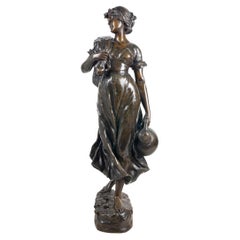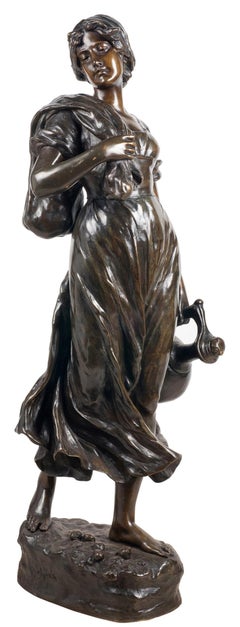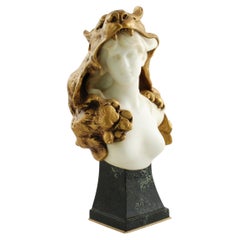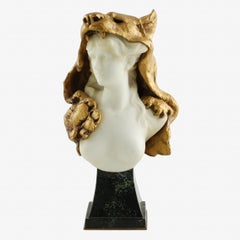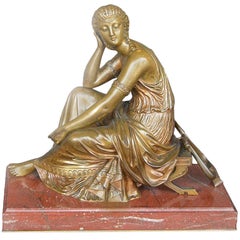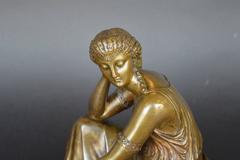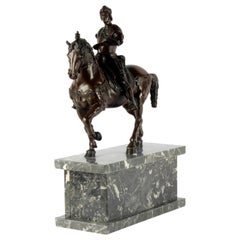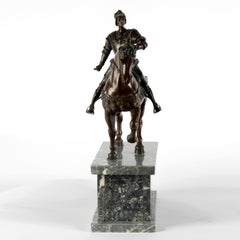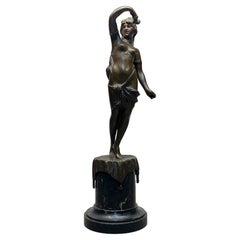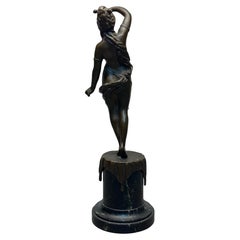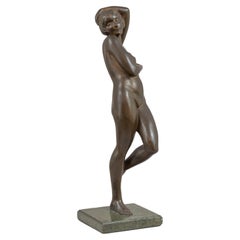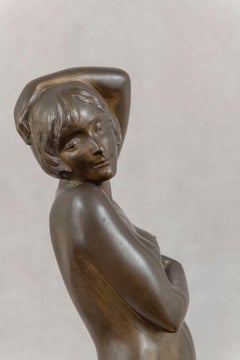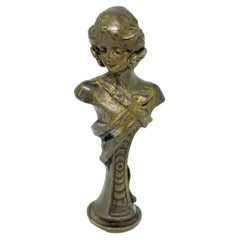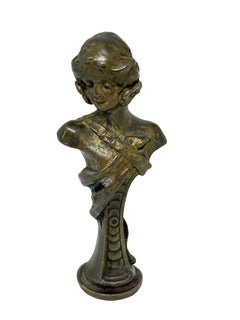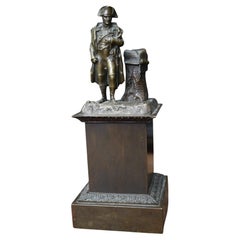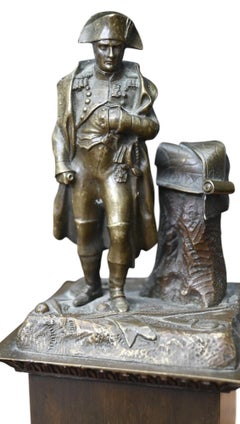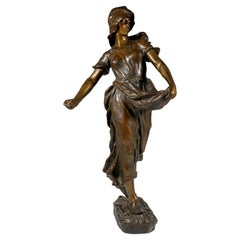
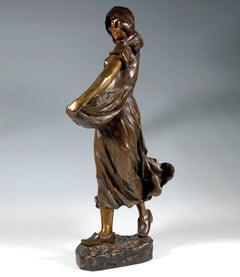
'La Sémeuse', Large Art Nouveau Bronze Figure After Oscar Roty, Vienna, Ca 1899
By Hans Schörk
Located in Vienna, AT
A young woman in a long dress with short sleeves, softly enveloping her body, with a scarf covering her hair and falling well over her face to protect her from the burning sun, walking across the field at a leisurely pace, holding out her apron with the seeds spread out in front of her with her left hand and making a sweeping gesture with her right. On a narrow, elongated natural plinth with rounded corners, with the artist's signature ‘Schork 99’ incised on the side, as well as the Goldscheider manufactory's pressed stamp, pressed model number and incised monogram ‘AH’ on the back behind the figure. This motif is particularly well known in France, where it adorned all French franc coins and postage stamps for many years and was continued in a stylised form on all cent coins of the euro after 2001. Louis Oscar Roty (1846 - 1911) This sower is very familiar to the French: she was depicted on the fifty-centime coin and on the one-, two- and five-franc coins until 2001, when a stylised version of her appeared on the ten-, twenty- and fifty-centime coins of the euro. The figure dates back to 1887, when Roty designed a prize medal for the Ministry of Agriculture, a project that was not pursued. When the Minister of Finance commissioned new coins in 1896, Roty was among the selected artists. He drew on the Sower of 1887, but transformed his robust farmer into a slender Marianne, who wore the Phrygian cap of freedom. The traditional profile of the Republic was abandoned in favour of a more active, standing figure. This effigy was criticised, but generally very well received: ‘The seeds she generously throws into the earth are the countless ideas that may one day germinate and flourish when we are no longer here’ (La Liberté, 8 October 1898). The gesture is more symbolic than realistic – we do not sow against the wind, which nevertheless makes the hair behind the sower flutter – but it makes the composition more dynamic. Originally, ‘The Sower’ was used on the fifty-centime to two-franc coins introduced in 1897 and 1898, before appearing on postage stamps in 1903. It is thus the most widely circulated work of art in France. Although not included in the Musée d'Orsay's medal collection, this wax drawing on slate, typical of the technique of a medallist, is one of the most beautiful pieces and demonstrates the virtuosity of Roty. (Musée d'Orsay, The Collections) Design by HANS SCHORK...
Early 1900s Austrian Art Nouveau Antique Hans Schörk Furniture
Bronze