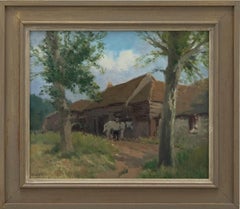
Harry Emerson Lewis Paintings

to
1
Overall Width
to
Overall Height
to
1
1
1
1
1
1
1
775
759
754
666
1
1
Artist: Harry Emerson Lewis
Related Items
Michael Sanders, A Walk in Felbrigg, Original Landscape Painting Traditional Art

Michael Sanders, A Walk in Felbrigg, Original Landscape Painting Traditional Art

By Michael Sanders

Located in Deddington, GB

MICHAEL SANDERS A Walk at Felbrigg Original mixed-media painting Mixed-media on canvas Canvas Size: H 90cm x W 90cm x D 3.8cm Sold Unframed Ready to Hang Please note that in situ ima...

Category

21st Century and Contemporary Impressionist Harry Emerson Lewis Paintings

Materials

Canvas, Oil

Painting of horses and farm animals by Herring the Younger

Painting of horses and farm animals by Herring the Younger

By John Frederick Herring Jr

Located in London, GB

Painting of horses and farm animals by Herring the Younger British, 19th Century Frame: Height 83cm, width 97cm Canvas: Height 64cm, width 77cm This charming painting is by John Fre...

Category

19th Century Harry Emerson Lewis Paintings

Materials

Canvas, Oil

Landscape American Hungarian European Modernism 1938 Realism Long Island WPA era

Landscape American Hungarian European Modernism 1938 Realism Long Island WPA era

By Stephen Csoka

Located in New York, NY

Landscape American Hungarian European Modernism 1938 Realism Long Island WPA era. The canvas measures 18” x 20". The artist signed the stretcher as well as the canvas. The scene depicts a spots in New York where Queens borders with Nassau county, Rosedale, which abuts the Five Towns. The border runs through Hook Creek, another painting we are currently offering. Stephen (Istvan) Csoka was born in Gárdony, Hungary on January 2, 1897 and died in New York in 1989. He is best remembered as a painter and etcher of portraits, nudes, landscapes, genre, and horses. Csoka studied at the Budapest Royal Academy of Art and his memberships include Associate of the National Academy of Design in New York City; the Society of American Etchers in Brooklyn, NY; the Society of Brooklyn Artists; and the Hungarian Etchers Association. Csoka's exhibitions and awards include a medal at the Barcelona International Exhibition in 1929; a prize at the City of Budapest Exhibit in 1930; prizes at the Society of American Etchers in 1942 and 1945; prizes at the Library of Congress in 1944 and 1946; a prize at the Society of Brooklyn Artists in 1944; a prize at the Philadelphia Watercolor Club in 1945; the Corcoran Gallery of Art in 1945; the Carnegie Institute in 1943, 1944, and 1945; the Art Institute of Chicago in 1944; the Los Angeles Museum of Art in 1945; the National Academy of Design from 1940 through 1945; one-artist shows at the Contemporary Artists in 1940, 1943, and 1945; and the Minneapolis State Fair in 1943. *Stephen continued to recieve awards and exhibit his work throughout his life. In 1997, Hofstra Museum sponsored a Retrospective/Centennial exhibition in honor of his birth. Collections representing Csoka's work are the Metropolitan Museum of Art, New York, NY; the Brooklyn Museum, Brooklyn, NY; the Museum of Fine Arts, Boston, MA; the British Museum, London, England; the Bezalel National Museum, Jerusalem, Israel; the Butler Institute of American Art, Youngstown, Ohio; Whistler House Museum of Art, Lowell, MA; the Cleveland Museum of Art, Cleveland, OH; Columbus Museum of Art, Columbus, OH; the Sheldon Swope Art Museum, Terre Haute, IN; the Mobile Museum of Art, Mobile, AL; the Frederick R. Weisman Art Museum, Minneapolis, MN; the Museum of New Mexico, Santa Fe, NM; the Budapest Museum of Fine Arts, Budapest, Hungary; Hungarian National Gallery, Budapest, Hungary, the Museum of the City of Budapest, Budapest, Hungary; the Library of Congress, Washington, DC; Carnegie Museums of Pittsburgh, Pittsburgh, PA; the Chrysler Museum of Art, Norfolk, VA; Georgia Museum of Art, Athens, GA; Hofstra Museum, Hofstra University, Hempstead, NY; Holocaust Museum, Glen Cove, NY; National Academy of Art, New York, NY; New Orleans Museum of Art, New Orleans, LA; New York Historical Society, New York, NY;New York Public Library, New York, NY; National Gallery of Art, Washington, DC; Peabody Museum, Cambridge, MA; Pennsylvania Academy of the Fine Arts, Philadelphia, PA; Reading Public Museum, Reading, PA; Livingston Arts Center, Mount Morris, NY; Ball State Teachers College, Muncie, IN; City College, New York, NY; Fashion Institute of Technology, New York, NY; Hungarian Consulate, New York, NY; Hungarian Heritage, New Brunswick, NJ; Hunter College, New York, NY; IBM Collections; Princeton Print Club...

Category

1930s Realist Harry Emerson Lewis Paintings

Materials

Canvas, Oil

"Bluebonnets Texas Hill Country"

"Bluebonnets Texas Hill Country"

Located in San Antonio, TX

Robert Wood (G. Day) (1889 -1979) San Antonio Artist Image Size: 20 x 24 Frame Size: 29 x 33 Medium: Oil Signed Lower left "Bluebonnet" Biography Robert Wood (G. Day) (1889 -1979) A painter of realistic landscapes reflecting a vanishing wilderness in America, Robert Wood (not to be confused with Robert E. Wood) is reportedly one of the most mass-produced artists in the United States. His painting became so popular he was unable to meet all of the demands, and many of his works were reproduced in lithographs and mass distributed as prints, place mats, and wall murals by companies including Sears, Roebuck. He was born in Sandgate, Kent on the south coast of England near Dover, the son of W.L. Wood, a famous home and church painter who recognized and supported his son's talent. In fact, he forced his son to paint by keeping him inside to paint rather than playing with his friends. At age 12, Wood entered the South Kensington School of Art. As a youth, he came to the United States in 1910, having served in the Royal Army, and he never returned to England. He traveled extensively all over the United States, especially in the West, often in freight cars, and also painted in Mexico and Canada. His itinerant existence took him to Illinois where he worked as a farmhand, to Pensacola, Florida where he married, briefly in Ohio, Seattle, Washington, and Portland, Oregon. In 1912, he was in Los Angeles, and in the late 1920s and early 1930s, in San Antonio, Texas, where he lived and in 1928 exhibited in the "Texas Wildflower Competition." From San Antonio, he gained a national reputation for his strong colored, dramatic paintings. Some of that prestige has been credited to his association with Jose Arpa, prominent Texas artist. Wood also gave art lessons, and one of his students was Porfirio Salinas. During this period, Wood sometimes signed his paintings G. Day or Trebor, which is Robert spelled backwards. In 1941 he went to California and painted numerous desert and mountain landscapes and coastal scenes. He lived in Carmel for seven years, and then moved to Woodstock, New York, but he soon returned to California, settling first in Laguna Beach, then San Diego, and finally in the High Sierras, where he and his wife built a home and studio near Bishop and lived until his death in 1979. Robert Wood was born March 4, 1889, in Sandgate, England, a small town on the Kentish coast not far from the white cliffs of Dover. His father, W. J. Wood, was a successful painter who recognized Robert's unusual talent. At the age of twelve, his father enrolled Wood in art school in the small town of Folkstone. He then attended the South Kensington School of Art. While attending art school, Wood won four first awards and three second awards, one each year, a record. In 1910 after service in the Royal Army, nineteen-year-old Wood and his friend, Claude Waters, immigrated to America. Initially, he settled in Illinois and worked as a hired hand on a farm belonging to Water's uncle. He would then strike out on his own, living the life of an itinerant painter. Wood traveled as a hobo, hopping freight trains and selling or bartering small paintings to support him along the way. When times were hard, he worked at whatever job was available. In this manner, he saw most of the United States and fell in love with rural America. By 1912, Wood visited Los Angeles for the first time, arriving on the day of the Titanic tragedy. Later that year, he had met, courted and married young Eyssel Del Wagoner in Florida. The couple moved to Ohio where a daughter, Florence, was born. During World War I, the family moved to Seattle where a son, John Robert Wood, was born in 1919. In the early 1920's, the young Wood family was almost constantly on the move. They stayed for short periods in Kansas, Missouri, California and for a longer time in Portland, Oregon, where Wood's friend Claude Waters had settled. Wood's seemingly endless wanderings disrupted his family life and delayed his development as a painter. However, through his travels he developed an appreciation for the American landscape that would inspire him for the rest of his career. Although aware of the current movement away from traditional realism in American art, he elected to travel that solitary path and remain true to his own vision of American’s grandeur and beauty poetically translated through his landscape and seascape paintings. In 1923, the Wood family discovered the beautiful city of San Antonio, Texas and it was there that he and his family would finally settle. He studied briefly at the San Antonio Art School with Spanish colorist Jose Arpa y Perea (1860-1952), who had arrived in San Antonio that same year. In the latter part of the 1920’s, Jose Arpa’s influence quickly became evident. Wood after several years of experimentation was becoming fine easel painter, capable of great subtlety with a new mature original style. Like Texas painters Robert Onderdonk (1853-1917) and his son Julian Onderdonk (1882-1922), Robert Wood concentrated on the distinctive Texas landscape with its Red Oak trees and wildflowers that covered the hill country landscape. He developed a reputation for his scenes of Blue Bluebonnets, the state flower. In the spring, the Texas prairie is covered with wildflowers, especially in the hill country surrounding San Antonio and Austin. Wood incorporated native stone barns and rough wood farmhouses that added authenticity and romance to his compositions. In 1925, Wood was divorced from his wife. In 1932, he moved to the famous scenic loop on San Antonio's outskirts. While still living in Texas, he took extensive western sketching trips that brought him to California. It is evident that his 1930’s California...

Category

1950s Impressionist Harry Emerson Lewis Paintings

Materials

Oil
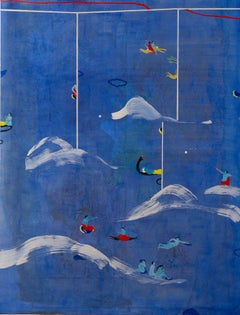
‘Cottage By a River’ post impressionist original oil on board, framed

‘Cottage By a River’ post impressionist original oil on board, framed

Located in Hillsborough, NC

Post Impressionist painting by J. Samuel LaMorna Birch (1869-1955) of French style stucco cottage, with blocks of color reflected in the still river waters. Masterful artist of water...

Category

Early 20th Century Post-Impressionist Harry Emerson Lewis Paintings

Materials

Oil, Board

An Italianate landscape with a messenger & his horse on a wooded path, a lake

An Italianate landscape with a messenger & his horse on a wooded path, a lake

Located in Stoke, Hampshire

John Tobias Young (1786-1828) An Italianate landscape with a messenger & his horse on a wooded path, a lake & ancient ruins beyond Signed & dated “J. Young 1821” lower centre Oil on ...

Category

19th Century Old Masters Harry Emerson Lewis Paintings

Materials

Oil
Oil Painting by James Maule "Fishing Boats going out"

Oil Painting by James Maule "Fishing Boats going out"

Located in Mere, GB

Oil Painting by James Maule "Fishing Boats going out" 1835 - 1863 Lewisham painter of marine subjects. Exhibited regularly in London represented in the Enfield Museum. Oil on canvas....

Category

19th Century Harry Emerson Lewis Paintings

Materials

Oil
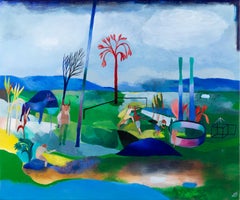
Vintage New England Countryside   Landscape Oil Painting 1950's

Vintage New England Countryside Landscape Oil Painting 1950's

Located in Douglas Manor, NY

3765 New England landscape painting Set in a hand carved wood frame Image size 7.5x9.5"

Category

1940s Harry Emerson Lewis Paintings

Materials

Oil
"Porte Saint-Denis, Paris", Early 20th Century Oil on Canvas by Joaquín Pallares

"Porte Saint-Denis, Paris", Early 20th Century Oil on Canvas by Joaquín Pallares

Located in Madrid, ES

JOAQUÍN PALLARÉS ALLUSTANTE Spanish, 1853 - 1935 PORTE SAINT - DENIS signed "J. Pallares" (lower left) oil on canvas 10-1/2 x 15-3/4 inches (26.5 x 40...

Category

Early 1900s Realist Harry Emerson Lewis Paintings

Materials

Canvas, Oil

Hermanus Koekkoek Jr Dutch Harbor Scene Oil Jan van Couver Painting

Hermanus Koekkoek Jr Dutch Harbor Scene Oil Jan van Couver Painting

Located in Stockholm, SE

This atmospheric harbour scene by Hermanus Koekkoek Jr., working under the pseudonym Jan van Couver, exemplifies the artist’s mature approach to maritime and town views during his London period. The composition presents a Dutch waterfront animated by boats, windmills, and clustered buildings, all set beneath a vast and dynamic sky. The emphasis on shifting weather conditions and the interaction between water, light, and architecture reflects a deep engagement with both tradition and contemporary developments in nineteenth century painting. Koekkoek belonged to one of the most distinguished artistic dynasties in the Netherlands. As the son of Hermanus Koekkoek the Elder and nephew of Barend Cornelis Koekkoek, he inherited a strong foundation in landscape and marine painting. His early training within the family atelier in Amsterdam provided him with a disciplined understanding of composition and natural observation. However, his later move to London in 1869 marked a decisive shift in both style and market orientation. It was during this period that he adopted the name Jan van Couver, a strategic choice that aligned his work with a broader European appeal. The present painting reveals a confident and increasingly free handling of paint. The foreground water is rendered with swift horizontal strokes that capture the movement of the surface, while the boats and harbour structures are constructed through more concentrated applications of pigment. The use of impasto is particularly notable, lending the painting a tactile presence and enhancing the interplay between light and texture. This painterly richness contributes to a vivid sense of immediacy, as if the scene were observed directly on site. The sky dominates the composition, occupying a large portion of the pictorial space. Broad, swirling brushstrokes articulate the mass of clouds, which appear to gather and disperse in response to changing atmospheric conditions. This treatment reflects the influence of the Hague School, whose artists sought to convey the mood and variability of the Dutch landscape through tonal harmony and expressive brushwork. Koekkoek’s interpretation is more animated, however, suggesting an openness to impressionistic tendencies that were gaining ground across Europe. At the same time, the painting remains anchored in a clear compositional structure. The line of the harbour guides the viewer’s eye into the distance, where the forms dissolve into a softer haze. The presence of windmills, a quintessential feature of the Dutch landscape, reinforces the sense of place while also introducing vertical accents that balance the horizontal expanse of water and sky. The architecture is suggested rather than fully defined, allowing atmosphere and light to take precedence over detail. Koekkoek’s work occupies an interesting position between tradition and modernity. While rooted in the conventions of Dutch marine painting...

Category

Late 19th Century Post-Impressionist Harry Emerson Lewis Paintings

Materials

Canvas, Oil

"Timberline" - Impressionist Mountain Landscape, Oil Painting on Board

"Timberline" - Impressionist Mountain Landscape, Oil Painting on Board

By G. Russell Case

Located in Denver, CO

Born in Cedar City, Utah, Russell was heavily influenced to paint by his father–an accomplished painter and artist in his own right, who spent most of his career as a graphic illus...

Category

2010s Realist Harry Emerson Lewis Paintings

Materials

Oil, Board

Hanging Clothes to Dry, Post Cover

Hanging Clothes to Dry, Post Cover

By John Philip Falter

Located in Fort Washington, PA

The Saturday Evening Post, April 7, 1945, Cover Illustration. Stated on page 4 of the Post: Just to show you how cover artists work, we asked John Falter to send us one of his early...

Category

1940s Harry Emerson Lewis Paintings

Materials

Oil
Previously Available Items
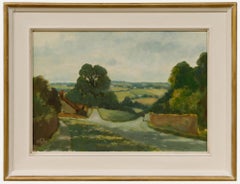
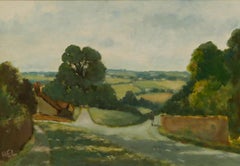
H. E. Lewis - Framed Mid 20th Century Oil, Vicarage Lane, Hailsham

H. E. Lewis - Framed Mid 20th Century Oil, Vicarage Lane, Hailsham

By Harry Emerson Lewis

Located in Corsham, GB

H. E. Lewis, oil on board. A serene rural scene with narrow lanes snaking past lush greenery and quaint country cottages. Presented in a contemporary white frame with gilt detail. Si...

Category

20th Century Harry Emerson Lewis Paintings

Materials

Oil
Harry Emerson Lewis paintings for sale on 1stDibs.

Find a wide variety of authentic Harry Emerson Lewis paintings available for sale on 1stDibs. You can also browse by medium to find art by Harry Emerson Lewis in oil paint, paint and more. Not every interior allows for large Harry Emerson Lewis paintings, so small editions measuring 19 inches across are available. Customers who are interested in this artist might also find the work of Leigh Ann Van Fossan, Stephanie Buer, and Richard Levine. Harry Emerson Lewis paintings prices can differ depending upon medium, time period and other attributes. On 1stDibs, the price for these items starts at $688 and tops out at $688, while the average work can sell for $688.