Hendrik Goudt Art

to
1
Overall Width
to
Overall Height
to
1
1
1
1
1
1
1
1
10,043
2,758
1,381
1,375
1
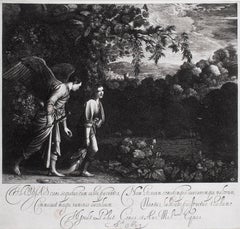
Artist: Hendrik Goudt
Tobias and the Angel
By Hendrik Goudt
Located in Chicago, IL
References: Bartsch, Dutuit and Hollstein 2
Category

17th Century Old Masters Hendrik Goudt Art

Materials

Engraving

Related Items
18th C. Portrait of Edward Stanley from Henry VIII's Court after Holbein Drawing
By Hans Holbein
Located in Alamo, CA
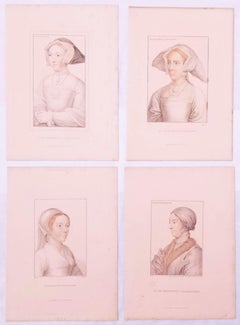
This is an 18th century engraved portrait of "Edward Stanley" created by Francesco Bartolozzi (1728–1815), after a drawing by Hans Holbein the Younger (1497- 1543) in the 16th century. Holbein was the official artist in the court of King Henry VIII. Bartolozzi used both etching and stipple engraving techniques to create the work which was published by John Chamberlaine in London in 1793 in "The Book of Imitations of Original Drawings by Hans Holbein in the Collection of His Majesty". Edward Stanley, 3rd Earl of Derby...
Category

Late 18th Century Old Masters Hendrik Goudt Art

Materials

Engraving, Etching

Limon Lavrae: A 17th C. Hand-colored Engraving of Lemon Anatomy by G. Ferrari
By Giovanni Battista Ferrari
Located in Alamo, CA
This 17th century hand-colored engraving of a lemon entitled "Limon Lavrae", plate 219 from Giovanni Baptista Ferrari's publication "Hesperides, sive, De Malorum Aureorum Cultura Etu...
Category

17th Century Old Masters Hendrik Goudt Art

Materials

Engraving

Ancient Roman Architecture: Original Framed 18th C. Etching by G. Piranesi
By Giovanni Battista Piranesi
Located in Alamo, CA
"Veduta del Sepolcro della Famiglia Plauzia per la Strada Che Conduce da Roma a Tivoli vicino a Ponte Lugano" from "Le Antichità Romane" (Roman Antiquities), one of the most famous works by Piranesi. "Antichita" illustrates the tombs along the Appian Way...
Category

Early 18th Century Old Masters Hendrik Goudt Art

Materials

Etching, Engraving, Drypoint

North and South America: An 18th Century Hand-colored Map by Johann Homann
By Johann Baptist Homann
Located in Alamo, CA
This early 18th century hand-colored copperplate map of North and South America entitled "Totius Americae Septentrionalis Et Meridionalis Novissima Repraesentatio" was created by Johann Baptist Homann and published in Nuremberg, Germany, between 1710 and 1731. The map details cities, forts, mountains, forests and lakes, as well as districts. There is a decorative cartouche in the lower left which depicts a volcano, scenes representing the people in their native costumes, as well as animals and plants of the Americas. A village is seen in the background on the left. A second smaller decorative cartouche in the upper right includes text and a series of allegorical figures. A large portion if the north central and western portions of North America is left without detail, because the region was largely unexplored at the time this map was created. The map also shows "Terra Esonis Incognita", representing a mythical continuous land bridge from North America to Asia, a northwest passage. The map preceded the French and...
Category

Early 18th Century Old Masters Hendrik Goudt Art

Materials

Engraving

Besler Hand Colored Botanical Engraving of Wood Pink & Cottage Pink Flowers
Located in Alamo, CA
A 17th century hand-colored copper plate engraving entitled "Caryophyllus Maior Sylve Strisvarie Gatus" (Wood Pink & Cottage Pink Flowers) from Basilius Besler's landmark work, Hortus Eystettensis (Garden at Eichstatt), first published in 1613 in Eichstatt, Germany near Nuremberg and later in 1640 and 1713. This engraving is presented in a silver and gold-colored wood frame with a green edge and three elaborate cream-colored French mats...
Category

17th Century Old Masters Hendrik Goudt Art

Materials

Engraving

Sir. John Powell, Knight: Early 18th C. Engraved Portrait After William Sherwin
Located in Alamo, CA
This is an early 18th century portrait of Sir John Powell entitled "The Honorable Sr. John Powell, Knight. one of the Justices of her Majesties' Court of Common Pleas. Ano. D 1711". It was engraved and published by John King in London in 1711, after an earlier work by William Sherwin. The engraving depicts a bust length portrait of Powell wearing an elaborate fir-trimmed robe and collar. The portrait is encompassed in an ornate oval frame, sitting on a pedestal with an impressive coat-of-arms below. This engraved portrait is printed on laid, chain-linked watermarked cream-colored paper The sheet measures 15.25" high and 11.38" wide. It is adhered to an archival thick card at the upper corners, There is a 1/8" tear at the lower edge of the sheet, but the print is otherwise in very good condition. This engraving is held by museums and institutions, including the British Museum and the Harvard University Art Museum. Sir John Powell (1632-1696) was an English lawyer and judge who served as a justice of the King's Bench from 1683 until his death. He was born in Glamorganshire, Wales, and studied at Jesus College, Oxford, before being called to the bar at the Middle Temple in 1656. Powell was known for his staunch support of the monarchy and the Church of England, and he played a prominent role in the trial of the Whig leader Lord William Russell in 1683, which resulted in Russell's execution for his alleged involvement in a plot to assassinate King Charles II. Powell was also involved in the trials of several other prominent Whig politicians, including Algernon Sidney and Titus Oates. In addition to his work as a judge, Powell was also a member of Parliament for various constituencies throughout his career, and he served as Solicitor General and Attorney General for Wales under King James II. However, he opposed James's efforts to promote Catholicism and supported the Glorious Revolution of 1688, which led to James's overthrow and the installation of William and Mary as joint monarchs. Powell was known for his intellectual rigor and his legal expertise, and he authored several influential legal treatises during his lifetime. He was widely respected by his peers and by the legal community as a whole, and his legacy as a jurist and judge continues to be celebrated today. William Sherwin (1645-1709) was an English engraver who worked during the late 17th and early 18th centuries. He was born in Chesterfield, Derbyshire, and is known for his high-quality engravings of various subjects, including portraits, landscapes, and architectural views. Sherwin was trained as an engraver and worked as an apprentice to the renowned engraver Robert White. After completing his training, he went on to establish his own studio in London, where he produced a significant body of work over the course of his career. One of Sherwin's most famous works is his engraving of the portrait of John Locke...
Category

Early 18th Century Old Masters Hendrik Goudt Art

Materials

Engraving

Vatican Hallway designed by Raphael: 18th C. Hand-colored Engraving by Volpato
By Giovanni Volpato
Located in Alamo, CA
This is an original 18th century hand-colored copper-plate engraving by Giovanni Volpato after a drawing by Camporesi. It was the frontispiece for volume one of the rare and valuable...
Category

Late 18th Century Old Masters Hendrik Goudt Art

Materials

Engraving

Besler Autumn Snowflake and Meadow Saffron Flowers: 17th C. Botanical Engraving
Located in Alamo, CA
A hand-colored copperplate engraving entitled "Leucoium bulbosum autumnale tenufolium (Autumn Snowflake); Colchicum vulgare Polyanthos; Colchicum biflorum; Colchicum vulgare album; C...
Category

17th Century Old Masters Hendrik Goudt Art

Materials

Engraving

Cartusia Bruxellensis Monastery in Brussels: A 17th C. Hand-colored Engraving
By Lucas Vorsterman the Younger
Located in Alamo, CA
This is a 17th century hand-colored copperplate engraving entitled "Cartusia Bruxellensis" by Lucas Vorsterman, the Younger, after a drawing by Jacob van Werden or Jacques van Weerden, published in 1659 in Antonius Sanderus' book 'Chorographia sacra Brabantiae sive celebrium aliquot in ea provincia ecclesiarum et coenobiorum descriptio . . . Brussel' (A sacred chorography of Brabant, or a description of several famous churches and convents in that province). It also appeared in other publications by Sanderus. In the 17th century, Brussels was within the Duchy of Brabant. This engraving depicts a bird's-eye view of the Scheut Carthusian Monastery in Brussels. Scheut is a district of Anderlecht, a municipality of Brussels, Belgium. The monastery housed monks, who took a vow of silence, in 20 rooms. There is a central courtyard with trees and shrubs. Monks are depicted strolling along its pathways. The cells for the friars are in the middle the cloister. There are people along the streets in the foreground and to the right of the large, imposing monastery. Some are on horseback, others are walking. In the lower right, what appears to be a dog pulls a small cart containing barrels, possibly of beer or wine. Districts and neighborhoods are labelled in the background, including Scheut, Anderlecht and Ransfort. A very ornate cartouche in the lower left contains Latin and the artist's attribution. Another decorative cartouche in the upper central area contains the title. This beautifully hand-colored and detailed engraving is printed on laid, chain-linked paper with wide, full margins. The sheet measures 17.25" high and 21.25" wide. It has Latin text on the verso. It has a central vertical fold, as issued, which is reinforced on the verso. Two small spots in the lower margin may actually represent drops of watercolor paint used to color the engraving. It is otherwise in very good condition. Antonius Sanderus (1586-1664) was a Flemish Catholic cleric and historian. He was born "Antoon Sanders", but Latinized his name like many writers and scholars of his time. He was the author of several books, including 'Chorographia Sacra Brabantiae', which was illustrated with this engraving. Lucas Vorsterman the Younger (1624-between 1666 & 1676) was a Flemish Baroque engraver and draughtsman. He produced engravings after the work of contemporary painters and for books by Antwerp publishers. Jacob van Werden or Jacques van Weerden (active 1643-1669), was a Flemish draughtsman, cartographer, military engineer and archer who was active in the Habsburg Netherlands. His drawings were used as designs for prints executed by various printmakers. He worked on maps, topographical views, historical scenes, portraits and book illustrations. He had a career as a military engineer and a member of the guard of the Spanish King. He advised on various military engineering projects and was an engineer of the Spanish army...
Category

Mid-17th Century Old Masters Hendrik Goudt Art

Materials

Engraving

Map of the World: An Original 18th Century Hand-colored Map by E. Bowen
Located in Alamo, CA
This is an original 18th century hand-colored map entitled "A New & Correct Chart of All The Known World Laid down according to Mercator's Projection" by Emanuel Bowen. It was published in 1744 in London in John Harris's "Navigantium atque Itinerantium Bibliotheca" or "A Complete Collection of Voyages and Travels". This highly detailed and colorful map depicts the world. as it was known in the mid 18th century. A majority of the northern and central portions of Canada and America are left blank due to the purity of knowledge at the time this map was published. The map is embellished with four Compass Roses in the lower left, lower center, lower right and center, along with many rhumb lines. There a is a decorative title cartouche in the upper left. This colorful, attractive, historical and interesting 1744 map presents the entire world on Mercator's projection as it was understood in the middle part of the 18th century, before the landmark explorations of Captain’s Cook, Vancouver, Wilkes and others. It is an example of a nautical chart, a type of map that was designed specifically for use by mariners. The map is centered on the equator and includes both the Eastern and Western Hemispheres. The continents of North America, South America, Europe, Africa, and Asia are depicted, as well as various islands in the Atlantic, Pacific, and Indian Oceans. The map is laid out according to the Mercator projection, a type of cylindrical map projection that was developed in the 16th century by Flemish cartographer Gerardus Mercator. This projection has the advantage of preserving angles and shapes, making it useful for navigation. The map presents a paucity of inland detail, particularly for the Americas, but major cities, geographical landmarks, and regions are included. Ocean currents and Tradewinds are identified, as well as the magnetic declination lines or magnetic variance, which refers to the difference between true north and compass north. The continents are color coded, enhancing the beauty of this map. The three compass roses indicate the directions of the cardinal points. The depiction of the western coast of America, the Pacific and Australia are interesting. There was very little exploration of Australia between the navigations of William Damper in 1699 and Tobias Furneaux in 1773. Most of the maps detail relies on the 17th century Dutch expeditions to Australia's western coast, by Abel Tasman and William Janszoon. Van Diemen's Land (Tasmania) and New Guinea appear connected to the Australian continent. New Zealand appears as a single landmass. North of New Zealand there is a landmass labelled 'Ter d' St. Esprit' which probably represents the New Hebrides Islands. This map precedes the accurate exploration of the South Pacific and east coast of Australia by Captain James Cook later in the 18th century. The map includes ‘Drakes' Port,' the site where Sir Francis Drake supposedly landed in 1579 during his 1579 circumnavigation of the globe. Here he claimed territory for England, restocked, and repaired his vessels. Drake named the region New Albion. The exact location of Drake's Port is a cartographic mystery. Drake's Harbor is believed to be in the region of San Francisco Bay, Bodega Bay, San Pablo Bay...
Category

Mid-18th Century Old Masters Hendrik Goudt Art

Materials

Engraving

Rugen Island, Germany: An Early 17th Century Map by Mercator and Hondius
By Gerard Mercator
Located in Alamo, CA
This is an early 17th century map entitled "Nova Famigerabilis Insulae Ac Ducatus Rugiae Desciptio" (Map of Rugen Island, Germany) by Gerard Mercator and Henricus and Joducus Hondiu...
Category

Early 17th Century Old Masters Hendrik Goudt Art

Materials

Engraving

Europe: An Original 18th Century Hand-colored Map by E. Bowen
Located in Alamo, CA
This is an original 18th century hand-colored map entitled "A New & Accurate Map of Europe Drawn from the Best Authorities Assisted by the Most Improved Modern Charts and Maps." by E...
Category

Mid-18th Century Old Masters Hendrik Goudt Art

Materials

Engraving

Hendrik Goudt art for sale on 1stDibs.

Find a wide variety of authentic Hendrik Goudt art available for sale on 1stDibs. You can also browse by medium to find art by Hendrik Goudt in engraving and more. Much of the original work by this artist or collective was created during the 18th century and earlier and is mostly associated with the Old Masters style. Not every interior allows for large Hendrik Goudt art, so small editions measuring 10 inches across are available. Customers who are interested in this artist might also find the work of Adriaen van Ostade, Cornelis Bega, and Rembrandt van Rijn. Hendrik Goudt art prices can differ depending upon medium, time period and other attributes. On 1stDibs, the price for these items starts at $12,000 and tops out at $12,000, while the average work can sell for $12,000.

Artists Similar to Hendrik Goudt

Still Thinking About These?

All Recently Viewed