By Henri-André Martin
Located in Harkstead, GB
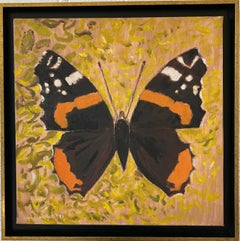
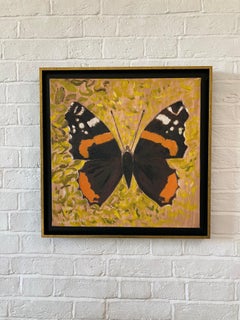
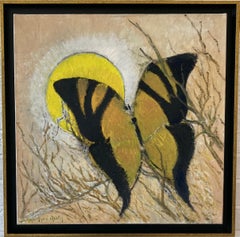
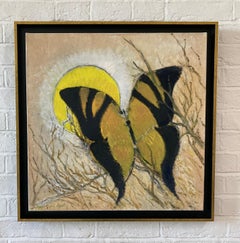
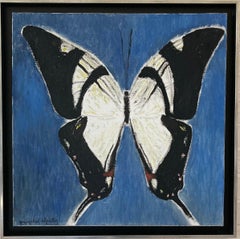
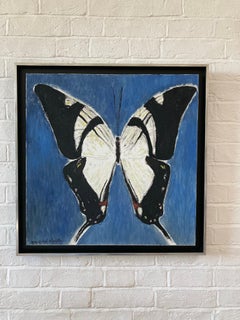
An incredibly striking image of a black and yellow butterfly. Painted with great energy and style. This looks stunning against a white wall.
Henri-André Martin (1918-2004)
A Swallowtail butterfly
Signed
Oil on canvas
23½ x 23½ inches excluding frame
26½ x 26½ inches including frame
Provenance: The artist's studio sale
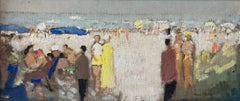
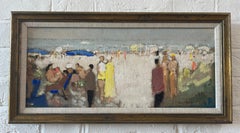
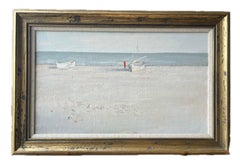
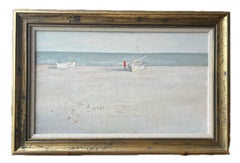
Born in Lyon in 1918, Henri-André Martin spent his youth in Saint-Étienne. Following his father into the medical profession, he spent his first years studying medicine in Lyon, but also enrolled in the École de Beaux Arts during this time. Upon returning from captivity in 1942, Martin soon became director of the otolaryngology clinic at Édouard-Herriot hospital. Painting, however, remained his true calling in life - it was, to him, an invaluable form of self-expression. Reserved and extremely modest, and frequently regarded as somewhat aloof, art was a means of articulating his anxieties and apprehensions, as well as giving a voice to his inner child. Martin had a brush in hand at all times, wherever he went, and painted countless gouaches of varying sizes. His beach paintings in particular have been compared to those of Boudin. Until the 1970s, Martin had a tendency to paint ‘on the ground’, yet in all of his paintings, there is a distinct sense of distance and removal from the subject-matter. In the years that followed, we see a development in this simplification and abstraction of the subject-matter, as seen, for example, in his images of almond trees standing alone against the stark winter sky of Provence. The palette begins to darken, his work acquires a feeling of gravity, as his paintings of Hamburg Port evidently reflect. His collection entitled ‘Trunks’, six lithographic plates, draws on visual and written material in the book, L’Olivier. His interest in the symbolism of the olive tree subsequently grew, and he turned to literature, painting and historical traditions to develop and nuance his understanding of its allegorical value. This fascination with the olive tree, and more broadly, with the nature of symbolism, came to profoundly inform his later work. What he learnt to represent was not merely the physical reality of his subjects, but their implicit interconnection with abstract ideas. As René Déroudille writes, the lithographic plates are ‘especially devoted to and embrace renewal’, revealing an artist who is in ‘full mutation’. In the 1980s, Martin’s work took a more explicit turn towards abstraction. It was during this time that he produced a series of large nudes, which he entered into the major exhibition at L’Atrium in Lyon, in 1992. In the years that followed, Martin focused on animating the shapes and forms born of his imagination, eventually accomplishing this and changing his focus once again, turning to more attractive, even decorative subjects, like Japanese...
Category
20th Century Modern Henri-André Martin Art