Henri Charles Guérard Art

to
2
1
Overall Width
to
Overall Height
to
3
3
2
1
3
2
2
2
1
1
1
1
1
3
3
11,272
2,855
2,494
1,461
3
Artist: Henri Charles Guérard
Related Items
ENDE
ENDE

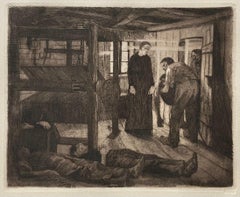
Käthe KollwitzENDE, 1895 (1945)

$750

H 9.625 in W 12 in

ENDE

By Käthe Kollwitz

Located in Santa Monica, CA

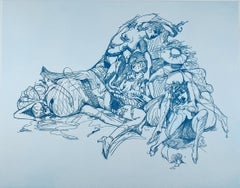
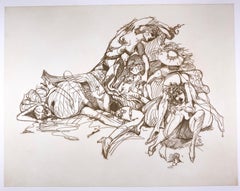
KATHE KOLLWITZ (German 1867 -1945) ENDE, (Klipstein 37 ) Etching and aquatint with the von de Becke blind stamp in the lower right. Printed around 1945. Unsigned posthumous impres...

Category

1890s Modern Henri Charles Guérard Art
Materials

Etching

Chas Laborde - Paris - Capucine's Boulevard - Original Etching

Chas Laborde - Paris - Capucine's Boulevard - Original Etching

By Chas (Charles) Laborde

Located in Collonge Bellerive, Geneve, CH

Chas Laborde - Paris - Capucine's Boulevard - Original Etching Dimensions : 13 x 10". Paper : Rives vellum. Edition : 225 copies. 1927 From Tableaux de Paris, Emile-Paul Freres, Paris Chas LABORDE Charles Laborde was born in Buenos Aires on August 8, 1886. He was the youngest of the five sons of Adolphe-Sylvestre Laborde-Pinou, a Basque-Bearne millionaire who had made a fortune selling spirits to the Indians and luxury goods imported from France to wealthy Argentines. The family returned to France when Charles was six months old. His mother died when he was two. He spent his childhood at their family château d’Escout outside Oloron-Sainte-Marie in the Pyrenees. His brothers went to a boarding-school, his father was often in Paris on business, and little Charles was left to his devices. Though it was a lonely childhood, he was a darling of his generous and magnanimous father. Charles got his early drawing skills from a village artist and found support in his brother Jean-Felix. Charles frequently accompanied his father visiting artisans and helped him choose de luxe objects to be sold in Argentine. He first attended the Rollin college in Paris, then a lyceum in Pau, where he lived with full board and lodging after his father’s death in 1901. From childhood Charles wanted to be an artist and tried several pseudonyms for himself: Ch. Laborde, Carlos Laborde,Carlos Edrobal and Carl Lab. He started wearing a velvet suit and a large hat. At 17, the timid shortsighted teenager wearing big glasses was expelled from college for smoking and drinking alcohol and went to Paris into the custody of his elder brother Jean-Felix, who carried on his father’s business. Charles enrolled in the prestigious l’Académie Julian, studying under Henri Royer and Marcel Baschet. Simultaneously he was a pupil of William Bouguereau and Luc-Olivier Merson at l’École des Beaux-Arts. The latter was famous for being the designer of the 50 and 100 franc banknotes, and he believed that he was teaching a “little Daumier”. In England, where he went every year from 1905 to 1914 with the family of his friend Cooper, a classmate at l’Académie Julian, he found not only his pseudonym Chas (short for Charley), but also the land of his dreams. Peculiarities of London and its inhabitants were reflected in drawings of William Hogarth and Thomas Rowlandson, whose album The Microcosm of London (1808) prompted Charles to make his London Streets Scenes (1928). Owing to those trips Charles took a liking to the atmosphere of England and its reserved and terse humor. In 1905 the château d’Escout and the Buenos Aires Commercial Fund were sold. After coming into inheritance, Laborde became financially independent and obtained an atelier in Montmartre at 11 bis Rue des Saules. His neighbors were de la Butte, Francis Carco and Pierre Mac Orlan, who sympathized with the easy-going young man with a positive attitude to life. His friend Pierre Falke...

Category

1920s Modern Henri Charles Guérard Art
Materials

Etching

Backlighting Etching, Contemporary Style, Signed, Edition of 50, 1990s

Backlighting Etching, Contemporary Style, Signed, Edition of 50, 1990s

By Paolo Ciampini

Located in New Orleans, LA

"Backlighting" was issued in an edition of 50. Paolo Ciampini was born in Montopoli in Val d'Arno in 1941. After graduating from the Art Institute of Cascina (Pisa) in 1962, he com...

Category

1990s Contemporary Henri Charles Guérard Art

Materials

Etching

Soup
Soup

Edmund BlampiedSoup, 1920

$850

H 20 in W 16 in D 2 in

Soup

By Edmund Blampied

Located in Plano, TX

Soup. 1920. Drypoint. Appleby 65. 9 x 8 1/8 (sheet 15 x 11 9/16). Edition 100. Illlustrated: Print Collector's Quarterly 13 (1926): 85. Signed in pencil. Edmund Blampied was a painter, etcher, lithographer and sculptor. Born in 1886 to a family of three boys in St. Martin, Jersey, Blampied became interested in drawing at an early age. After visiting the studio of John Helier Lander in 1899, Blampied decided to make a career as an artist. In 1903 he went to London to attend Lambeth Art School, where he studied etching under Walter Seymour. In 1905, he joined the Daily Chronicle as an artist. In that year he was awarded a scholarship to Bolt Court Scool of Photo-engraving and Lithography. In 1912 he left the Chronicle and established his own studio. He earned a living by illustrating novels and short stories. In 1913, he had his first exhibition at the Leicester Gallery in London. The following year he married Marianne Van Abbé. During the 1920's, he became a member of the Royal Society of Painter-Etchers and Engravers. During the 1920s Blampied became a member of the Royal Society of Painters-Etchers and Engravers and exhibited in London to critical acclaim. He produced a folio of comic drawings in the 1930s which was published in New York in 1934 and another that was published in London in 1936. The Keeper of Prints and Drawings at the British Museum published a mongraph on his work. His London exhibitions were highly successful. In 1938, he moved to Bulwarks, St.Aubin in Jersey, but at the onset of the Occupation, had to relocate to Route Orange, St. Brelade. remained there throughout World War II during the German Occupation, despite the fact that his wife was Jewish. During the Occupation he designed bank...

Category

1920s Modern Henri Charles Guérard Art
Materials

Drypoint, Etching

The Loop II (the artist's memories of days at Chicago's Art Institute)

The Loop II (the artist's memories of days at Chicago's Art Institute)

By Richard Gilbert

Located in New Orleans, LA

The Loop II was created in a small edition of 15. The Loop is a vibrant area featuring eclectic eateries, shops, theaters and parks. Comprised mostly of high-rises, it’s also home to the 108-story Willis Tower. The iconic “Cloud Gate...

Category

1990s Modern Henri Charles Guérard Art
Materials

Etching

Jewish Shtetl Shabbat Candles Russian Judaica Etching w Hand Watercolor Painting

Jewish Shtetl Shabbat Candles Russian Judaica Etching w Hand Watercolor Painting

By Eugene Abeshaus

Located in Surfside, FL

EUGENE ABESHAUS Leningrad, Russia, (1939-2008) Hand-Colored, with watercolor painting, Etching hand signed in pencil in English and Hebrew Numbered 47/110 Framed 21.5 x 16. image 13.5 x 9 Eugene Abeshaus (also spelled Evgeny Abezgauz, Евгений Абезгауз in Russian; 1939–2008) was a Jewish artist who worked in Russia (then USSR) and Israel. Born in Leningrad to a typical intelligentsia family, Abeshaus was educated as an electrical engineer but soon abandoned this career and enrolled in the Mukhina School for Applied Art. By the time of his graduation from the famous “Mukha” (Fly in Russian), he had already developed a critical stance towards the official Soviet art dominated by the Communist ideology and began exhibiting at semi-underground exhibitions. This was culminated by his taking part in a famous 1975 exhibition at the Nevsky Palace of Culture. Abeshaus was fired from his job and censured by the official press – which however admitted his "artistic taste, a good sense of color and form". Soon afterwards, Abeshaus set up, together with several Jewish artists, the Alef Group and became its leader. The group’s first exhibition in November 1975 was held at Abeshauses’ small apartment. According to the Alef Manifesto written by Alek Rapoport, “We are trying to conquer the influence of small-town Jewish art and find sources for our work in deeper, wiser, and more spiritual European culture, and from it build a bridge to today and tomorrow". He was part of a generation of Russian, mostly Jewish artist's that included Oskar Rabin, Evgeny Rukhin...

Category

20th Century Modern Henri Charles Guérard Art
Materials

Watercolor, Etching, Paper

Interiors VII: The Train from Munich

Interiors VII: The Train from Munich

By Peter Milton

Located in Middletown, NY

Interiors VII: The Train from Munich Robert E. Townsend, 1991. Resist ground etching and engraving with hand refinement in charcoal, pencil, stabilo, and eraser on BFK Rives white wove paper, 20 x 36 inches (507 x 914 mm), full margins. Signed, titled, dated and numbered 51/175 by the artist in pencil, lower margin. A brilliant, inky impression with luminous light and gradient tones. In excellent condition with one extremely minor and superficial spot of light tan adhesive residue on the verso, unobtrusive and not visible on the recto, with no other visible defects. With the blind stamp of the printer, Robert E. Townsend in the lower left margin. An especially fine impression in superb condition. [Milton 113]. When asked about this work in particular, Milton expressed that his favorite images were his darkest images, in theme, mood, and in ink. Milton, who has said that his work is infused with a postmodern awareness of the past, has focused here in a deeply personal way on a segment of history that continues to haunt us all. The work, published in 1991, evokes one of the darkest periods of European history, the eroding and erasing of European culture under fascism, and the eventual total loss of humanity. The Train from Munich is an especially relevant and emotional work for Milton, who created the piece for his wife, Edith, who escaped Munich in 1939 as a child on the fabled Kinderstransport. The Kinderstransport was a desperate rescue effort on the part of the British government to save as many Jewish children as possible by railway before borders closed on the precipice of the Second World War. Children left their parents behind, and boarded the trains alone, leaving the impending doom of Nazi Germany, they arrived in Great Britain as refugees. More than 10,000 children escaped the holocaust via the Kinderstransport. In Train from Munich, the image itself holds an almost immeasurable amount of symbolism; each inch of the matrix is a successful effort to confront this history in a way that is poignant through a series of motifs. We see the Café disappearing into a ghostlike memory of the past, an allegory to the disintegration of culture, while through the windows we can see a rampant, snarling dog; a portrait of Hitler's shepherd, Blondi. Blondi isn't the only notable figure in the composition. Milton has pointed out that the fading figure of the doorman at the Hotel Metropole is modeled after the artist and intellectual Marcel Duchamp, and the face of the young girl peering...

Category

1990s American Modern Henri Charles Guérard Art
Materials

Charcoal, ABS, Engraving, Etching

Politics
Politics

Edmund BlampiedPolitics, 1926

$1,250Sale Price|28% Off

H 16 in W 20 in D 0.5 in

Politics

By Edmund Blampied

Located in Plano, TX

Politics (Tonnere de Brest). 1926. Drypoint. Appleby 108. 7 x 9 (sheet 10 1/2 x 15 1/2). A rich impression printed on cream wove paper with full margins. Illustrated: Salaman, Modern...

Category

Early 20th Century Modern Henri Charles Guérard Art
Materials

Drypoint, Etching

Femme au Fauteuil (Woman in the Armchair) - Signed Engraving Edition, 1939

Femme au Fauteuil (Woman in the Armchair) - Signed Engraving Edition, 1939

By Pablo Picasso

Located in Palm Desert, CA

A significant aquatint by Picasso, ‘Femme au Fauteuil’ demonstrates the artist's mastery of a technique pioneered by Goya in his revolutionary printmaking practice. The aquatint medi...

Category

Mid-20th Century Modern Henri Charles Guérard Art
Materials

Paper, Engraving, Aquatint

France at her Furnaces

France at her Furnaces

By James McBey

Located in Plano, TX

1917. Etching. Hardie 175. 8 x 15 (sheet 10 1/8 x 16 15/16). Edition 76. Slight mat line; otherwise excellent condition. A rich impression printed on antique laid paper with full m...

Category

1910s Modern Henri Charles Guérard Art
Materials

Drypoint, Etching

Dufza - Paris - Conciergerie - Original Handsigned Etching

Dufza - Paris - Conciergerie - Original Handsigned Etching

By Dufza

Located in Collonge Bellerive, Geneve, CH

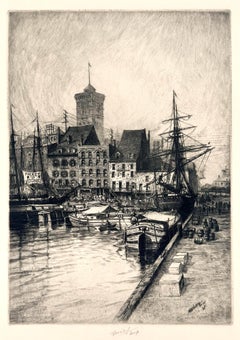
Dufza - Paris - Conciergerie - Original Handsigned Etching Circa 1940 Handsigned in pencil Dimensions: 20 x 25 cm

Category

1940s Modern Henri Charles Guérard Art
Materials

Etching

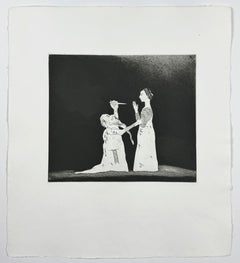
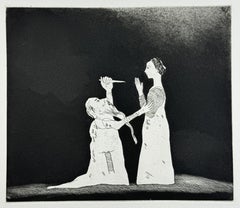
André Derain - Ovid's Heroides - Original Etching

André Derain - Ovid's Heroides - Original Etching

By André Derain

Located in Collonge Bellerive, Geneve, CH

André Derain - Ovid's Heroides Original Etching Edition of 134 Dimensions: 32 x 25 cm Ovide [Marcel Prevost], Héroïdes, Paris, Société des Cent-une, 1938 Andre Derain was born in 1880 in Chatou, an artist colony outside Paris. In 1898, he enrolled in the Academie Carriere in Paris where he met Matisse. He attended art school and in 1900, set up a studio with Maurice deVlaminck. After his military service from 1900-1904, Derain exhibited his work at the Salon des Independants and then at the Salon d'Automne with Matisse, Vlaminck and others, thus creating the movement of Fauvism.He worked with Henri Matisse in 1905 at Collioure, and participated in the 1905 Salon d’Automne with Matisse, Vlaminck, and Braque, the exhibition in which this group was labeled as Fauves, or Wild Beasts. Along with Vlaminck, Derain was one of the first artists to collect the tribal art of Africa which was influential to many of the artists of the early 20th century. In 1906, Derain met Picasso and his dealer, who purchased Derain's entire studio, creating newfound financial success. During this time, he was hired for the illustrations for works by Guillaume Apollinaire and Andre Breton. After World War I, his friend's Cubism movement affected his art, along with influence from Classicism and African Art. Derain stayed in Paris during most of the Occupation, where he was esteemed by the Nazis because of his artistic integrity. Hitler's Foreign Minister commissioned him to paint a family portrait, but he politely refused. His popularity began to decline after the war because of disagreement over new artistic movements. He later lost most of his eyesight due to illness, which may have been the reason he was hit by a truck in 1954, dying from shock at the age of 74. Derain’s Fauve paintings are typically bright with intense color. Influenced by the work of Cézanne as well as the early Cubist paintings of Picasso and Braque’s, Derain’s style changed and by 1912, the paintings became more traditional and structured. For the remainder of his career, he continued to investigate different compositional methods including the perspective of Cézanne and the pointillism of Seurat. He also designed ballet sets and made a number of sculptures. At the turn of the century, Andre Derain exhibited at the radical Fauve Salon d’Automne (1905) and was one of the founding members of the Fauvist movement together with his life-long friends Matisse and Vlaminck. The works he produced in this period, often under the guidance of Matisse, have been counted among the masterpieces of Fauvism. From around 1918, Derain turned his back on the avant-garde and had begun to explore some of the more traditional genres of Western art, including landscapes. His main source of inspiration once the Fauves group had dispersed was found in the Louvre, where he admired the early Renaissance works in particular. Talking of his frequent visits there, he once said, ‘That seemed to me then, the true, pure absolute painting.’ His work evolved through many styles and, most significantly, turned back to the past, particularly after 1922 when Lenin had publicly pronounced his disdain for abstract art. Derain built up an immense and fascinating collection of paintings, sculpture and objets d’art throughout his life which aided his experimentation and was reflected in his work between 1930 and 1945. During these years, his painting technique displayed the most avenues of invention, using a repertoire of primitivist motifs. His eclectic collection was constantly changing. In 1930 he sold his African collection in exchange for bronzes of antiquity and the Renaissance which indicated a real change of interest in the objects, as did his later pursuit of Greek ceramic painting and his enthusiasm for grand cycles of literary and antique themes...

Category

1930s Modern Henri Charles Guérard Art
Materials

Etching

Previously Available Items
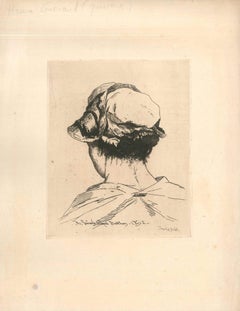
Close-up - Original Etching by H. C. Gérard - 1872

Close-up - Original Etching by H. C. Gérard - 1872

By Henri Charles Guérard

Located in Roma, IT

Close-up is a beautiful etching on paper, realized by the French artist Henri-Clarles Guérard (Paris, 1846-1897), after Paul Berthon and printed by Charles Delaitre, as the inscription etched on the lower margin reports with the year "1872". Inspired by some Art-Nouveau female portrait by Berthon, this wonderful close-up of a woman from behind is in excellent conditions, except for some minor stains above all on the edges of the sheet. Henri Charles Guérard...

Category

1870s Henri Charles Guérard Art
Materials

Etching

Henri Charles Guérard art for sale on 1stDibs.

Find a wide variety of authentic Henri Charles Guérard art available for sale on 1stDibs. You can also browse by medium to find art by Henri Charles Guérard in etching and more. Much of the original work by this artist or collective was created during the 19th century and is mostly associated with the modern style. Not every interior allows for large Henri Charles Guérard art, so small editions measuring 8 inches across are available. Customers who are interested in this artist might also find the work of Auguste Lançon, Léopold Flameng, and Charles Courtry. Henri Charles Guérard art prices can differ depending upon medium, time period and other attributes. On 1stDibs, the price for these items starts at $276 and tops out at $276, while the average work can sell for $276.

Artists Similar to Henri Charles Guérard