Henry Moore Abstract Sculptures

British, 1898-1986

Henry Spencer Moore OM CH FBA was an English artist. He is best known for his semi-abstract monumental bronze sculptures, which are located around the world as public works of art. As well as sculpture, Moore produced many drawings, including a series depicting Londoners sheltering from the Blitz during the Second World War, along with other prints and graphic works on paper.

His forms are usually abstractions of the human figure, typically depicting mother-and-child or reclining figures. Moore's works are usually suggestive of the female body, apart from a phase in the 1950s when he sculpted family groups. His forms are generally pierced or contain hollow spaces. Many interpreters liken the undulating form of his reclining figures to the landscape and hills of his Yorkshire birthplace.

Moore became well known through his carved marble and larger-scale abstract cast bronze sculptures, and was instrumental in introducing a particular form of modernism to the United Kingdom. His ability in later life to fulfil large-scale commissions made him exceptionally wealthy. Despite this, he lived frugally; most of the money he earned went toward endowing the Henry Moore Foundation, which continues to support education and promotion of the arts.

Find original Henry Moore art on 1stDibs.

to
1
Overall Width
to
Overall Height
to
1
1
1
1
1
138
216
119
84
78
1
Artist: Henry Moore
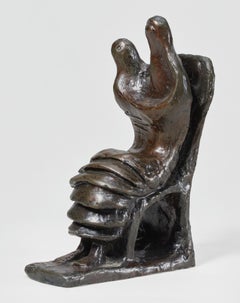
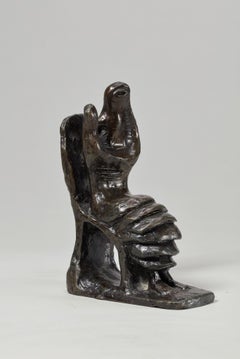
Mother and Child: Petal Skirt - Henry Moore, sculpture, modern, british, small

Mother and Child: Petal Skirt - Henry Moore, sculpture, modern, british, small

By Henry Moore

Located in London, GB

Henry Moore (1898-1986) Mother and Child: Petal Skirt conceived in 1955; cast in 1955 bronze; edition 4 of 6 plus 1 artist’s proof by the Fiorini foundry, London 19 x 9 x 15.5 cm (in...

Category

1950s Modern Henry Moore Abstract Sculptures

Materials

Bronze

Related Items
Woman Lying Down & Growing with Tree bronze sculpture by Yulla Lipchitz

Woman Lying Down & Growing with Tree bronze sculpture by Yulla Lipchitz

Located in Hudson, NY

Organic, abstract bronze sculpture by Yulla Lipchitz of a woman lying down with a tree. About this artist: Yulla Lipchitz, née Halberstadt, was born on April 21, 1911 in Berlin, Ge...

Category

1970s Modern Henry Moore Abstract Sculptures

Materials

Bronze

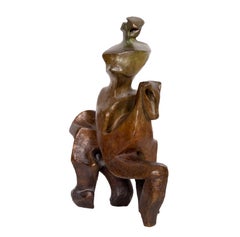
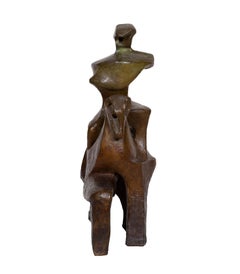
Morris Brose "Bronze Bull" Figurative Sculptural Abstract

Morris Brose "Bronze Bull" Figurative Sculptural Abstract

Located in Detroit, MI

"Bronze Bull" is an exquisite example of Morris Brose's abstract/figurative sculpture. No soft edges on this piece and no invitation to caress, the power, strength and beauty of the bronze are front and center and create awe. "Bronze Bull" is a free-standing piece signed on the base. Morris Brose, Polish/American was born in Wyszkow, Poland. He became a sculptor and instructor of sculpture at the Detroit Institute of Arts, Wayne State University and Cranbrook Academy of Art, Bloomfield Hills, Michigan. Cranbrook was designed by architect and faculty member, Eliel Saarinen who collaborated with Charles and Ray Eames on chair and furniture design. Numerous creative artists who are alumni of Cranbrook include: Harry Bertoia, Florence Knoll, Jack Lenor Larsen, Donald Lipski...

Category

Late 20th Century Modern Henry Moore Abstract Sculptures

Materials

Bronze

Ted Egri Taos Modernist Judaica Cubist Bronze Sculpture Rabbi & Torah WPA Artist

Ted Egri Taos Modernist Judaica Cubist Bronze Sculpture Rabbi & Torah WPA Artist

Located in Surfside, FL

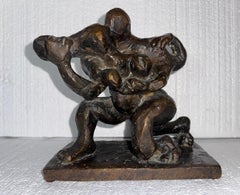
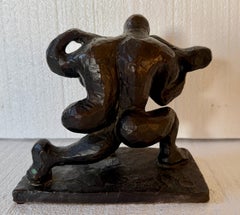
Ted Egri (American, 1913-2010) Bronze sculpture Rabbi Signed Egri and numbered 4/30 on side. Dimensions: 12"L x 8.5"H x 6.75" D Born in New York city in 1913 to a Hungarian Jewish emigre family (both of his parents were born in Hungary), Egri was first exposed to music later dropping that for art. He studied with Howard Giles at the Master Institute of the Roerich Museum in New York where he was introduced to Oriental arts, Chinese and Japanese art forms, and later with Hans Hofmann. He worked for the Federal Arts Project, the WPA, making mural paintings and silkscreen prints as well as easel painting. Once WWII began, Egri signed up to serve as a map maker for the Navy, and was witness to some of the fiercest battles in the Pacific. As an artist, he painted many important depictions of his wartime experiences and these works have all be donated to the U.S. Naval Museum. Already a practicing painter and instructor at the Kansas City Art Institute, Ted Egri came to Taos, New Mexico with his wife Kit in 1950 to continue his study of painting at Ribak's Taos Valley Art School on the GI Bill. Louis Ribak quickly introduced Egri to Eulalia Emetaz, the owner of La Galleria Escondida, who gave him his first one-person show in 1951. A prolific and versatile artist, as well as arts organizer and advocate, Egri's contributions to underserved African American, Native American, Hispanic and women were honored by two Taos mayors, with no less than two Ted Egri days during his 50-year art career in Taos. Egri remained in Taos. He became widely known for his sculpture, influenced by cubism and painting, with his style ranging from abstract to realistic. Egri had incredible draftsmanship - charcoal, pencil, pastel, watercolor, oils, mixed media, pen and ink, acrylic, gouache Over time his work gradually shifted from its focus on human struggle to an exploration of natural elements and the changes that come about as a result of living in a physical environment like Taos. "The impact of the majestic Sangre de Cristo Mountain Range and the vast spaces of the mesas directed me toward space and form. I moved into sculpture," Egri said in a 1987 interview with ARTSPACE magazine. He was included in a show at Stables Gallery along with Emil Bisttram, Louis Catusco, Edward Corbett, Lawrence Calcagno, Keith Crown, Andrew Dasburg, John De...

Category

Mid-20th Century American Modern Henry Moore Abstract Sculptures
Materials

Bronze

"Couple II" Mid 20th Century Modern Abstract Figurative 1940s European Sculpture

"Couple II" Mid 20th Century Modern Abstract Figurative 1940s European Sculpture

By Jacques Lipchitz

Located in New York, NY

"Couple II" Mid 20th Century Modern Abstract Figurative 1940s European Sculpture Jacques Lipchitz (1891-1973) "Couple II" Bronze signed on the base The sculpture was conceived in 19...

Category

1940s Modern Henry Moore Abstract Sculptures
Materials

Bronze

Brutalist Modern Abstract Bronze Sculpture Metropolis Manner of Louise Nevelson

Brutalist Modern Abstract Bronze Sculpture Metropolis Manner of Louise Nevelson

By Abbott Pattison

Located in Surfside, FL

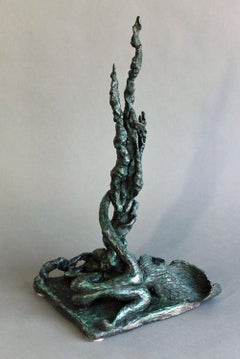
A very heavy, massive bronze sculpture by an important Chicago sculptor. Signed and marked "Firenze" with "Fuse Marinelli". METROPOLIS. Seven abstract shapes on black marble base. 1...

Category

20th Century Modern Henry Moore Abstract Sculptures
Materials

Marble, Bronze

Milton Hebald Mid Century Bronze Menorah Sculpture WPA Artist Modernist Judaica

Milton Hebald Mid Century Bronze Menorah Sculpture WPA Artist Modernist Judaica

Located in Surfside, FL

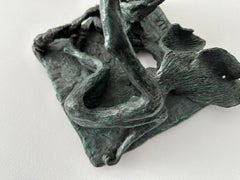
Milton Hebald (American, 1917-2015) Lion of Judah menorah bronze on a white marble plinth base signed in bronze 12" H x 10.5" W x 2.5" D Milton Elting Hebald (1917 – 2015) was a s...

Category

1960s American Modern Henry Moore Abstract Sculptures
Materials

Marble, Bronze

Vintage 1970 Modernist Chicago Picasso Souvenir Cubist Sculpture Head Metal

Vintage 1970 Modernist Chicago Picasso Souvenir Cubist Sculpture Head Metal

By (after) Pablo Picasso

Located in Surfside, FL

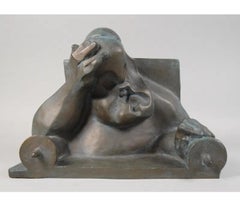
This is a souvenir model of the large Picasso sculpture in Chicago it is a vintage piece. it is marked 1967 and 1970 and was made for the Chicago Public Building Commission. it is a...

Category

1960s Modern Henry Moore Abstract Sculptures
Materials

Metal

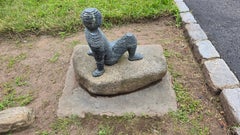
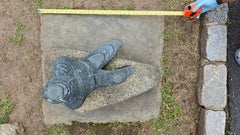
"Zofar" Boaz Vaadia, Human Body, Bronze and Stone, Anthropomorphic Sculpture

"Zofar" Boaz Vaadia, Human Body, Bronze and Stone, Anthropomorphic Sculpture

By Boaz Vaadia

Located in New York, NY

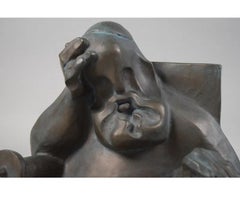
Boaz Vaadia Zofar, 1997 Bronze, bluestone, and boulder Overall 20 x 29 x 27 inches From the edition of 7 Provenance Elaine Baker Gallery, Boca Raton, Florida Boaz Vaadia is the in...

Category

1990s American Modern Henry Moore Abstract Sculptures
Materials

Stone, Bluestone, Bronze

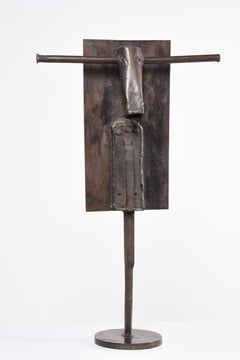
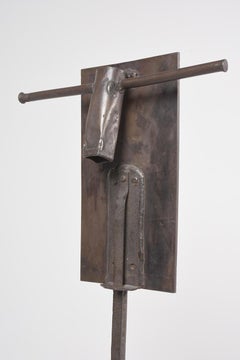
Walking Man
Walking Man

Walking Man

By Maxine Kim Stussy 1

Located in West Hollywood, CA

Maxine Kim Stussy, a prolific sculptor and painter from the late 1940’s to present. Maxine led an incredibly artistic life traveling the world with h...

Category

1970s Modern Henry Moore Abstract Sculptures
Materials

Bronze

Hattakitkosol Somchai Art Bronze Bird Sculpture, circa 1980

Hattakitkosol Somchai Art Bronze Bird Sculpture, circa 1980

By Hattakitkosol Somchai

Located in Atlanta, GA

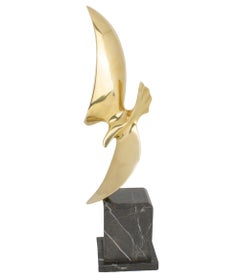
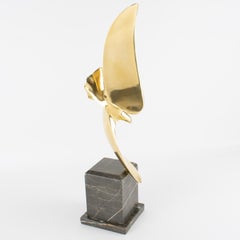
Soar into the realm of timeless artistry with this magnificent gilded bronze sculpture by celebrated Thai artist Hattakitkosol Somchai (1934–2000)—a commanding representation of a bi...

Category

1990s Modern Henry Moore Abstract Sculptures
Materials

Bronze

Previously Available Items
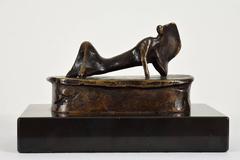
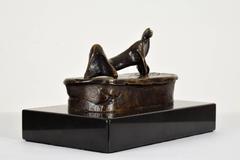
Maquette for Reclining Figure: Cloak

Maquette for Reclining Figure: Cloak

By Henry Moore

Located in London, GB

Bronze 7.1 x 12.1 x 5.6 cm (2 ¾ x 4 ¾ x 2 ¼ inches) Signed and numbered on the back, Moore 9/9 Conceived in 1966 Provenance Wildenstein & Co., Inc., New York, acquired directly from the artist The Arthur and Anita Kahn...

Category

20th Century Modern Henry Moore Abstract Sculptures
Materials

Bronze

Henry Moore abstract sculptures for sale on 1stDibs.

Find a wide variety of authentic Henry Moore abstract sculptures available for sale on 1stDibs. You can also browse by medium to find art by Henry Moore in bronze, metal and more. Much of the original work by this artist or collective was created during the 20th century and is mostly associated with the abstract style. Not every interior allows for large Henry Moore abstract sculptures, so small editions measuring 4 inches across are available. Customers who are interested in this artist might also find the work of Émile Gilioli, Louise Nevelson, and Ryan T. Schmidt. Henry Moore abstract sculptures prices can differ depending upon medium, time period and other attributes. On 1stDibs, the price for these items starts at $30,000 and tops out at $98,000, while the average work can sell for $52,500.
Questions About Henry Moore Abstract Sculptures
  • 1stDibs ExpertApril 5, 2022
    Henry Moore’s sculptures often represented the connection between the human body and landscapes. The underlying meaning is that humanity is shared with the natural world, and many of his large-scale sculptures were created to compliment the outdoor landscape where they were placed. You’ll find a selection of Henry Moore sculptures and sketches on 1stDibs.
  • 1stDibs ExpertMay 30, 2024
    Henry Moore drew hands to symbolize the passage of time. His series of drawings depicting his own hands in old age and other elderly people's hands were meant to represent the effects of work and living on the human body. Much of Moore's work reflected on the human form, including his large bronze sculptures. Explore a diverse assortment of Henry Moore art on 1stDibs.
  • 1stDibs ExpertJune 6, 2024
    Henry Moore's style of art was modern. He is best known for his monumental bronze sculptures, which are installed around the world, often as public art. He used abstract forms of the human body, typically depicting mother-and-child or reclining figures. His more abstract forms are generally pierced or contain hollow spaces. Many critics have likened the undulating shapes of his reclining figures to the landscape and hills of his Yorkshire birthplace. On 1stDibs, find an assortment of Henry Moore art.
  • 1stDibs ExpertMay 3, 2024
    Opinions vary as to what Henry Moore's most famous piece is. Since the British artist's semi-abstract monumental bronze sculptures are often public works of art, many have become well known. Among them are Reclining Figure: Festival (1951), Harlow Family Group (1954-5), Helmet Head No. 4: Interior/Exterior (1963), The Arch (1963-69) and Mother and Child (1983). On 1stDibs, find a variety of Henry Moore art.
  • 1stDibs ExpertApril 5, 2022
    Henry Moore frequently used the wax resist process in his drawings, which involved sketching the forms in wax crayon and coating the drawing with a wash of gray watercolor. He then went in with black ink, gray and black crayons and white watercolor. Find a selection of Henry Moore artwork from top art dealers around the world on 1stDibs.
  • 1stDibs ExpertApril 26, 2024
    Henry Moore created sculptures for a few reasons. Born in Castleford, Yorkshire, in 1898, he had an early interest in being a sculptor, and in 1921, he was awarded a scholarship to study at the Royal Academy of Art in London. As he would explain, this is where he was particularly inspired to pursue his sculpting practice: “Even when I was a student I was totally preoccupied by sculpture in its full spatial richness, and if I spent a lot of time at the British Museum in those days, it was because so much of the primitive sculpture there was distinguished by complete cylindrical realization.” He also had an interest in exploring how the human body connected to landscapes. He often produced works with specific locations in mind, considering how his figures would relate to the space around them. His forms are usually abstractions of the human body, typically depicting mother-and-child or reclining figures, and are often pierced or contain hollow spaces. Many interpreters liken the undulating form of his reclining figures to the landscape and hills of his Yorkshire birthplace. On 1stDibs, shop a variety of Henry Moore art.
  • 1stDibs ExpertMarch 13, 2024
    Henry Moore drew sheep for a few reasons. The British artist thought sheep were peaceful and found watching them graze to be relaxing. He also liked how they stood out against the landscape due to their coloring, likening it to the way a statue draws the eye away from the rest of its surroundings. On 1stDibs, find a diverse assortment of Henry Moore art.
  • 1stDibs ExpertAugust 20, 2024
    How much a Henry Moore statue is worth depends on its history, condition and other factors. In 2022, his Reclining Figure: Festival, created for the 1951 Festival of Britain, set an auction record for the artist when it sold for $31 million. The piece is a good example of the artist's forms, which are usually abstractions of the human figure, typically depicting a mother and child or reclining figure. Moore's works are often suggestive of the female body, apart from a period in the 1950s when he sculpted family groups. If you own a Henry Moore statue, a certified appraiser or experienced art dealer can help you determine its estimated value. Shop an assortment of Henry Moore art on 1stDibs.
  • 1stDibs ExpertApril 5, 2022
    Henry Moore used holes in his sculptures to create the illusion that his work was growing from an empty center. His sculptures Oval with Points and Double Oval are two examples of the technique. You'll find a selection of Henry Moore art on 1stDibs.
  • 1stDibs ExpertApril 5, 2022
    Henry Moore moved to London to study art and often visited the British Museum where he was inspired by ancient sculptures from Egypt, Africa and Mexico. His sculptures have a semi-abstract nature, but he often dabbled in other styles of art. Moore even created his own form of modernism with an eye toward the abstract. On 1stDibs, find a variety of original artwork from top artists.
  • 1stDibs ExpertOctober 30, 2024
    Yes, Barbara Hepworth knew Henry Moore. They met while she was attending the Leeds School of Art in the 1920s. Moore and Hepworth maintained a friendly rivalry throughout their careers. Along with Paul Nash and Ben Nicholson, the two founded the Unit One art movement in 1933. The movement's purpose was to promote avant-garde art in the UK. Explore a wide variety of Barbara Hepworth art.
  • 1stDibs ExpertNovember 20, 2024
    Yes, Henry Moore and Barbara Hepworth were friends. The two met at the Leeds School of Art in the UK and maintained a friendly rivalry throughout their careers. Both Hepworth and Moore were members of Unit One, a group of British artists who sought to educate the public about avant-garde art during the 1930s. Shop a selection of Henry Moore and Barbara Hepworth art on 1stDibs.
  • 1stDibs ExpertApril 5, 2022
    Henry Moore was a prolific artist and it’s difficult to pinpoint exactly how many pieces of art he created. The Henry Moore Foundation lists that their online catalogue of his works currently features more than 11,000 sculptures, drawings, tapestries, textiles and graphics. That’s a significant number indeed and does not represent all of his contributions to the art world. On 1stDibs, find a variety of original artwork from top artists.