Hiroshige II Prints and Multiples

to
1
Overall Width
to
Overall Height
to
1
1,576
1,101
945
681
1
1
1
1
1
1
Artist: Hiroshige II
Related Items
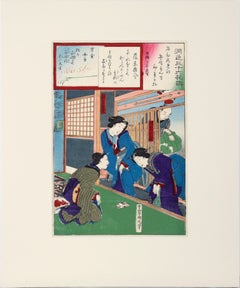
"Enshoku Sanju-roku Kasen" (Thirty-six Enchanting Flowers) Woodblock on paper

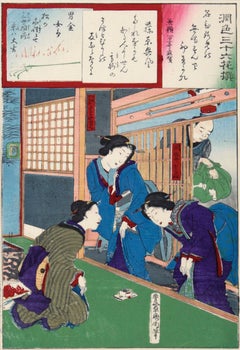
"Enshoku Sanju-roku Kasen" (Thirty-six Enchanting Flowers) Woodblock on paper

By Toyohara Kunichika

Located in Soquel, CA

"Enshoku Sanju-roku Kasen" (Thirty-six Enchanting Flowers) Woodblock on paper Elegant woodblock print by Toyohara Kunuchika (Japanese, 1835-1900). Three women are in talking with each other inside, while a man waits outside holding a bag of some kind. The colors in this piece are rich and saturated, primarily blues, greens, and purple. Mat size: 16"H x 20"W Paper size: 14.75"H x 9.88"W Born in 1835, Toyohara Kunichika grew up in the Kyobashi district of Edo in the midst of merchants and artisans. In 1848, at age 13, he was accepted as an apprentice into the studio of Utagawa Kunisada I...

Category

1880s Edo Hiroshige II Prints and Multiples

Materials

Ink, Rice Paper, Woodcut
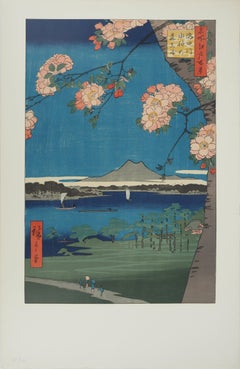
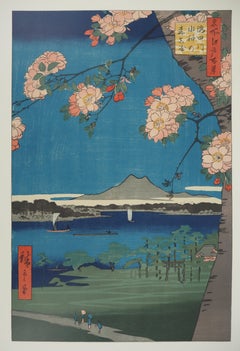
Japan, Suijin Shrine and Masaki on the Sumida River - Lithograph (Mourlot)

Japan, Suijin Shrine and Masaki on the Sumida River - Lithograph (Mourlot)

By Utagawa Hiroshige

Located in Paris, IDF

Utagawa HIROSHIGE (1797-1858, after) Japan, Suijin Shrine and Masaki on the Sumida River Lithograph after a woodcut (Mourlot workshop) Printed signature in the plate Numbered / 150 ...

Category

Mid-20th Century Edo Hiroshige II Prints and Multiples

Materials

Lithograph

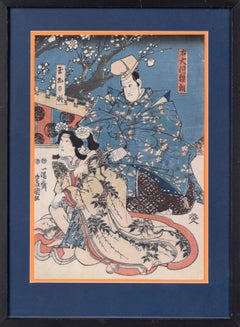
Two Actors - Japanese Woodblock by Chikanobu Yoshu

Two Actors - Japanese Woodblock by Chikanobu Yoshu

By Toyohara Chikanobu

Located in Soquel, CA

Two Actors - Japanese Woodblock by Toyohara Chikanobu (豊原周延, 1838–1912), better known to his contemporaries as Yōshū Chikanobu (楊洲周延). Colorful and expressive court scene. Two actors...

Category

1890s Edo Hiroshige II Prints and Multiples

Materials

Ink, Rice Paper, Woodcut
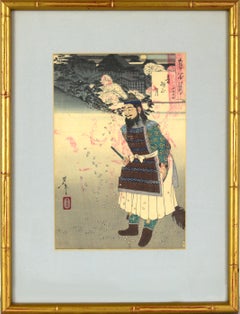
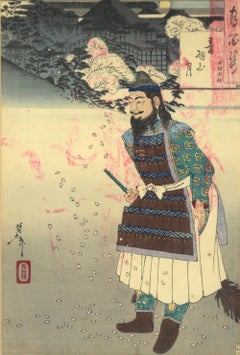
One Hundred Aspects of the Moon, Mt Otawa Moon - Bright God Tamura

One Hundred Aspects of the Moon, Mt Otawa Moon - Bright God Tamura

By Tsukioka Yoshitoshi

Located in Soquel, CA

"Mount Otawa Moon: Bright God Tamura" - Woodblock on Paper by Tsukioka Yoshitoshi From the series "One Hundred Aspects of the Moon" This piece depicts the general Sakanoe no Tamura...

Category

1880s Edo Hiroshige II Prints and Multiples

Materials

Paper, Ink, Woodcut

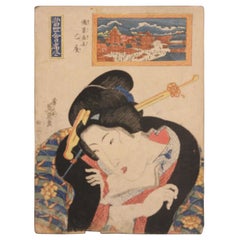
Biensennyo-ko Japanese Woodblock Print

Biensennyo-ko Japanese Woodblock Print

By Keisai Eisen

Located in Houston, TX

Japanese Woodblock print of a Biensennyo-ko a powder face women. Behind the women is a framed cityscape. The print is possibly from the series "Eight Favorite Things in the Modern World". The woodblock print is printed on rice paper. The print is not framed. Artist Biography: Keisai Eisen...

Category

Early 1800s Edo Hiroshige II Prints and Multiples

Materials

Woodcut

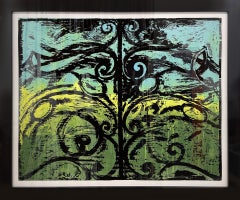
The First Woodcut Gate (The Landscape), 27/49, 1983 — Jim Dine

The First Woodcut Gate (The Landscape), 27/49, 1983 — Jim Dine

By Jim Dine

Located in Santa Monica, CA

The First Woodcut Gate (The Landscape), 1983, by Jim Dine. Hand-embellished woodcut in colors, numbered 27/49. Printed by Nicholas Dine, Aspen, and published by Pace, New York. Catal...

Category

15th Century and Earlier Hiroshige II Prints and Multiples

Materials

Woodcut

Edo Landscape Japanese Woodblock Print

Edo Landscape Japanese Woodblock Print

By Utagawa Hiroshige (Ando Hiroshige)

Located in Houston, TX

Edo Meisho woodblock print of a famous Japanese coastal dock. This woodblock is most likely apart of the series "One Hundred Famous Views of Edo." The woodblock print is printed on r...

Category

1850s Edo Hiroshige II Prints and Multiples

Materials

Woodcut

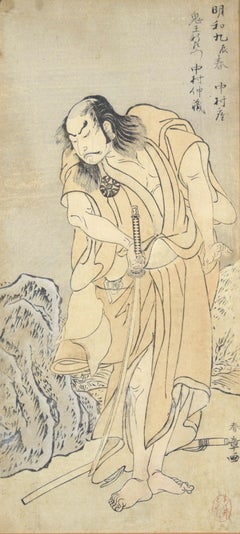
Actor as Samurai - 18th Century Japanese Woodblock Print

Actor as Samurai - 18th Century Japanese Woodblock Print

By Katsukawa Shunshō

Located in Soquel, CA

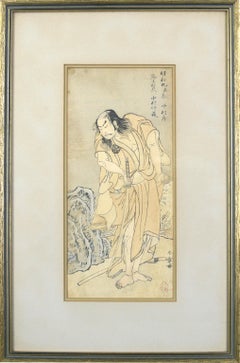
Actor as Samurai - 18th Century Japanese Woodblock Print Woodblock print depicting an actor, possibly Nakamura Denkuro II, as a samurai. The actor stands with his sword unsheathed a...

Category

Late 18th Century Edo Hiroshige II Prints and Multiples

Materials

Woodcut, Rice Paper

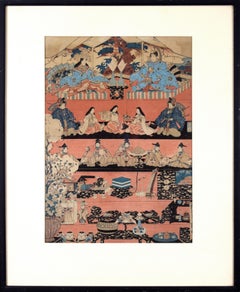
"Various Himochi" Wagashi Festival Japanese Woodblock Print by Utagawa Toyokuni

"Various Himochi" Wagashi Festival Japanese Woodblock Print by Utagawa Toyokuni

By Utagawa Toyokuni

Located in Soquel, CA

"Various Himochi" Wagashi Festival Japanese Woodblock Print by Utagawa Toyokuni Rare oversized early 19th century 5-tiered woodblock by Utagawa Ichiyosai Toyokuni, (Japan, 1769-1825), a Japanese lord and wife oversee a sekku festival of food, music, and dolls or toys. '"oshi" is the first day of “Mi (Snake)” in the third month of the lunar calendar. This day, known in modern Japan as the Girls' Festival, originated in China as a form of purification ceremony in which water and drinking peach blossom wine were used to drive away evil. Many kinds of hishi-mochi appear in this picture of hina ningyo (dolls associated with Hinamatsuri, or the Girl’s Day) from Omochae. The custom of eating special dishes at events throughout the year and at milestones in people's lives has existed since ancient times. This paragraph specifically focuses on the annual event called sekku, and life events that involve eating sweets. Joshi is the first day of “Mi (Snake)” in the third month of the lunar calendar. This day, known in modern Japan as the Girls' Festival, originated in China as a form of purification ceremony in which water and drinking peach blossom wine were used to drive away evil. According to the Keiso saijiki, in ancient China, on the third day of the third lunar month, people ate “ryuzetsuhan,” which is the juice of gogyo (Jersey cudweed) mixed with rice flour and nectar. In Japan, there is a record in the Heian period history book Nihon Montoku tenno jitsuroku [839-5] that it was an annual event to make kusamochi using gogyo on the third day of the third month of the lunar calendar, which may have been influenced by Chinese customs. The tradition of eating kusamochi on the third day of the third month of the lunar calendar continued after that. By the Edo period, however, hishimochi had come to be used as a sweet to serve on the third day of the third month. A picture of a hishimochi is included in the Morisada manko , which we mentioned in Part 1. According to it, hishimochi in the Edo period were often three layers of green-white-green instead of the now common red-white-green. However, it is possible to see from our collection that not all hishimochi were made in this way. Omochae published in 1857, is a good example. Omochae is a type of ukiyoe print...

Category

1820s Edo Hiroshige II Prints and Multiples

Materials

Ink, Rice Paper, Woodcut
Beauties on the Beach with view of Mount Fuji

Beauties on the Beach with view of Mount Fuji

By Yoshu Chikanobu

Located in Burbank, CA

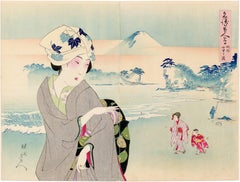
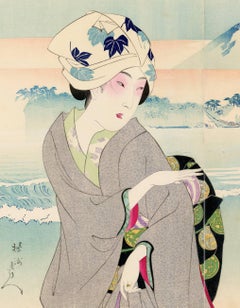
Shichirigahama, Sagami Province. A beauty in the foreground waves to her young companions, who run towards her on the beach. The beauty at left wears a western-style golden ring. We ...

Category

1890s Edo Hiroshige II Prints and Multiples

Materials

Handmade Paper, Mulberry Paper, Woodcut
3 Panel Hand Colored Japanese Woodcut Print Lithograph

3 Panel Hand Colored Japanese Woodcut Print Lithograph

By Keisai Eisen

Located in Soquel, CA

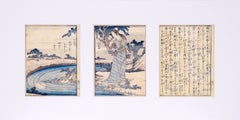
3 Panel Hand Colored Japanese Woodcut Print Lithograph Three panel hand colored woodcut lithograph from Nanso Satomi hakkenden, Tale of the Eight Dogs...

Category

Early 19th Century Edo Hiroshige II Prints and Multiples

Materials

Paper, Ink, Woodcut

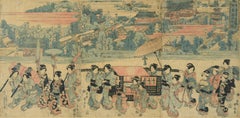
The Pilgrimage Procession to Kinryuzan Temple at Asakusa in the Eastern Capital

The Pilgrimage Procession to Kinryuzan Temple at Asakusa in the Eastern Capital

By Kuniyasu

Located in Soquel, CA

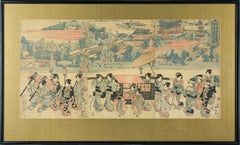
Japanese Parade - Woodblock Print Japanese woodblock print by Utagawa Kuniyasu (歌川 国安) (Japan, 1794–1832). Japanese women, dressed in blue and red kimonos, are the focal point. A vi...

Category

Mid-19th Century Edo Hiroshige II Prints and Multiples

Materials

Paper, Ink, Woodcut

Previously Available Items
Otsu, Mount Hiei, Lake Biwa.

Otsu, Mount Hiei, Lake Biwa.

By Hiroshige II

Located in Plano, TX

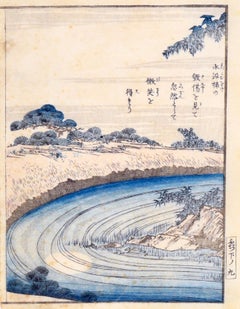
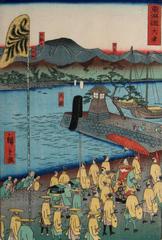
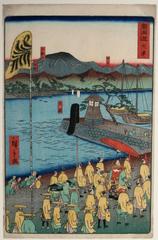
Otsu, Mount Hiei, Lake Biwa. c. 1864. Series: The 53 Stations of the Tokaido Road. Vertical oban. 13 x 8 3/4 (sheet 14 x 9). Good color and impression. The image is the procession of...

Category

Mid-19th Century Edo Hiroshige II Prints and Multiples

Materials

Woodcut

Hiroshige Ii prints and multiples for sale on 1stDibs.

Find a wide variety of authentic Hiroshige II prints and multiples available for sale on 1stDibs. You can also browse by medium to find art by Hiroshige II in woodcut print and more. Not every interior allows for large Hiroshige II prints and multiples, so small editions measuring 10 inches across are available. Customers who are interested in this artist might also find the work of Utagawa Hiroshige (Ando Hiroshige), Toyohara Chikanobu, and Kunichika Toyohara. Hiroshige II prints and multiples prices can differ depending upon medium, time period and other attributes. On 1stDibs, the price for these items starts at $12,000 and tops out at $12,000, while the average work can sell for $12,000.