By Barbara Latham
Located in Myrtle Beach, SC
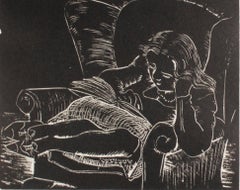
Barbara Latham, 'Our Mexican Kitchen', wood engraving, edition not stated but small, 1932. Signed and titled in pencil. A fine richly-inked impression, on tan wove paper, with full margins (5/8 to 7/8 inch), in excellent condition. Matted to museum standards, unframed.
Image size: 5 5/8 x 7 5/8 inches (143 x 194 mm); sheet size 7 1/4 x 9 inches (184 x 229 mm).
An impression of this work is held in the collection of the Metropolitan Museum of Art.
ABOUT THIS WORK
During the late 1920s and early 1930s, Latham traveled extensively with her husband, the artist–printmaker Howard Cook, working for periods in Mexico, Europe, and the American South. These experiences broadened her artistic vision while reinforcing her commitment to creating modernist works rooted in direct observation.
'Mexican Kitchen' (also known as 'Our Mexican Kitchen') exemplifies Latham's technical mastery and assured compositional sense. Transforming an ordinary domestic interior into a compelling modernist composition, she employs strong structural rhythms, subtle tonal contrasts, and carefully balanced forms to create a dynamic space imbued with an intimate sense of everyday life.
ABOUT THE ARTIST
Barbara Latham (1896–1989) was an American printmaker, painter, and illustrator whose work is closely associated with the Regionalist movement and the broader development of American graphic art in the first half of the twentieth century. Born in Walpole, Massachusetts, she pursued her early studies at the School of the Museum of Fine Arts, Boston, and later in New York, where she became part of a generation of artists committed to depicting American subjects with unembellished clarity and conviction.
Latham's formation as an artist coincided with a period of renewed interest in printmaking as a primary medium of expression. Working principally in lithography and wood engraving, she developed a disciplined approach grounded in draftsmanship and strong compositional integrity. Her work reflects direct engagement with the American scene, particularly the rural environments of New England, the American South, and later the Southwest, where she worked from direct observation.
By the 1930s and 1940s, Latham had established a distinctive voice within American Regionalism. Her prints depict landscapes, village life, and shared human experience with an unusual balance of modernist design and emotional accessibility. Rather than romanticizing rural subjects, Latham approached them with empathy and quiet humanism, finding dignity and beauty in ordinary moments. This combination of formal restraint and genuine warmth remains one of the defining qualities of her work.
Technically, Latham's lithographs are notable for their subtle tonal gradations and ability to evoke atmosphere without sacrificing clarity. Her wood engravings demonstrate a decisive economy of line, simplified forms, and masterful control of black and white to create compositions of remarkable graphic strength. Across both media, her work reflects exceptional technical expertise anchored by a deep commitment to balanced design and visual integrity.
In addition to her work as a fine artist, Latham enjoyed a distinguished career as an illustrator. She designed greeting cards for the Norcross Publishing Company and contributed illustrations to such publications as Forum magazine and The New York Times Sunday Magazine. She also earned widespread recognition as a children's book illustrator. Her book 'Maggie' was selected by the American Institute of Graphic Arts as one of the outstanding illustrated books produced between 1945 and 1950, reflecting the same clarity of design and sympathetic observation that characterize her prints.
Following her move to Taos, New Mexico, Latham became associated with the community of artists known as the Taos Moderns. There she expanded her work in painting, producing luminous landscapes and scenes of Southwestern life that complemented her achievements in printmaking. Her New Mexico paintings...
Category
1930s American Modern Keisei Eisen Prints and Multiples