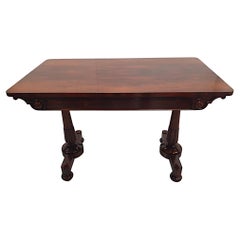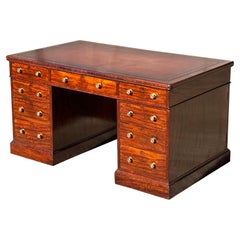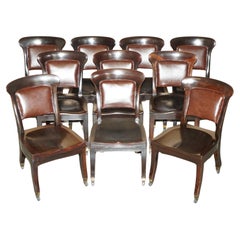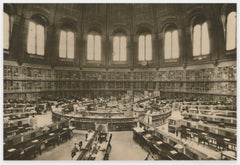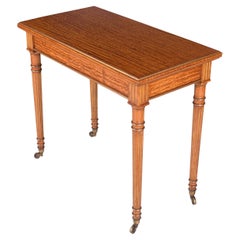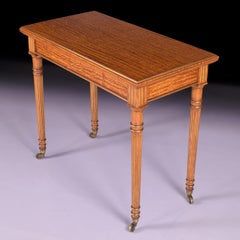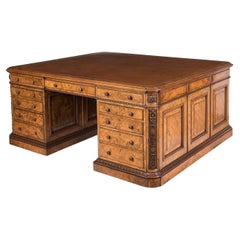
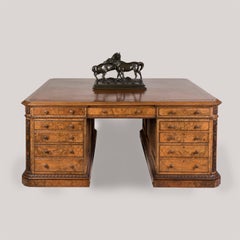
By Holland & Sons
Located in West Sussex, Pulborough
Royal House Antiques
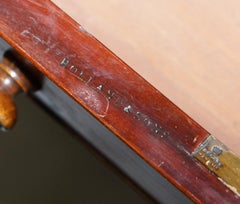
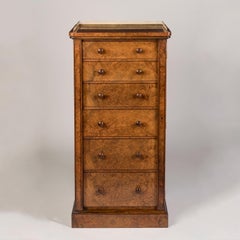
Royal House Antiques is delighted to offer for sale this absolutely exquisite very rare Holland &Son's Mount Street London stamped, dome fronted display cabinet with the original glazing and drop front secrataire desk finished in oxblood leather
Please note the delivery fee listed is just a guide, it covers within the M25 only for the UK and local Europe only for international, if you would like an accurate quote, please send me your postcode and I’ll provide you with the exact price.
A very good looking and well-made piece, this is pretty much the finest quality example of this type of furniture you will ever see, it is super decorative, hand carved to the middle panels, the form is Gothic Revival, each section has a church spire look and feel to it, it is a museum quality piece that commands attention in any setting
We have cleaned waxed and polished it, it is in perfect period condition throughout, the only point to note is I don't have any keys for the locks
Dimensions
Height:- 188.5cm
Width:- 149.5cm
Depth:- 46cm
Please note all measurements are taken at the widest point, if you would like any additional or specific measurements please ask.
COMPANY HISTORY
The firm of Holland & Sons (1803–1942) became from 1843 one of the largest and most successful cabinet makers, and a rival to Gillows of Lancaster and London. The company's labelled Day books are now housed in the Victoria and Albert Museum Archive of Art and Design where they present a virtual 'who's who' of nineteenth century society.
Established in 1803 by Stephen Taprell and William Holland, a relation of the architect Henry Holland (architect). Always on the leading edge of fashion, Holland & Sons employed some of England's foremost designers and participated in all of the International Exhibitions of 1851, 1855, 1862, 1867, 1872 and 1878. Holland and Sons also participated in many of the leading international exhibitions including London in 1862, Vienna in 1873 and Paris in 1867 and 1872. After a brief period in which the company was known as Taprell, Holland & Son c.1835-43, William Holland gained sole command after the senior partner Taprell's retirement. From 1843 onwards they were known as Holland and Sons.
The relationship between builder and cabinet maker is similar to another leading Victorian firm, Trollope and Sons. Their earliest known commission was to furnish the Athenaeum Club, London, 1824- 1838. They also worked alongside the prestigious firm of Thomas Dowbiggin at Osborne House, and eventually took over their premises and business at 23 Mount Street, London in 1851 and 1853 respectively.
In 1851, when the company was based in Mount Street and employed 351 people, they won a prize at the Great Exhibition for a bookcase. By then, after being granted a Royal Warrant of Appointment (United Kingdom) early in the reign of Queen Victoria, they had already taken a leading part in the decoration and furnishing of Osborne House, Sandringham House, Balmoral Castle, Windsor Castle and the apartments of the Prince and Princess of Wales at Marlborough House...
Category
19th Century English Gothic Revival Antique Holland & Sons